
International SEO: What Multi-Language SEO Actually Takes
International SEO is not translation plus a plugin. Here is the structure, research, authority and measurement work that decides whether you are found across markets.

International SEO is the work of making a website findable in several countries and languages. For a B2B company it takes more than translation: a deliberately chosen site structure, hreflang that tells search engines which version serves whom, keyword research in each market’s own language, local authority and reporting by market. Translation is usually the smallest part of the job.
Most teams arrive at international SEO with the same mental model: take the pages that already rank, translate them, switch on a plugin, repeat for each market. It feels like a content task. It is mostly an engineering and research task wearing a content costume.
Search engines do not reward you for having German text on a page. They look for the right page, in the right language, for the right person, with signals clean enough that a crawler never has to guess. Get any of those wrong and you do not fail loudly. You quietly split your own authority, confuse the index and wonder why traffic stays flat while the word count triples.
This guide sets out what the work really involves and what it costs. It opens our series on international and multilingual SEO; you can find all SEO & AI Search articles on the category page.
What is international SEO?
International SEO is the practice of helping search engines show the right version of your site to people in different countries and languages. Two related terms are often mixed up, and Google’s own definitions separate them well:
| Aspect | Multilingual SEO | Multi-regional SEO |
|---|---|---|
| What the site does | Offers content in more than one language | Explicitly targets users in different countries |
| What Google tries to do | Match pages to the searcher’s language | Find the right locale page for the searcher |
| B2B example | One product range in English, German and Turkish | Different ranges, prices or certificates for Germany and Austria |
| Main signals | Visible page content and hreflang | Domain, hreflang, local addresses, currency and links from local sites |
Many sites are both. Language targeting and country targeting are separate decisions: Austria and Germany share a language but may need different pages if your distributors, standards or delivery terms differ. In this guide, international SEO covers both.
The real scope of the job
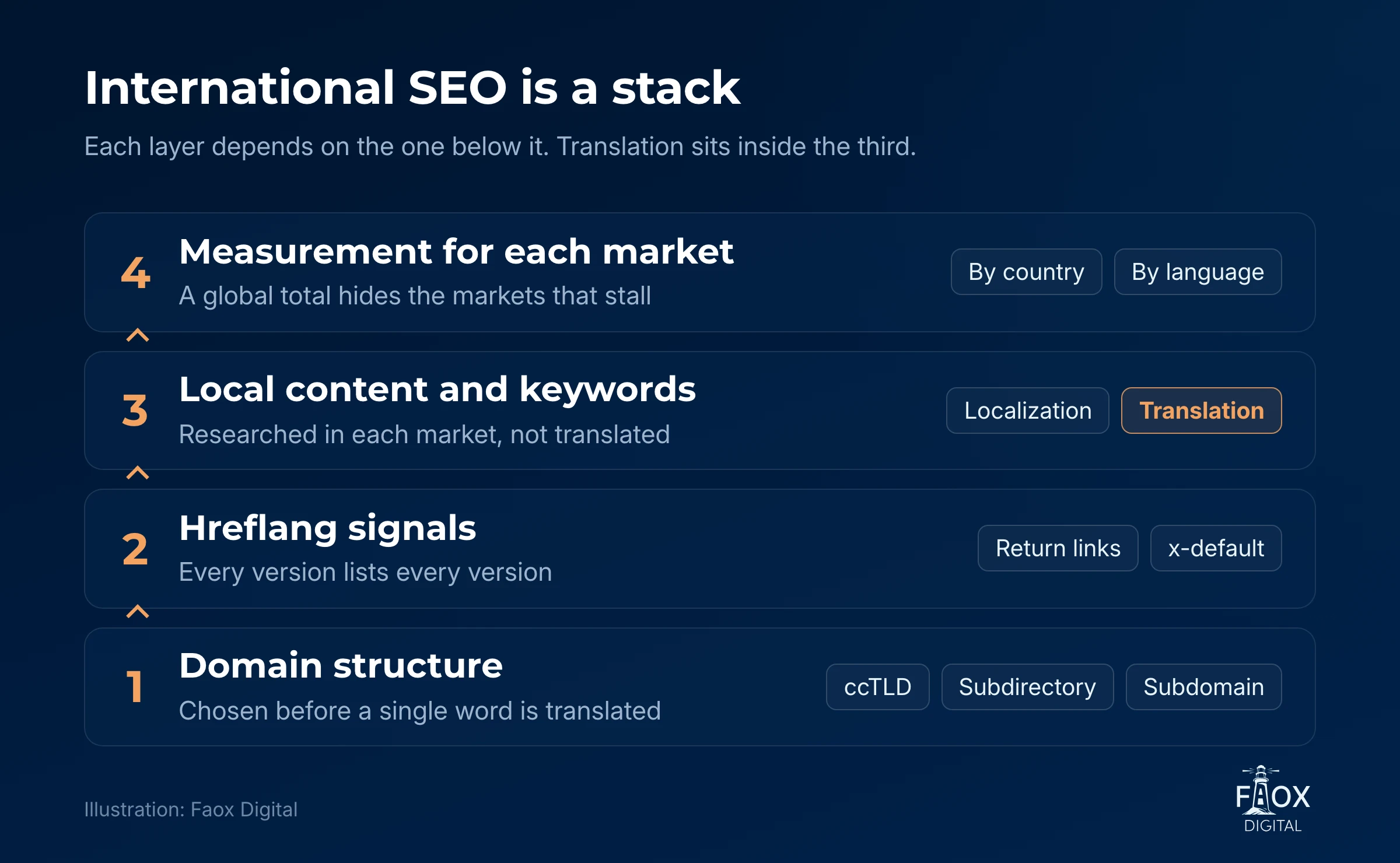
Before we talk tactics, here is the honest version of the work. Four layers decide whether international SEO pays off, and each one depends on the layer below it: the domain structure, the hreflang signals, local content and keywords, and measurement for each market. Translation sits inside the third layer.
Site structure: ccTLD, subdirectory or subdomain
Before a single word gets translated, you choose how the markets sit together. That choice is hard to reverse later. Google describes the options like this:
| Structure | Google’s view of the advantages | Google’s view of the drawbacks | Best when |
|---|---|---|---|
| ccTLD (example.de) | Clear geotargeting; server location does not matter | Expensive, more infrastructure, sometimes strict rules, one country only | You have local teams and budgets in that country |
| Subdirectory (example.com/de/) | Easy to set up, low maintenance | Geotargeting unclear from the URL, harder to separate later | You want all markets on one domain |
| Subdomain (de.example.com) | Easy to set up, allows different servers, easy to separate | Users may not know whether "de" means a language or a country | Hosting or infrastructure forces a split |
Google does not recommend URL parameters such as ?loc=de.
For most B2B companies entering several markets, we would start with subdirectories. They keep every market on one domain, so reputation is not split across several sites, and they keep your operational surface small. The exception is genuine local entities with their own budgets and content teams, where country-code domains can earn their cost, because each domain has to earn its own links. Our article on ccTLD vs subdirectory goes through the decision in detail.
Three technical rules apply whichever you choose. Give each language version its own URL, because Google may not find versions that change only with cookies or browser settings. Avoid redirecting people automatically by language or location, and do not adapt content by IP address, which Google calls generally unreliable. And remember that Google determines language from the visible content, not from code-level lang attributes or the URL.
Hreflang: telling search engines which page serves whom
Hreflang is the set of annotations that tell search engines which page serves which language and region. It is where good intentions go to die. It looks like three lines of markup, but in practice it is a graph.
Google’s rules are strict:
- Each version lists every version. A page must list itself as well as all its other language versions, and the set must be identical on each of them.
- Links must be returned. If two pages do not point to each other, Google says the tags will be ignored.
- Codes must be valid. The language comes first, with an optional region after it. You cannot use a country code alone, and regions such as
EUorUKhave no effect. - There are three equal methods. HTML tags, HTTP headers and XML sitemaps work the same for Google, and using all three adds nothing.
x-defaultis the fallback. Use it for a language selector or for a page that serves people no other version matches.
Miss a return tag, mismatch a code or let one stale URL linger, and search engines fall back to their own judgment. That is a common reason Google shows the wrong country version of a site. Nothing in your dashboard explains it, which is why the lesson is to validate hreflang continuously and not once at launch. It breaks silently every time someone adds, moves or retires a page. Our guide to hreflang tags covers how to implement them.
Keywords are local, not translated
Here is the assumption that quietly wastes the most money. Teams take their winning English keywords, translate them and target the translations. The grammar is correct. The intent is gone.
People in different markets search for the same product with different words, different specificity and different buying logic. A direct translation of your best English term might be a phrase nobody types, while the phrase that drives real demand never appears in your plan. You end up with pages that read well but go unfound.
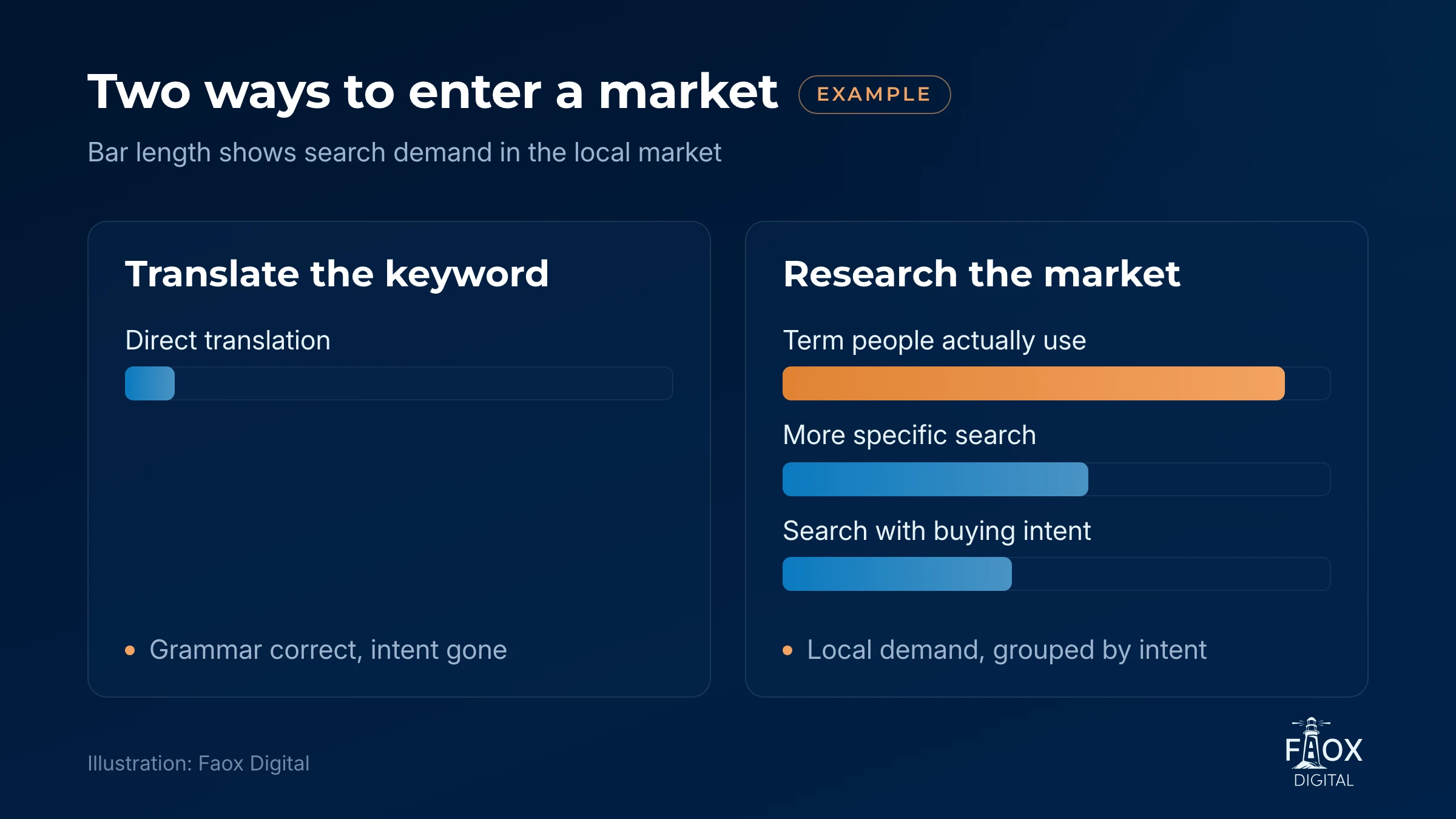
Done properly, each market gets its own research, run in its own language, ideally with someone who lives there. You map the local demand, group it by intent and build pages around the terms people actually use. The method is the same as keyword research for B2B at home, applied market by market, and our article on international keyword research explains why translated keywords miss local searches.
Translation preserves your words. Research preserves your customer’s intent.
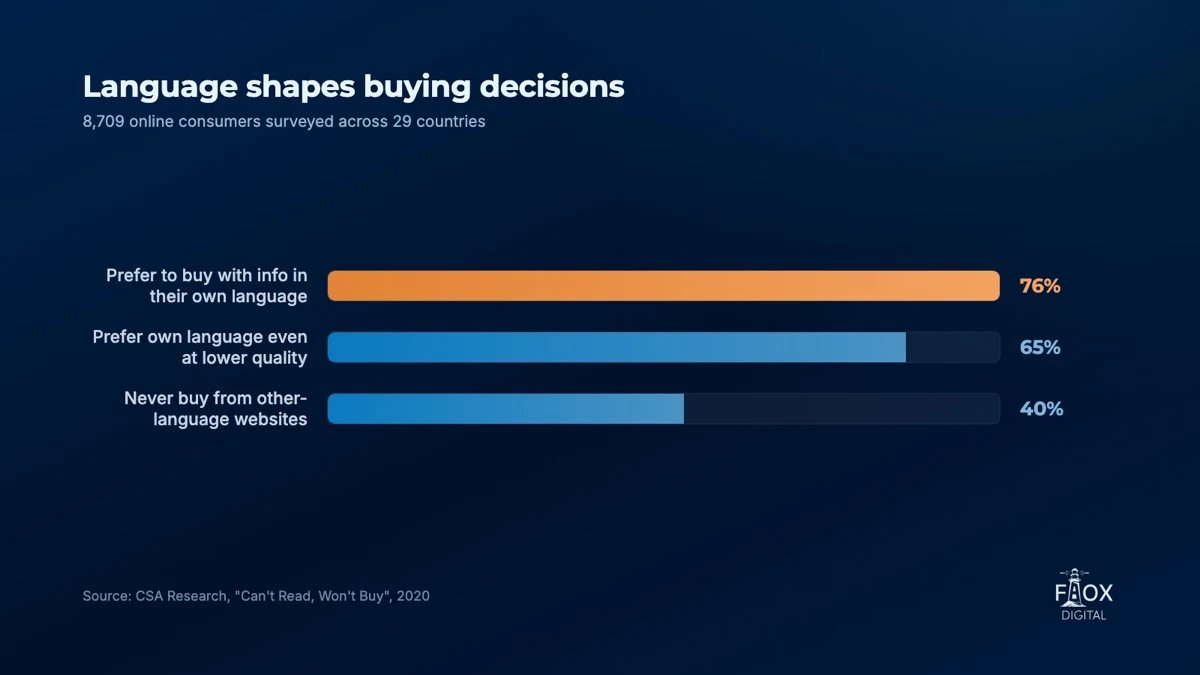
The demand side backs this up. In CSA Research’s "Can’t Read, Won’t Buy" survey of 8,709 consumers in 29 countries (2020), 76% of online shoppers said they prefer to buy with product information in their own language, 65% prefer content in their language even if its quality is poor, and 40% will never buy from websites in other languages. These are consumers and not B2B buyers, so read them as a direction. The supply is lopsided too: in November 2026, W3Techs counted English as the content language of 49.5% of websites, and no other language above 6.1%.
Translation and localization
Translation changes the language. Localization changes whatever else a buyer in that market needs to see. For a B2B company, that often means:
- Technical units and standards: metric or imperial, and the local norm a purchaser will ask about
- Certificates and approvals: what applies in that market, and proof that you hold it
- Commercial details: currency, delivery terms, local distributors and a real contact route
- Proof: references and examples a buyer in that country can relate to
- Vocabulary: the terms your engineers’ counterparts use there, checked by someone in the trade
Some of this also helps search engines. Google lists local addresses, phone numbers and currency among the signals it uses for locale. The translation workflow and the choice of a multilingual CMS are a project of their own; our guide to building a multilingual website covers them.
Search engines beyond Google
Google is not the leading search engine in every market. Statcounter’s data for October 2026 shows where this matters most:
| Market | Leading engines | What to do |
|---|---|---|
| China | Baidu 49%, Bing 21.69%, Google 6.83% | Get local advice before you plan: rules on hosting and content differ |
| Russia | Yandex 70.22%, Google 28.36% | Follow Yandex’s own markup guidance for language versions |
| South Korea | Google 48.48%, Naver 42.25% | Plan for both, and check Naver’s own guidance |
Yandex recommends hreflang markup on the page and says it no longer supports sitemaps for language versions. That differs from Google, where all three methods work. We could not confirm from official documents how Baidu and Naver treat hreflang, so take local specialist advice if these markets matter to you.
Most B2B exporters will not need all of this. Check where your buyers actually search before you budget for a second search engine. Statcounter’s figures come from the sites that use its tracking, so treat them as a guide.
AI tools and language
AI answers are not the same in every language. Profound analyzed 3.25 billion AI citations across 7 models and 14 countries in March 2026, and found that the query’s language changes which kinds of sources get cited. For example, social citations in ChatGPT fell from about 10% in English to 3 to 5% in other languages. This is one vendor’s data, and it measures the mix of sources and not their quality.
Availability differs too. Google’s help pages publish separate lists of the countries and languages where AI Overviews and AI Mode are offered, and these lists change.
The practical steps are simple. Test the questions your buyers ask in each language and market, because a good answer in English tells you nothing about the answer in German. Publish real content in each language, because an AI tool working in that language needs something to cite. For the wider picture, see our guide to generative engine optimization.
Measuring across markets without fooling yourself
Once several markets are live, a single global traffic number becomes the most comforting and least useful figure you own. It can rise while three of your five markets quietly stall, carried by one strong performer. Measurement has to happen market by market, and we think about it in four layers, each moving on its own clock:
| What you watch | Why it matters | When it moves |
|---|---|---|
| Technical health per market (hreflang, indexing, crawl errors) | A broken signal caps everything above it | First |
| Keyword visibility per market and language | Shows whether the right pages reach the right country | Next |
| Search traffic per market | Shows whether visibility is turning into visits | After that |
| Enquiries and revenue per market | The only layer that proves the investment | Last |
Reading these together keeps you honest. If visibility climbs in a market but traffic does not, your titles or snippets are losing the click. If traffic climbs but enquiries do not, the problem is the page or the offer, not the SEO.
Search Console helps here: its Performance report can be grouped by country, and its Generative AI performance report also shows impressions by country. It does not group by language, so add your language folders as their own properties or filter by page. Our article on market-by-market reporting sets out how to build this view.
What it actually costs
Clients usually want a single number, and the part most proposals skip is that there is not one. Cost scales with these factors:
- The number of markets, and how different they are from each other
- Scripts and search habits: a second language with the same alphabet and similar search culture is modest work, while five markets with different scripts and entrenched local competitors is a different project
- The existing foundation: a clean site with one language structure costs less to extend
- The platform: how well your CMS handles language versions and hreflang
- Local authority: the outreach each market needs
- Maintenance: new pages, retired products and hreflang checks never stop
The translation line item is small and predictable. The research, the structure and the ongoing maintenance are where the real budget lives, and they are the lines that get cut first when someone is shopping on price. Cut them, and you pay later, in pages that read well but go unfound, in authority split across structures that fight each other, and in a relaunch. The cheapest international SEO is the kind you scope honestly the first time.
If you are comparing providers, our article on choosing an international SEO consultant lists the questions to ask.
An international SEO strategy: where to start
You do not need every market at once. A workable international SEO strategy starts small:
- Choose markets from evidence. Look at where enquiries, distributors and existing search impressions already come from, and where you can actually deliver and support.
- Fix the base. Solve crawling, indexing and structure problems first, because every new language copies them.
- Decide the structure. Choose domains or folders, and how languages and countries relate, before anything is translated.
- Research one market in depth. Build the keyword map in that language, with someone who knows the trade.
- Localize the pages that matter. Start with key products, applications and contact routes, not the whole site.
- Implement and validate hreflang. Check it after launch and whenever pages change.
- Earn local authority. Plan trade press, associations and distributors in that market.
- Measure, then expand. Read the four layers for this market before you open the next one.
Manufacturers have some extra considerations, such as distributors, export documents and product standards; our article on SEO for exporting manufacturers covers them.
International SEO checklist
- Target markets are chosen from evidence, with language and country decided separately
- Each language version has its own crawlable URL, with no automatic redirects by language or location
- Hreflang is reciprocal, self-referencing and uses valid codes, with
x-defaultwhere needed - Hreflang is checked again whenever pages are added, moved or retired
- Keywords are researched in each market’s own language, not translated
- Units, standards, certificates, currency and contact details are localized
- Each market has a plan for local links and coverage
- The leading search engines in each market have been checked
- Buyers’ questions have been tested in AI tools in each language
- Reporting is split by market, down to enquiries
How Faox Digital approaches international SEO
At Faox Digital, the international SEO strategy rests on a keyword map built market by market, because buyers in each country search in their own words. Each language gets its own structure, with hreflang done properly, and we treat localization and translation as two different jobs.
Key takeaways
- Translation is the smallest part of the job. Structure, research, local authority and measurement decide whether you are found.
- Choose your site structure deliberately. For most B2B companies entering several markets, subdirectories are the sensible start.
- Hreflang breaks silently. It must be reciprocal and self-referencing, and it needs checking whenever pages change.
- Research each market in its own language. Translated keywords target words people may not type.
- Watch markets separately, down to enquiries, so one strong market does not hide three stalled ones.
Frequently asked questions
What is international SEO?
International SEO is the work of helping search engines show the right version of your website to people in different countries and languages. It covers site structure, hreflang, keyword research by market, localized content, local links and reporting by market. Translation is only one part of it.
How do you do international SEO?
Choose markets from evidence and fix your technical base first. Then decide on the site structure, research keywords in each language, localize the most important pages, implement hreflang and earn links in each market. Start with one market, measure it and only then open the next.
What is multilingual SEO?
Multilingual SEO means making content in several languages findable, so that each searcher reaches the version in their language. Multi-regional SEO targets countries, which may share a language. Many B2B sites need both, and treat them as separate decisions.
What are the best practices for international SEO?
Give each language version its own URL, avoid automatic redirects by location, keep hreflang reciprocal and valid, and research keywords locally instead of translating them. Localize units, standards, certificates and contact details, and report by market. Check hreflang again whenever pages change.
Do you need an international SEO agency?
Not always. A company entering one similar market can often manage with a good translator, a local reviewer and solid technical help. Outside specialists earn their cost with several markets, different scripts or a complicated site structure, because mistakes there are expensive to undo.
Sources
Let’s talk
Where do you want to be found?
Tell us the searches that matter to your business. We will review your site and tell you plainly what to fix first, including what you can do yourself.