
Generative Engine Optimization: How B2B Companies Prepare for AI Search
How AI answer tools find and cite sources, how GEO relates to classic SEO, and the practical work that creates the conditions for a B2B company to be found and described correctly.
Generative engine optimization (GEO) is the work of making your company findable, understandable and citable for AI tools that write answers, such as ChatGPT, Perplexity, Gemini, Claude and Google’s AI Overviews. For a B2B company it means keeping pages open to crawlers, publishing expert content, keeping company facts consistent and earning mentions on trusted sites. It builds on classic SEO, and no one can promise a place in an AI answer.
A purchasing engineer who once typed a few keywords into Google can now ask an AI tool to compare suppliers, explain a standard or draft a shortlist, and read the answer without opening a website. For the supplier, that changes what being found means. Your company can be named, described wrongly or left out of the answer, and your analytics may show none of it.
This guide explains what generative engine optimization is, how AI tools choose their sources, how GEO relates to SEO and answer engine optimization, and what a B2B company should prepare. It opens our series on AI SEO and GEO; you can find all SEO & AI Search articles on the category page.
One point up front: this work creates the conditions for visibility in AI answers. It does not buy a place in them.
What is generative engine optimization (GEO)?
Generative engine optimization is the practice of improving how a company and its content appear in answers written by AI. The term comes from a research paper by Aggarwal and colleagues, first published in November 2023 and accepted at the KDD conference in 2024. The authors describe generative engines as search systems that use language models to summarize several sources into one answer.
A classic search engine returns a list of pages and leaves the reading to you. A generative engine does the reading and returns a written answer, sometimes with links to its sources. The AI answer tools that matter today fall into two groups: assistants such as ChatGPT, Perplexity, Gemini and Claude, and the AI features inside Google Search, AI Overviews and AI Mode.
For a B2B company, GEO has three goals:
- Being found: the tool can reach your pages and knows your company exists.
- Being described correctly: what it says about your products, markets and certifications is accurate.
- Being cited: the answer names your company or links to your site as a source.
The second goal gets the least attention, and in B2B it can matter most. A buyer who reads that you do not serve their sector, or that you still make a product you dropped years ago, may never contact you to find out otherwise.
You will also see the term AI SEO. People use it for two different things: optimizing for AI answers, and using AI tools to do SEO work. In this series it means the first.
Why generative engine optimization matters for B2B companies
Survey figures vary because they ask different questions of different people. Gartner surveyed 645 B2B buyers in August and September 2025 about a recent purchase. Forrester’s Buyers’ Journey Survey 2025, which looks at AI use in the buying process more broadly, reports 94%. G2’s survey of 1,076 buyers, run in March 2026, covers software only, so it does not tell you how buyers of industrial equipment behave.
The pattern is clearer than the numbers: AI tools are one research source among several. Gartner’s buyers used an average of seven information sources in a recent purchase, and used generative AI mainly to gather information on vendors and products.
Three features of B2B buying raise the stakes:
- Many people ask. Forrester puts the typical buying decision at 13 internal stakeholders and nine external influencers. Each of them can put a different question to a different tool.
- Deals are few and large. A company that wins a small number of big contracts a year has a lot to lose from each shortlist it misses.
- The facts are technical. Specifications, standards and certifications are exactly where a wrong answer does damage.
Clicks are changing too. In Pew Research Center’s study of 900 U.S. adults in March 2025, people who saw an AI summary clicked a traditional result in 8% of visits, against 15% without a summary, and clicked a link inside the summary in 1% of visits. A citation is not always a click, so visits alone no longer show whether buyers saw you. Our article on AI search and your customers looks at what this means for a business.
How AI answer tools build an answer
A large language model is trained on very large amounts of text and writes by predicting language from the patterns it has learned. On its own it does not look anything up, and its built-in knowledge ends at a training cutoff. That is why most answer tools now add a search step.
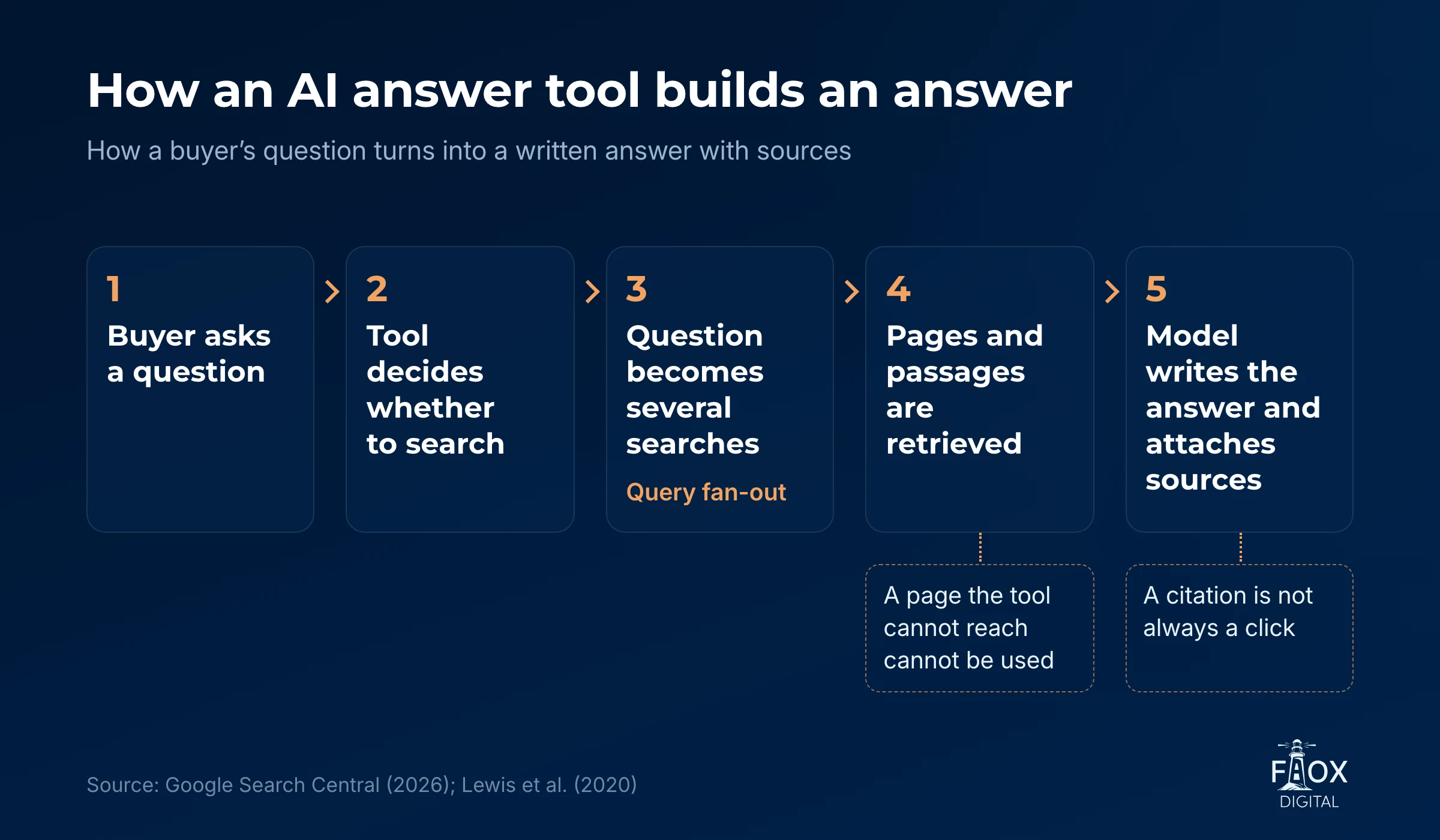
The method is retrieval-augmented generation (RAG), described by Lewis and colleagues in 2020: the system retrieves relevant documents, and the model writes from them. Google also calls this grounding. Its guide says AI Overviews and AI Mode use its core ranking systems to retrieve pages from the Search index, then generate a response with links to supporting pages. The process looks like this:
- The buyer asks a question. It is often long and specific: which suppliers make mechanical seals for chemical pumps, and which standards should I ask them about?
- The tool decides whether to search. ChatGPT may search when a question would benefit from current information, and Gemini judges whether a Google Search would improve the answer. Without a search, the answer rests on what the model learned in training, which may be out of date.
- The question becomes several searches. Google calls this query fan-out: a set of related queries that fetch more results. OpenAI says ChatGPT typically rewrites a question into one or more targeted queries.
- Pages and passages are retrieved. A page the tool cannot reach cannot be used.
- The model writes the answer. It combines what it retrieved and, depending on the tool, attaches its sources.
At the time of writing (November 2026), the main tools work like this:
| Tool | Where web results come from | What to check | How sources appear |
|---|---|---|---|
| Google AI Overviews and AI Mode | Google’s Search index, through its core ranking systems | Googlebot access; the Search generative AI setting in Search Console | Links to supporting pages |
| ChatGPT | OAI-SearchBot and partner search providers (OpenAI’s help page names Microsoft and Shopify) | OAI-SearchBot access | Citations in responses that use web search |
| Gemini | Google Search, through grounding | The Google-Extended token, which covers grounding in Gemini Apps | Can show sources when an answer is grounded |
| Perplexity | Web search | PerplexityBot access | Numbered citations in its answers |
| Claude | Web search, when Claude uses it | Claude-SearchBot and Claude-User access | Direct citations when it uses web content |
These tools read far more than your website: a trade magazine, a directory or a forum thread can shape what they say about you. We look at how sources are chosen in Google AI Overviews and at how AI assistants describe companies in separate articles.
Citations do not prove an answer is right. OpenAI warns that search results and citations can be incomplete, outdated or incorrect. In a March 2025 test by the Tow Center for Digital Journalism, eight AI search tools gave incorrect answers to more than 60% of 1,600 queries that asked them to identify the source of a news excerpt. In G2’s survey, 64% of software buyers said they meet inaccurate AI recommendations often or very often. Checking what these tools say about you is part of the work.
Generative engine optimization vs answer engine optimization
Neither term has an official definition, and many people use them as synonyms. Google describes both as labels for work aimed at visibility in AI search experiences.
We find one distinction useful, though it is our working definition and not a standard. Answer engine optimization (AEO) looks at the page: can a system lift a clear, correct answer from it? GEO looks at the company: across everything on the web, do AI tools find you and describe you correctly? Our guide to answer engine optimization covers how to write passages AI tools can quote.
| Aspect | Classic SEO | AEO | GEO |
|---|---|---|---|
| Main question | Does the page rank for the search? | Can a system lift a clear answer from the page? | Do AI tools find the company and describe it correctly? |
| Where it shows | Search results | Featured answers, voice assistants, AI answers | AI assistants, AI Overviews, AI Mode |
| Main work | Technical health, content, links | Direct answers, clear headings, passages that stand alone | All of these, plus crawler access, consistent company facts and third-party mentions |
| What you track | Rankings, clicks, conversions | Whether your passage is used | AI impressions and citations, accuracy, enquiries |
How GEO relates to classic SEO
Google’s position is direct. Its guide, published in May 2026, says its generative AI features are rooted in its core Search ranking and quality systems, and that optimizing for generative AI search is "still SEO." For AI Overviews and AI Mode there are no extra technical requirements: a page must be indexed and eligible to appear in Search with a snippet. Google also lists things you can ignore for its own Search, including llms.txt files, splitting content into small chunks and rewriting pages just for AI.
That position covers Google Search only. Other tools run their own crawlers, and other companies give different advice. Microsoft describes AI assistants as splitting pages into smaller pieces, and recommends clear headings, question-and-answer formats, lists, tables and sentences that still make sense on their own.
The two views fit together: a page with clear sections and direct answers serves readers and both companies’ systems. What makes little sense is keeping a second version of your content just for machines.
So classic SEO remains the base. In practice, GEO adds four things to it: more crawlers to check, mentions on the sources AI tools read, consistent company facts across the web, and new measures such as AI impressions, citations and the accuracy of what is said about you.
What the research says, and where it stops
The original GEO study built a benchmark of 10,000 queries and tested content changes on a simulated engine built on GPT-3.5, then on 200 queries in Perplexity. Adding quotations, statistics and source citations raised visibility the most, by up to 40% on the study’s measures, while keyword stuffing brought little or no improvement. Pages ranked lower in the underlying results gained more than those at the top, and results varied by subject area.
A 2025 preprint by Chen and colleagues compared AI search services with Google. It found a strong bias toward earned media, meaning third-party, authoritative sources, with much less weight on brand-owned and social content.
Read these as direction, not recipes. Both studies describe specific systems at a point in time, and their measures are visibility and sources, not enquiries or sales. The first study’s findings do match what good B2B content already does: quote real experts, show data and name sources. Do that because it makes a page better for the buyer, not just to appear in an answer.
How to implement generative engine optimization
None of these steps can promise a citation. Together they remove obstacles and give AI tools accurate material to work with. We suggest this order for a B2B company:
- Test where you stand. Ask AI tools your buyers’ questions and record what they say.
- Open access. Check that search crawlers can reach your important pages.
- Fix your company facts. Make them consistent on your site and on outside profiles.
- Improve the pages buyers need. Add direct answers and first-hand knowledge.
- Earn third-party mentions. Build a presence in the sources your sector trusts.
- Make key actions usable. Keep forms and product data simple for people and AI agents.
- Measure and repeat. Combine the reports with your own tests and what buyers tell you.
The rest of this guide takes these steps in turn.
Start by testing what AI tools say about you
Write down the questions your buyers ask, in the words they use in enquiries and sales conversations. Cover three kinds:
- Category questions: which companies make this product for this application in this market?
- Comparison questions: what is the difference between these two options, and which suits this use?
- Company questions: what does your company make, which certifications does it hold, and does it export to this market?
Ask them in the tools your buyers are likely to use. Record who is named, what is said about you, whether it is correct and which sources are cited. Repeat each question more than once, because answers vary: Google notes that AI Overviews and AI Mode may show different responses and links. Treat the results as a sample, not a ranking.
The list of sources is the most useful result. It shows which magazines, directories and sites shape answers in your sector, and it points to where a wrong fact may come from.
Let AI crawlers reach your pages
An AI tool cannot use a page it cannot fetch, and AI crawlers can be blocked by accident. Most AI companies run separate crawlers for search, model training and live user requests, each with its own token in robots.txt, so these are separate decisions. At the time of writing (November 2026):
- OpenAI: sites that opt out of OAI-SearchBot are not shown in ChatGPT search answers. GPTBot collects training content and is controlled separately.
- Anthropic: Claude-SearchBot and Claude-User serve search and user requests, and blocking them may reduce your visibility. ClaudeBot collects training content.
- Perplexity: PerplexityBot indexes for search results and is not used for training. Perplexity-User fetches pages on request and generally ignores robots.txt.
- Google: Googlebot crawls for Search, including its AI features. Google-Extended is a token that controls use of content for Gemini training and for grounding in Gemini Apps, with no effect on inclusion or ranking in Google Search.
As of August 31, 2026, every site also has a Search generative AI setting in Search Console, and sites are included by default. Excluding a site removes it from AI Overviews, AI Mode and generative features in Discover. Google says the setting does not affect other parts of Search or AI training.
You can now state "no AI training" with one shared robots.txt token, __usage_ai-training, defined in a draft that builds on the work of the IETF’s AI Preferences (AIPREF) working group: Anthropic began honoring it on October 30, 2026, and Google’s crawler documentation, updated that day, says Google intends to support it in early 2027. Before you use it, note that a rule naming ClaudeBot still takes priority at Anthropic, and that unless your file names Google-Extended, Google plans to treat an opt-out through the shared token as a Google-Extended block, which also covers grounding in Gemini Apps.
For a B2B company that wants to appear in AI answers, the search crawlers matter most; blocking training crawlers is a separate business decision. Check your CDN and firewall as well as robots.txt: services such as Cloudflare sort AI bots into search, agent and training categories with their own blocking options, so a setting chosen by IT can stop a crawler that marketing wants. Our guide to technical SEO basics covers crawling, indexing and the main crawlers in more detail.
Keep key content in readable text. In a December 2024 study by Vercel and MERJ, crawlers from OpenAI, Anthropic, Meta, ByteDance and Perplexity did not render JavaScript. Microsoft warns that hidden content may be skipped and advises against keeping core information only in PDFs or images. On B2B sites that is often where the catalog sits: specifications in PDF datasheets and product data behind tabs or scripts. Publish the key facts as normal web pages.
Keep llms.txt in proportion. The llms.txt file is a proposal, published by Jeremy Howard in September 2024, for a short Markdown overview that points AI tools to a site’s most useful pages. It is not a formal standard. Google says its Search ignores the file, and that having one neither helps nor harms visibility there. It costs little to add if a system you care about uses it, but it should not come before the rest of this list.
Make your company easy to identify: entity consistency and structured data
An entity is something a system can recognize as one distinct thing: your company, a product line, a named expert. Entity consistency means the facts about it match wherever they appear. Microsoft says AI assistants, browsers and agents reason over data on and off your site, so an old address in a directory or a discontinued product on a distributor’s page can end up in an answer.
Typical B2B weak spots are a legal name that differs from the brand name, an old name still used after a merger, product names that differ between languages or distributors, and outdated certifications.
- The company name is written the same way on your site, LinkedIn, directories and association listings
- An About page states plainly what you make, for which industries, in which markets and with which certifications
- Product names and model numbers match across web pages, datasheets and distributor pages
- All language versions state the same facts
- Organization structured data lists your name, address, telephone, URL and logo, and matches the visible text
Structured data helps, within limits. Google says Organization markup can help it disambiguate your company from others, and that a sameAs property can point to a profile on another site. It also says generative AI search needs no special schema, and that structured data should match the visible text on the page. So add it as part of normal SEO, and do not expect it to earn citations on its own.
Our article on entity SEO goes through this in detail. If you sell in several markets, every language version is another place for facts to drift; our guide to multi-language SEO explains how language versions should work together.
Publish content only your company could write
Google says content people find unique, compelling and useful will likely influence your presence in generative AI search over the long run more than anything else in its guide. It contrasts this with commodity content: common knowledge that could come from anyone, or that a generative AI model could easily produce.
B2B companies start with an advantage here. Your engineers, technicians and project managers know things no general publisher does. For a hypothetical valve manufacturer, the difference looks like this:
| Commodity content | Content only that company could write |
|---|---|
| What is a butterfly valve? | Where butterfly valves failed in our slurry tests, and what we recommend instead |
| How to choose a valve supplier | What we test on each batch before it ships, and the documents you receive |
A few habits make this content easier for readers and AI tools to use. Start each page with a direct answer to its main question. Use headings that match the questions buyers ask. Put specifications and comparisons in tables. Give facts with dates and sources, and name the expert who checked them.
Do not create a separate page for every variation of a question: Google says doing this mainly to manipulate rankings or AI responses breaks its scaled content abuse policy. Drafts made with AI tools must meet the same standards, and the expertise has to come from your people.
Earn mentions on third-party sources
AI tools form their view of a company from more than its own website. Google says its generative AI features can show what is being said about products and services across the web, including blogs, videos and forum discussions. In G2’s survey, 45% of software buyers named citations from review sites as the signal that most raises their confidence in an AI answer, although G2 runs a review site, so read that with care. This is the old logic of why people trust others: what others say about you carries more weight than what you say yourself.
Brand mentions and third-party sources differ by sector. For most B2B companies, the useful ones are:
- Trade magazines and industry news sites
- Industry associations, certification bodies and trade fair exhibitor lists
- Distributor, partner and customer pages that describe what you do
- Articles and talks by your experts on other sites, and their LinkedIn profiles
- Review and comparison platforms, where your sector has them
Start from your test results. The sources cited in answers about your category are the ones shaping those answers. Check whether you appear there, whether the facts are right, and what it would take to earn a place through real news, data or expertise.
Google warns that seeking inauthentic mentions is not as helpful as it may seem, because its systems focus on quality content and block spam. Fake reviews and mass-posted articles also damage your standing with the buyers who find them.
Prepare for AI agents
AI agents are autonomous systems that perform tasks for people. Google’s examples are booking a reservation and comparing product specifications, and the second is easy to picture in B2B: an agent collects specifications from several suppliers or fills in a quote request. Browser agents read a page through screenshots, its HTML structure and the accessibility tree.
Google’s own advice is modest: look into this if it is relevant to your business and you have time. We would do the simple part now, because it helps people as well, including those using assistive technology:
- Use real buttons and links rather than styled page elements.
- Connect every form label to its field, on enquiry and quote forms above all.
- Avoid transparent overlays on clickable elements, and keep key controls in stable positions.
Proposals such as WebMCP and the Universal Commerce Protocol are still developing, and WebMCP is available only for experimentation at the time of writing. Most B2B companies can watch these for now. Our agentic browsing checklist covers the detail.
How to measure AI visibility
Measurement is still partial, and no single report covers every tool. Combine these sources:
| Source | What it shows | Limits |
|---|---|---|
| Search Console: Generative AI performance report | Impressions in AI Overviews and AI Mode, by page, country, device and date | Impressions only; the report may not appear for a site with few impressions |
| Bing Webmaster Tools: AI Performance | Citations in Microsoft Copilot, AI summaries in Bing and some partner tools, with cited pages and grounding queries | Announced as a public preview in February 2026; grounding queries are a sample |
| Analytics referrals | Visits from AI tools that pass referral information, and what those visitors do next | Misses every answer that leads to no click |
| Your repeated tests | Who is named, what is said, which sources are cited | A sample; answers vary between runs |
| Branded searches | Whether more people search for your company and product names | Many other causes can move them |
| Sales calls and enquiry forms | What buyers say about how they found you and what they were told | Self-reported and incomplete |
Google’s report has been open to all websites since August 31, 2026. Clicks from its AI features are not split out: they stay in the overall Performance report, under the Web search type.
Google says no third-party tool has access to its internal ranking or AI systems. Tools that run prompts for you can save time, but treat their output as a sample and check their advice against official guidance.
Judge the work by business results as well as visibility: enquiries, quote requests and what buyers tell your sales team. Our article on measuring AI visibility sets out a reporting method.
What GEO can and cannot do
GEO can remove barriers, correct sources and give AI tools better material. It cannot make any tool name you. Google says that even a page meeting every requirement may not be crawled, indexed or served, and the other tools offer no more certainty. Keep these limits in mind:
- Platforms change. The features and crawler rules in this guide reflect November 2026. Check the primary documentation before you act on them.
- Corrections take time. Fixing a fact on your site does not change answers straight away. Crawlers must return, other sites must update, and models may still carry what they learned in training.
- Promises are a warning sign. Be careful with anyone who promises citations, rankings or a place in ChatGPT.
Much of this work you can start yourself: the test, the robots.txt review and the company facts take time, not a large budget. Outside help makes sense when internal capacity is the limit, or when earning third-party coverage needs steady effort. Our article on AI SEO services explains when you need them and what to ask before you hire.
How Faox Digital approaches generative engine optimization
At Faox Digital, generative engine optimization runs inside the same SEO project as classic search: the audit checks whether AI tools can read the site, the keyword map includes the questions buyers ask AI tools, and the content is built to be quoted. No one can promise a place in an AI answer; we build the conditions for one and show where the company starts to appear.
Key takeaways
- Generative engine optimization helps AI tools find your company, describe it correctly and cite it. It creates the conditions for visibility; no one can promise a place in an answer.
- Most AI answer tools retrieve pages before they write, so crawler access and indexing come first, in robots.txt and in your CDN.
- Classic SEO remains the base. GEO adds more crawlers to check, consistent company facts and mentions on third-party sources.
- Content only your company could write, built on real expertise and data, is what Google says will likely matter most over time.
- Measure with Search Console’s generative AI report, Bing’s AI Performance report, your own repeated tests and enquiries, and re-check platform rules often.
Frequently asked questions
How do you implement generative engine optimization?
Start by testing what AI tools say about your company. Then check crawler access, fix inconsistent facts, improve the pages buyers need, earn mentions on sources your sector trusts and measure the results. Repeat the test regularly, because answers and platforms change.
How can you improve generative engine optimization results?
Let your test results guide you. If you are named but described wrongly, find and fix the source of the error. If competitors are named and you are not, look at which sources the answers cite and whether you appear in them. If you are absent everywhere, check access and indexing first.
How do you measure generative engine optimization?
Combine the Generative AI performance report in Search Console, AI Performance in Bing Webmaster Tools and referral data in your analytics with repeated tests of your buyers’ questions. Ask new enquirers how they found you. No single report covers every tool.
How can you learn generative engine optimization?
Start with primary sources: Google’s guide to generative AI features, the crawler documentation from OpenAI, Anthropic and Perplexity, and the original GEO paper. Then practice on your own company: run the test described above, change something and test again. Be careful with advice that cannot name a source.
Does generative engine optimization replace SEO?
No. In Google’s view, optimizing for its AI features is still SEO, and other AI tools also depend on pages they can reach and understand. GEO adds work on top of SEO and does not remove the need for it.
Sources
- Aggarwal et al.: GEO: Generative Engine Optimization, KDD 2024
- Google Search Central: Optimizing your website for generative AI features on Google Search, 2026
- Gartner: Survey Finds 69% of B2B Buyers Turn to Sales Reps to Validate AI-Generated Insights, 2026
- G2: Half of B2B Software Buyers Now Start Their Research With AI Chatbots, 2026
Let’s talk
Where do you want to be found?
Tell us the searches that matter to your business. We will review your site and tell you plainly what to fix first, including what you can do yourself.