
How to Measure Generative Engine Optimization and AI Visibility
Which reports show what about AI visibility, where each one stops, and a simple method for tracking mentions, citations, AI referrals and enquiries over time.
How to measure generative engine optimization comes down to combining platform reports with your own tests: AI referral traffic in GA4’s AI Assistant channel, impressions in Search Console’s generative AI report, citations in Bing’s AI Performance report, changes in branded searches and a fixed set of test questions. Track whether you are mentioned, whether the description is correct and which sources are cited, against your competitors, and tie it to enquiries. No report covers every tool, so read the result as a trend, not a score.
Six months into work on AI search, someone asks whether it is paying off. GA4 shows a small number of visits from ChatGPT, Search Console shows impressions with no clicks beside them, and a vendor’s dashboard offers a score nobody can explain. Each is a piece of the answer, and none is the answer.
This guide sets out what each source can and cannot show, and a simple way to report on it. It is the measuring half of SEO for AI search. Tools and reports in this field change often, so all details reflect November 2026.
What you can and cannot measure
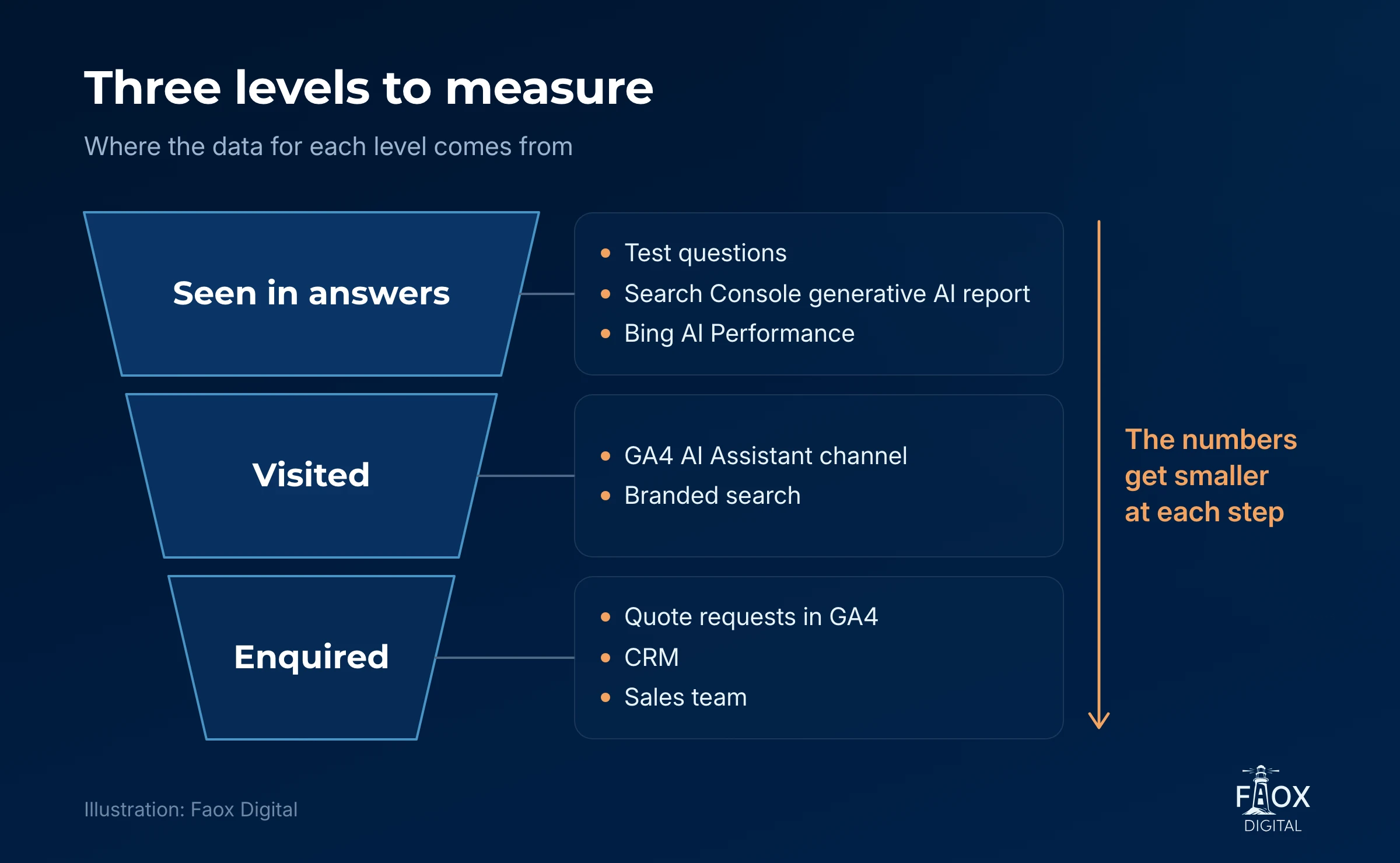
AI visibility tracking has no single report. You are measuring three different things, and the numbers get smaller at each step: being seen in answers, getting a visit and getting an enquiry.
| What to track | Where | What it shows | Where it stops |
|---|---|---|---|
| AI referral traffic | GA4, AI Assistant channel | Visits and key events from assistants | Misses answers with no click and visits with no referrer |
| Impressions in Google’s AI features | Search Console, generative AI report | Pages shown, by country, device and date | No clicks and no queries |
| Citations in Microsoft’s AI tools | Bing Webmaster Tools, AI Performance | Cited pages and grounding queries | Microsoft’s surfaces and some partners only |
| Branded search | Search Console, branded queries filter | Whether more people look for your name | Many other causes can move it |
| Mentions, citations and accuracy | Your test questions | Who is named, what is said, which sources | A sample, using your wording, not buyers’ |
| Enquiries | CRM, enquiry form, sales | Business effect | Self-reported and incomplete |
How to measure generative engine optimization: the method
You can track generative engine optimization with free tools and a spreadsheet. We suggest this order:
- Take a baseline now. Record every measure before you change anything, so that later numbers have something to be compared with.
- Set up GA4. Check the AI Assistant channel, and mark quote requests as key events.
- Open the platform reports. Verify your site in Search Console and Bing Webmaster Tools, and note your starting figures.
- Write your test questions. Fix the wording and the list of competitors.
- Run them and log the results. Use clean sessions and the same countries each time.
- Ask people. Add "How did you find us?" to your enquiry form, with an AI tool option, and brief your sales team to ask it too.
- Report on a rhythm. Follow the same page layout each time, so that trends are easy to see.
AI referral traffic in GA4
GA4 now does part of this for you. Since May 2026 it has had an AI Assistant channel in its default channel group. When a referrer matches a recognized assistant, GA4 sets the medium to ai-assistant and the campaign to (ai-assistant). Google’s help pages name ChatGPT, Gemini, Claude, DeepSeek, Copilot and Grok as examples. Older guides that tell you to build a custom channel with a regular expression are out of date for most sites.
Three details matter. Google’s AI Overviews and AI Mode are not in this channel: GA4 counts them under Organic Search. Perplexity is not among the named examples, so look at the session source for chatgpt.com, perplexity.ai and gemini.google.com, and add a custom channel if one of them is still under Referral. And a visit that arrives with no referrer falls into Direct, so treat the channel as a minimum. We found no reliable measure of how many visits that hides.
Look at key events by landing page, not only at sessions. How you set those up is covered in our guide to GA4 setup for B2B websites. Browser agents can also look like ordinary visitors, which our agentic browsing checklist explains.
Expect small numbers, because published shares differ with the sample:
- Leadfeeder, which sells company identification software, found in its October 2026 study that AI referrals were 1.8% of AI and organic search visits combined on B2B sites, flat for a year. ChatGPT sent 81% of them, Gemini 8%, Claude 5%, Perplexity 3% and Copilot 2%.
- SE Ranking puts AI platforms at 0.32% of all traffic on 101,574 websites, for January to April 2026.
- Conductor reports 1.08% across 1,215 enterprise customer domains, based on U.S. traffic from May to September 2025.
Do not assume these visitors are better, either. Vendors disagree. Conductor’s report cites data from Knotch showing AI-referred visitors converting at twice the rate of other sources. In Leadfeeder’s data, 15.8% of the companies sent by AI matched the site’s target customer profile, against 20.4% from organic search, and they visited less often: 2.68 times on average against 3.78. Leadfeeder calls its rates directional for B2B sites in general, and a few dozen visits can swing any percentage. Use your own figures.
The limits of Search Console data
Search Console has offered a generative AI performance report to all sites since August 31, 2026. It counts impressions in AI Overviews and AI Mode, by page, country, device and date. It helps you see which pages appear and whether that is growing, but it has clear limits:
- No clicks. Clicks from these features stay in the main Performance report, under the Web search type, and are not split out.
- No queries. You see the page, not the question that brought it up.
- Low volume. The report may not appear if your site has had too few impressions.
- Google only. It says nothing about ChatGPT, Perplexity or Claude.
Bing’s AI Performance report, announced as a public preview in February 2026, fills a different gap. It shows total citations, cited pages and grounding queries, the phrases the AI used to retrieve your content, across Microsoft Copilot, AI summaries in Bing and some partner tools. Those queries are a sample, but they are the nearest thing to question data that a platform gives you.
Changes in branded search
A buyer who reads your name in an AI answer may search for it later, with no visit from the assistant to record. So watch branded search. Search Console’s branded queries filter, open to all eligible sites since March 2026, splits your data into branded and non-branded queries. Google says its AI-assisted system includes misspellings and products unique to you, and that the filter needs enough queries and impressions to work.
This is supporting evidence at most. Trade fairs, press coverage and sales campaigns move branded search too. Ahrefs’ May 2025 study of 75,000 brands found a correlation of 0.392 between branded search volume and visibility in AI Overviews, which says the two tend to travel together and not that one causes the other. Note what else happened in the same month before you credit the AI work.
Test questions: mentions, citations and accuracy
Test questions are the only measure that covers every tool, and the only one that shows what is said about you. Our guide to how AI assistants describe companies explains how to run them cleanly. For reporting, keep these rules:
- Fix the set. Use 20 to 30 questions across three groups: category, comparison and company. That number is our suggestion, not a standard. Change the set only once a year, and note it when you do.
- Repeat each question. Answers vary too much for one run to mean anything. SparkToro and Gumshoe’s 2026 study found under a 1 in 100 chance of getting the same list of brands twice. Its authors ran each prompt 60 to 100 times, which few teams can do by hand. We would use ten runs per question, which gives a direction, not statistics.
- Count shares, not positions. Record the share of runs that name you. SparkToro found the order of a list close to random.
Log four things for each run:
| Measure | Question it answers | Example |
|---|---|---|
| Mentions | Are we named? | Named in 4 of 10 runs |
| Citations | Is one of our pages a source? | About page cited in 2 of 10 runs |
| Accuracy | Is what it says correct? | Says we do not export to Germany: wrong |
| Sources | Which pages shaped the answer? | A trade directory and a distributor page |
These are invented examples. Keep mentions and citations apart, because you can be named with no link and linked with no name. Treat every wrong fact as a job, and our article on entity consistency for AI shows how to fix it at its source.
Comparing against competitors
No platform report shows your competitors, so this comparison has to come from your test questions or a tool. Pick three to five companies your sales team really meets, and log them in the same runs. Then compare the share of runs for each, by question group. A difference of a run or two is noise. Look for a gap that lasts across quarters.
The more useful comparison is of sources. List the pages cited when competitors are named and you are not. That list is your work plan: a directory to join, a magazine to approach, a page to write.
The limits of AI visibility tools
Measurement tools can run your questions at a scale you cannot match by hand, and they have real limits. Google says no third-party tool has access to its internal ranking or AI systems, so these tools sample answers from the outside. SparkToro calls the prompts a "giant hole" in tracking: when its volunteers wrote their own prompts, 142 responses produced barely two that looked alike. A tool can only test the prompts you or the vendor choose.
How the data is collected matters too. Surfer, which sells a tracker that reads the consumer interface, ran 1,000 prompts both through the interfaces and through APIs in 2026. The brands named overlapped by only 21.3% to 31.6%. Treat the figure with care, given Surfer’s interest, but ask any vendor these questions:
- Do you read the consumer interface or call an API?
- How many times do you run each prompt, and from which countries?
- Who chooses the prompts, and can we use our own wording in our own languages?
- Can we see the raw answers behind a score?
- How do you tell a mention from a citation?
Be wary of a single score. If nobody can explain how it is built, it cannot tell you what to do next.
Reporting rhythm
A steady reporting rhythm matters more than a detailed report. This is what we would suggest for most B2B companies:
- Monthly: AI Assistant sessions and key events, generative AI impressions, Bing citations and branded queries.
- Quarterly: the full test set, competitors, sources and errors fixed, with a short note on what to do next.
- After a big change: a site migration, a new product line or a major model release calls for an extra test.
- Yearly: review the question set and the competitor list.
Keep it to one page: the baseline, the trend, the pages most often cited, the errors fixed and the enquiries that mention AI. Judge the work over quarters, because B2B buying is slow and each monthly figure is small. Corrections also take time to show, since answers from training data may hold an old fact until a newer model arrives.
If you do not have the time for this, a provider should be able to show you the same page. Our article on AI SEO services explains what to ask before you hire one.
How Faox Digital reports on AI visibility
Measurement is the fifth step of a Faox Digital SEO project: our reports show rankings, organic traffic and whether AI tools start to cite the company, so you can see where it begins to appear. The work carries on after the first results arrive.
Key takeaways
- No single report measures AI visibility. Combine GA4, Search Console, Bing, branded search, test questions and enquiries.
- GA4’s AI Assistant channel now records assistant visits, while AI Overviews and AI Mode stay under Organic Search.
- Search Console’s generative AI report shows impressions only, with no clicks or queries.
- Repeat fixed test questions, and log mentions, citations, accuracy and sources, against your competitors, as a share of runs.
- Report monthly on platform data and quarterly on tests, and judge the work by enquiries over time.
Frequently asked questions
How do you track generative engine optimization without paid tools?
Use GA4’s AI Assistant channel, Search Console’s generative AI report and Bing’s AI Performance report, all of which are free. Add a spreadsheet of test questions run by hand, and an enquiry form field asking how people found you. A paid tool adds scale, not a different kind of truth.
How can you tell if generative engine optimization is improving?
Look for the same measures moving together over several quarters: a higher share of test runs naming you, fewer factual errors, more cited pages and more enquiries that mention AI. One good month is not a trend.
Why does GA4 show so little traffic from AI tools?
Many answers end without a click, and visits with no referrer fall into Direct. Clicks from AI Overviews and AI Mode count as Organic Search. Leadfeeder’s 2026 B2B data puts AI at 1.8% of AI and organic search visits, so small numbers are normal.
Is there a single AI visibility score I can trust?
No. Scores differ with the prompts, the tools covered and how the data is collected, and no outside tool can see inside these systems. Use a score to spot movement if it helps, and read the raw answers before you act on it.
Sources
- Analytics Help: Default channel group, accessed November 2026
- Leadfeeder: AI Referrals in B2B, October 2026
- SparkToro: AIs are highly inconsistent when recommending brands or products, 2026
- Surfer: Why you cannot track AI visibility through an API, 2026
Let’s talk
Where do you want to be found?
Tell us the searches that matter to your business. We will review your site and tell you plainly what to fix first, including what you can do yourself.