
ChatGPT SEO: How ChatGPT, Perplexity and Gemini Find and Describe Companies
Where ChatGPT, Perplexity and Gemini get their information about companies, and a practical way to test and improve how yours is described.
ChatGPT SEO is the work of making sure ChatGPT and similar AI tools can find your company and describe it correctly. These tools combine what their models learned in training with live web search: ChatGPT through OAI-SearchBot and partner search providers, Perplexity through PerplexityBot and Gemini through Google Search. A B2B company can open crawler access, correct its facts, earn third-party mentions and test the results, but no one can promise a mention.
A buyer asks ChatGPT which suppliers can make a part to a certain standard. A colleague asks Perplexity, and a third person asks Gemini. They may get three different answers with different sources, and your company may be named in one, described wrongly in another and missing from the third.
This article explains where these tools get their information about companies and gives a practical way to test and improve how yours is described. It is one part of generative engine optimization, the wider work of preparing for AI answers.
A note on words: "ChatGPT SEO" borrows the language of search, but these tools have no fixed list of positions. The useful goals are being mentioned and being described correctly.
How ChatGPT SEO works: training data and live search
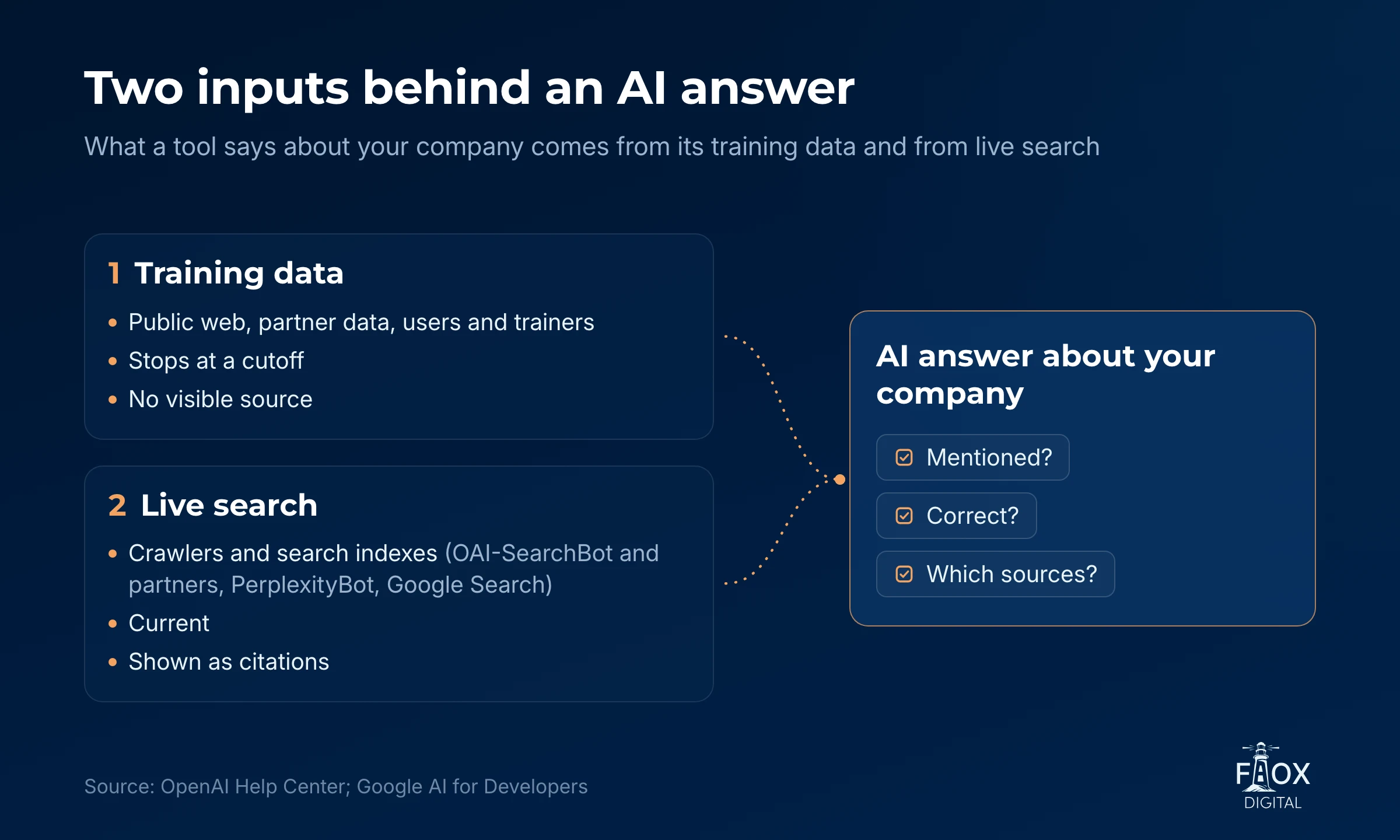
What an AI tool says about your company can come from two places, and they behave very differently.
Training data is what the model learned before release. OpenAI says its models are developed from publicly available internet content, information from partners, and information from users, trainers and researchers. The model does not keep copies of those pages. It learns patterns and predicts the next word, which is one reason OpenAI says the same question can bring different answers.
Live search happens when the tool looks up pages for the question. OpenAI says ChatGPT may search automatically when a question would benefit from current information, and Google says Gemini judges whether a search would improve the answer.
| Aspect | Training data | Live search |
|---|---|---|
| What it is | Patterns the model learned | Pages retrieved for this question |
| How current | Stops at a training cutoff | As current as the crawler’s last visit |
| Can you see the source? | No | Usually, through citations |
| How you influence it | Slowly, through what is published about you across the web | By being crawlable, indexed and useful |
Question-form searches are the other difference. Buyers type full questions, and the tool turns them into searches of its own: OpenAI says ChatGPT typically rewrites a question into one or more targeted queries. That may help explain an Ahrefs finding from 15,000 long-tail queries in July 2025. About 12% of the links cited by AI assistants were in Google’s top 10 for the same question, and about 80% did not appear in Google’s results for it at all. A page can be used without ranking for the question as typed.
Where ChatGPT, Perplexity and Gemini find company information
At the time of writing (November 2026), they work like this:
| Tool | Live web sources | What to allow | How sources are shown |
|---|---|---|---|
| ChatGPT search | OAI-SearchBot and partner search providers (OpenAI’s help page names Microsoft and Shopify) | OAI-SearchBot | Citations in responses that use search, and a Sources panel when available |
| Perplexity | Web search with its own crawler | PerplexityBot | Numbered citations in its answers |
| Gemini | Google Search, through grounding | Googlebot; the Google-Extended token covers grounding in Gemini Apps | A Sources button or in-line sources, though not on every response |
ChatGPT. Sites that opt out of OAI-SearchBot are not shown in ChatGPT search answers. GPTBot collects training content and is a separate decision. Because OpenAI names Microsoft among its search providers, make sure you are in the Bing index too: verify your site in Bing Webmaster Tools, whose AI Performance report shows citations in Copilot and some partner tools. Do not treat Bing as a shortcut, though. Ahrefs found ChatGPT’s citations matched Google’s top 10 and Bing’s top 10 about equally, at around 8% each.
Perplexity. Perplexity SEO starts with access. Perplexity recommends allowing PerplexityBot in robots.txt and, if you use a firewall, explicitly allowing its published IP ranges. Changes can take up to 24 hours. Ahrefs found Perplexity’s citations closest to Google’s results, with 28.6% in the top 10 on long-tail queries, so classic SEO work may carry over more directly here.
Gemini. Gemini’s web results rest on the Google index, so your pages must be crawlable and indexed in Google. Google-Extended has no effect on Google Search, but it does cover grounding in Gemini Apps, so think before you block it. The same goes for the shared "no AI training" robots.txt token, __usage_ai-training: Anthropic began honoring it on October 30, 2026, and Google intends to support it in early 2027 and plans to treat an opt-out through it as a Google-Extended block unless your file names Google-Extended.
Keep company facts in the page’s HTML as well. In a December 2024 study by Vercel and MERJ, OAI-SearchBot and PerplexityBot did not render JavaScript, while Gemini uses Googlebot’s infrastructure, which does.
Citation formats decide what you can check. When a tool shows its sources, you can trace a wrong fact to a page. When it does not, you can only correct what is published and test again later.
What shapes how your company is described
Your own site. State plainly what you make, for which industries and markets, and with which certifications. Those facts should match everywhere they appear; our article on entity consistency for AI covers how. Pages that answer specific buyer questions give these tools something to use, and we explain how to write content AI tools can quote in a separate guide.
Third-party lists and comparison pages. A question such as "which suppliers make this product?" invites an answer drawn from pages that already compare suppliers: industry directories, association member lists, trade fair exhibitor lists, "top suppliers" articles and review sites. A 2025 preprint by Chen and colleagues found that AI search services lean heavily toward earned media, meaning third-party, authoritative sources. In G2’s March 2026 survey, 45% of software buyers named citations from review sites as the signal that most raises their confidence in an AI answer, although G2 runs such a site. Vendor studies disagree on how often ChatGPT cites list pages, so we quote no figure. Check what is cited in your own category.
Brand mentions. Trade press coverage, conference talks and partner pages all describe your company in words you did not write. Keep an eye on them, and correct what is out of date.
What does not help:
- Buying your way in. OpenAI says ads in ChatGPT run on separate systems and do not influence its answers.
- Manipulating assistants. Over 60 days, Microsoft’s security team found 31 companies hiding prompts in "Summarize with AI" buttons to make assistants remember them as trusted sources. It calls this AI Recommendation Poisoning, and it is not something to do to your buyers.
- Relying on llms.txt. Writing an llms.txt file costs little, but Google says its Search ignores the file, and we found no statement from OpenAI or Perplexity that it affects which sources they cite.
How to improve your ChatGPT SEO
The method is simple, and most of it needs time rather than budget:
- Write test questions. List what buyers ask: who makes this, how do two options compare, what does your company do and which certifications does it hold. Use their words and several wordings, because SparkToro found that people with the same need write very different prompts.
- Run them in a clean setting. Use an unpersonalized temporary chat in ChatGPT or stay signed out, because memory, custom instructions and location can change results. Note the date and the country.
- Repeat and record. Run each question several times in each tool and log the results in a table like the one below.
- Check access. Confirm that robots.txt, your CDN and your firewall allow OAI-SearchBot, PerplexityBot, Googlebot and Bingbot, and that important pages are indexed in Google and Bing.
- Trace errors to their source. Open the citations behind every wrong statement. Fix your own site first, then ask the owner of the third-party page to correct theirs.
- Fill the gaps. Where you are missing from category answers, look at which pages are cited and whether you can earn a place on them with real news, data or references.
- Test again. Give crawlers time to return, then rerun the same questions and compare.
A simple log is enough. These two rows are invented examples:
| Test question | Tool | Mentioned | Correct? | Sources cited | Action |
|---|---|---|---|---|---|
| Who makes mechanical seals for chemical pumps? | ChatGPT | 3 of 10 runs | Yes | Trade directory, competitor page | Apply for the directory listing |
| Does this company export to Germany? | Perplexity | 10 of 10 runs | No, it says the company does not | Old distributor page | Ask the distributor to update it |
Count the share of runs, not the position. SparkToro and Gumshoe collected 2,961 responses from ChatGPT, Claude and Google’s AI features. They found less than a 1 in 100 chance of getting the same list of brands twice, and about 1 in 1,000 of getting the same order. The authors say the share of runs in which a brand appears is a reasonable measure. Their study is small and not peer-reviewed, and a tracking vendor took part, but the pattern matches what OpenAI says about varying answers.
What to expect
- Training data moves slowly. A corrected fact is likely to show up first in answers that use live search. An answer with no search may repeat older information until a newer model arrives.
- Errors happen anyway. OpenAI warns that search results and citations can be incomplete, outdated or incorrect, and Google says Gemini can present inaccurate information as fact.
- Platforms change. Crawler names and the way sources are chosen shift often, so check the platform documentation before you act on any of this.
You can do much of this in-house: the tests, the robots.txt review, the company facts and the directory listings. If time is the limit, or third-party coverage needs steady effort, our article on choosing a GEO agency explains what to ask.
How Faox Digital works on visibility in ChatGPT and other AI tools
When Faox Digital starts an SEO project, the audit checks whether AI tools can read the site, and the keyword map includes the questions buyers ask ChatGPT and other assistants. We write pages built to be quoted and earn placements in the press buyers read, then report whether AI tools start to cite the company.
Key takeaways
- ChatGPT, Perplexity and Gemini combine training data with live search. You can influence live search directly and training data only slowly.
- Each tool has its own route to the web: OAI-SearchBot and partner providers, PerplexityBot, and Google Search. Check access for all of them, in robots.txt and in your CDN.
- Third-party lists, comparison pages and brand mentions shape answers, so check what is cited in your category.
- These tools have no fixed positions. Repeat your test questions, and track how often you are mentioned and whether the description is right.
- Ads and tricks do not buy a mention, and no one can promise one.
Frequently asked questions
How does ChatGPT SEO work?
ChatGPT answers from what its model learned in training and, when it searches, from pages it retrieves through OAI-SearchBot and partner search providers. ChatGPT SEO means keeping your pages reachable, your facts consistent and your company visible on the sources these tools are likely to read.
How can you improve ChatGPT SEO?
Start with test questions: see where you are mentioned, whether it is correct and which sources are cited. Then allow the crawlers, fix errors at their source, improve the pages buyers need and earn mentions on third-party sites. Repeat the test to see what changed.
Can you rank on ChatGPT?
Not in the way you rank on Google. ChatGPT has no fixed list of positions, and the same question can bring different answers. A more useful measure is how often you are mentioned across repeated runs, and whether what it says is correct.
Can you train ChatGPT to describe your company correctly?
Not directly. Memory and custom instructions change your own chats, not what other buyers see. What you can do is correct the information on the public web, which live search can pick up and future training may include.
Can you use ChatGPT for SEO content writing?
Yes, as a drafting assistant, though that is a different topic from appearing in its answers. Google says content made with generative AI tools must meet its usual standards and spam policies, so subject experts should supply the substance and check the facts.
Sources
- OpenAI Help Center: Searching the web with ChatGPT, accessed November 2026
- Perplexity Help Center: How does Perplexity work?, accessed November 2026
- Google AI for Developers: Grounding with Google Search, accessed November 2026
- Ahrefs: Only 12% of AI cited URLs rank in Google’s top 10 for the original prompt, 2025
Let’s talk
Where do you want to be found?
Tell us the searches that matter to your business. We will review your site and tell you plainly what to fix first, including what you can do yourself.