
Answer Engine Optimization: How to Write Content AI Tools Can Quote
How to write passages that AI tools can lift and quote accurately, with examples, a checklist and an honest look at what the evidence does and does not show.
Answer engine optimization (AEO) is the practice of writing and structuring content so that AI tools and search features can lift a clear, correct answer from it. A quotable passage opens with a direct answer, names its subject, gives a specific fact with its source and still makes sense on its own. This also helps human readers, but no format can promise a citation.
When an AI tool answers a question, it rarely uses a whole article. Microsoft describes assistants splitting a page into smaller pieces and combining the useful ones into an answer. So the unit that matters is the passage: a sentence or paragraph that can stand alone and still be correct.
This guide shows how to write such a passage, with examples and a checklist, and says what the evidence does and does not support. It covers the page; for the work on your company as a whole, see our guide to SEO for AI search.
What is answer engine optimization (AEO)?
Answer engine optimization is the practice of making content easy for answer engines to find, understand and quote. An answer engine is any system that replies with an answer and not just a list of links: AI assistants, Google’s AI Overviews and AI Mode, featured answers and voice assistants.
The term has no official definition. Google describes AEO and GEO as labels for work on visibility in AI search, and says that for its own Search this is still SEO. In this series we use AEO for the page and GEO for the company. Google and Microsoft also give advice that differs in emphasis:
| Topic | Microsoft | |
|---|---|---|
| Splitting content | No need to break content into small chunks; no ideal page length | Assistants split pages into pieces, so clear sections help |
| Writing style | No need to write in a special way for AI; write for people | Direct questions with clear answers; sentences that make sense alone |
| Structure | Paragraphs, sections and headings that help readers | Headings like chapter titles; lists and tables for reusable detail |
| Quality | Unique, non-commodity content matters most over time | Specific, measurable facts; no vague claims |
The advice overlaps more than it conflicts. A clearly organized page with direct answers and specific facts serves readers first and suits both systems. What makes little sense is keeping a second version of your content for machines.
The structure of a quotable passage
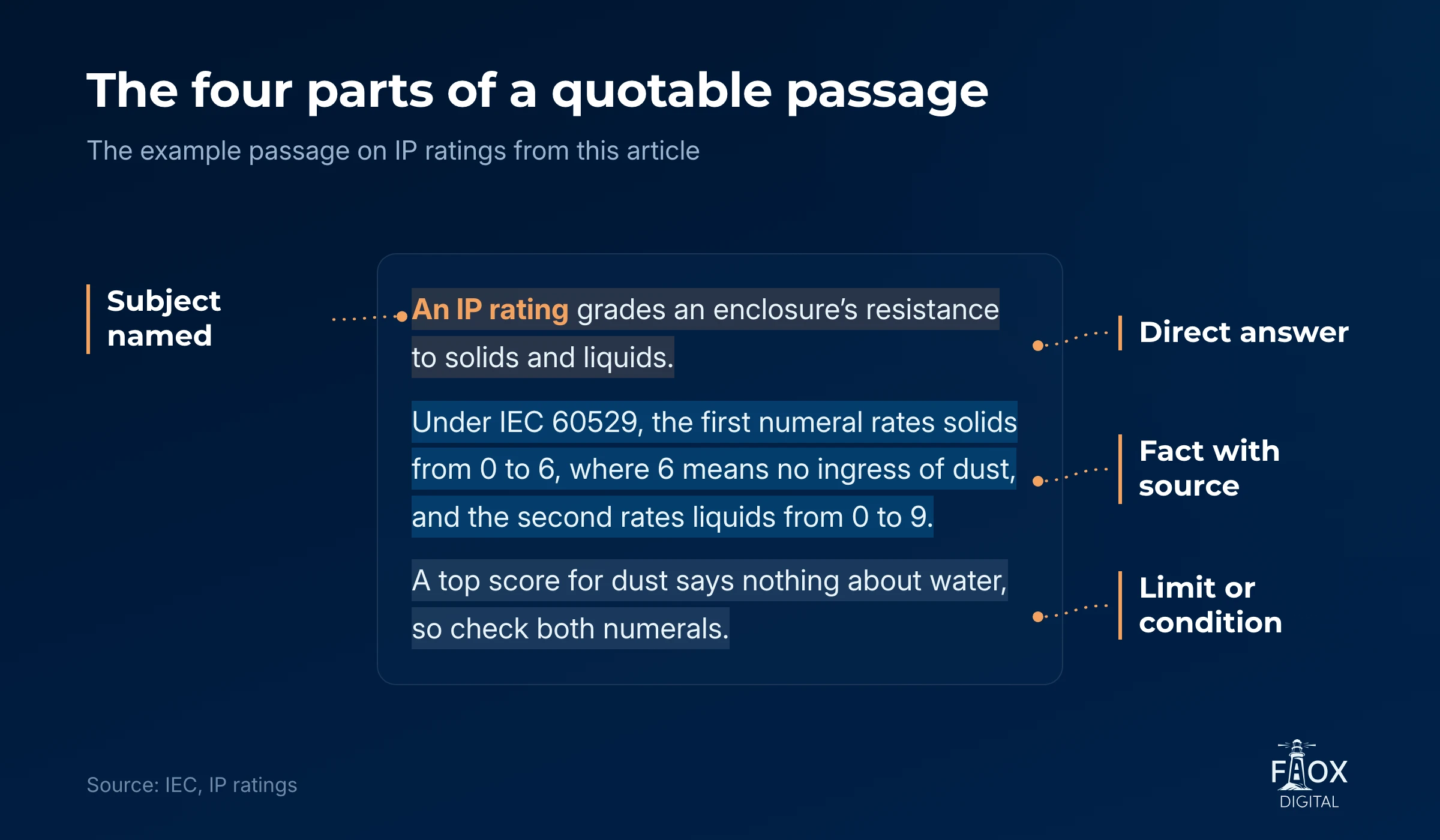
A citable passage answers one question, names what it is talking about and can be quoted without the text around it. It usually has four parts:
- A direct answer. The first sentence answers the question, with no warm-up.
- Definition sentences. Name the subject and say what it is: "An IP rating grades", not "It grades".
- Specific numbers and sources. Give the fact, where it comes from and, if it can change, when.
- A limit or condition. Say when the answer changes, so that nobody takes it too far.
Here is one written that way, on a subject many industrial buyers ask about:
An IP rating grades an enclosure’s resistance to solids and liquids. Under IEC 60529, the first numeral rates solids from 0 to 6, where 6 means no ingress of dust, and the second rates liquids from 0 to 9. A top score for dust says nothing about water, so check both numerals.
The same idea applies to self-contained paragraphs. Words such as "this", "it" and "the above" lose their meaning when a passage is lifted out of the page, and Microsoft advises sentences that still make sense when pulled out.
Put the answer early, too. In CXL’s analysis of 100 AI Overview citations, published in March 2026, 55% of cited passages came from the first 30% of the source page, and 21 of the 100 came from the bottom 40%. The sample is small, but readers want the same thing: the answer first and the detail after.
Answer engine optimization examples
These invented examples show the difference between text that is hard to quote and text that is easier to quote:
| Element | Hard to quote | Easier to quote |
|---|---|---|
| Direct answer | "Protecting equipment is a challenge many companies face today." | "An IP rating grades an enclosure’s resistance to solids and liquids." |
| Subject named | "It is rated on two scales." | "The IP code is rated on two scales." |
| Specific fact | "Our enclosures offer the highest levels of protection." | "The first numeral runs from 0 to 6, where 6 means no ingress of dust (IEC 60529)." |
| Stands alone | "As mentioned above, this matters in harsh settings." | "A top dust rating says nothing about water, which the second numeral rates." |
The left column is not wrong, but an AI tool has nothing specific to take from it, and neither does a buyer. The IEC itself says the IP code exists to avoid vague marketing terms such as "waterproof".
How to write content AI tools can quote
Beyond the single passage, these page elements make your content easier to use:
Question-form subheadings. Where a section answers a real question, say so in the heading. Microsoft notes that direct questions with clear answers mirror the way people search. Take the wording from enquiries and sales calls, and do not force a question where a plain heading is clearer.
Tables and lists. Put specifications, comparisons and steps in HTML tables and lists. Microsoft says they break complex details into reusable segments, and warns against keeping core information only in PDFs or images.
First-hand data. Google says content people find unique and useful will likely matter more over the long run than anything else in its guide, and it calls common knowledge that could come from anyone commodity content. Your test results, failure analyses and application notes are what others cannot copy.
Specific numbers and sources. In the original GEO study, adding quotations, statistics and source citations raised visibility by up to 40% on its measures, while keyword stuffing brought little or no improvement. Use real figures from primary sources, with their year. Google asks whether content has clear sourcing and whether it has easily verified errors.
Term consistency. Use one name for each product and concept, and define abbreviations the first time they appear. Google says its AI systems understand synonyms, so you do not need every keyword variation. Ambiguity is the real risk, and AEO is a good example: it also stands for Authorised Economic Operator, a customs status many exporters know. Consistent names are also the base of entity SEO.
An FAQ section. Answer real buyer questions in two or three sentences. Google stopped showing FAQ rich results on May 7, 2026, so add the section for readers and not for a search feature.
Author and date. Google recommends accurate bylines that lead to more about the author, and a visible date that matches the structured data. Name the engineer or specialist who checked the content.
Freshness. Ahrefs compared about 17 million cited URLs in 2025 and found that pages cited by AI assistants were 25.7% newer than those in organic results. The average cited page was still about 2.9 years old, and AI Overviews stayed close to organic results. So update facts when they change. Do not simply change the date: Google lists that as a warning sign.
For the wider craft of writing for buyers and search engines together, see our guide to SEO content writing.
What the evidence does and does not show
Format alone is not enough. Advanced Web Ranking hand-coded 112 passages from AI Overviews and Copilot answers on SEO topics in July 2026, comparing 95 that were cited with 17 that were surfaced but not cited:
| Passage attribute | Cited | Not cited |
|---|---|---|
| Definition format | 60% | 65% |
| Direct answer in the first sentences | 76% | 71% |
| Fresh date visible | 80% | 53% |
| Subject named at first mention | 96% | 82% |
| Only repeats common knowledge | 61% | 82% |
Structure did not separate the two groups. Dates, named subjects and saying something beyond the consensus did. The study is small, covers one topic and had a single coder, so treat it as a direction and not a rule. Most evidence in this field comes from vendors, and none of it shows that a format causes a citation.
Our reading: clear structure is the groundwork, because it lets a tool and a reader find your answer. What earns the quote is having something specific and current to say.
A checklist for your next article
- The first sentence of the page answers its main question
- Each section opens with the answer to its heading
- Key sentences name their subject, with no "this" or "the above" left unexplained
- Numbers have a source and, where they can change, a date
- The page contains something only your company could say
- Specifications and comparisons sit in HTML tables or lists
- Each product and concept has one name, and abbreviations are defined
- The author’s name and role are visible, and the date is real
- FAQ answers respond to questions buyers really ask
What to avoid
- A second version for machines. Google says you do not need to write specially for AI or cut content into tiny pieces.
- A page for every variation. Google says doing this mainly to manipulate rankings or AI responses breaks its scaled content abuse policy.
- Hidden answers. Microsoft warns that AI systems may not render hidden content, so key details in tabs or accordions can be skipped.
- Invented figures or quotes. A made-up statistic is easy to lift and hard to take back. Use only what you can source.
How to check whether it is working
Ask AI tools the questions your page answers and see whether they use your wording and cite your page, using the test method in our article on ChatGPT SEO. Answers vary between runs, so repeat each question.
Then look at the data. Search Console’s Generative AI performance report shows impressions in AI Overviews and AI Mode by page. AI Performance in Bing Webmaster Tools shows cited pages and the grounding queries behind them, which tells you what your passages were retrieved for. Our article on tracking AI referrals sets out a reporting method.
No format can promise a citation. Most of this can be done by your own writers and subject experts. If you are weighing outside help, our article on AI SEO services explains when you need it.
How Faox Digital approaches answer engine optimization
At Faox Digital, a digital growth partner for B2B companies, we write pages built to rank on Google and to be quoted by AI tools. A place in an AI answer cannot be promised, so we build the conditions for it: quotable pages, crawler access and placements in the press your buyers read. Our reports show rankings, organic traffic and whether AI tools start to cite the company.
Key takeaways
- Answer engine optimization means writing passages that AI tools can lift and quote accurately. It works at the level of the page, and it helps readers as well.
- A quotable passage has a direct answer, a named subject, a sourced fact and a limit, and it makes sense on its own.
- Question-form headings, tables, term consistency, a real author and a real date all make passages easier to use.
- Format alone does not earn citations. First-hand data and specific, current facts are what give a tool a reason to quote you.
- No format can promise a citation, so test your questions and watch the reports over time.
Frequently asked questions
What is the definition of answer engine optimization?
Answer engine optimization is the practice of writing and structuring content so that AI tools and search features can lift a clear, correct answer from it. There is no official definition, and many people use it interchangeably with generative engine optimization.
What is the difference between answer engine optimization and generative engine optimization?
No standard separates them. We use answer engine optimization for the page, meaning whether a system can quote it, and generative engine optimization for the company, meaning whether AI tools find it and describe it correctly. Google treats both as SEO for its own Search.
What are examples of answer engine optimization?
Opening a page with a direct answer, naming the subject in each key sentence, giving a figure with its source, and putting specifications in a table are all examples. So is replacing "our products offer the highest protection" with the actual rating and the standard behind it.
Which answer engine optimization tools are useful?
Start with the free ones: Search Console’s Generative AI performance report, Bing Webmaster Tools and the AI tools themselves for testing. Paid trackers can save time, but Google says no third-party tool has access to its internal ranking or AI systems, so treat their results as a sample.
Do you need answer engine optimization services?
Often not at first. Your writers and experts can apply this method to your most important pages. Outside help makes sense when you lack the time or need to rewrite many pages, and no provider can honestly promise citations.
Sources
- Microsoft Advertising: Optimizing your content for inclusion in AI search answers, 2025
- Google Search Central: Optimizing your website for generative AI features on Google Search, 2026
- Aggarwal et al.: GEO: Generative Engine Optimization, KDD 2024
- Advanced Web Ranking: What gets quoted and what gets absorbed, 2026
Let’s talk
Where do you want to be found?
Tell us the searches that matter to your business. We will review your site and tell you plainly what to fix first, including what you can do yourself.