
SEO Content Writing for B2B: How to Write for Buyers and Search Engines
A page-by-page method for writing content a technical buyer trusts and search engines understand, from the first paragraph to the AI edit.

SEO content writing means writing pages that answer what a buyer searches for, in a form search engines can understand and people want to read. For a technical B2B reader, that means a clear answer in the first paragraph, headings that follow the reader’s questions, explained terms, real examples and sourced data, plus a title and meta description that say what the page offers. Keywords guide the writing, but knowledge makes it worth reading.
B2B companies tend to get this wrong in one of two ways. A marketer writes text full of keywords that an engineer dismisses after two lines. Or an engineer writes an accurate paper that nobody finds, because it opens with the company’s history and never uses the words buyers search for. One page can serve both readers. This guide shows how, as the writing side of a B2B content strategy. The examples come from a hypothetical pump seal manufacturer.
What is SEO content writing?
SEO content writing is writing for one specific search and the person behind it. It is not a separate style for machines. Google’s SEO Starter Guide (2025) asks for content that is easy to read, well organized and unique, and says length alone does not matter for ranking. It also notes that people who know a topic well search with different words from newcomers, so part of the job is using the words your readers use.
Most parts of a page do two jobs at once:
| Part of the page | What the buyer gets | What search engines get |
|---|---|---|
| Title and headings | Knows at once whether the page fits | A clear statement of the topic |
| First paragraph | The answer, with no warm-up | A passage that can appear as a snippet |
| Technical terms | Precise language, explained once | The words people really search with |
| Examples and data | Evidence to trust and reuse | Facts that other pages lack |
| Internal links | The next useful page | A route to related pages and their context |
| Images and alt text | Diagrams that explain, and access for screen reader users | A description of what each image shows |
How to write SEO content for a website, step by step
- Start from a brief. State the search, the reader and the question. An SEO content brief keeps this on one page.
- Read the current results. Search in the market you sell to, and note which page types and formats rank.
- Talk to the expert. Collect the facts, examples and limits before you write a word.
- Write the title and first paragraph. Say what the page offers and answer the question.
- Outline the headings. Turn the reader’s next questions into H2s and H3s.
- Write the body. Explain terms, use examples and cite sources.
- Add links, images and alt text. Put each where the reader needs it.
- Edit for readability and accuracy. Then have the expert check the result.
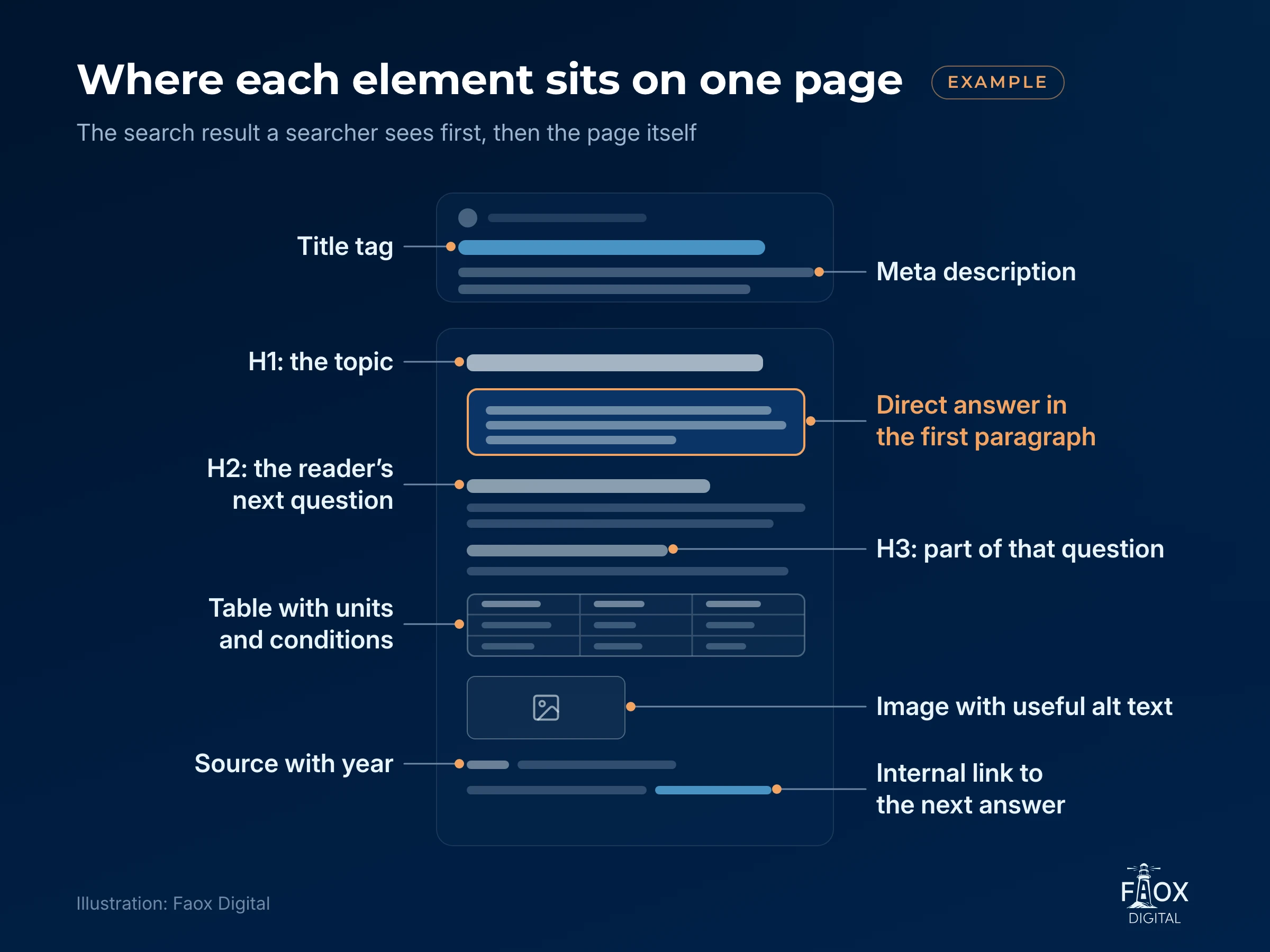
An introduction that fits search intent
The first lines decide whether the reader stays, and what they expect depends on search intent. Someone who typed a fault wants the cause, not the history of the product. Nielsen Norman Group calls this the inverted pyramid: the most important information comes first, so even a reader who stops after one paragraph knows what the page says. Jakob Nielsen’s 2008 analysis of browsing data from 2005 estimated that users have time to read at most 28% of the words on an average page. The data is old, but it explains why the opening carries so much weight.
So give a direct answer in the first paragraph. These invented examples show the difference:
| Weak opening | Stronger opening |
|---|---|
| "Mechanical seals are a vital part of many industries. In this article, we look at why they can fail." | "Seals in high-temperature pumps usually fail through cracked faces, a lost fluid film or hardened elastomers. Check the faces first." |
The second version would also work if lifted out of the page. Our guide to passages AI tools can quote explains how to build that kind of paragraph.
Heading hierarchy: H1, H2 and H3
Heading hierarchy gives a page its outline: one H1 for the topic, H2s for the main questions and H3s for parts of an H2. Google’s starter guide says semantic order is good for screen readers but makes no difference from a Search perspective, and that there is no ideal number of headings. The W3C’s accessibility guidance says to nest headings by rank and avoid skipping levels. So keep the order for your readers, not for rankings.
The useful test is to read the headings alone. They should tell the story of the page. "Why seal faces crack at high temperature" passes, and "Overview" or "Challenges" does not. Put a search term in a heading where it fits naturally, and leave it out where it does not.
Title tag and meta description
The title tag and meta description are often what a searcher sees before the page itself. Google builds its title links automatically, drawing on the title element, the main visible title, headings and even links pointing to the page, so make sure they agree. It asks for titles that are descriptive and concise, without repeated keywords or boilerplate.
Google creates snippets primarily from the page content, and uses the meta description when it describes the page better. Neither element has a length limit, but both are cut as needed to fit the screen. So write the meta description as a short pitch for the page, and do not expect to see it every time. These invented examples show the idea:
| Element | Write | Avoid |
|---|---|---|
| Title tag | "Why Mechanical Seals Fail in High-Temperature Pumps" | "Mechanical Seals, Pump Seals, Seals for Pumps" |
| Meta description | "Cracked faces, a lost fluid film or hardened elastomers: how to find out why a seal failed in a hot pump, and what to change." | "We are a leading manufacturer of high-quality sealing solutions." |
Technical terms and readability
Technical terms are keywords in B2B, because buyers search with them. Do not simplify them away. Use the precise term and explain it once, in passing: "the seal faces, the two polished rings that do the sealing". The engineer skips the explanation and the purchaser keeps reading. Keep to one name for each thing, so nobody wonders whether two words mean two products.
Readability does not mean writing down to anyone. Nielsen Norman Group’s 2017 usability study with experts in science, technology and medicine found that even highly educated readers want succinct information that is easy to scan. In practice:
- Keep to one idea per paragraph, and start with the point.
- Use lists for parallel items and tables for specifications.
- Prefer the active voice and short words where they say the same thing.
- Cut anything a reader would not miss, including throat-clearing such as "it is worth noting".
Examples, data and sources
Examples and data separate your page from the ten others on the same subject. Google’s 2026 guide to generative AI features contrasts commodity content, which rests on common knowledge, with content that offers expert or experienced takes. A real case, a measured value or a worked calculation is the difference. Give units and conditions as well: a stated temperature, pressure and medium tell an engineer far more than "extreme conditions".
Citing sources lets the reader check you. Name the source and year of every number in the sentence, link to the primary source and leave out what you cannot verify. Your own test data counts as a source, as long as you say how you measured it.
Internal links, images and alt text
Internal links belong where a reader would want the next answer, with link text that describes the target. Which page links to which should come from your plan, not from the writer’s memory; our guide to pillar pages and topic clusters sets out those rules.
Use images that carry information, such as diagrams, cross-sections and test photos, and place them near the text they support. Google says it uses alt text, along with computer vision and the page’s content, to understand an image, and it warns against stuffing it with keywords. So describe what the image shows: "Cross-section of a double mechanical seal with barrier fluid between the seal faces". Do not lock specifications inside images. Put the values in text and tables as well.
SEO content optimization and content scores
SEO content optimization means improving a page for its target search, whether it is new or old. Compare it with what ranks and ask which questions those pages answer that yours does not. Tools can speed this up with content scores and lists of terms. Google’s 2026 guidance on third-party tools says they have no access to its ranking data and that their predictions are their own, so treat a score as a prompt to look for missing subjects, not as a target. Adding terms to raise a score adds no knowledge.
No writing method can promise a ranking either. How to write SEO content that ranks on Google is only part of the answer, because technical health, links and competition all count too.
AI drafts and human editing
AI drafts are now normal. In the Content Marketing Institute and MarketingProfs survey published in November 2026, 88% of 861 B2B marketers said their organization uses AI content tools. They credited the tools with speed (78%) and efficiency (59%) far more than quality (17%), and named accuracy (54%), quality control (54%) and brand voice (52%) as their biggest challenges.
The ranking evidence points to quality, not to a penalty for using AI. Ahrefs’ July 2026 study of 331,000 pages, based on its own AI detector, found that pages with under 50% AI text held 82.2% of top-three rankings, although pages scored as fully AI also appeared there (5.3%). Low and moderate AI pages earned two to three times the impressions of heavily AI pages. Ahrefs concludes that Google is against bad content, not AI as such, and that the two often overlap. Detector scores are estimates, and this is correlation.
Google’s guidance (updated October 2026) warns that generative models predict likely words and do not retrieve facts. It calls it critical to fact-check all AI-generated content, and says generating many pages without adding value may break its spam policies. So divide the work, and budget for human editing:
| Task | AI tool | Human editor |
|---|---|---|
| Outline and first structure | Can draft it | Checks it against the brief and the reader |
| Shortening and rewording | Works well | Checks that the meaning survived |
| Facts, numbers and standards | Do not rely on it | Verifies each one against a primary source |
| First-hand experience | Has none | The engineer supplies it |
| Final responsibility | None | A named person signs it off |
Before and after you publish
Run this check on every page before it goes live:
- The title and first paragraph say what the page offers
- The headings make sense when read alone, in order
- Terms are explained once and used consistently
- Every number names its source and year
- Links lead to the next useful page
- Images have useful alt text, and no key data sits only inside an image
- An expert has checked the facts
Publishing is not the end. Check the queries the page earns in Search Console, and plan a content refresh when facts, products or standards change. A good article also gives you material for other channels; our guide to making B2B social content shows how to reuse it.
If your team cannot do all this in-house, the next question is who to hire and how to pay them. Our guide to paying for SEO content compares the options.
How Faox Digital writes SEO content
Faox Digital writes pages built to rank on Google and to be quoted by AI tools, each one planned from the keyword map. The writing comes in the content and authority step of an SEO project, after the audit and the foundations, so the pages land on a site that search engines can read.
Key takeaways
- SEO content writing serves one search and the person behind it, so most parts of a page do two jobs at once.
- Put a direct answer in the first paragraph, and make the headings tell the story when read alone.
- Use technical terms, explain them once and give units and conditions, because that is what buyers search for and trust.
- Write the title and meta description as a pitch, knowing Google may build its own from the page.
- Let AI speed up drafts and rewording, but have a person verify every fact and add the experience.
Frequently asked questions
How do I learn SEO content writing?
Start with Google’s SEO Starter Guide, then practice on one real search. Read what ranks, write a better answer with an expert’s help, and check in Search Console which queries the page earns. Having an engineer critique your drafts teaches you more than any course on keywords.
How long should an SEO article be?
As long as the question needs. Google says length alone does not matter for ranking, and that there is no minimum or maximum. Look at how much detail the current results give, then write what the reader needs and stop.
Should engineers write their own SEO content?
They can, but few have the time. A common setup is for a writer to interview the engineer, draft the page and send it back for correction. The engineer brings the facts and experience, and the writer brings the structure and the reader’s words.
How do I become an SEO content writer in B2B?
Learn one industry well enough to interview its experts, then learn the basics of search intent, headings and sourcing. Build samples on real technical topics. In B2B, the ability to get accurate detail from an engineer is worth more than knowing keyword tools.
Sources
Let’s talk
Where do you want to be found?
Tell us the searches that matter to your business. We will review your site and tell you plainly what to fix first, including what you can do yourself.