
Entity SEO: Making Sure AI Tools Describe Your Company Correctly
Where AI tools get their facts about a company, how to keep those facts consistent across your site, profiles and directories, and what to do when an answer is wrong.
Entity SEO is the work of making sure search engines and AI tools recognize your company as one distinct thing and hold the right facts about it. AI tools learn about a company from your website, LinkedIn, industry directories, what others publish about you and, where you qualify, Wikipedia and Wikidata, and when those sources disagree, an answer can repeat the wrong one. Keep your name, description, address and people consistent everywhere, fix errors at their source and test again; no one can promise a correct answer.
A buyer asks an AI tool what your company makes. The answer names a product you dropped three years ago, an address you have left and a managing director who has retired. Nothing in your analytics shows that this happened, and the buyer may simply move on.
This guide shows where these tools get their facts about a company, how to keep those facts consistent and what to do when an answer is wrong. It is one part of SEO for AI search. It deals with facts, not with what you want to be known for, which is a question of brand positioning.
What is entity SEO?
An entity is something a system can recognize as one distinct thing: a company, a product line, a person. Google described the idea in 2012, when it announced its Knowledge Graph as a move to "things, not strings". Its help pages now call the Knowledge Graph a database of billions of facts about people, places and things, drawn from public sources, licensed data and content owners.
Entity SEO means making it easy for these systems to recognize your brand entity: your company as one thing, with one name and one set of facts, kept apart from others with similar names. It has two parts: stating the facts clearly on your own site, and making sure the rest of the web agrees.
The Knowledge Graph belongs to Google. It is not a shared register that every AI tool reads, and we found no AI company that publishes a list of the sources it trusts for company facts.
Where AI tools learn about a company
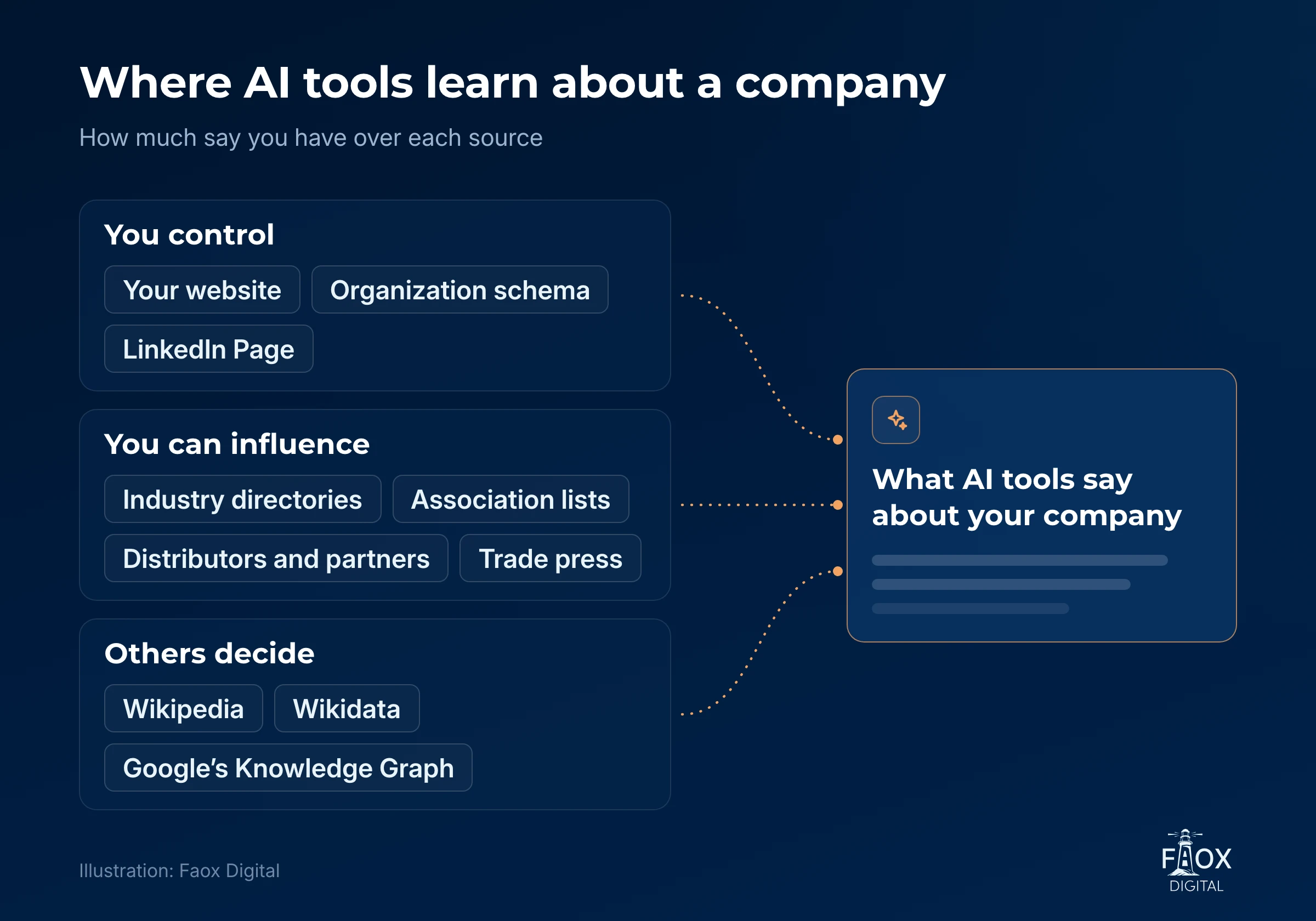
AI tools answer from what their models learned in training and from pages they retrieve for the question. Our guide to ChatGPT SEO explains how those two differ. In practice, the facts about a company sit in these places:
| Source | Facts it usually holds | Who controls it |
|---|---|---|
| Your website | What you make, markets, certifications, address, people | You |
| Organization schema | Name, legal name, address, identifiers, links to profiles | You |
| Description, industry, size, locations, employees | You for the Page, each person for their profile | |
| Industry directories and association lists | Category, products, location, contacts | The publisher, though you can often edit your entry |
| Trade press, distributors and partners | What you do, news, old names, old products | The publisher, who can correct on request |
| Wikipedia and Wikidata | History, founders, identifiers, if an entry exists | Volunteer editors, not you |
| Google’s Knowledge Graph | Google’s own view, shown in a knowledge panel | Google, though you can suggest changes |
Vendor studies disagree on which of these matters most, and all three below sell services in this market:
- Yext, which sells brand visibility software, counted 6.8 million citations from ChatGPT, Gemini and Perplexity in July and August 2025. First-party websites made up 44% and listings 42%, on queries for retail, finance, healthcare and food service locations.
- Muck Rack, which sells software to PR teams, analyzed more than 25 million links cited by ChatGPT, Claude and Gemini (May 2026). It puts earned media at 84%, broadly defined to include journalism (27%), encyclopedic sites and third-party corporate content.
- Peec, which sells AI search analytics, analyzed 30 million cited sources in the US in March 2026. LinkedIn was the third most-cited domain and Wikipedia the fourth, after Reddit and YouTube.
None of them looks at B2B manufacturers in particular. The citations in answers about your own company are the better guide.
How consistent facts affect what AI tools say
Entity consistency means the facts about your company match wherever they appear. We found no controlled study that isolates its effect on AI answers, so treat this as reasoning and not as proof: a tool that retrieves pages with two addresses has to choose one, and Microsoft says AI assistants "reason over data on and off your site".
The best public picture of the errors comes from Searchable, a vendor of AI visibility tools. Of 32,556 facts that AI tools stated about 1,704 brands, up to July 2026, the brands’ own employees flagged 9.2% as false, including outdated details and confusion with another brand. Companies with up to 50 staff saw 9.4%, against 6.3% for those above 250.
Rates were highest for things that change, such as pricing (13.5%) and partnerships and clients (9.9%), and lower for products and services (8.6%), history and founding (6.9%) and location and coverage (4.8%). The sample is the vendor’s own users, and its sector table does not list manufacturing, so use these figures as a guide to what to check first.
How to make your company facts consistent
- Write one fact sheet. List the approved names, description, address, people, products, markets and certificates, and name someone to keep it current.
- Test what AI tools say. Ask the company questions buyers ask, and log each error with the sources cited.
- Fix your own site first. Check the About and contact pages, the footer and every language version.
- Add Organization schema. Mark up the same facts on your home page or About page.
- Align your profiles. Bring LinkedIn and other official profiles into line with the sheet.
- Update directories and lists. Work through industry directories, association lists and exhibitor lists.
- Ask others to correct theirs. Start with the pages that AI answers cite.
- Test again. Give crawlers time to return, rerun the same questions and repeat when a fact changes.
Company name and description
Decide three things: the brand name you use in text, the legal name on your contracts, and any former or translated names. A legal form such as GmbH or A.Ş. belongs in the legal name. For an invented company, the sheet might read: brand name Example Valves, legal name Example Valves Ltd, former name Example Armatur until 2019.
Google’s Business Profile guidelines ask for the real-world name used consistently on your website and stationery, a good rule for every listing. Then write one plain sentence saying what you make, for which industries and in which markets, and build your About page, LinkedIn overview and directory entries on it. The wording can vary between pages and languages, but the facts should not.
Say plainly what has changed: a short history with dates helps readers and tools connect an old name to a new one. Clear statements like these also make content AI tools can quote.
Organization schema and sameAs
Organization schema is structured data on your home page or on one page about the company. Google says it can help it understand your administrative details and disambiguate your organization in search results. No property is required. The useful ones here are name, legalName, alternateName, description, url, logo, address, telephone and foundingDate. If your name is common, identifiers help too: Google says some, such as iso6523Code and naics, are used behind the scenes to tell organizations apart.
sameAs points to a page on another website with more information about your company, such as a LinkedIn Page or a directory entry. List only profiles that really represent you.
Keep your expectations modest. Google says structured data is not required for generative AI search and that there is no special markup to add. Use it to state your facts plainly, and make sure it matches the visible text. Our article on schema markup for B2B websites covers how to add and test it, and what the evidence says about AI citations.
LinkedIn and industry directories
LinkedIn deserves an early hour of your time, because Peec’s data suggests AI tools cite it often. LinkedIn’s help pages recommend completing the industry, company size, overview, logo, website URL and locations, with one marked as your primary office. Use your fact sheet for all of them, and ask senior staff to show the current company name and role on their own profiles.
Industry directories differ by sector and market. At the time of writing (November 2026), examples include wlw in German-speaking countries, europages across Europe and Thomasnet in North America, along with association member lists and trade fair exhibitor lists. Update the entries you have, remove duplicates and fix old addresses. List your company where your buyers really source, not for the links, because Google’s spam policies name low-quality directory links as link spam.
Founder, team and contact details
Founder and team information answers a question buyers do ask: who runs this company? Publish names, roles and short, checkable bios for the people who represent you, link to their LinkedIn profiles and update the page when someone leaves.
Address and contact details should match on your contact page, footer, schema, LinkedIn and directories. If you have several sites, label each one: head office, plant or sales office. If customers visit you, keep a Google Business Profile as well, because Google manages those panels separately from knowledge panels.
Knowledge panels: check, claim and suggest changes
A knowledge panel is the information box Google shows for entities in its Knowledge Graph. You cannot apply for one: Google says panels are created automatically when there is enough information on the open web.
Search your exact company name. If a panel appears and you represent the company, look for the option to claim it. Google verifies you through a sign-in to an official site or profile, such as YouTube or Search Console, and says not all panels can be claimed. Anyone can send corrections through the Feedback link, and links to pages that verify the fact help.
Wikipedia and Wikidata: what the rules allow
Some SEO advice tells companies to create a Wikipedia article or claim a Wikidata entry. We do not, because the rules of both projects point the other way.
Wikipedia. Its notability guideline says a company generally qualifies only if it has been the subject of significant coverage in reliable, independent secondary sources. Its conflict of interest guideline strongly discourages editing about your own company and requires paid editing to be disclosed. If an article about you contains an error, its guide for people in this position says to post suggestions and sources on the talk page for uninvolved editors, and not to write them with AI.
Wikidata. Its policy accepts an item that has a link to a Wikimedia page, fills a structural need or describes a clearly identifiable entity using "serious and publicly available references". An essay on the site, which is not policy, says that creating an item about your own organization is strongly discouraged and likely to be deleted. Paid contributions must be disclosed. So check whether an item exists, and if it is wrong, raise it on the item’s discussion page with a source.
Most B2B companies will have neither, and that is fine. Independent coverage comes first.
Third-party sources: correct and earn
Third-party sources carry weight with buyers as well as AI tools, which is the old logic of third-party credibility. Treat them in two ways. Correct what is wrong: send distributors your current description, and send magazines a factual correction with its source. Earn what is missing through real news, data and expertise.
Ahrefs’ 2025 study of 75,000 brands found that web mentions correlated with visibility in AI Overviews at 0.664, against 0.218 for backlinks. That is a correlation in the vendor’s own data, not a cause. Google warns that seeking inauthentic mentions is not as helpful as it may seem.
Correcting AI answers that get you wrong
Correcting AI answers starts with the source, not the tool. We found no tool that offers a way to edit what it says about a company. OpenAI, Google and Anthropic each point people to a thumbs-down button, and none promises that an answer will change. So work from what you see:
| What you see | Likely cause | What to do |
|---|---|---|
| A cited page states the wrong fact | An outdated or wrong page | Fix it if it is yours; ask the owner if it is not |
| The sources are right, the answer is not | The tool misread them | State the fact more plainly on your page; send feedback |
| An old product, address or leader, with no source | Training data or old pages | Correct what is published and test again later |
| You are confused with a similar name | Two entities look alike | State your legal name, location and products; add identifiers to your schema |
| You are missing altogether | Too little about you, or blocked crawlers | Check crawler access; earn coverage |
| Your knowledge panel is wrong | Google’s Knowledge Graph | Suggest a change with a link that verifies it |
Expect delays. Answers that use live search can change once crawlers return, while answers from training data may carry the old fact until a newer model arrives. OpenAI warns that search results and citations can be incomplete, outdated or incorrect, so some errors will survive good work. Rerun the same questions on a schedule; our article on measuring AI visibility sets out a method.
Most of this takes time, not budget, and you can start with the fact sheet today. If time is the limit, or third-party coverage needs steady effort, our article on AI SEO services explains when outside help makes sense and what to ask.
How Faox Digital approaches entity SEO
At Faox Digital, the audit at the start of an SEO project checks whether AI tools can read the site, and the foundations include structured data, where company facts are stated for machines. Placements in the press buyers read then add third-party sources, and our reports show whether AI tools start to cite the company.
Key takeaways
- Entity SEO helps systems recognize your company as one thing with one set of facts. It cannot promise a correct answer.
- AI tools draw on your site, LinkedIn, directories, third parties and, where they exist, Wikipedia and Wikidata, and these can disagree.
- Start with one approved fact sheet, then work outward: your site, Organization schema, profiles, directories and other people’s pages.
- Do not create a Wikipedia article or Wikidata item about your own company to influence AI tools. Both projects’ rules point the other way.
- Fix wrong answers at their source and test again, because feedback buttons promise no change.
Frequently asked questions
How does AI SEO work for company facts?
AI tools combine what their models learned with pages they retrieve. For company facts, AI SEO means keeping those pages reachable, accurate and in agreement, so that the tool has the right material to work with. It cannot make a tool repeat your facts every time.
How do you do ChatGPT SEO when it gets your company wrong?
Open the citations behind the wrong statement and fix that page, or ask its owner to. If no source is shown, correct what is published on your site and profiles, use the thumbs-down button and test again later.
Does my company need a Wikipedia page?
No. Wikipedia’s guideline requires significant coverage in reliable, independent sources, and it strongly discourages editing about your own employer. Many sound B2B companies will not qualify. Work on your site, profiles, directories and earned coverage instead.
How do I get a knowledge panel?
You cannot apply for one, because Google creates panels automatically when there is enough information on the open web. Clear facts on your site, Organization schema and consistent profiles are sensible groundwork, but no one can promise a panel.
Sources
- Google Search Central: Organization structured data, updated September 2026
- Searchable: The AI brand misinformation report, updated July 2026
- Wikipedia: Notability (organizations and companies), accessed November 2026
- Yext: 86% of AI citations come from brand-managed sources, October 2025
Let’s talk
Where do you want to be found?
Tell us the searches that matter to your business. We will review your site and tell you plainly what to fix first, including what you can do yourself.