
Google AI Overviews and AI Mode: How Sources Are Chosen
What AI Overviews and AI Mode are, how Google picks the pages they link to, and what that means for a B2B website’s visibility and clicks.

AI Overviews are AI-generated summaries that Google shows at the top of some search results, with links to supporting pages. Google picks those pages from its Search index using its core ranking systems and several related searches, and a page must be indexed and eligible for a snippet to be considered. For a B2B site, appearing depends on access and on useful content for the questions buyers ask, and no one can promise a place.
Search for a technical question on Google and the first thing you see may no longer be a link. It may be a written answer with a few sources beside it. Those sources are not simply the top results for your search, which is why ranking well no longer tells you whether your page was used.
This article explains what AI Overviews and AI Mode are, what Google says about choosing sources, what independent studies add and what it all means for a B2B website. For the wider picture beyond Google, see our guide to SEO for AI search.
What are AI Overviews in Google Search?
AI Overviews are AI-generated snapshots of key information, with links to read further, shown above the regular results. Google says they appear when its systems judge that generative AI can be especially helpful, and that they often do not trigger. Searchers cannot turn them off, although the Web filter shows text links only.
They do not appear on every search. In Pew Research Center’s study of U.S. browsing in March 2025, 18% of Google searches produced an AI summary: 8% of one- or two-word searches, 53% of searches of 10 words or more, and 60% of searches starting with a question word. BrightEdge reports about 48% for February 2026, but it tracks a chosen set of keywords, while Pew measured what people actually typed.
The pattern matters in B2B. Long, specific questions are how engineers and buyers research, and they are the searches most likely to get a summary. Our article on long-tail keywords explains why these low-volume searches are worth your attention.
AI Overviews and AI Mode: what is the difference
AI Mode is the other generative AI feature in Google Search. The two share a foundation but work differently:
| Aspect | AI Overviews | AI Mode |
|---|---|---|
| Where it appears | At the top of some regular search results | In a conversational mode the user opens |
| Who decides | Google, when it judges a summary helpful | The user |
| Suited to | Quickly understanding a topic from several sources | Complex questions, comparisons and follow-ups |
| Links | Links to supporting pages | Links to supporting pages, or a set of web links when confidence is low |
| Monthly users (Google, June 2026) | Over 2.5 billion | Over 1 billion |
Google says the two may use different models and techniques, so their responses and links vary. They are also moving closer: since January 2026, people on mobile can ask a follow-up from an AI Overview and continue in AI Mode.
Monthly users are not the same as share of searches. SparkToro’s analysis of U.S. web searches from January to April 2026 found that only 0.34% reached AI Mode, although it excludes Google’s mobile app. For now, most B2B sites will see more effect from AI Overviews.
How Google chooses the sources
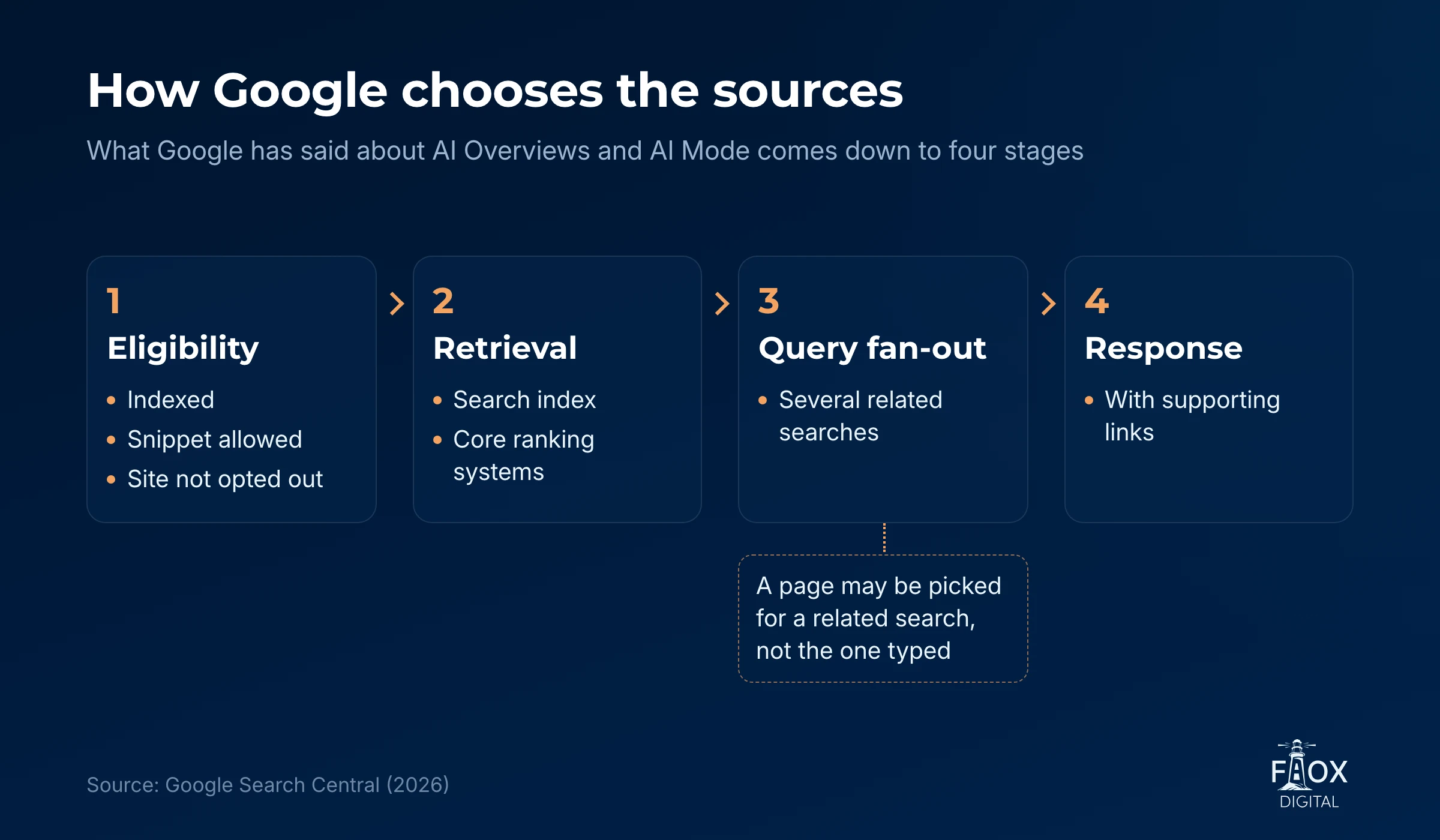
Google has not published a formula for which pages get linked. What it has said comes down to four stages:
- Eligibility. A page must be indexed and eligible to appear in Search with a snippet, and the site must not have opted out of these features. Google asks for no extra technical requirements, special files or special markup.
- Retrieval. Google’s core ranking systems retrieve relevant pages from the Search index. Google calls this retrieval-augmented generation, or grounding.
- Query fan-out. Google runs several related searches across subtopics at the same time, which brings in a wider set of pages than one classic search.
- Supporting links. The system reviews the retrieved pages, writes the response and shows links to pages that support it.
Google says its core ranking systems focus on high-quality content while other systems block spam, and that its generative AI features depend on both. In 2024 it said AI Overviews are built to show only information backed up by top web results, and its help page still warns that they can make mistakes.
Independent studies add useful detail. Ranking for the search someone typed is neither required nor enough:
- Ahrefs analyzed 863,000 keyword results and about 4 million cited URLs in early 2026. It found 38% of cited URLs in the top 10 for that query, down from about 76% in July 2025, and 31% outside the top 100.
- BrightEdge puts the overlap with the top 10 lower, at about 17% overall and 22.6% for B2B technology queries (February 2026). The methods differ, so these figures should not be averaged.
- Pew found that Wikipedia, YouTube and Reddit made up 15% of sources linked in AI summaries, and that government sites made up 6%, against 2% in standard results.
Ahrefs’s leading explanation is query fan-out: a page may be chosen for a related search and not the one typed. That is an inference, because Google does not disclose its fan-out queries, and Ahrefs notes that citations change from run to run.
What decides whether a B2B site appears
No one outside Google can say exactly. Based on its statements and the studies above, these are the conditions a B2B site can influence:
- Access and indexing. Googlebot must be able to crawl your important pages, and they must be indexed. A wrong rule can take a page out before any judgment of quality; our article on sitemaps and robots.txt shows what to check.
- Answers to the related questions. Because of fan-out, a page can be picked for a subtopic. A buyer asking how to choose a heat exchanger for corrosive fluids may set off searches on materials, standards and maintenance, so clear pages on each subject give Google more to find. Do not create a page for every variation: Google says doing that mainly to manipulate rankings or AI responses breaks its spam policy.
- Something others do not say. Google expects unique, non-commodity content to matter most over time. Test data, application experience and real specifications are hard for others to copy.
- Information in text. Google asks that important content be available in textual form, so key facts should not sit only in a PDF or an image.
- Reputation beyond your site. Google says these features can show what is said about products and services across the web, and that seeking inauthentic mentions is not as helpful as it may seem.
Public data on B2B queries is thin. Semrush studied more than 600,000 U.S. desktop keywords from November 2025 to April 2026. The share of commercial-intent results with an AI Overview grew 71% on average, while the share for transactional results fell 5%. That suggests comparison and evaluation searches are increasingly covered. We found no reliable public figures for manufacturing or other industrial sectors, so test your own market: search your buyers’ questions, and note which ones show an AI Overview and which sources it links to.
What AI Overviews do to clicks
Zero-click searches end without a click to any destination. SparkToro’s figure comes from Similarweb data and covers every cause, not only AI Overviews. In Pew’s study, people clicked a link inside the summary in 1% of visits, and ended their session on 26% of pages with a summary, against 16% without one. The Ahrefs click-through rate estimate uses desktop data from December 2025 and shows a correlation, not a proven cause.
Being cited helps but does not restore the old rate. Seer Interactive’s data from 53 brands shows organic click-through on informational queries in 2025 of 2.07% when the brand was cited, 0.94% when it was not and 3.35% with no AI Overview. Seer says this is correlation, since stronger brands are more likely to be cited, and that one large account pulls down the uncited figure.
Google reads this differently. In August 2025 it said total organic clicks from Search were relatively stable year over year and that click quality had increased, and in June 2026 it said it had added more inline links and website previews. Its post gave no figures we could check.
For a B2B site, expect fewer visits on simple definitions, and judge the work by enquiries as well as traffic. Our article on how AI is changing search looks at what this means for a business.
Visibility in Search Console
Search Console shows these features in two places:
- Generative AI performance report. It shows impressions in AI Overviews and AI Mode by page, country, device and date, and has been open to all websites since August 31, 2026. An impression means a link to your site was shown in the feature. The report may not appear for a site with few impressions.
- Performance report. AI feature data stays in the overall figures, under the Web search type. A click on a link counts as a click, and an AI Overview takes a single position that all its links share. AI Mode follows the usual position method.
So you can see how often you were shown, but not how many clicks those features sent.
Preview controls and opting out
Most B2B companies that want to be found should leave the defaults in place. If you need to limit use of your content, these are the preview controls and related settings at the time of writing (November 2026):
| Control | What it does | Side effect |
|---|---|---|
nosnippet | Stops a snippet and stops the content being used as direct input for AI Overviews and AI Mode | Also removes the text snippet in classic results |
max-snippet | Limits the text used in snippets and as direct input | Short limits also shorten classic snippets |
data-nosnippet | Excludes marked text from snippets | Affects only the marked text |
noindex | Keeps the page out of search results | Removes it from Search entirely |
| Search generative AI setting in Search Console | Excludes a site from AI Overviews, AI Mode and generative features in Discover; sites are included by default | No traffic or impressions from those features; Google says it is not a ranking signal elsewhere |
Google-Extended is not one of these controls. It covers Gemini training and grounding in Gemini Apps and has no effect on Google Search.
AI Overviews in Türkiye
Google announced AI Overviews and AI Mode for Türkiye on February 18, 2026, with a gradual rollout. In Turkish they are called AI Bakışı and AI Modu. At the time of writing, Google’s help pages list both the country and the Turkish language as supported. Country and language lists change often, so check them before you plan around them.
Early data is limited. An analysis published by Stradiji used Search Console data from 10 sites and 1,035 sampled queries from February to June 2026. Average position held at about 7.6, while daily clicks in June were 33% below the pre-launch baseline, and AI Overviews appeared on 59% of the sampled queries. The sample is small and seasonal effects are possible, so treat this as an early signal.
Turkish companies selling abroad should test each market separately, in the language buyers search in.
What to do next
Nobody can promise a place in these summaries: Google says even a page that meets every requirement may not be shown. What you can do is confirm that your important pages are indexed and eligible, test your buyers’ questions, strengthen the pages behind them and watch the new report in Search Console. The next question is how to tell whether that work is paying off, which our article on measuring AI visibility answers.
How Faox Digital works on AI Overviews
At Faox Digital, preparing for AI Overviews runs through every step of an SEO project: the audit checks whether search engines and AI tools can read the site, the foundations cover structured data and crawler access, and the content is built to be quoted. Our reports then show whether AI tools start to cite the company.
Key takeaways
- AI Overviews are summaries with links at the top of some results; AI Mode is a conversational mode the user opens. Both are rooted in Google’s core ranking systems.
- A page must be indexed and eligible for a snippet. No special files or markup are needed, and no one can promise a citation.
- Query fan-out means a page can be chosen for a related search, and studies find many cited pages outside the top 10 for the search typed.
- AI Overviews go with fewer clicks. Being cited helps but does not restore the old rate, so track impressions in Search Console and enquiries as well as traffic.
- Features, names and country coverage change often, including in Türkiye, where they arrived in February 2026. Check before you act.
Frequently asked questions
What is the difference between AI Overviews and AI Mode?
AI Overviews appear on their own at the top of some search results when Google judges them helpful. AI Mode is a separate mode a person opens, built for complex questions and follow-ups. Both link to web pages, though the links can differ.
Can you turn off AI Overviews in Google?
Searchers cannot turn the feature off, but the Web filter shows only text links. Site owners can limit their content with preview controls, or exclude a whole site with the Search generative AI setting in Search Console.
What is "AI Overviews and more" in Search Labs?
It was the name of a Google Search Labs experiment for trying AI Overviews and related features early. Google’s help page now refers to "AI in Search" in Labs. Opting out of that experiment does not remove regular AI Overviews, and Search Console does not include data from Labs.
What is generative engine optimization, and how does it relate to AI Overviews?
Generative engine optimization is the work of improving how a company appears in AI-written answers across different tools. AI Overviews and AI Mode are one part of that picture, and Google says optimizing for them is still SEO. Other tools, such as ChatGPT, use their own crawlers and sources.
Sources
- Google Search Help: AI Overviews, accessed November 2026
- Google Search Central: Optimizing your website for generative AI features on Google Search, 2026
- Pew Research Center: Google users are less likely to click on links when an AI summary appears in the results, 2025
- Ahrefs: 38% of AI Overview citations pull from the top 10, 2026
Let’s talk
Where do you want to be found?
Tell us the searches that matter to your business. We will review your site and tell you plainly what to fix first, including what you can do yourself.