
Long-Tail Keywords in B2B: Why Low-Volume Searches Matter
Why the specific searches that tools show as zero can matter most to a B2B company, and how to find them without relying on volume data.

Long tail keywords are specific searches with few searches each, such as a product code, a technical specification or a niche application. In B2B they matter because the person typing them usually knows what they need, and a single enquiry can be worth more than many visits from a broad term. Volume tools often show them as zero, so find them in Search Console, in sales and support conversations, and in the long questions buyers ask AI tools.
Keyword tools can make a B2B market look empty. Type in the exact specification your best customers ask for, and the tool may report zero searches. That does not mean nobody is looking. It usually means the tool cannot see them. This article explains what long tail keywords are, why low-volume searches matter in B2B and how to find the ones no tool shows you. It builds on our guide to keyword research for B2B, and its examples come from a hypothetical valve manufacturer.
What are long tail keywords in SEO?
Long tail keywords are searches with low individual demand. The name comes from the shape of the demand curve: a few searches with huge volumes at the head, then a very long tail of searches with few each. Ahrefs, in an analysis updated in May 2026, reports that keywords with fewer than 10 searches a month make up almost 93% of its US keyword database. Google says 15% of the searches it processes every day are ones it has never seen before.
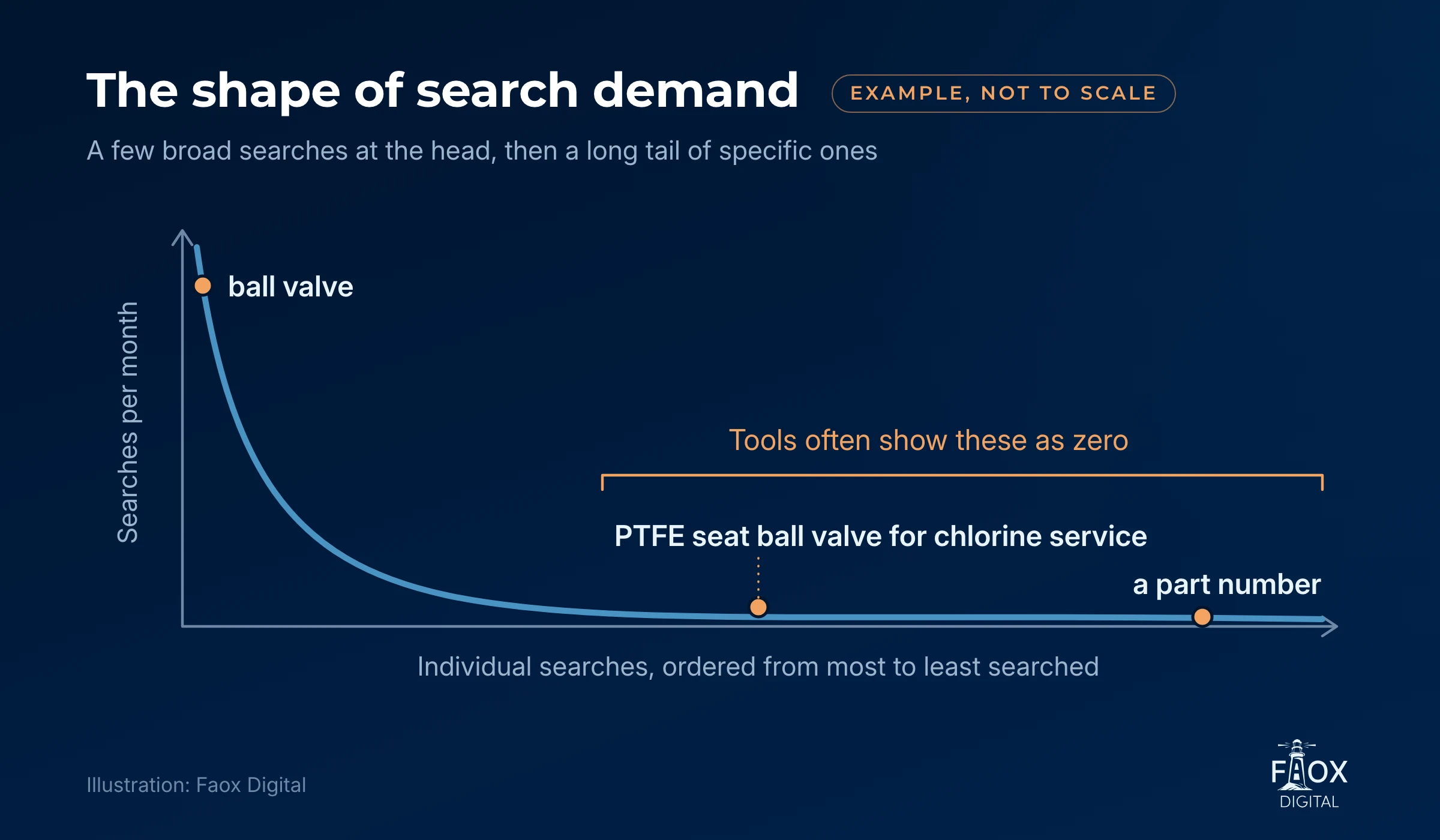
Long tail and short tail describe demand, not word count. Ahrefs calls defining them by length a big mistake, and it sets no fixed volume threshold, because the line mostly depends on the head keyword you compare it to. A part number is one word and sits far along the tail. Most long tail searches are longer, simply because buyers add details.
| Short tail | Long tail | |
|---|---|---|
| Example | "ball valve" | "PTFE seat ball valve for chlorine service" |
| Search volume | High | Low, often shown as zero |
| Intent | Mixed: students, buyers, competitors | Usually clear |
| Competition | Marketplaces, publishers, large brands | Fewer pages answer it precisely |
| Page it needs | Category page or broad guide | Product, application or support page |
B2B markets are small by nature, so low volume is normal rather than a warning sign. Our article on what B2B SEO is explains how long sales cycles and buying groups change the way SEO is measured.
Long tail keywords examples for B2B
Most B2B long tail searches fall into a few groups, and each tells you something about the person searching:
| Type | Example search | What it tells you |
|---|---|---|
| Product codes | "VB-316-DN50 datasheet" | They have a specific item in mind, perhaps a replacement |
| Technical specifications | "ball valve DN50 PN40 316 fire safe" | An engineer is specifying, or a purchaser is matching a drawing |
| Niche applications | "isolation valve for hydrogen service" | A real problem in a real industry |
| Standards and certificates | "API 6D ball valve manufacturer" | They are building a shortlist |
| Problems and faults | "ball valve stem leak repair" | An existing user needs support or spare parts |
| Long questions | "PTFE seat temperature limit for steam service" | They are researching, perhaps in an AI tool too |
The extra words do useful work: they make the goal clearer. Our guide to types of search intent explains how to read that goal and choose the right page.
Why search volume tools miss them
Search volume tools were not built for this end of the curve, and each has its own blind spot:
- Keyword Planner. Google Ads Help (November 2026) says keywords with very low search volumes are not discoverable or forecastable in it.
- Search Console. Google’s 2022 note on its data says queries not issued by more than a few dozen users over two to three months are anonymized. They count in the totals, but you cannot see them, and its interface exports at most 1,000 rows.
- Third-party tools. They publish their own estimates, and a query needs repeating to register at all. Ahrefs says over 95% of the conversational queries people bring to AI platforms have no measurable volume.
Between them, these gaps hide many of the searches that matter most to a niche supplier.
Zero volume keywords: what the number really means
Zero volume keywords are searches a tool reports as having no volume. Read that as "no data", not "no demand". Before you dismiss one, ask four questions:
- Have customers used these words? Check RFQs, enquiry emails and sales notes. One real use is better evidence than any tool.
- Would this searcher buy what you sell? A precise search from the wrong market is still the wrong search.
- Is there an outside signal? An Autocomplete suggestion reflects real searches, and relevant results show the phrase means what you think it means.
- What does it cost to answer? Often the answer is one section or one table row on an existing page.
If the answers are good, treat the search as real, even though no one can tell you how often it happens. If they are not, leave it: not every invented phrase deserves attention.
Do long tail searches convert better?
Often, but be careful with the proof. The figure usually quoted is 2.5 times, and it comes from a 2011 Conductor study of more than 7 million visits to three major retailers, comparing searches of three or more words with shorter ones. That is old data from retail. We did not find a comparable public study for B2B.
The logic is still sound. Someone who types a grade, a size and a service has already narrowed their choice, and in B2B one enquiry can outweigh a large volume of casual visits. Conversion is best measured on your own site: compare enquiries per landing page, not visits, and record in your CRM which page each enquiry came from.
How to find long tail keywords in Search Console
Search Console shows the searches you already appear for, including many that keyword tools report as zero:
- Open the Performance report. Choose the Queries view and a long date range.
- Filter for long searches. Add a query filter, choose Custom (regex) and enter
(\S+\s){4,}to see queries of five words or more. - Filter for questions. Use
^(what|how|why|which)to list the questions that bring you impressions. - Look for near misses. Queries with many impressions and few clicks show where a page only partly fits.
- Check the page. Click a query, then open the Pages view to see which page appears for it.
- Repeat by country. Buyers in each market use different words, so filter by country as well.
Your own material fills the gaps Search Console leaves: enquiry emails, RFQ documents, sales call notes, support tickets and your site’s internal search. These are the words buyers really use, and many of them never appear in a keyword tool.
Long questions in AI tools
The long tail is growing in AI search. Google reported in May 2026 that, in the US, the average AI Mode search is triple the length of a traditional query. Pew Research Center’s 2025 analysis of March 2025 browsing data found that 8% of one- or two-word Google searches produced an AI summary, against 53% of searches with 10 words or more. So the long, specific questions B2B buyers ask are also the ones most likely to be answered on the results page.
You cannot look these questions up. Search Console’s Generative AI performance report shows impressions by page, device and country, not the questions behind them. AI tools still need something to draw on, so state the specifics in plain text: limits, grades, standards and applications. Ask your sales team which questions come up, and test the important ones yourself. Our article on AI Overviews and AI Mode explains how Google picks its sources, and nothing here ensures that yours will be chosen.
How to use long tail keywords without thin pages
A page for every phrase is the wrong response. Google’s spam policies describe doorway abuse as sites or pages created to rank for specific, similar search queries, and near-identical pages help no one. Work this way instead:
- Group searches that share one answer. All the sizes and pressure ratings of a valve belong in one table on one product page.
- Put product codes and technical specifications in the text. A search cannot match details locked inside a PDF or an image as reliably as text on the page.
- Give a page to a different answer. Niche applications with their own requirements, such as hydrogen service, can earn a page of their own.
- Answer real questions where they arise. Add the questions sales hears to the product or application page they belong to.
Once you know which searches you want, the next question is how to research more of them without paying for a tool; our guide to keyword research for free walks through Google’s own options.
How Faox Digital treats long-tail searches
At Faox Digital, the keyword map includes the long, specific searches buyers type and the questions they ask AI tools, with commercial and informational intent side by side. We build it market by market after the audit, so it starts from what the site already ranks for.
Key takeaways
- Long tail keywords are defined by low demand, not by word count: a part number can be one word.
- A zero in a keyword tool means no data, not no demand, so test it against what customers really say.
- The common 2.5 times conversion figure comes from 2011 retail data, so measure enquiries per page on your own site.
- Search Console, RFQs and sales notes show searches that volume tools cannot.
- Group similar searches on one strong page instead of building a page for every phrase.
Frequently asked questions
What is the difference between long tail and short tail keywords?
Short tail keywords are broad, high-volume searches such as "ball valve", usually with mixed intent. Long tail keywords are specific searches with few searches each, such as a size, grade and application together. They are easier to match to one page and one kind of buyer.
How many words is a long tail keyword?
There is no set number, because the term describes demand, not length. Most long tail searches run to several words, but a part number can be a single word with almost no search volume.
Is there a free long tail keywords finder?
Search Console is the most useful free source, because it shows searches you already appear for. Google Autocomplete adds variations. Your own RFQs, enquiry emails and support tickets add the wording no tool shows.
Should I target zero volume keywords?
Yes, if customers really use the words, the searcher could buy from you and the answer fits on a page you have or need anyway. Do not build new pages for phrases you have only guessed at.
Sources
- Ahrefs: Long-tail keywords: what they are and how to get search traffic from them, 2026
- Google Search Central Blog: A deep dive into Search Console performance data filtering and limits, 2022
- Pew Research Center: Google users are less likely to click on links when an AI summary appears, 2025
- Search Engine Watch: On-page optimization not dead: long-tail keywords increase rankings, conversions, 2011
Let’s talk
Where do you want to be found?
Tell us the searches that matter to your business. We will review your site and tell you plainly what to fix first, including what you can do yourself.