
Search Intent: What B2B Buyers Mean When They Search
How to read what a B2B buyer wants from a search, and how that decides whether a blog post, category page, product page or service page should answer it.
Search intent is what someone wants to achieve when they type a query: learn something, compare options, act on a purchase or reach a known company. On a B2B site it decides which type of page should answer the search: a blog post, a category page, a product page or a service page. To identify it, read the current results for the query, then match the page type they show and the buyer’s next step.
Two people type "ball valve". One is a student checking a definition, and the other is a purchaser who needs three suppliers by Friday. The words are the same, but the page each one needs is not. A site that offers a product page to the student and a blog post to the purchaser disappoints both. That is why intent comes straight after finding the words. If you have not built your list of searches yet, start with our guide to B2B keyword research. This article explains how to read the intent behind each search and which page it calls for. The examples come from a hypothetical valve manufacturer.
What is search intent in SEO?
Search intent is the goal behind a query. Google says that to return relevant results, it first has to establish what you are looking for, which it calls the intent behind your query. It reads clues in the words: a query with "cooking" or "pictures" points its systems towards recipes or images.
The idea is older than most SEO advice. In 2002, Andrei Broder sorted web searches into three classes: navigational, informational and transactional. SEO practice later added commercial investigation between the last two. Google’s own Search Quality Rater Guidelines (September 2025) use other labels: Know, Do, Website and Visit-in-Person.
So there is no official list. The labels are a working tool, and the real question is the same for all of them: what does this person want to do next?
The four search intent types in B2B
Most B2B searches fall into one of these four types. The words in the query often give it away, though not always.
| Intent | Typical words | Example search | What the buyer wants next |
|---|---|---|---|
| Informational intent | what, how, why, a standard’s name | "what does PN40 mean" | A clear explanation they can trust |
| Commercial investigation intent | vs, manufacturer, supplier, certified, alternatives | "API 6D ball valve manufacturers" | Evidence to compare and shortlist |
| Transactional intent | quote, price, sample, RFQ, datasheet | "ball valve DN50 RFQ" | A way to act now |
| Navigational intent | a company, brand or product line name | "[company name] spare parts catalog" | The exact page, quickly |
Informational searches rarely bring an enquiry at once, but they reach the engineer early and build trust that counts when the company later compares suppliers. Because a B2B purchase involves several people over months, one company can produce all four types. Our article on B2B SEO explained covers how that changes the work.
How to identify search intent: read the results page
No tool replaces looking at the results. Search for the query in the country and language you sell to, and read the first page as a buyer would. It shows what Google’s systems currently judge useful for that query, so it is your best evidence.
| What you see on the results page | What it usually means | Page type to consider |
|---|---|---|
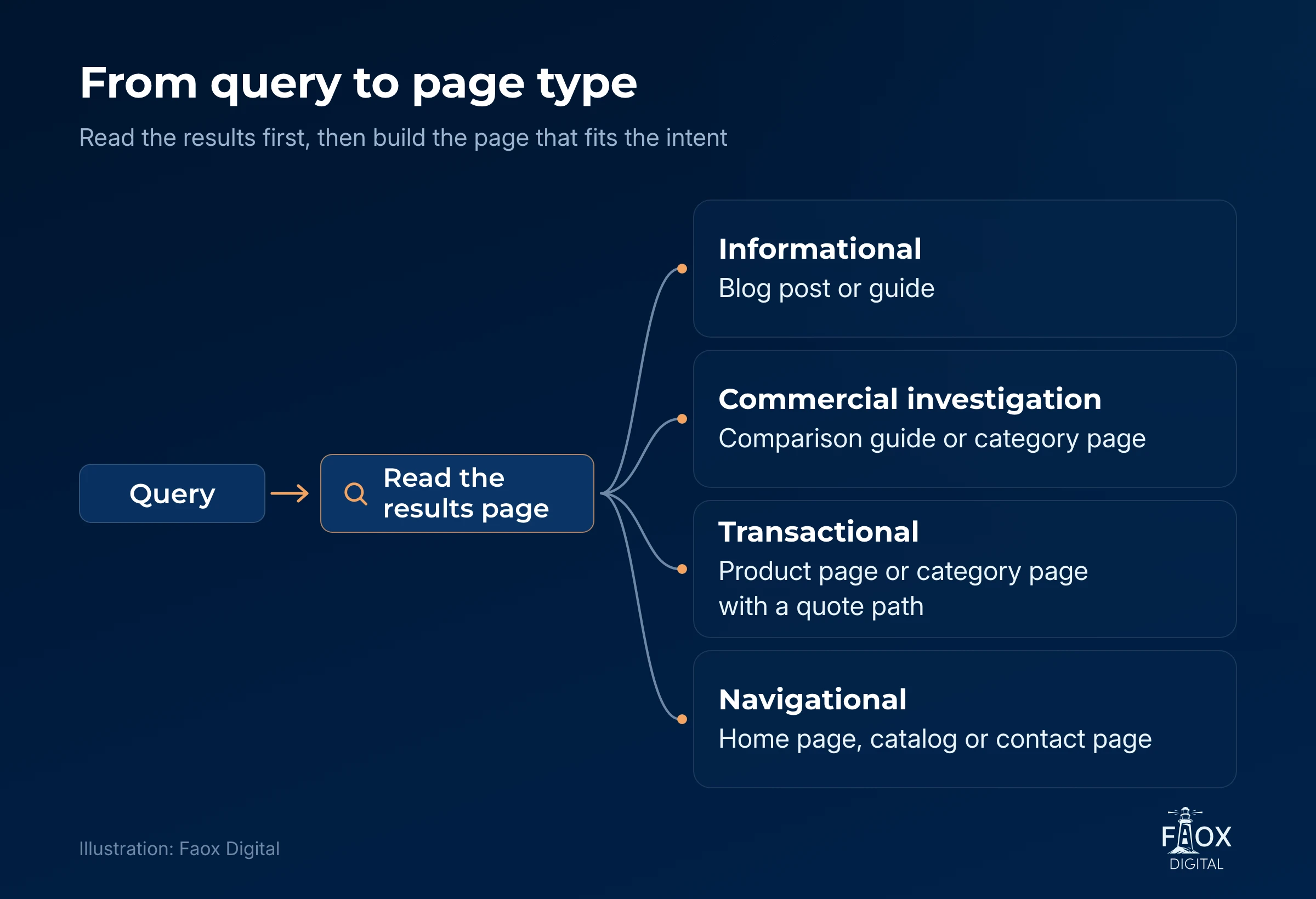
| Guides, definitions, explainer videos | Informational | Blog post or guide |
| "Top manufacturers" lists, directories, comparison articles | Commercial investigation | Comparison guide or category page |
| Product and category pages, marketplaces, supplier ads | Transactional or commercial | Product or category page |
| One company’s site filling the results | Navigational | Home page, catalog or contact page |
| A blend of the above | Mixed intent | See the next section |
Content type and format tell you more. Content type is the kind of page that ranks: an article, a category page, a product page or a tool. Format is how it is built: a how-to, a list, a comparison, a calculator. If the first page for "control valve sizing" is full of step-by-step guides and calculators, a one-paragraph definition will not satisfy that searcher.
Match the type and format, not the content. A page earns its place with what the others lack: test results, tolerances and real application experience. Our guide to E-E-A-T for B2B explains how to show that.
AI summaries change what a click is worth. An AI Overview at the top of the page suggests Google can answer the question there. Pew Research Center’s 2025 analysis of browsing by 900 US adults, from March 2025 data, found that 60% of searches starting with words such as "what" or "why" produced an AI summary. People clicked a traditional result on 8% of visits to pages with a summary, against 15% without. That is general web behaviour, not B2B data, but it suggests that a plain definition page may earn fewer visits than a page with specifications or a real comparison.
Mixed intent: why B2B searches often mean two things
Many B2B queries have no single intent. Google’s rater guidelines say many queries have more than one likely intent. They separate a dominant interpretation, which is what most users mean, from common and minor ones, and they note that not every query has a dominant one.
This is normal in B2B, because a buying group shares the same vocabulary. An engineer and a purchaser can both search "PTFE seat ball valve": one wants temperature limits, and the other wants suppliers. Handle mixed intent like this:
- Build for the dominant intent. Let the results page tell you what most searchers want, and make that the main job of the page.
- Give the second intent a path. A product page can carry a short explanation and link to the guide, and the guide can link to the product range.
- Split the page if the results split. If guides and supplier pages share the first page evenly, you may need one page for each.
- Use the longer searches. Extra words reveal the goal: "ball valve" is mixed, while "ball valve manufacturer ISO 9001" is not. That is one reason long-tail keywords matter in B2B.
Choosing the page type: blog, category, product or service
Once you know the intent, the page type usually follows:
| Page type | Fits this intent | Example search | What it must contain |
|---|---|---|---|
| Blog post or guide | Informational, some commercial | "how to size a control valve" | A direct answer, worked examples, a link to the relevant range |
| Category page | Commercial, broad transactional | "stainless steel ball valves" | The range, selection help, standards, a route to a quote |
| Product page | Transactional | "ball valve DN50 PN40 316" | Specifications, datasheet, quote form |
| Service page | Commercial and transactional, for services | "valve repair service Germany" | Scope, process, proof, contact |
A guide can rank for a broad term and still bring the wrong visitors, so judge the page by the next step it offers, not only by its position.
Comparison searches need one more thing: a point of view. When a buyer searches for one solution against another, they are asking why they should choose you, and a neutral list will not answer that. If you have not settled the answer yet, see our guide on how to do brand positioning.
Intent mismatch: how to spot it and fix it
Intent mismatch means a page may be good, but it is the wrong kind of page for the search. These signs point to it:
- Different results around you. Your blog post sits below a page of supplier sites for "valve supplier Germany".
- Impressions without clicks. The Performance report in Search Console shows a query with many impressions and few clicks.
- Visits without a next step. Visitors arrive from a commercial search, then leave without looking at products or the contact page.
- Queries the page was not written for. A product page starts appearing for "what is" questions it barely answers.
The fix depends on the gap. If the page type is wrong, create the right page or point the search to one you already have; rewriting a blog post rarely turns it into a supplier page. If only the format is wrong, restructure it, for example by adding a comparison table or steps. If the page is close, add the missing section and make the title say what the page offers.
Matching intent does not earn a ranking by itself, but a page that misses it starts at a disadvantage however good it is. Once you know the intent behind each search, the next question is which page should target it, and a keyword map answers that.
How Faox Digital plans for search intent
Faox Digital builds every keyword map with commercial and informational intent side by side, market by market, so each search is matched to the page that should answer it. The map follows an audit of what the site already ranks for, and you see the priorities and the reasons before any work begins.
Key takeaways
- Search intent is the goal behind a query, and it decides which type of page should answer it.
- Read the results page in your target market before you build anything; it is better evidence than any label.
- B2B searches often have mixed intent, so build for the dominant intent and give the other a clear path.
- Match the page type and format of what ranks, then add the expertise the others lack.
- If a good page underperforms, check for intent mismatch before you rewrite it.
Frequently asked questions
What is search intent alignment?
It means the page matches what the searcher came to do, in its type, format and content. A page is aligned when a visitor can take their next step without going back to the results.
What is commercial search intent?
The searcher is comparing products, solutions or suppliers before deciding. In B2B these searches often include words such as "manufacturer", "supplier", "certified" or "vs", and they sit close to a quote request.
What is navigational search intent?
The searcher already knows where they want to go, such as your company’s catalog or contact page. Make sure those pages exist, are easy to find and carry clear titles, so the search ends in the right place.
How do tools classify search intent?
SEO tools label queries automatically, using word patterns and the pages that rank. Treat the label as a first pass and check the results page yourself, especially for mixed searches in your own trade.
What is search intent in Google Ads?
It is the same idea, but you pay for each click, so it decides which keywords are worth buying. Google Ads Help says exact match can show ads for searches with the same meaning or intent as the keyword, so review the searches your ads actually appear for.
Sources
Let’s talk
Where do you want to be found?
Tell us the searches that matter to your business. We will review your site and tell you plainly what to fix first, including what you can do yourself.