
International SEO Reporting: How to Measure Performance Market by Market
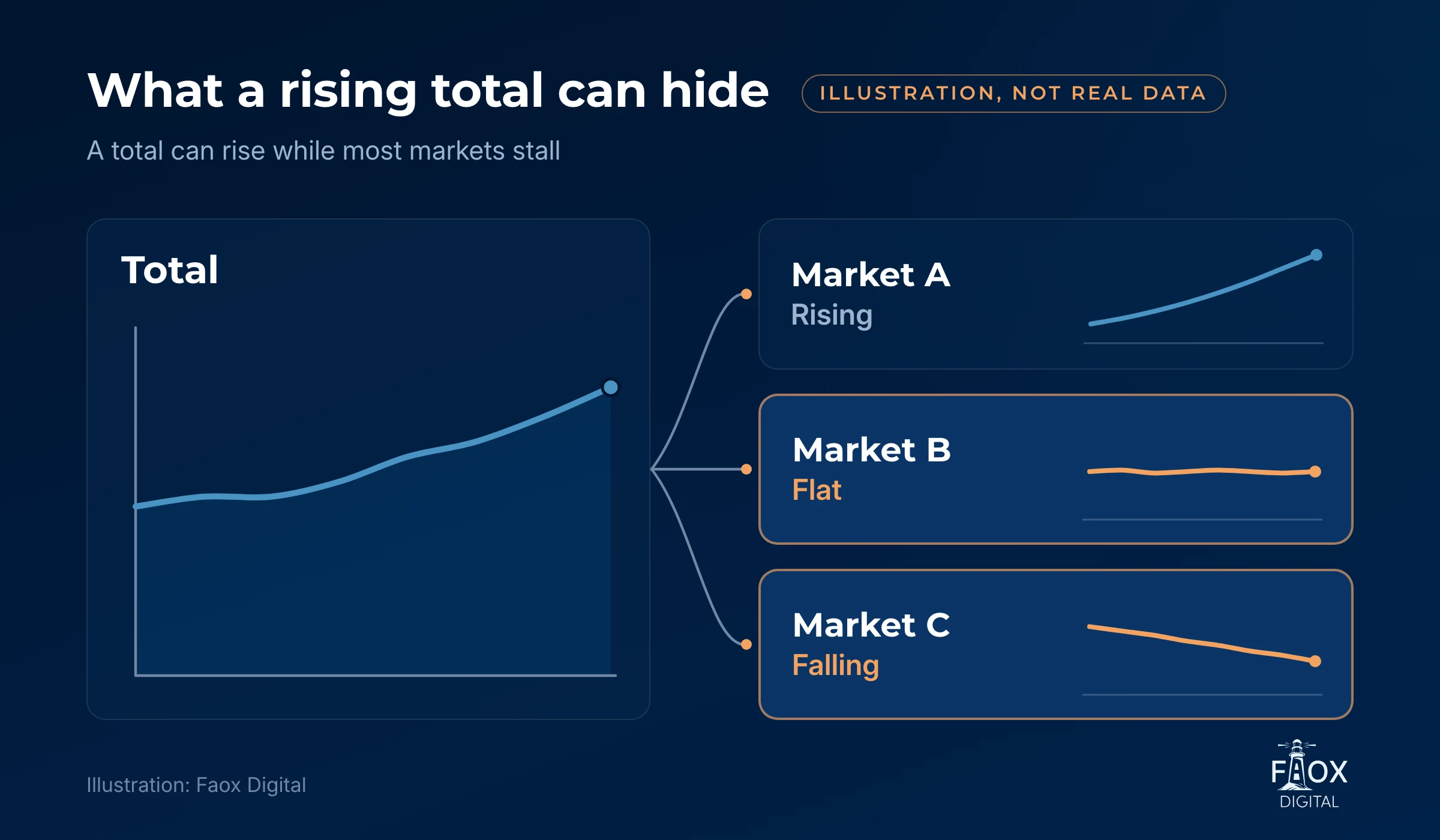
A global total can rise while most of your markets stall. How to measure search performance market by market, and what to put in the report.

International SEO reporting means measuring search performance separately for each market and language version, from Search Console data through to quote requests, instead of reading one global total. A total can rise while most markets stall, because one strong market hides the rest. Report a small set of KPIs per market, check that the right version gets the impressions, and compare each market with its own past.
Your SEO report shows search traffic up on last year, so everyone moves on. Then the German sales team asks why enquiries have dried up. The total was true, and it hid the problem.
This article shows how to measure by market and language with tools you probably already have, where those numbers mislead and what to put in a report. For where reporting fits in the wider work, see our guide to multi-language SEO.
Why global totals mislead
Misleading totals usually come from a few causes:
- One market hides another. Growth in your home market can cover falls in three export markets.
- Brand searches flatter the numbers. Where you are already known, people search for your name. Those searches show existing awareness, not new buyers finding you.
- Some traffic cannot buy. Impressions from countries you do not serve still count in the total.
- Versions can take each other’s traffic. The total stays flat while buyers reach the wrong language or country page.
- Currency and seasons shift the comparison. A market can look stronger or weaker because of the calendar or the exchange rate.
Measuring SEO by country in Search Console
Search Console’s Performance report is the place to start, because it needs no cookies and comes from Google’s own search data. Its country filter groups data by the country where the search originated. Filter by one country, then read the Queries and Pages tabs for that market.
There is no language dimension, so a language version has to be identified by its URL:
- Filter by page. Use URLs containing
/de/, or a regular expression for several folders. - Add a URL-prefix property for each folder, such as
https://example.com/de/, so that each market has its own view. - Use separate properties for country domains. Your international site structure decides how much of this setup you need.
Three more features help. The branded queries filter separates brand searches from the rest and has been open to all eligible sites since March 2026, though not to sites with few impressions or to folder and subdomain properties, so read non-branded figures for a version in the top-level property, with a page filter. The Generative AI performance report also shows impressions by country. And Search Console keeps 16 months of data, so you can compare a market with the same period last year.
One limit to remember: filtering by query or URL can change the report’s totals, because Google truncates data and omits anonymized queries. Use those figures for trends within a market, and do not expect them to add up exactly.
GA4: country and language dimensions
GA4 shows what visitors do after the click, but its fields mean something slightly different:
| Question | Search Console | GA4 | CRM |
|---|---|---|---|
| Which country? | Where the search originated | Derived from the visitor’s IP address | Delivery country on the form |
| Which version? | Filter pages by folder | Filter by page path | Record the page on the form |
| Which searches? | Queries | Not combined with Analytics dimensions | Not available |
| Did they act? | Not available | Key events | Quote requests and won quotes |
GA4’s Language dimension is the setting of the visitor’s browser or device, not the language of the page. An engineer in Germany with an English browser counts as English while reading your German page, so use the page path to report on a version.
Link Search Console to GA4 to get the Google Organic Search Traffic report. It shows landing pages with both sets of metrics, and you can drill into them by country. The report collection is unpublished by default, so someone has to publish it in the library first.
Consent also affects comparisons. Where visitors decline analytics cookies, GA4 misses them. Its behavioral modeling can fill the gap, but among other conditions it needs at least 1,000 events a day from visitors who declined, for at least seven days, which many B2B sites do not reach. So do not compare raw visit counts between markets with different consent rules. General GA4 setup is a wider subject, covered with our guide to B2B marketing metrics.
Rank tracking and local results
Average position in Search Console is useful for trends, but it blends many searches. For the terms that matter, use rank tracking set to each country and language, starting from the map you built in your international keyword research. Track fewer terms well: a short list per market that sales agrees with.
Then check the local results yourself once a month. Google customizes results by region, and its search settings let you choose another one, or you can ask a colleague or distributor in the market to look. Rank tools show a position. A person sees which of your pages appears, who sits beside it and whether the result would make sense to a buyer.
Cannibalization between language versions
Cannibalization here means one of your versions taking the impressions another should get, such as your German page showing to buyers in Austria when you have an Austrian page. To find it, filter by one country and group by page, then add up the impressions by folder. We call the share that lands on the intended version the right-version share. It is our own working measure, not a Google metric, and it is one of the most useful numbers in the report.
Read it with care. Search Console assigns most data to a page’s canonical URL, so when a searcher clicks a duplicate URL, the click counts toward the canonical. If Google treats your Austrian page as a duplicate of your German one, Austrian clicks may appear under the German URL. Check the Google-selected canonical in URL Inspection, and compare with landing pages in GA4.
If the wrong version keeps winning, the cause may be hreflang, weak local signals or pages that are too alike. That is how buyers end up on the wrong country version.
Quote requests per market
Search data stops at the click. For a B2B company, the number that counts is quote requests per market, and GA4’s country will not give you that alone, because it shows where the visitor sits and not where the goods will go. Add a delivery country field to each quote form, record it in your CRM and log enquiries passed to distributors. Sales cycles are long, so read won quotes by quarter.
Currency and seasons
Currency can create growth that is not there. The European Central Bank’s reference rate rose from 48.36 lira per euro on November 4, 2025 to 56.36 on November 4, 2026, so a total kept in lira would show about 16.5% growth with no change in euro value. Choose one reporting currency and one fixed rate for the year, and show local currency only as extra detail. GA4 converts to your property’s currency using the rate from the day before each transaction, so its figures move with exchange rates too.
Seasons differ by market. In Google Trends on November 16, 2026, interest in forklift terms over the past 12 months was at its lowest in Germany (Gabelstapler) in the week of December 28, 2025, and close to its lowest in France (chariot élévateur), while in Saudi Arabia (forklift) it stayed well above its own low. In the week of March 22, 2026, just after Eid al-Fitr, the picture reversed: interest fell in Saudi Arabia and stayed high in Germany. This is one term over one year, scaled separately for each country, and Google Trends uses a sample of searches, so values can shift between readings: read it as a pattern to check for your own terms.
Some dates also move. Eid al-Fitr fell on March 30 in 2025 and March 20 in 2026, and is tentatively March 10 in 2027, according to Time and Date. A month-on-month or even same-month comparison can mislead there, so note holidays in the report.
Other events move the numbers too. Before you credit SEO for a jump, check for a trade fair or press coverage, and note activity from your global PR strategy beside the figures.
International SEO reporting: KPIs and a template
Keep the list short. These international SEO KPIs follow the path from being seen to winning work:
| KPI, per market | Source | What it tells you |
|---|---|---|
| Non-branded impressions | Search Console | Whether new buyers can find you |
| Right-version share | Search Console | Whether the intended page is shown |
| Non-branded clicks | Search Console | Whether the result earns the visit |
| Visits to quote and distributor pages | GA4 | Whether interest is turning into intent |
| Quote requests by delivery country | Forms and CRM | Whether buyers act |
| Quotes won, in one currency | CRM and distributors | Whether the market pays back |
Use the same one-page report template for each market, so that multilingual SEO reporting stays comparable:
- The period, compared with the same period last year
- The six KPIs above, with the change for each
- Tracked terms and which page ranks for each
- Technical health: indexing and hreflang issues for this version
- Notes on holidays, fairs, press coverage and site changes
- One decision or next action
Add one summary page across markets. Show each market’s direction, and resist ranking markets by raw volume, because a small market with a clear rise in quote requests may matter more than a large flat one.
To set this up:
- List your markets and versions. Note which version is meant to serve each country.
- Prepare the data. Add Search Console properties, link GA4 and mark quote forms as key events.
- Add the delivery country to quote forms, and agree how distributors report enquiries.
- Agree the KPIs and currency with sales and finance.
- Build the template and fill it in for one market first.
- Set a rhythm. Review search data monthly, quote requests and won work quarterly.
If a market keeps falling and nobody can explain why, or you run more markets than your team can read, the next question may be outside help. Our guide to choosing international SEO help lists what to ask.
How Faox Digital reports across markets
At Faox Digital, the strategy and keyword map are built market by market, and measurement is the fifth step: our reports show rankings, organic traffic and whether AI tools start to cite the company. The work continues after the first market moves.
Key takeaways
- A global total can rise while most markets stall, so report each market and language version separately.
- Search Console has a country filter but no language dimension: identify versions by folder or property.
- GA4’s Language is the visitor’s browser or device setting, not the language of your page.
- Check which version gets the impressions in each country, and remember that clicks may be credited to the canonical URL.
- Keep one reporting currency and compare each market with its own past, with holidays noted.
Frequently asked questions
What KPIs should I use for international SEO?
Follow the path from being seen to winning work: non-branded impressions, right-version share, non-branded clicks, visits to quote pages, quote requests by delivery country and quotes won. Report them per market, because a global figure hides what each market is doing.
Can Search Console show performance by language?
Not directly. It has a country dimension but no language dimension, so filter pages by language folder or add a URL-prefix property for each one. Country domains need their own properties.
How often should I report on international SEO?
Review search data monthly and quote requests quarterly. B2B sales cycles are long and small markets have low numbers, so one month’s change often means little. Look for a direction across several periods.
Should I compare markets with each other?
Compare each market with its own past first. Markets differ in size, holidays, consent rules and how well they know your brand, so a direct comparison often says more about the market than about your SEO.
Sources
- Search Console Help: Performance report, dimensions and data groupings, accessed November 2026
- Google Search Central Blog: Introducing the branded queries filter in Search Console, 2025
- European Central Bank: Euro reference rates, Turkish lira, November 2026
- Google Trends: forklift, Saudi Arabia, past 12 months, November 2026
Let’s talk
Where do you want to be found?
Tell us the searches that matter to your business. We will review your site and tell you plainly what to fix first, including what you can do yourself.