
ccTLD vs Subdirectory vs Subdomain: Which Structure for International SEO?
Country domain, folder or subdomain? What each structure means for SEO, what it takes to run and how to choose one you can keep.
In the ccTLD vs subdirectory decision, most B2B companies entering several markets should start with subdirectories on one generic domain (example.com/de/), because they are the simplest to run and keep every market on one site. Choose a ccTLD (example.de) when a market has its own team, budget and reason to look local, and a subdomain (de.example.com) only when hosting or systems force a split. Pick a structure you can keep, because changing it later is slow and risky.
Before anyone translates a page, someone has to decide where it will live. This choice of international site structure is easy to make by accident: a distributor already owns a domain, or a developer prefers one setup. It is much harder to undo. This article compares the options from the SEO side: what each one signals, how authority and upkeep differ, and how to decide. For how it fits into the wider work, see our guide to multi-language SEO.
ccTLD vs subdirectory vs subdomain at a glance
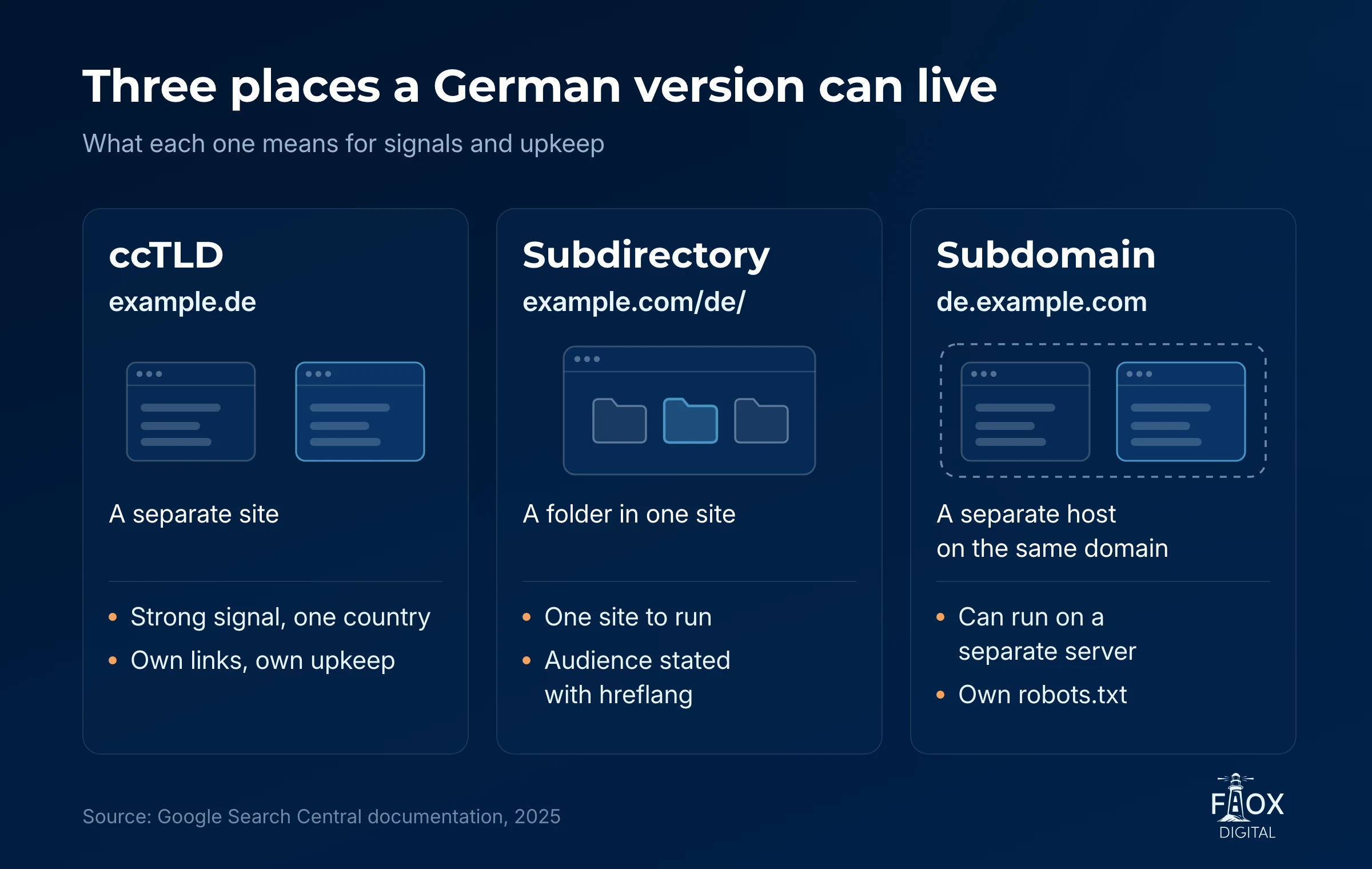
A German version of example.com can live at four kinds of address:
| Structure | Example | Country signal | Upkeep | Use it when |
|---|---|---|---|---|
| ccTLD | example.de | Strong, for one country only | Highest: a separate site per country | A market has its own team and budget |
| Subdirectory on a gTLD | example.com/de/ | Comes from hreflang and page content | Lowest: one site | You want all markets on one domain |
| Subdomain on a gTLD | de.example.com | Comes from hreflang and page content | Medium: separate hosts on one domain | Hosting or systems force a split |
| URL parameter | example.com?loc=de | Unclear from the URL | Low, but hard to segment | Avoid it: Google does not recommend it |
A ccTLD is a country-code domain, such as .de or .com.tr. A gTLD is a generic domain with no country attached, such as .com or .org. Google also treats .eu and .asia, and country codes often used as brands, such as .io, .ai, .co and .tv, as generic, so none of these targets a country on its own.
Rule out the URL parameter first. Google also prefers separate URLs to switching language through cookies or browser settings, because it may not find and crawl every version.
The other three all work at scale. In November 2026 we looked at the German sites of seven large B2B companies: Siemens, Schneider Electric and Grundfos use subdirectories; Hilti, Würth and DigiKey use country domains; RS Components uses a subdomain. That shows each can work. It does not show which suits you.
ccTLD SEO: what a country domain gives you
Google describes a ccTLD as a strong signal, to users and search engines, that a site is meant for one country. That is the main benefit and also the limit. Google lists targeting a single country as a drawback, and says geotargeting can help in the target country at the expense of other locales. A German site on .de is a weaker fit for buyers in Austria or Switzerland. For the same reason, we would not run export markets from a home domain, as in example.com.tr/en/.
Ranking data points the same way, with limits. In SE Ranking and GA Agency’s 2024 study of 20,000 purchase-intent keywords across 15 markets, ccTLDs held over half of the top three positions and subdirectories over 20%. These are e-commerce searches, not B2B ones, and the study shows a pattern, not a cause: many of those sites may simply be local businesses on local domains.
A country domain also brings costs that a folder does not:
- Registration rules. Google warns that some countries restrict who can use their ccTLD. At the time of writing (November 2026), France’s
.frrequires a registered office or main place of business in the EU, Switzerland, Liechtenstein, Norway or Iceland, and Canada’s.carequires a Canadian presence. Germany’s.deis open to holders abroad, but its registry can ask them to name a representative in Germany. - The name. The domain may be taken, and your brand may not be free to use there, so run an international trademark search first.
- A separate site to run. Each domain needs its own links, settings and reporting, as the sections below show.
Subdirectories: one site for every market
A subdirectory keeps all markets on one domain. Google lists easy setup and low maintenance as its advantages, and a single server location, a target country that is unclear from the URL and harder separation later as its drawbacks. Its URL guidance names country domains and country subdirectories as the recommended patterns for multi-regional sites.
A folder name tells Google little. Google says it does not use language labels in a URL to decide the audience, so /de/ needs hreflang to state who it is for. It also looks at local addresses, phone numbers, currency and links from local sites. Without these, Google may show the wrong country version.
Let folders follow your real offer. Use /de/ if one German version serves all German speakers, and add /at/ only if Austria has different prices, certificates or contacts. The CMS side of this is covered in our guide to building a multilingual website.
Subdomain vs subdirectory SEO: what Google says
Google says it can work with either. In a late-2017 video, John Mueller said Google web search is fine with subdomains or subdirectories, and advised picking a setup you can keep for longer, because URL changes take time to settle. In 2018 he said Google generally sees the two the same, and that he would keep things together, using subdomains where things really differ. These statements are old, but we found nothing newer from Google that replaces them.
Usage is lopsided. Subdomains accounted for 3% of positions in the SE Ranking and GA Agency study, and they were common at the top only for French and Italian searches in Switzerland. Their real advantage is practical: Google notes they allow different server locations, so a market can run on its own setup. The price is a separate host, with its own robots.txt, and visitors who may not know whether de means a language or a country. If nothing forces a split, choose the subdirectory.
What else differs: trust, servers and upkeep
Local trust signals. A .de address may reassure a German buyer that you serve the market, but we found no current, independent data on B2B buyers. The surveys we found are older, mostly cover consumers and often come from registries that sell those domains. Ask your distributors or sales team in that market. Whatever the domain, buyers can also check a local address, phone number, currency and named contact.
Server location. Google treats it as one signal but not a definitive one, because some sites use content delivery networks or host elsewhere. That makes a subdirectory’s single server a smaller problem than it looks. Markets with their own hosting rules, such as China, need local advice.
Cost and management load. Translation costs much the same under any structure. The difference is in everything around it:
| Task | ccTLD | Subdirectory | Subdomain |
|---|---|---|---|
| Domains to register and renew | One per country | One | One |
| robots.txt | One per domain | One | One per subdomain |
| Search Console | One property per domain | One Domain property, plus folder properties if you want them | One Domain property covers them all |
| Analytics across versions | Needs cross-domain setup | One site | Check cookie settings |
| Links to earn | For each domain | For one site | For one domain, on separate hosts |
Search Console properties follow the same pattern. A Domain property covers every subdomain and protocol, and needs DNS verification. To see one folder alone, add a URL-prefix property such as https://example.com/de/. Each ccTLD needs its own property, and an account can hold up to 1,000. Turning these into market-by-market reporting is a topic of its own.
The risk of changing structure later
Changing structure means changing every URL, so every page needs a redirect. Google says a small to medium-sized site can take a few weeks for most pages to move, that visibility may fluctuate during that time, and that redirects should generally stay for at least a year.
Domain moves can take longer in practice. In Search Engine Journal’s 2025 study of 892 domain migrations, it took 523 days on average for the new domain to match the old one’s estimated organic traffic, and 17% had not caught up after 1,000 days. These are third-party estimates from mixed sectors, so read them as a warning, not a forecast.
Two Google rules matter for international moves:
- Moves are not symmetrical. The Change of Address tool can move a domain into a folder on another domain, such as
example.detoexample.com/de/. It cannot move a folder out, so going from/de/toexample.derelies on redirects alone. - Consolidate one site at a time. Google warns that moving several sites into one location at once can cause confusion and traffic loss. Merging five country domains is five moves, with a pause for traffic to settle after each.
So if country domains are already bringing in enquiries, keep them unless you have a clear operational reason to change.
A decision table for B2B companies
| Your situation | Start with | Why |
|---|---|---|
| Several markets, one marketing team | Subdirectories on a gTLD | One site to run and one domain for links |
| One new market, testing demand | A subdirectory | Fast to start, with no registry rules to meet |
| Local subsidiary with its own budget, content and PR | A ccTLD for that market | The local team can run it and earn its links |
| Strong home-market ccTLD, now exporting | Keep it for home, and add a gTLD with subdirectories for export | A ccTLD targets one country, and moving it carries risk |
| Language versions, not country versions | Subdirectories by language | A ccTLD would narrow each language to one country |
| A market on a separate platform or server | A subdomain | Allows a different setup without a second domain |
| China, or another market with its own rules | Local advice first | Rules on hosting and content differ |
To reach your own answer, work through these steps:
- Separate language from country. Note which markets need their own version because prices, certificates, stock or contacts differ, and which only need a language.
- Check the demand. Research keywords for each market before you commit to a domain.
- Ask who will run each market. No local team or budget points to subdirectories.
- Check the constraints. Look at registry rules, domain availability, trademarks and hosting needs.
- Count the upkeep. Name who handles renewals, links and reporting for each domain or host.
- Write down the pattern. Record the URL format for current and future markets, and connect the versions with hreflang.
If you sell in a few similar markets from one team, you can make this decision in-house. With several legal entities, existing country domains or a move in view, the next question is who should advise you, and our guide to choosing international SEO help covers what to ask.
How Faox Digital plans an international site structure
At Faox Digital, the structure of an international site is decided in the foundations step of an SEO project, after the audit and the keyword map, and each language gets its own structure. We plan it with the markets that matter in mind, since changing the structure later is costly.
Key takeaways
- For most B2B companies entering several markets, subdirectories on a generic domain are the sensible start.
- A ccTLD is a strong country signal, but it targets one country and adds a site to run.
- Google says it is fine with subdomains or subdirectories, so use a subdomain only when hosting or systems force a split.
- Domains such as
.eu,.ioand.aiare treated as generic, and folder names tell Google little, so hreflang states the audience. - Changing later means redirects, lost time and risk, so choose a structure you can keep.
Frequently asked questions
Is a subdirectory or a subdomain better for SEO?
Google says it can work with either, so neither has a stated ranking advantage. We would choose a subdirectory unless hosting or systems force a split, because it leaves one site to run.
Does a ccTLD rank better in its own country?
It is a strong country signal, and ccTLDs held over half of the top three positions in SE Ranking and GA Agency’s 2024 study of e-commerce searches. That is a pattern, not proof of cause, and a domain name alone does not make up for weak pages.
Does a .eu domain target Europe?
No. Google treats .eu as generic, and EU has no effect as a region code in hreflang. To reach several European countries, use language versions or one version per country.
What is hreflang used for if I already have country domains?
It connects the versions so that Google can show the right one. You still need it, because a German page on .de and another on .at can compete for the same searches, and hreflang works across domains.
How do you do international SEO, and where does structure fit?
Choose markets from evidence and fix your technical base first. Then decide on the structure before anything is translated, research each market, localize the key pages, add hreflang, earn local links and report by market.
Sources
Let’s talk
Where do you want to be found?
Tell us the searches that matter to your business. We will review your site and tell you plainly what to fix first, including what you can do yourself.