
International SEO for Manufacturers: How to Be Found in Each Export Market
How a manufacturer gets found in each export market: the product terms buyers use, the pages to build first, the role of distributors and fairs, and what to measure.
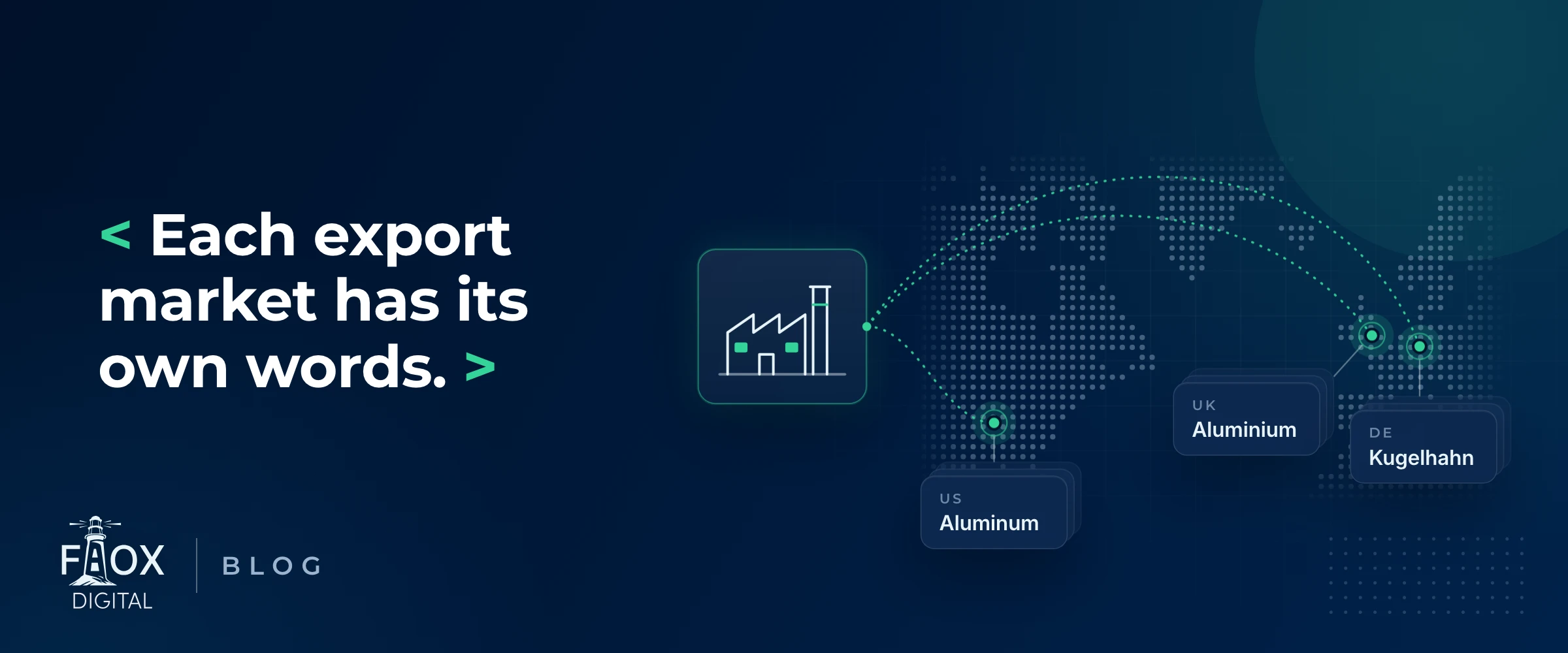
International SEO for manufacturers means making each product family findable in the words buyers use in each export market. Research search demand and product terms market by market, build language versions around product, application and certificate pages, agree which searches your distributors should answer, and earn mentions in local trade media. Then measure quote requests by country, because a single traffic figure will not show which markets are working.
Many exporting manufacturers have a similar website: an English catalog, a few translated pages and a list of distributors. Sales come through fairs, agents and existing relationships. Meanwhile, a purchaser in Germany or an engineer in Poland may be looking for a supplier online, in their own language and with their own terms.
This guide covers what changes when international SEO meets a product catalog, a distributor network and a fair calendar. For the general method, see our guide to multi-language SEO; here we stay with what is specific to international SEO for exporters. We do this work as part of our B2B SEO services, and you can run most of these steps in-house.
International SEO for manufacturers: how much to build in each market
Not every export market needs the same effort. Choosing the markets is a strategy decision, covered in our guide to market entry strategy. Once you have the list, match the work to how you sell in each one:
| How you sell there | What to build | What to watch |
|---|---|---|
| Your own sales team or subsidiary | A full language version: product families, applications, certificates, local contact and local trade press | Quote requests and visibility on product terms |
| Through distributors or dealers | Key product families, a distributor page and product data your distributors can use | Enquiries passed to distributors, and searches for your brand in that country |
| Testing the market | One product family in the local language, alongside your English pages | Impressions and first enquiries from that country |
Move a market up a level when its enquiries justify the work.
Research search demand in each market
Market-by-market search demand is the starting point. Four sources cover most of it:
- Search Console: group the Performance report by country to see where you already get impressions, then read the queries for each country. English queries from a non-English market may come from importers and international purchasers, so check this with your sales team.
- Keyword Planner: set the location and language for each market. It needs a Google Ads account with billing details, and keywords with very low volume do not appear.
- Google Trends: compare terms within a country. It shows relative interest from 0 to 100, not search counts, and low-volume terms show as 0.
- People in the market: niche product terms often show no volume at all, so ask distributors and sales engineers what buyers actually write in their enquiries.
Then look at who ranks. Have someone in the market run your main terms, or use a rank tracker set to that country. You may find local makers, distributors and marketplaces where you expected your usual competitors.
Product terminology changes from market to market
Product terminology is where translated catalogs often fail. Three kinds of difference matter:
| Difference | Example | What to do |
|---|---|---|
| The trade term is not the literal translation | A ball valve is usually a Kugelhahn in German. In Google Trends for Germany, Kugelhahn averaged 76 over the past 12 months and the literal Kugelventil averaged 2 (November 2026) | Research terms in the language, then translate around them |
| Standards name the same thing differently | One common stainless steel is sold as Type 304 (UNS S30400) under ASTM and 1.4301 under EN | Show every designation buyers may use on the product page |
| Same language, different word | Aluminum in the United States, aluminium in the United Kingdom | Check each English-speaking market separately |
Build a term list for each market with the people who hear these words: distributors, sales engineers and customer service. Your translated manuals and data sheets are another source, because your engineers may already have checked those terms. Give the list to translators before they start. Then search each term: if the results show a different kind of product, it is the wrong term.
Language versions and hreflang for a product catalog
English alone may not be enough, even for technical buyers. In CSA Research’s 2020 survey of B2B buyers of technology products, respondents rated their written English highly, yet a strong majority still preferred their own language. In the same series, 66% of business users said they would pay up to 30% more for a localized product. The question was hypothetical and the survey covered technology products, not industrial goods, so read this as a direction.
A catalog makes language versions harder, because it can run to thousands of part numbers. So multilingual SEO for manufacturers starts with a decision on what to translate first.
- Product family and category pages. These answer the main commercial searches.
- Application and industry pages. These match buyers who search for a problem, not a product.
- Certificate and standards pages. Buyers check these before they add a supplier to a list.
- Contact, distributor and quote pages. Without these, a found page leads nowhere.
- Data sheets and manuals. Start with the products you most want to sell in that market.
- Part-number pages. Leave these until last, because many are mostly numbers.
The rules for hreflang are in the guide linked above. Three points are specific to catalogs:
- PDFs: Google can index PDFs, and says hreflang in HTTP headers is useful for non-HTML files like these. Keep key specifications on the HTML page as well, so that buyers do not have to download a file to compare products.
- Template-only translation: Google’s guidance covers pages where only the navigation and footer are translated, but such a page gives a local buyer little. Translate the content on the pages that matter.
- Country pages: avoid sets of pages such as "valve supplier in Poland" and "valve supplier in Spain" with only the country changed. Google’s spam policies list pages aimed at specific regions that funnel users to one page as doorway abuse. A country page needs real content: a local contact, certificates and delivery terms.
Product pages, data sheets and quote pages deserve their own attention, and our guide to manufacturing SEO covers them.
International certificates: a search term and a buying condition
International certificates do two jobs. Buyers may add them to a search, and they check them before they consider a supplier. Which ones count depends on the market:
| Mark | Where it matters | What it shows |
|---|---|---|
| CE marking | European Union | The manufacturer indicates that the product meets the EU rules that apply to it |
| UKCA marking | Great Britain, where CE marking is also still recognized in many cases | The manufacturer’s view that the product meets the UK requirements |
| NRTL certification, such as UL | United States workplaces, under OSHA’s electrical standards | A recognized lab has certified the product against a safety test standard |
This table was correct at the time of writing (November 2026). It shows how the marks differ, not which ones apply to you, so check that with your compliance team.
Give each certificate a page or a clear section in the market’s language: what it covers, which products, the issuing body, the validity date and the document itself. Buyers also ask for export documents such as declarations of conformity and test reports, so make it clear how to get them. State only what you hold, and keep the dates current.
Distributor and dealer pages: who should answer which search
Your distributors can compete with you for the same searches, or they can cover the searches you cannot. Agree which is which:
| Search | Who should answer it | Why |
|---|---|---|
| Product family and specification | You, in the local language | You own the specifications, certificates and applications |
| Your brand plus a country | Your country page, naming the distributor | It confirms who is authorized and routes the enquiry |
| Stock, price and delivery | The distributor | They hold this information |
| Spare parts and repair nearby | The dealer or service partner | They do the work locally |
Then turn this into working rules:
- Give each partner a real page. Distributor pages and dealer pages should state the region covered, the products, the services and a named contact. Google lists local addresses and phone numbers among its locale signals, so a real local contact helps buyers and search engines alike.
- Share data, and ask them to add to it. Give distributors your specifications and images, and ask them to add local stock, delivery and service. If every site repeats the same text, search engines have little reason to prefer yours, and buyers learn nothing new.
- Do not force links. Google’s spam policies list requiring a link in a contract without letting the site owner qualify it, and partner pages made only for cross-linking. A link from a company that really sells your products is reasonable, so let them decide how to mark it.
- Check Business Profile rules. A profile needs a location that customers can visit, or a business that travels to customers, and virtual offices are not eligible. A distributor uses its own name; only an authorized and fully dedicated seller may use your brand name.
If you sell machinery through dealers, our guide to heavy equipment SEO goes further into models, dealer pages and spare parts.
Trade fairs: plan pages around the search calendar
Trade fairs change what people search for. In Google Trends for Germany, interest in "bauma" over the past five years reached 100 in the week of bauma 2025 and 82 in the week of bauma 2022, against an average of 2, and it began to rise about a month before each fair. That measures interest in the fair’s name, not in products. We found no public data on how product searches move around fairs, so check your own terms in Trends and Search Console.
- Publish a fair page in the local language at least a month before the event, with your stand number, the products on show and a contact
- Keep one permanent URL for each fair, and update it for each edition
- Check that your entry in the exhibitor directory links to the right language version
- After the fair, compare Search Console data for that country with the weeks before it
- Check the calendar each year, because dates move: Hannover Messe runs 5 to 8 April in 2027 and 24 to 27 April in 2028, and bauma (3 to 9 April) and K (18 to 25 October) both return in 2028
Local trade publications and sourcing platforms
Local trade publications do two jobs: buyers read them, and Google lists links from other local sites among its locale signals. Start with the titles your distributors and customers read. Offer editors something useful, such as an application story or a change in a standard, not a translated press release. Our guide to international media outreach explains how to build a media list for each market. Editors decide what they publish, so no one can promise coverage.
Sourcing platforms are a separate channel. At the time of writing (November 2026), examples include wlw in German-speaking countries, europages across Europe and Thomasnet in North America. List your company where your buyers really source, for the enquiries. Do not buy directory listings for the links, because Google’s spam policies name low-quality directory links as link spam.
Quote requests by country and market-by-market measurement
For a manufacturer, the result that counts is a qualified enquiry from a market you can serve. Two habits make quote requests by country reliable:
- Ask for the delivery country on every quote form. The buyer’s location and the project’s location can differ, especially with international purchasing teams.
- Log enquiries passed to distributors. Otherwise they disappear from your reports, and a distributor-led market looks dead. Record the country, the language version and the product family in your CRM, and ask distributors for outcomes each quarter.
Market-by-market measurement then follows the buying path:
| Measure, by market | Where to find it | What it tells you |
|---|---|---|
| Impressions and clicks on product terms | Search Console, grouped by country | Whether the right pages reach that market |
| Visits to quote and distributor pages | Your analytics | Whether interest is turning into intent |
| Quote requests by delivery country | Forms and CRM | Whether buyers act |
| Quotes won | CRM and distributors | Whether the market pays back |
Industrial sales cycles are long, so read these by quarter, and compare a market with its own past before you compare it with another.
Success stories for each market
A buyer in a new market wants proof from someone like them. Success stories work best when they come from the same sector or application, name the standard or conditions involved and appear in the local language. Ask your distributors which local customers might agree to a reference. Publish only with the customer’s permission and use only figures you can document. If a customer will not be named, a story that keeps the sector, the country and the technical problem can still help. Link each story from the product and country pages it supports.
How to set up the work
Export marketing SEO is a shared job. Sales knows the buyers, engineers know the terms, distributors know the market and marketing runs the plan. A sensible order:
- Agree the markets and the level of each with sales. Use the table at the top of this guide.
- Fix the technical base. Every new language copies existing crawling and indexing problems.
- Collect terms and run the research for one market. Start with one product family.
- Build that language version. Follow the translation order above.
- Set the distributor rules. Agree the pages, the data and how enquiries are logged.
- Plan fairs and trade press. Use the fair calendar to time your pages.
- Measure by quarter, then expand. Open the next market once the process works.
Your team holds the product knowledge; outside help adds research in each language, technical work and outreach. If you compare providers, our guide to choosing an international SEO consultant lists the questions to ask. On a small budget, start with your Search Console data, a term list from one distributor and one product family in one language.
How Faox Digital approaches international SEO for manufacturers
For a manufacturer selling abroad, Faox Digital starts with an audit and baseline, then a keyword map built market by market, including the questions buyers ask AI tools in each language. Each language gets its own structure, and we treat localization and translation as two different jobs. You see the priorities and the reasons before any work begins, and if you want to test one market before the full push, we start there.
Key takeaways
- Match the work to how you sell in each market: a full language version, key products with a distributor page, or a small test.
- Research product terms in each language, because the trade term is often not the literal translation.
- Translate product families, applications, certificates and contact pages first, and part-number pages last.
- Agree which searches you answer and which your distributors answer, and do not force links in contracts.
- Measure quote requests by delivery country, including enquiries passed to distributors.
Frequently asked questions
What is international SEO for manufacturers?
It is the work of making a manufacturer’s products findable by buyers in each export market. Beyond structure and hreflang, it covers product terms by market, certificates, distributor pages, trade fairs and local trade media. Success is measured in quote requests by country, not in total traffic.
How do you do multilingual SEO for a product catalog?
Research terms in each language first, then translate in order of value: product families, applications, certificates, contact pages, data sheets and, last, part numbers. Give each language version its own URL, connect the versions with hreflang and check them whenever pages change.
Does a manufacturer need a separate website for each export market?
Usually not. For most B2B companies entering several markets, we would start with subdirectories on one domain. Country domains can earn their cost when you have local entities with their own budgets and content teams.
Should a manufacturer compete with its distributors in search?
Only where it makes sense. You should answer searches about products and specifications, because you own that information. Leave local stock, delivery and service to distributors, and name them on your country pages.
Do manufacturers need an international SEO agency?
Not for a first step. One similar market can often be handled by your team with a good translator, a local reviewer and technical help. Outside specialists earn their cost with several markets, different scripts or a large catalog.
Sources
- Google Search Central: Managing multi-regional and multilingual sites, accessed November 2026
- Google Trends: Kugelhahn and Kugelventil, Germany, past 12 months, November 2026
- CSA Research: Do B2B buyers value localization?, 2022
- Your Europe: CE marking, accessed November 2026
Let’s talk
Where do you want to be found?
Tell us the searches that matter to your business. We will review your site and tell you plainly what to fix first, including what you can do yourself.