
What Is B2B SEO, and How Is It Different From Regular SEO?
What B2B SEO means, why it differs from SEO for consumer businesses, and how it helps a company with a long sales cycle find customers.

B2B SEO is search engine optimization for companies that sell to other businesses: making your website appear in organic search results when engineers, purchasers and managers research a purchase. It differs from regular SEO because there are fewer searches, several people involved and a long sales cycle, so the goal is qualified enquiries, not traffic. It helps you find customers by putting useful answers in front of buyers months before they contact a supplier.
A plant engineer needs to replace a failing part. Before anyone calls a supplier, the engineer searches for specifications, a colleague in purchasing checks who holds the right certificates and a manager asks what it should cost. By the time a supplier hears about the project, the shortlist may already exist. Companies that were not found during that research never learn they were not considered.
This article explains what B2B SEO is, how it differs from SEO for consumer businesses, what the work includes and how to measure it.
What is B2B SEO?
Google’s starter guide describes search engine optimization (SEO) as work that helps search engines understand your content and helps people find your site. B2B SEO applies that work to companies selling to other companies: manufacturers, industrial suppliers, software firms and professional services. In plain terms, it means being found by business buyers while they research.
The work targets organic search results, the unpaid listings, as opposed to the ads around them. Google says it does not accept payment to crawl a site more often or to rank it higher. It also does not promise that any page will be crawled, indexed or shown.
Google’s process has three stages, and a page must pass each one to appear:
- Crawling: Google’s crawlers discover pages, mainly through links and sitemaps, and download them.
- Indexing: Google analyzes each page’s text, images and other content, and stores it in its index.
- Ranking: when someone searches, Google returns the indexed pages it considers most relevant to that person and query. Google calls this stage serving.
A strong product page that Google cannot crawl or index will not bring anyone in, however good it is. That is why the technical side comes first.
How B2B SEO differs from regular SEO
The mechanics are the same, because Google does not run a separate search engine for business. What changes is who searches, why and what happens next:
| Aspect | Regular SEO (consumer) | B2B SEO |
|---|---|---|
| Who decides | Usually one person | Several people with different roles |
| Search volume | Often large | Often small, on specific terms |
| Time to buy | Minutes to weeks | Often many months |
| Language | Everyday words | Technical terms, standards, part numbers |
| What the page must show | Price, reviews, delivery | Specifications, certificates, capacity, references |
| Goal of the visit | A purchase | A quote request, sample or call |
| What counts as success | Sales and traffic | Qualified enquiries and won deals |
Small numbers do not mean small value. A search that a few dozen people make each month can still come from exactly the people who buy from you, which is why long-tail keywords matter so much here. Google also notes that people who know a topic well search with different words than newcomers do. In B2B, that gap is wide: an engineer may type a standard or a size, while a manager describes the problem.
The long sales cycle and the buying group
The B2B buying process is long, and most of it happens before anyone speaks to a supplier. These figures come from 6sense, which sells to B2B marketers, so read them as direction:
Long sales cycles change what SEO is for. A page may help a buyer many months before any enquiry, and that buyer may never click an ad or fill in a form until the end. Technical buyers follow the same pattern. In the 2026 State of Marketing to Engineers by GlobalSpec and TREW Marketing, respondents said 62% of the buying process happens online before they speak to sales, and 77% use search engines more than generative AI, against 8% who use AI more.
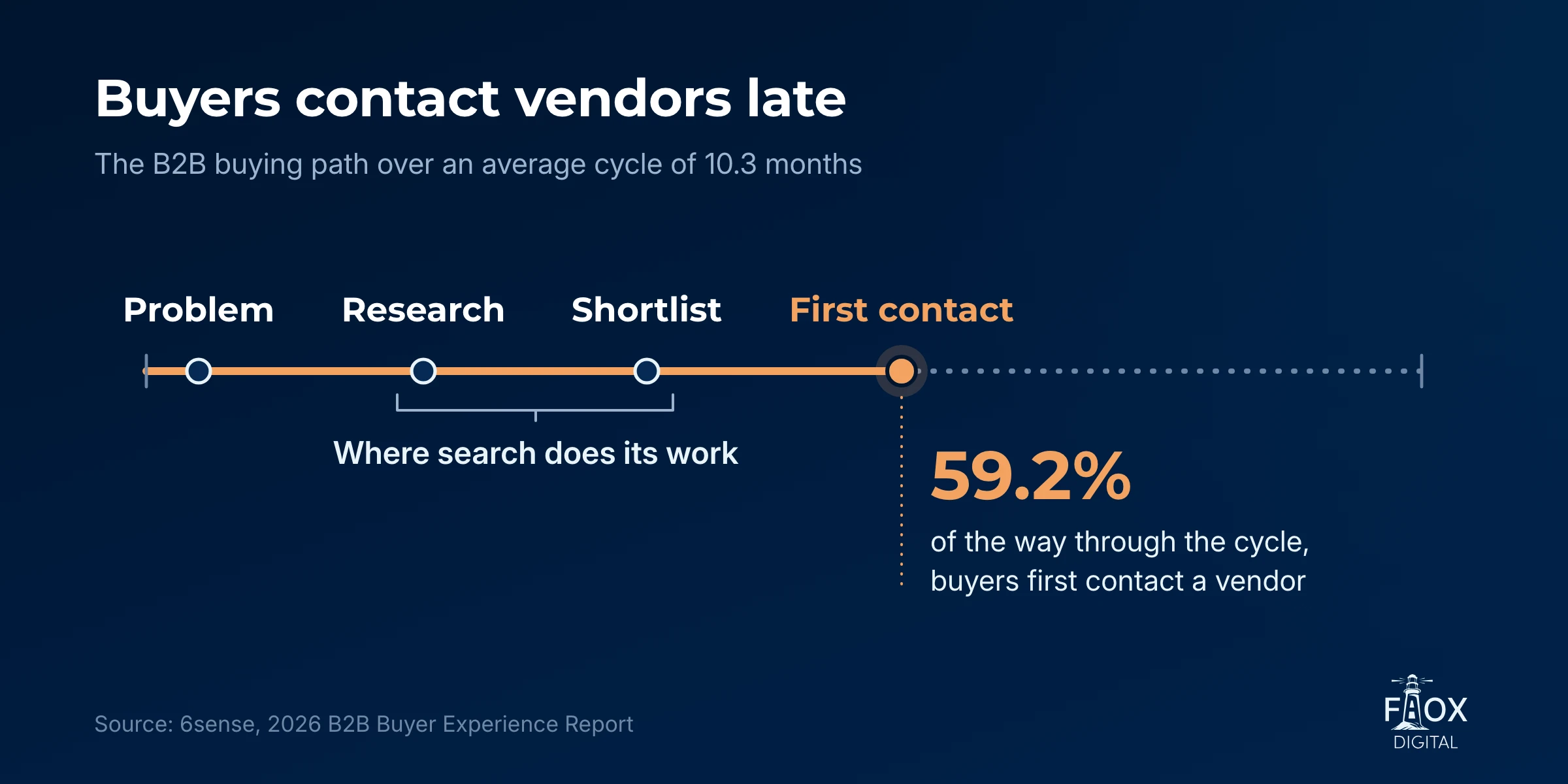
The buying group is larger than most teams assume. 6sense puts it at about 10 people. Forrester, which counts differently, says the typical decision in 2026 includes 13 internal stakeholders and nine external influencers, and that procurement professionals are decision-makers in 53% of buying cycles. Each role searches for something different. Here is an example for a hypothetical valve maker:
| Role | What they might search | What the page must give them |
|---|---|---|
| Engineer | stainless ball valve DN50 PN40 | Specifications, drawings, standards, data sheets |
| Purchaser | ball valve supplier ISO 9001 | Certificates, lead times, minimum orders, a contact |
| Manager | cost of valve failure in a process plant | The business case, references, who you are |
A website written for only one of these leaves the others to find a competitor.
SEO for B2B companies: what the work includes
SEO for B2B companies usually has six parts, and each depends on the others:
- Technical SEO. Making sure Google can crawl, render and index your pages, including filter pages, PDFs and language versions. Our guide to technical SEO basics covers the foundation.
- Keywords and search intent. Finding what buyers type and what they want at that moment: to learn, compare or buy. See our guide to B2B keyword research.
- Content. Product, application, comparison and guide pages that answer the buying group’s questions. A B2B content strategy decides what to write, and covering a subject in depth builds topical authority.
- Authority and backlinks. Links from trade publications, associations and partners. Google says link analysis is one of the things its systems use, and our guide to link building for B2B explains how they are earned.
- International SEO. Exporters need each market researched and served in its own language, which our international SEO guide sets out.
- AI search (GEO). AI Overviews, AI Mode and tools such as ChatGPT now answer part of these questions. Google says there are no additional requirements to appear in its AI features, so sound SEO remains the base. Read more on how AI is changing search and on generative engine optimization.
No provider can promise rankings or AI citations in any of these areas. The work improves your chances and your position over time.
SEO and paid ads: what is the difference?
Paid search ads and SEO appear on the same results page, but they work differently:
| Aspect | SEO | Paid search ads |
|---|---|---|
| What you pay for | Work on your site and content; nothing to Google | Clicks, through an ad auction |
| How fast it starts | Months | Soon after setup |
| When you stop | Pages can keep appearing, though positions change | Ads stop when the budget stops |
| Strongest at | The long research stage and many specific searches | Clear buying searches, launches and tests |
| Main weakness | Slow, with no promised result | Cost per click, and little volume on niche terms |
They are not rivals. Ads can test which terms bring real enquiries while SEO builds up, and SEO can reach the many specific searches that ads would not cover economically. How much to give each one is a decision for your overall B2B marketing budget.
How to measure B2B SEO
Traffic alone is a weak measurement in B2B, because a thousand visits from the wrong people are worth less than one from the right buyer. Follow the path instead:
- Search Console: impressions and clicks by page, search and country. It is free, and it shows whether buyers can see you. Separate brand searches from the rest.
- Google Analytics: visits to product and quote pages, with quote forms marked as key events.
- Your CRM: qualified enquiries, quotes and won deals, with a field recording how each contact found you.
Allow for time. We plan for first movement within a few months, meaningful results around six to eight months and a competitive position in a year or more. These are planning ranges and not a promise, since competition, the state of your site and how quickly changes get made all shift them.
When SEO is not the first priority
SEO is not the right first move for every company. If you sell to a small, known set of accounts, direct sales and account work may matter more. If buyers cannot get a prompt reply when they enquire, fix that first, because more visitors will not help. And if you need enquiries this quarter, ads or direct outreach will act sooner while SEO builds in the background. Many companies start elsewhere and add SEO once the basics work.
A simple B2B SEO strategy
A B2B SEO strategy does not need to be elaborate. It needs to start from sales:
- Agree the goal. Decide which products, markets and kinds of enquiry matter most to the business.
- Talk to sales. List the questions each role in the buying group asks, in their own words.
- Fix what blocks Google. Check crawling and indexing before you publish anything new.
- Research searches and intent. Group the terms by role and buying stage.
- Improve the pages closest to an enquiry first. Start with product and application pages, then add guides.
- Earn mentions and links from trade media, associations and partners.
- Measure through to enquiries, and review the plan each quarter.
A smaller company can do the first steps itself. Search Console costs nothing, and one well-researched product family is a sensible place to begin.
Once you know what the work involves, the next question is usually where you stand. A competitor keyword analysis shows which searches other suppliers already win, and which ones are open to you.
How Faox Digital approaches B2B SEO
A B2B SEO project at Faox Digital starts with an audit and baseline: what the site ranks for, who it competes with and what buyers search. The plan follows market by market, with commercial and informational searches side by side, including the questions buyers now ask AI tools.
Key takeaways
- B2B SEO makes your site visible in organic results while engineers, purchasers and managers research a purchase.
- It differs from regular SEO in volume, language, the number of people involved and the length of the sales cycle.
- Most of the buying journey happens before a supplier is contacted, so being found early matters.
- The work has six connected parts: technical SEO, keywords, content, authority, international SEO and AI search.
- Measure qualified enquiries and won deals, not traffic alone, and allow months for results.
Frequently asked questions
What is B2B SEO in simple terms?
It is the work of getting your company’s pages found on Google, and in AI answers built on search, when other businesses research what you sell. Success means enquiries from the right companies, not simply more visitors.
How do you create a B2B SEO campaign?
Start with the products and markets that matter most, and list what each buyer role asks. Fix crawling and indexing problems, research the searches, improve product and application pages, earn links from trade sources and measure enquiries. Plan in quarters, because results take months.
What is B2B SaaS SEO?
It is B2B SEO for software companies. The buying group and long cycle are similar, but the pages differ: features, integrations, comparisons and pricing. IT usually has a stronger voice. 6sense’s 2026 report found IT involved in about seven of ten software purchases, against about four in ten for physical goods.
Is SEO better than paid ads for B2B?
Neither is better in general. SEO suits the long research stage and many specific searches, while ads suit clear buying searches and quick tests. Many companies use both and move budget according to the enquiries each one brings.
How long does B2B SEO take?
Plan for first movement within a few months, meaningful results around six to eight months and a competitive position in a year or more. These are planning ranges, and no one can promise a date or a ranking.
Sources
Let’s talk
Where do you want to be found?
Tell us the searches that matter to your business. We will review your site and tell you plainly what to fix first, including what you can do yourself.