
B2B Marketing Budget: How Much to Spend and Where It Should Go
How much B2B companies spend on marketing according to 2026 surveys, how to set your own budget from your goals and how to divide it across channels and markets.
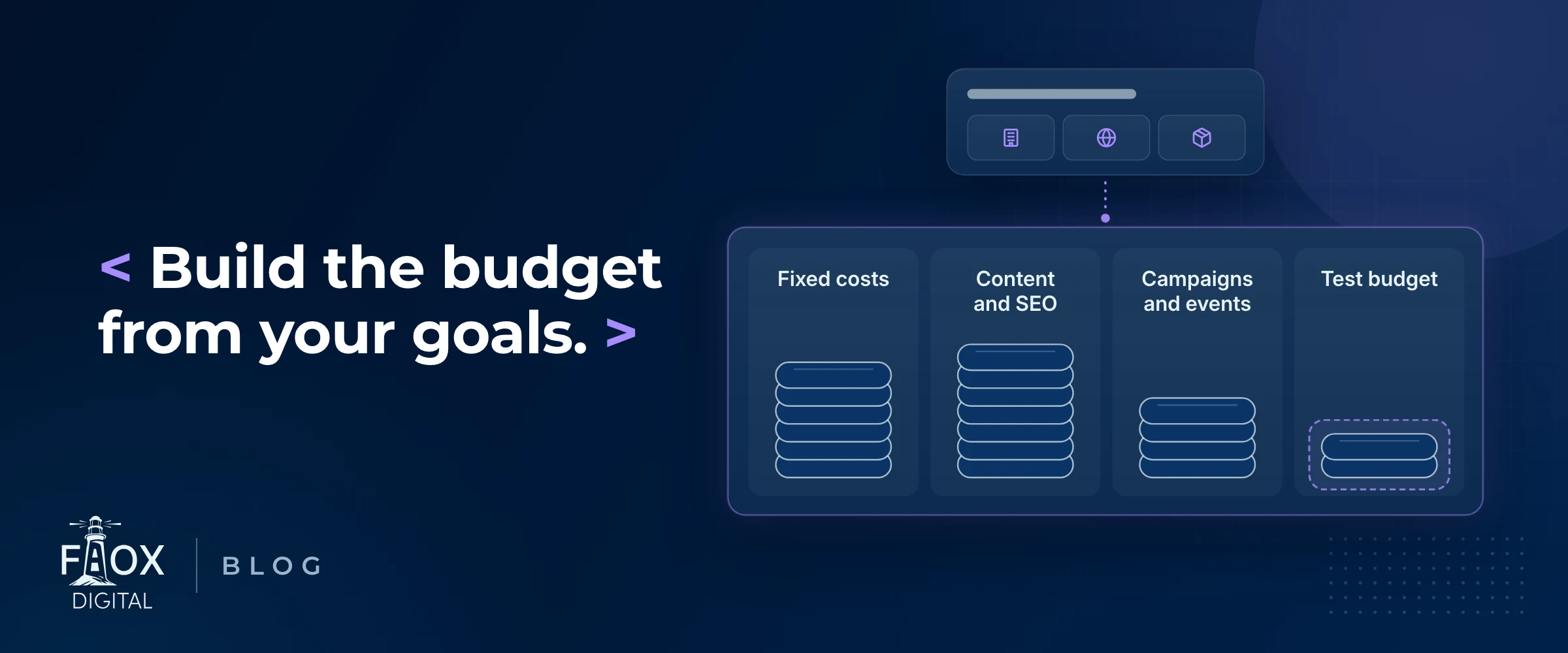
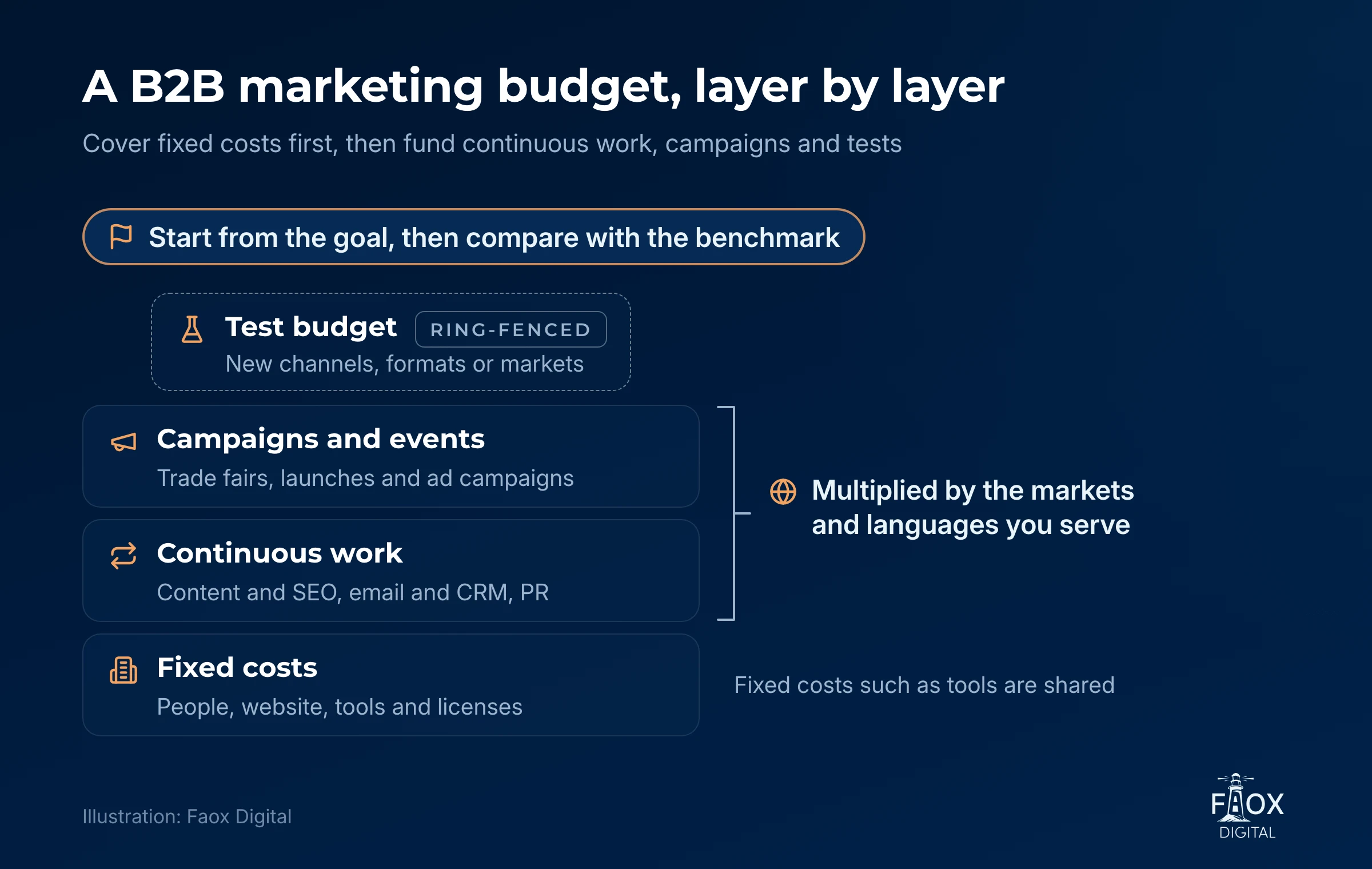
In large 2026 surveys, the average B2B marketing budget sits at roughly 7% to 10% of revenue: Gartner’s CMO Spend Survey puts the average at 7.8% of company revenue, and The CMO Survey found about 7% at B2B product companies and about 10% at B2B services companies. Use these figures as a sense check, then build your own budget from your goals: fixed costs, continuous content and SEO work, campaigns and events, ad spend and a test budget, multiplied by the markets and languages you serve.
"How much should we spend on marketing?" is usually the first question in budget season, and the answers found online range from a fixed percentage to "whatever the competition spends". Neither tells a B2B company what its own plan needs.
This guide sets out what 2026 surveys say about the B2B marketing budget, how to set yours from your goals and how to divide it across channels, markets and tests. Before you set a budget, decide how you will judge what it brings; our guide to B2B marketing metrics covers that. We work as a B2B digital marketing agency, so we have a stake in the answer; the figures below come from public surveys, and grants or incentive programs are left out.
B2B marketing budget as a percentage of revenue
Two large surveys give the most useful benchmarks for 2026:
| Survey | Who answered | Marketing budget as a share of revenue |
|---|---|---|
| Gartner 2026 CMO Spend Survey | 401 CMOs and marketing leaders in North America, the UK and Europe, most at companies with over $1 billion in revenue | 7.8% on average in 2026, up from 7.7% in 2025 |
| The CMO Survey 2026 | US marketing leaders, surveyed in January 2026 | 9.0% on average across all companies, B2C included; about 7% at B2B product companies and about 10% at B2B services companies |
Gartner describes budgets as being on a plateau since 2022, with the 2026 average 18% lower than the average allocation four years earlier. The CMO Survey’s averages hide a wide spread between companies, and both surveys lean towards larger firms, so a mid-sized manufacturer can sit well above or below them for good reasons.
Use the percentage as a sense check, not as the plan. A company entering two new markets this year may need more; a company with a strong position and a steady order book may need less.
How much should a B2B company spend on marketing?
Set the budget from what you want marketing to achieve, then compare the total with the benchmarks:
- Start from the goal. How many new customers, in which markets and product lines? Our guide to marketing metrics shows how to work back from a sales goal to the enquiries you need.
- Price the work. List what it takes to get those enquiries: website improvements, content and SEO, follow-up, PR, events and any advertising.
- Add the fixed costs. People, tools, licenses and the website you need regardless of campaigns.
- Compare with the benchmark. If the total is far above 7% to 10% of revenue, check the goals or the plan; if it is far below, ask whether the goals are realistic.
- Decide by stage. A new market, a new product line or a rebrand needs a bigger budget for a year or two; maintaining a strong position needs less.
Budget allocation: where the money should go
A B2B marketing budget has more lines than most companies plan for. This table shows the main ones:
| Budget line | What it covers | Fixed or variable |
|---|---|---|
| People | In-house marketing staff and their training | Fixed |
| Website | Hosting, maintenance, improvements | Mostly fixed |
| Tools and licenses | CRM, marketing automation, SEO, design and analytics software | Fixed |
| Content and SEO | Articles, guides, case studies, technical and search work | Continuous |
| Email and CRM | Sequences, newsletters, list care | Continuous |
| PR and media | Outreach, sponsored content, media partnerships | Continuous or per campaign |
| Events and trade fairs | Stands, travel, materials, follow-up | Per event |
| Ad spend | Search, LinkedIn and other paid media, paid to the platforms | Variable |
| Agency fees | Retainers and project fees for outside help | Fixed per contract |
| Tests | New channels, formats or markets | Ring-fenced |
Large companies show where the money goes. In Gartner’s 2026 survey, paid media took 31.4% of marketing budgets, funded by cuts to agencies, and labor’s share of the budget rose to 24.5% from 21.9% in 2025. A B2B company with a smaller budget will usually spend a larger share on content, the website and follow-up, and less on media.
Content and SEO investment
Content and SEO usually deserve a steady share of a B2B budget, because they keep working after the money is spent: a good application guide or product page can bring enquiries for years. The return comes slowly, so judge it over quarters, not months, and keep the investment steady rather than switching it on and off. What drives the price of search work, and what a monthly fee can cover, is explained in our guide to SEO cost.
Plan content around the questions your buyers ask in each market, written with your own experts, and budget for updating existing pages as well as creating new ones.
Ad spend, tools and agency fees
Ad spend works best in B2B for specific jobs: search ads for high-intent terms, LinkedIn ads to reach a defined group of companies or roles, and promotion of a launch or an event. It stops when the budget stops, so treat it as a lever on top of content and SEO rather than a replacement for them, and keep it separate from the fees of whoever manages it.
Tools and licenses are fixed costs that grow quietly. Review them once a year and cancel what nobody uses; our comparison of in-house or agency marketing lists what common tools cost. Agency fees depend on scope, markets and the fee model; our guide to marketing agency fee models explains how to compare them.
Markets and languages
Every market you serve multiplies part of the budget. Each priority market needs its own keyword research, content in its own language, trade press and often its own events, while fixed costs such as tools are shared. The CMO Survey 2026 gives a sense of scale for US companies: B2B product companies spent on average 77.10% of their marketing budget on their domestic market, so a little under a quarter went abroad.
Budget by market, not only by channel. Choose one or two priority markets for the year, give them a full plan and serve the rest at a lower level. A budget spread thinly across many countries usually achieves little in any of them.
Keep a test budget
Set aside a fixed share of the budget for tests: a new channel, a new content format, a new market or a new kind of event. Give each test a question, a time limit and a measure of success decided in advance, and stop it when the time is up unless the results justify more.
A test budget protects the rest of the plan. Without one, every new idea competes with proven work, and either the idea dies or the proven work loses money it needed.
Build an annual plan
An annual plan turns the budget into a sequence:
- Set the goals for the year. New customers, markets and product lines, agreed with management and sales.
- Cover the fixed costs. People, website, tools and licenses.
- Fund the continuous work. Content and SEO, email and CRM, PR, as monthly amounts.
- Place campaigns and events. Trade fairs, launches and ad campaigns, on the calendar.
- Ring-fence the test budget. Name the first two or three tests.
- Phase it by quarter. Match spend to the calendar, not twelve equal parts.
- Review every quarter. Move money from what does not work to what does, using the metrics agreed at the start.
For an example of how the parts fit together in practice, see our integrated marketing program example.
Where B2B marketers plan to invest in 2027
Two surveys show the direction. The Content Marketing Institute’s report on 2027 trends, based on 861 B2B marketers, mostly from North America, surveyed in mid-2026, found owned media at the top of the areas where organizations expect to invest most or increase investment in 2027 (42%), followed by events and experiential marketing (35%), AI-powered marketing tools (30%) and paid media (30%). Of the same marketers, 40% said they were spending more on owned media than a year earlier.
The CMO Survey 2026 points the same way for budgets. B2B product companies expected their overall marketing budgets to rise by 5.44% on average over the next 12 months, after almost no change in the previous 12 months, and their digital marketing spending by 9.37%.
Common budgeting mistakes
- Copying a percentage. A benchmark says what others spend, not what your goals need.
- Spreading the budget thin. Five channels and six markets at minimum effort rarely move anything.
- Cutting content and SEO first. They are easy to pause and slow to rebuild, so a cut this year shows in next year’s enquiries.
- Forgetting follow-up. Money spent on trade fairs and campaigns is wasted if nobody follows up the contacts.
- Leaving out your own team’s time. Experts, approvals and sales follow-up cost hours that belong in the plan.
- Setting the budget once a year. Plans that are never reviewed keep funding what does not work.
Budgeting on a small budget
On a small budget, spend first on what every other channel depends on: a website that explains and converts, and follow-up of every enquiry and trade fair contact. Add one channel at a time, starting with the one your buyers use most, and do the first steps in-house where you can. One market and one product line, done properly, teach you more than a thin plan across everything.
How Faox Digital plans a B2B marketing budget
Faox Digital, a digital growth partner for B2B companies in complex and international markets, plans its six services as one system rather than as separate channels. In SEO, for an early-stage company, a smaller budget or a test of one market before the full push, we start with an honest audit and a first step sized to its stage. We suggest first steps that fit the company’s budget and stage, even if that means the company does some of the work itself.
Key takeaways
- Large 2026 surveys put the average B2B marketing budget at roughly 7% to 10% of revenue; use that as a sense check, not as the plan.
- Build the budget from your goals: fixed costs, continuous content and SEO work, campaigns and events, ad spend and tests.
- Budget by market as well as by channel, and focus on one or two priority markets.
- Keep a ring-fenced test budget with clear questions and time limits.
- Phase the plan by quarter and move money every quarter towards what works.
Frequently asked questions
What is the average B2B marketing budget as a percentage of revenue?
Gartner’s 2026 CMO Spend Survey, mostly of large companies, put the average at 7.8% of company revenue. The CMO Survey 2026 of US marketing leaders found about 7% at B2B product companies and about 10% at B2B services companies, with a wide spread between firms.
How should a B2B marketing budget be allocated?
Cover fixed costs first (people, website, tools), then fund continuous work such as content and SEO, email and CRM and PR, then campaigns, events and ad spend, and keep a small test budget. Split the result by priority market, and review the allocation every quarter.
What does the B2B content marketing benchmarks report say about budgets?
The Content Marketing Institute’s report on 2027 trends found owned media at the top of B2B marketers’ investment plans (42% rank it among their top three), followed by events and experiential marketing (35%), AI-powered tools and paid media (30% each).
How much of a B2B budget should go to brand building?
There is no fixed rule, but brand building should not be the first line cut. In The CMO Survey 2026, B2B product companies expected brand-building spending to grow by 5.14% over the next 12 months and B2B services companies by 8.31%.
Sources
Let’s talk
Not sure where to start?
Tell us about your business and your goals. We will suggest first steps that fit your budget, even if that means doing some of it yourself.