
Marketing Agency vs In-House Team: Which Model Fits a B2B Company?
How a B2B company should decide between an in-house marketing team, an agency or a mix of both, with real cost figures and the trade-offs of each model.
Build an in-house team when marketing work is continuous, depends on deep product knowledge and you can afford several specialists. Hire an agency when you need a range of skills quickly without hiring. Most B2B companies end up with a hybrid model: an in-house owner who knows the products and the sales team, supported by an agency or freelancers for specialist skills and extra capacity.
The question behind searches such as "marketing agency vs in house" is rarely either-or. A B2B company needs strategy, content, a website, search, social media, email and PR, plus someone who knows the products well enough to keep all of it accurate. Few companies can hire every one of those skills, and no agency knows your products as well as your own people.
This guide compares the models on cost, tools, expertise, control, speed, scalability and knowledge, and shows when a mix works best. If you are new to agencies, start with how a marketing agency works. We work as a B2B marketing agency, so we have a stake in the answer; we say plainly below when an in-house team is the better choice.
What in-house marketing means
In-house marketing is done by your own employees: a marketing manager, a content writer or a designer on your payroll. An agency is an outside company that does the work under a contract, with a team covering several skills. A freelancer is one independent professional, usually in one discipline, such as copywriting, design or translation. A hybrid model combines them: usually an in-house owner who sets priorities, with an agency or freelancers doing specialist work.
Marketing agency vs in-house team: the comparison
| Aspect | In-house team | Agency | Hybrid |
|---|---|---|---|
| Cost structure | Salaries, benefits and tools, fixed | A fee for an agreed scope, variable | A smaller fixed team plus fees |
| Hiring cost and time | Recruiting, notice periods, training | Usually starts soon after signing | One or two hires, plus outside help |
| Breadth of expertise | Limited to the people you hire | Several disciplines in one team | The widest |
| Tools and licenses | Bought and managed by you | Usually brought by the agency | Core systems yours, specialist tools theirs |
| Control | Direct, day to day | Through the brief, scope and reviews | Direct on priorities, contractual on execution |
| Speed | Fast on daily changes, slow to start | Fast to start, slower on ad hoc requests | Fast on both, if responsibilities are clear |
| Scalability | Hard to scale up or down | Scales with the scope | Flexible at the edges |
| Knowledge | Builds inside while people stay | Builds in the agency’s team | Product knowledge inside, method outside |
| Main risk | Narrow skills, one person leaving | Generic work, junior staff | Blurred responsibility |
The table is our summary. Which column wins depends on how much work you have, how specialized it is and how much your marketing depends on product knowledge.
What an in-house team really costs
Salaries are only part of the cost. In the United States, the Bureau of Labor Statistics put these median annual wages for marketing roles in May 2025:
| Role | Median annual wage, May 2025 |
|---|---|
| Marketing manager | $166,790 |
| Web developer | $92,650 |
| Market research analyst or marketing specialist | $78,760 |
| Public relations specialist | $74,750 |
| Graphic designer | $62,960 |
Benefits come on top. In the Bureau’s Employer Costs for Employee Compensation for June 2026, wages made up 70.0% of private employers’ costs and benefits the other 30.0%. As our own arithmetic, a team of these five roles at median pay costs about $476,000 a year in wages, or about $680,000 with benefits, before recruiting, training and tools. Pay varies widely by country, city and seniority, so run the same sum with your local figures.
Most B2B companies could not justify all five roles, which is the real point: an in-house team usually means one or two people who cannot cover every skill.
Tools and licenses
An in-house team needs its own software, and the costs add up. At the time of writing (November 2026), HubSpot’s US pricing for Marketing Hub Professional starts at $800 a month for three core seats when billed annually, plus a required one-time onboarding fee of $3,000. An SEO tool such as Semrush starts at $139 a month. Add design software, social media scheduling, analytics and a CRM if you do not have one.
An agency usually brings its own working tools, such as SEO research, design and reporting software. Your core systems, such as the CRM, analytics and the website, should stay in your company’s name in every model, so that the data stays with you.
What an agency costs, and what it buys
An agency fee buys a share of several people’s time: a strategist, a writer, a designer, a developer and someone who reports. A salary buys one person’s full time and one person’s skills. That makes the two hard to compare directly, so compare what each option can actually deliver in a month.
Agencies charge through monthly retainers, project fees or hourly rates, and the fee depends on scope, markets, languages and seniority; our guide to marketing agency fee models explains each. Whatever the model, an agency still needs someone on your side to brief it, approve work and connect it to sales. That person’s time is part of the cost too.
Breadth of expertise, control and speed
Breadth of expertise is the agency’s strongest argument. B2B marketing draws on strategy, writing, design, web development, SEO, social media, email and CRM, PR and analytics. One or two hires rarely cover more than a few of them well, while an agency can bring the right specialist for each task.
Control is the in-house team’s strongest argument. Your own people sit next to sales and engineering, change priorities the same day and know which claims the company can make. An agency works through a brief, a scope and regular reviews, which adds a step to every change.
Speed cuts both ways. An agency can usually start soon after signing, while hiring takes weeks or months, and a new employee needs time to learn your products. Once both are up and running, an in-house person reacts faster to small, daily requests.
Scalability and knowledge
Scalability favors agencies and freelancers. A launch, a new market or a website project can be added to an agency’s scope and removed again when it ends, while a salary stays the same in quiet months. Freelancers are useful for peaks and for narrow tasks such as translation, photography or copywriting.
Knowledge is where in-house teams win, but only while people stay. The Bureau of Labor Statistics put the median time US wage and salary workers had been with their current employer at 4.1 years in January 2026. When a one-person marketing team leaves, much of what they knew leaves too. Agencies keep knowledge within their own team, which protects you from one departure but not from changing agency. In every model, keep research, decisions and accounts documented and in your company’s name.
The hybrid model
The hybrid model pairs an in-house owner with outside specialists. It is how many B2B companies end up, because it gives them product knowledge and specialist depth without building a full team:
| Area | In-house | Agency or freelancers |
|---|---|---|
| Strategy and budget | Owns and decides, with sales | Proposes, with evidence |
| Product knowledge | Supplies experts and checks accuracy | Asks the right questions, writes |
| Website and SEO | Sets priorities, gets internal decisions | Builds, optimizes and reports |
| Content | Plans topics with sales | Writes, designs and adapts by channel |
| PR and outreach | Provides news and spokespeople | Finds the story and approaches media |
| Reporting | Connects results to sales in the CRM | Prepares the analysis |
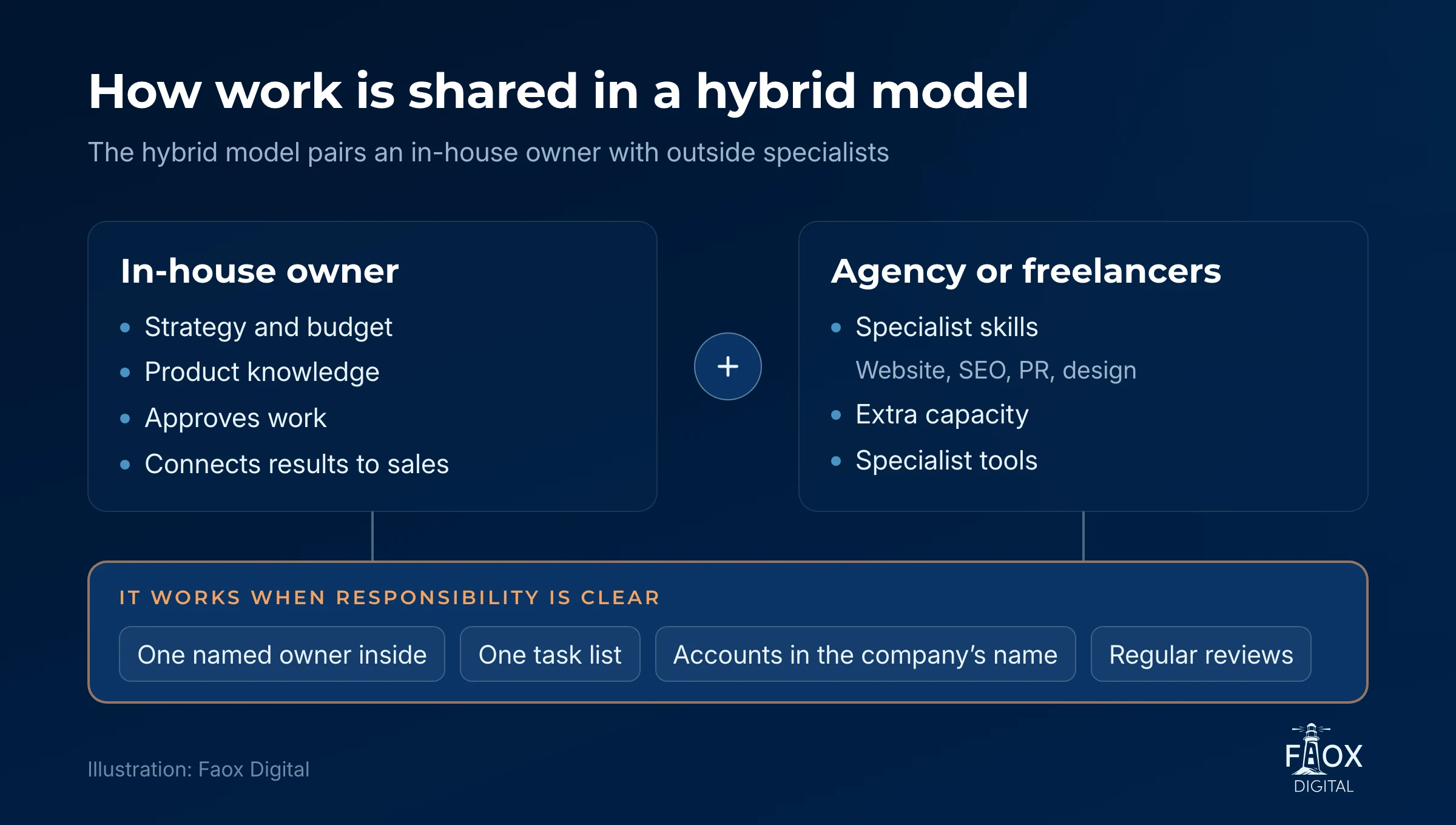
It works when responsibility is clear: one named owner inside, one task list, accounts in the company’s name and regular reviews.
Which model fits your company
| Your situation | Start with | Why |
|---|---|---|
| Small company, no marketer, limited budget | One agency or freelancer for the most urgent job, with a manager as owner | Buys skills without a fixed salary |
| One marketer who is stretched thin | A hybrid: the marketer owns, an agency adds specialist work | Keeps product knowledge inside |
| A defined project, such as a new website or rebrand | A specialist agency for the project | The skills are needed once, not every month |
| Several markets and languages | An agency or a network of native-speaking specialists | One hire rarely covers every market |
| Continuous content and a large product range | An in-house team, with outside help for gaps | Daily work needs someone close to the products |
| A mature team with specific gaps | Specialists for those gaps | Depth where the team is thin |
For one discipline at a time, our comparison of SEO consultant vs agency shows how the same decision looks for search. To size the overall spend, see our guide to the B2B marketing budget, and if an agency is part of the answer, our guide to how to choose a marketing agency lists the questions to ask.
How Faox Digital works alongside in-house teams
Faox Digital, a digital growth partner for B2B companies in complex and international markets, runs its six services as one system. We suggest first steps that fit the company’s budget and stage, even if that means the company does some of the work itself. In practice the client keeps the decisions: for social media, the client approves a monthly content calendar rather than every post, and in a website project the client signs off each step before the next one starts.
Key takeaways
- In-house teams win on control and product knowledge; agencies win on breadth of expertise, speed to start and scalability.
- A full in-house team is expensive: in the US, benefits make up 30% of private employers’ costs, and tools and recruiting come on top.
- Agencies bring their own tools, but your CRM, analytics and website should stay in your company’s name.
- Most B2B companies do best with a hybrid: one in-house owner plus specialists for the rest.
- Whatever the model, name an owner, document decisions and keep the accounts in your name.
Frequently asked questions
Is it cheaper to hire a marketing agency or an in-house team?
It depends on how much work you have. For a range of skills or a defined project, an agency usually costs less than hiring several people. For continuous work in one discipline, one well-chosen employee can be cheaper over time. Compare the full cost of each, including benefits, tools and management time, for the same scope.
What does in-house marketing mean?
Marketing done by your own employees rather than by an outside agency or freelancers. An in-house team can be one marketing manager or a full department with writers, designers and specialists.
When should a B2B company move marketing in-house?
When the work is continuous, the volume justifies a full-time person and product knowledge matters more than specialist depth. Many companies start with an agency, learn what works and then hire for the tasks they need every week, keeping outside help for specialist work.
Can we use an agency and freelancers at the same time?
Yes, as long as one person in your company owns the plan. Agencies suit work that needs several skills together; freelancers suit narrow, well-defined tasks. Keep both working from the same calendar and the same brief.
Sources
Let’s talk
Not sure where to start?
Tell us about your business and your goals. We will suggest first steps that fit your budget, even if that means doing some of it yourself.