
Topical Authority: What It Is and How B2B Websites Build It
What the term means, what Google has and has not said about it, and how a B2B site earns trust on a subject through focus, coverage and depth.

Topical authority is the SEO term for a site that covers one subject so thoroughly and reliably that readers, search engines and AI tools treat it as a strong source. Google publishes no topical authority score, so nobody can check or sell you a real number. A B2B site builds it by focusing on subjects it truly knows, answering buyers’ questions in depth, linking those pages well and earning recognition from others.
Why does a specialist manufacturer sometimes outrank a much larger site on its own subject, while scattered blog posts rarely do? SEO writers answer with two words: topical authority. The term is used loosely and often sold hard. This article separates what Google has actually said from what SEOs infer, then shows how a B2B site builds it as part of creating B2B content that gets cited. The examples come from a hypothetical pump seal manufacturer.
What Google has said about expertise on a topic
Google describes no general topical authority system, but several of its documents point the same way:
- News has a topic authority system. Google’s 2023 note describes one that looks at how notable a source is for a topic or location, its influence and original reporting, and its reputation. It covers newsy queries, so do not assume it applies to B2B sites as written.
- Pages come first, with some site-wide signals. Google’s guide to ranking systems (2025) says they work at page level and also use site-wide signals, and that good site-wide signals do not mean every page will rank highly.
- Focus matters. Google’s guidance on helpful content (updated October 2026) asks whether your site has a primary purpose or focus. It lists as warning signs producing lots of content on many different topics and entering a niche topic without real expertise.
- Others’ views count. Google’s How Search works page (accessed November 2026) says one quality factor is whether other prominent websites link or refer to the content.
SEO writers also point to Google API documents leaked in 2024, which mention a site focus score and a site radius (Ahrefs, 2026). Google has not explained how such fields are used, so treat them as hints. And Google’s John Mueller, as reported by Search Engine Journal in 2023, told SEOs not to worry about topical authority, after agreeing with a post that called it relevance. We read that as a warning against chasing the label, not against the work.
Why B2B websites start with an advantage
Outside evidence points the same way, with limits. Cyrus Shepard of Zyppy classified more than 400 sites that won or lost Google traffic over 12 months and published the results in April 2026. A tight topical focus appeared on 75.9% of winners and 61.3% of losers, a correlation of 0.25. Offering a product or service had the strongest link: 70.2% of winners against 34.6% of losers. The traffic figures are Ahrefs estimates, and the study shows association, not cause.
Many B2B companies already have what those winners had: real products, a narrow subject and engineers with first-hand knowledge. That knowledge often sits in PDFs and in people’s heads. Our article on B2B SEO explained covers how B2B search differs more broadly.
Semantic SEO: entities and how they relate
Semantic SEO means writing about things and how they connect, not repeating a phrase. Google announced its Knowledge Graph in 2012 as a model of real-world entities and their relationships: "things, not strings". Its guide to ranking systems (2025) describes neural matching, an AI system that matches the concepts in queries and pages.
Entities are the things a subject is made of: products, materials, standards, industries and problems. For a pump seal maker, that means mechanical seals, silicon carbide, API 682, dry running and chemical pumps. A page that names them precisely and says how they relate, such as which face material suits which medium, is clearer to engineers and to machines than one that repeats "mechanical seals" ten times.
Start with a topic map
A topic map lists what a subject contains before anyone writes. It goes wider than a keyword list, because it starts from entities and questions, not from search volumes. For our hypothetical manufacturer:
| Part of the subject | Examples | Page it may need |
|---|---|---|
| Product types | Cartridge seals, single and double seals | Category and product pages |
| Materials | Silicon carbide, carbon, tungsten carbide | Material selection guide |
| Standards | API 682 | Standards explainer |
| Failure modes | Dry running, face wear, thermal cracking | Troubleshooting guides |
| Applications | Chemical pumps, high-temperature service | Application pages |
| Buying questions | Lead times, testing, cost of failure | Sections on product pages |
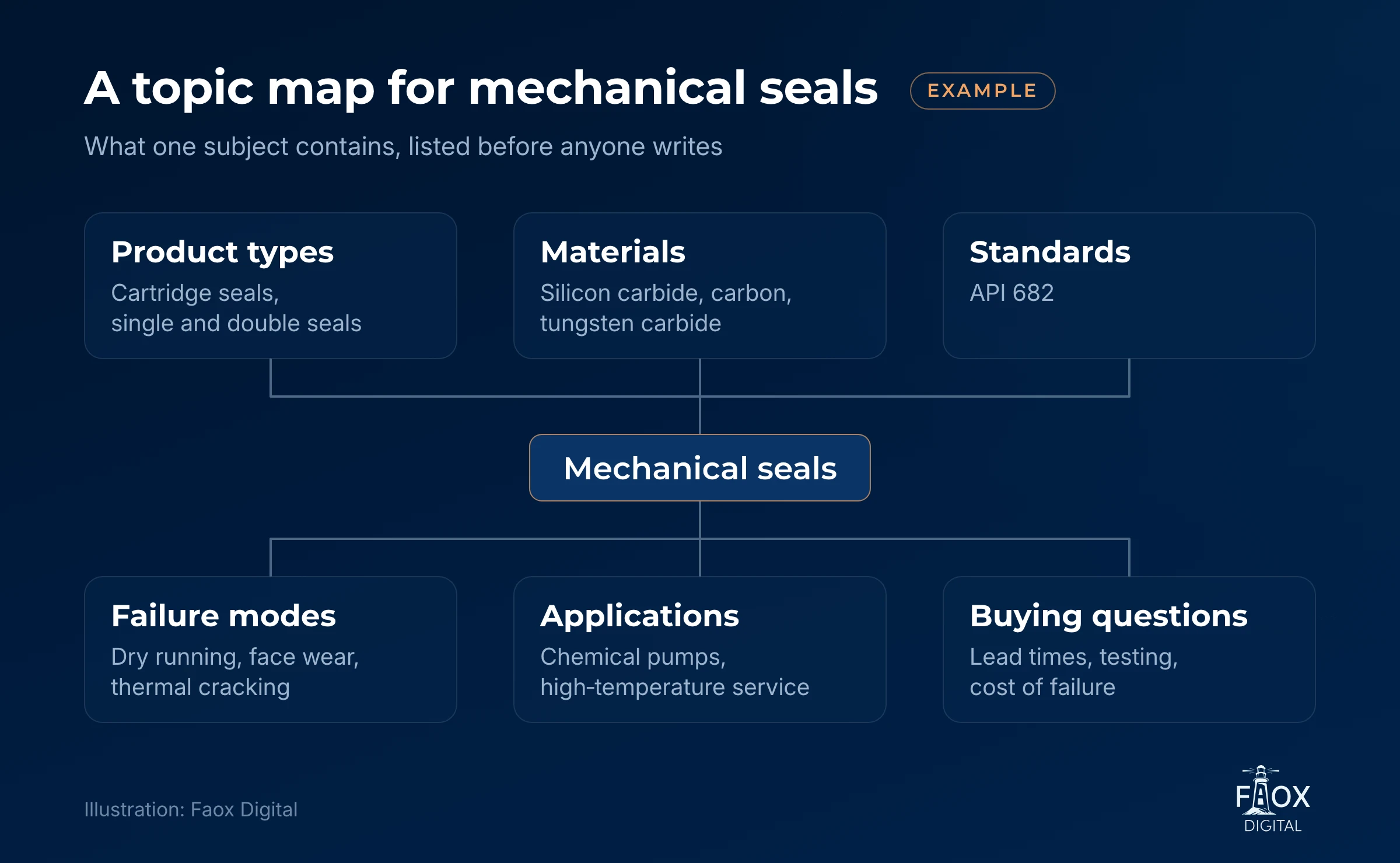
Not every box needs its own page, because some answers fit as a section. The map also shows what to leave out: a seal maker’s view on general marketing trends has no place on it.
Topic coverage and content depth
Topic coverage is how many of the map’s questions you answer. Content depth is how well you answer each one. You need both, and more pages alone give you neither. Google’s 2026 guide to generative AI features warns against creating separate content for every variation people might search, and says a high quantity of pages does not make a site higher quality. Ahrefs’ 2026 guide says no fixed number exists, and offers a rough 15 to 20 well-connected pieces for a specialized niche and 50 or more for a broader subject.
Depth in B2B rarely means length. It means facts a generalist cannot write: why a seal failed and how it was diagnosed, what a test showed, where a product should not be used. Ask one question of each page: could a competitor or an AI tool write this without talking to your engineers? If so, it adds little.
The internal link network
Your internal link network shows how the pieces of a subject fit together. Google says it uses links as a signal of relevance and to find new pages (Link best practices, 2025), and its guide to ranking systems adds that its systems look at how pages link to each other to work out what they are about. Our guide to how Google crawls your site explains the crawling side. Keep the structure simple:
- Guide and supporting pages link both ways. Every page you care about should have a link from at least one other page.
- Related pages link sideways where a reader needs the next answer.
- Guides link on to product and application pages, so readers can act.
- Anchor text describes the target, in words that make sense on their own.
Links organize good pages. They do not make thin pages authoritative.
Publishing consistency
Publishing consistency matters, but we found nothing from Google that rewards a publishing schedule as such. Its freshness systems show fresher content for queries where it is expected (ranking systems guide, 2025), and it lists changing page dates without substantial changes as a warning sign (2026).
Steady work matters for other reasons: it finishes the map and keeps facts current as standards and products change. Plan what your engineers can support for years, not for one campaign. Ahrefs’ 2026 guide estimates 6 to 12 months before significant movement, which is an estimate, not a promise.
How AI tools choose sources
How AI tools choose sources differs by tool, and none publishes a formula. Google’s 2026 guide says its generative AI features are rooted in its core Search ranking and quality systems, and that they use query fan-out, where one question becomes several related searches. So a page can be used for a related search, not only the one typed. Ahrefs’ March 2026 analysis of 863,000 keyword results found that 38% of URLs cited in AI Overviews also appeared in the top 10 for that query.
Covering a subject gives you more chances to be one of those pages, but the data is thin. Wellows, which tracks AI citations, studied 9,471 questions across five AI engines from January to May 2026. Sites cited on part of a topic tended to be cited on its other questions, with correlations from 0.13 on ChatGPT to 0.29 on AI Overviews. Citations on other topics correlated more strongly, from 0.29 to 0.37. So a wider reputation seems to count at least as much as coverage, neither finding proves cause, and nothing here promises a citation.
Frequently asked questions
What is a topical authority map?
It is a plan of everything a subject contains: its entities, the questions buyers ask and the page that answers each one. SEOs also call it a topical map. It shows what you have covered, what is thin and what to leave out.
How do I check topical authority?
No tool can show you Google’s view, because Google publishes no such score. Check the effects instead: how many non-brand searches each subject’s pages appear for in Search Console, where you stand on your key searches and whether enquiries on that subject are growing.
How do I improve topical authority on an existing site?
Compare what you have with a topic map. Improve thin pages, merge overlapping ones, add what is missing and link them together. Then ask whether off-topic posts still serve your audience, and retire the ones that do not.
How long does it take to build topical authority?
Ahrefs’ 2026 guide estimates 6 to 12 months before significant movement. Results depend on your competition, your starting point and the quality of the pages, so nobody can promise a date.
Sources
Let’s talk
Where do you want to be found?
Tell us the searches that matter to your business. We will review your site and tell you plainly what to fix first, including what you can do yourself.