
Domain Authority: What the Score Means and Why Google Doesn’t Use It
What Moz’s DA, Ahrefs’ DR and Semrush’s Authority Score really measure, what Google says about them, and how to use them without chasing a number.
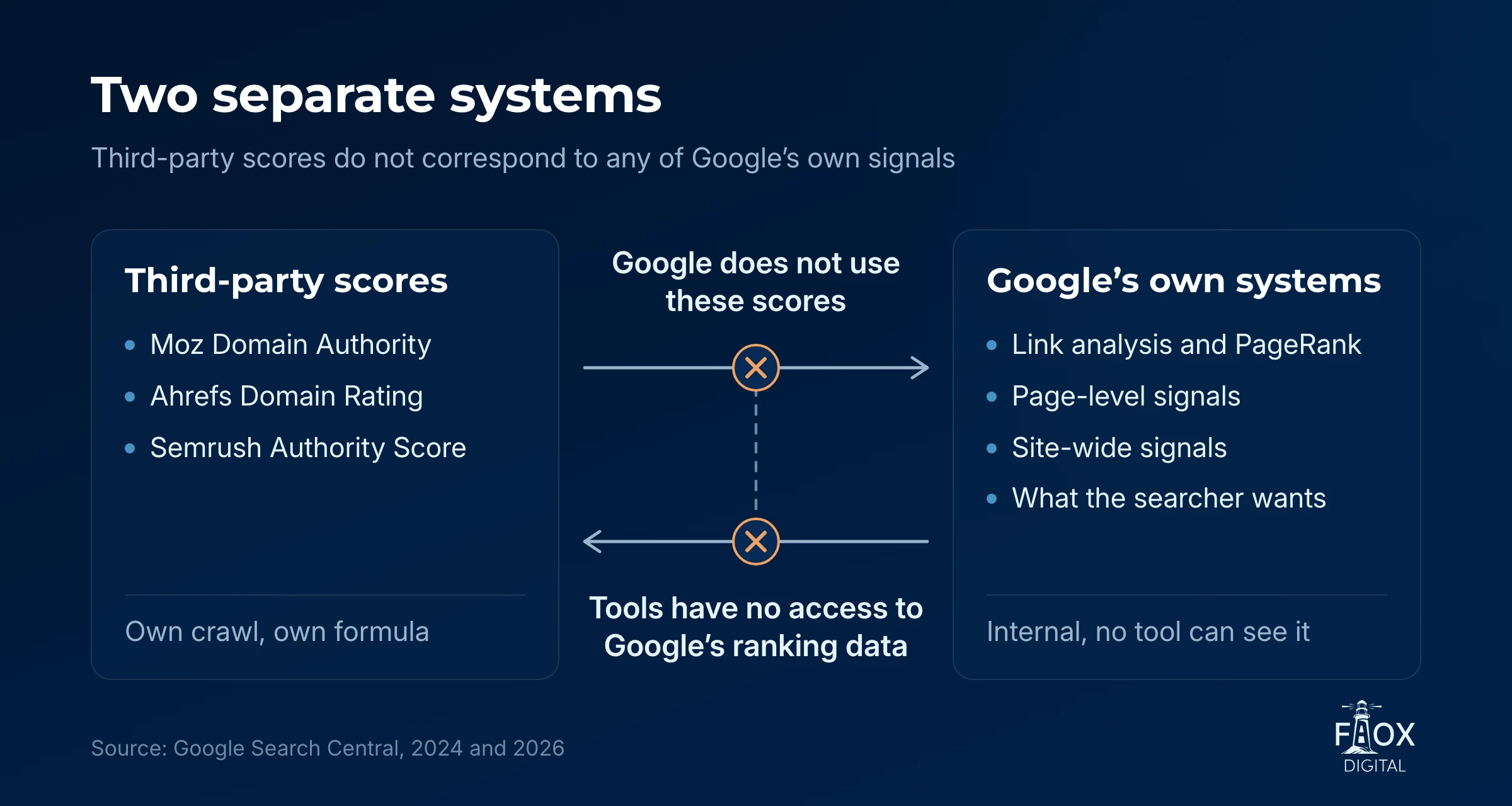
Domain authority is a 1 to 100 score from the SEO software company Moz that estimates how likely a website is to rank compared with others, based mostly on link data. Ahrefs’ Domain Rating and Semrush’s Authority Score are similar. Google does not use any of them and says such scores do not correspond to its own signals, so use them to compare sites, not as goals.
A monthly report says your domain authority slipped a few points. The same week, an email offers you links from "DA 50+ sites". Both sound important, yet neither tells you whether buyers can find you on Google.
These scores are a handy shorthand for how strong a site’s links look, and a poor target. This article explains what each one measures, what Google says about it and how to read the numbers. For the work behind the numbers, see our guide to how authority is earned.
What Google uses instead: PageRank and its own systems
Google’s own systems do look at links. Its guide to ranking systems (updated December 2025) says link analysis helps it work out what pages are about and which may be most helpful for a search. One of these is PageRank, used since Google’s launch, which Google says has changed a lot and remains part of its core ranking systems.
PageRank once had a public face: a 0 to 10 score in the Google Toolbar. Google removed that score in 2016, as Search Engine Roundtable reported at the time, and kept using PageRank internally. Since then, every public authority number has come from a third party.
Google works mainly at page level. Its guide says ranking systems are designed to work on individual pages, with site-wide signals also used, and that good or poor site-wide signals do not decide how every page ranks. Ahrefs notes that PageRank is calculated between pages while DR is calculated between websites, and that DR correlates with rankings less well than its URL Rating. This is page-level authority: the strength behind the page competing for a search, not a figure for the whole domain.
Google also has site-level signals, which no tool can read. Notes from a February 2025 call with Google engineer HJ Kim, a US Justice Department exhibit in its antitrust case against Google, describe a quality signal called Q* as largely related to the site rather than the query, with PageRank as one input. API documents leaked in 2024 mention a siteAuthority field feeding what they call Qstar. Google told The Verge in May 2024 that the documents were real but cautioned against assumptions drawn from them, so treat these as hints.
So Google does judge sites as well as pages. But the judgment is its own, and the number in your SEO tool is not a window onto it.
Nor does authority decide a search alone. A page has to fit what the searcher wants, which our guide to the types of search intent explains. A site earns trust on a subject through topical authority, and through the first-hand knowledge covered in E-E-A-T for B2B. A link-based score sees none of that.
Why a high score can mislead
A number that is easy to read and easy to sell invites metric manipulation. Ahrefs is open about this. In May 2022 it wrote that DR does not account for backlink spam, that large amounts of low-quality links may raise it, and that black-hat SEOs had found ways to inflate it for profit, though it had since closed many of those methods. A very high DR can even come from low-DR links alone, if there are enough of them.
Semrush builds six spam checks into its score for the same reason, such as many linking domains on one IP address or far more links than the site’s traffic would suggest. It connects these patterns with bought links and private blog networks: fake blogs set up only to pass links.
So a high score on a site with no search traffic, no clear subject and links to everyone tells you very little. Ahrefs’ own advice is never to judge a site on authority alone.
Link sellers’ score promises
Offers built on these numbers are easy to find on freelance marketplaces, usually as guest posts on "DA 50+" sites or as a set score for your own domain within weeks. Link sellers’ score promises have three problems:
- They sell a number Google does not use. A higher DA on a report is not a higher ranking.
- The number says nothing about your buyers. A "DA 50" site may have no readers in your sector, and its score may rest on the same kind of links being sold to you.
- Buying links breaks the rules. Google’s spam policies (updated August 2026) list buying or selling links for ranking purposes as link spam, and Moz’s own guide warns against buying backlinks.
Before you pay, ask which sites are involved, who reads them and whether the link will be labeled as paid. If the answer is a score, you know what you are really buying.
Frequently asked questions
What is a good domain authority score?
There is no universal one. Moz says a DA of 30 might be exceptional in one industry and low in another, and Ahrefs and Semrush say much the same of their scores. Judge yours against similar sites and against the sites that rank for the searches you want.
Is there a free domain authority checker?
Yes. At the time of writing (November 2026), Moz offers a free Domain Analysis tool, plus Link Explorer with a free account, and Ahrefs and Semrush each have a free Website Authority Checker. Each shows only its own score, so use the same checker every time.
Can I see a site’s domain authority history?
Moz says its checker and Link Explorer let you monitor changes over time, and Ahrefs shows the change in DR in its Site Explorer Overview report. You can also note the score each month in a spreadsheet, next to the links you gained or lost.
How do I increase my domain authority?
Earn links from more sites worth being on. Ahrefs says more referring domains is the only way to raise DR, and that raising it should never be your primary goal. Aim that work at the pages you want to rank, and let the score follow.
Sources
Let’s talk
Where do you want to be found?
Tell us the searches that matter to your business. We will review your site and tell you plainly what to fix first, including what you can do yourself.