
Toxic Backlinks and Disavow: When Cleanup Is Worth It
What the toxic label means, what Google does with spammy links, and the few cases where a cleanup or a disavow file is worth your time.
Toxic backlinks is a label from SEO tools, not a Google term. Google says it can usually work out which links to trust, so most sites never need its disavow tool. Clean up only if you have a manual action for unnatural links, or many bought or artificial links likely to cause one; otherwise, doing nothing is usually the right call.
An SEO tool shows hundreds of toxic backlinks in red and offers to build a disavow file. A few days later, an agency offers to clean them up for a monthly fee. It looks urgent, and for most B2B sites it is not.
This article explains what the label means, what Google does with bad links and the few cases where cleanup is worth the time. It belongs to our series on how authority is earned, and it starts from a simple question: did you, or someone working for you, build these links?
What toxic backlinks are, and who uses the term
Toxic backlinks are links an SEO tool has flagged as likely to harm your site. Google uses other words. Its disavow help page never says toxic; it speaks of spammy, artificial or low-quality links, which is what we mean here by spammy backlinks. John Mueller of Google went further on Reddit in May 2024. As Search Engine Roundtable reported, he first wrote that the concept was made up by SEO tools so that you keep paying them, then edited his reply, which now says only that nothing has really changed and you can continue to save yourself the effort.
The limits of toxicity scores are easy to see once you read how they work. Semrush’s Toxicity Score runs from 0 to 100 and draws on more than 45 markers, such as identical pages on several domains or many linking domains sharing a Google Analytics ID (accessed November 2026). Those patterns can point to link networks, and Semrush itself describes the score as a way to decide what to investigate. But it has three limits:
- It is an estimate. Google says third-party tools have no access to its internal ranking data (guidance updated June 2026).
- It cannot see what Google already ignores. A flagged link may be doing nothing at all.
- It responds to what you tell it. Semrush recalculates the score once you confirm you have disavowed links, so a better score shows that you filed a list, not that Google changed its view.
What Google does with spammy links
Google ignoring spammy links is the normal outcome. Its disavow help page says that in most cases Google can assess which links to trust without extra guidance. In December 2022 Google said its SpamBrain system can detect sites buying links and sites passing them, and that credit from such links is lost. Mueller wrote in May 2024 that most spammy, paid, placed or swapped links are simply ignored now.
Two things follow. An ignored link is not hurting you, so removing it will not lift your rankings. Mueller told one site owner in February 2024 that following a Semrush report or disavowing those links would not bring lost rankings back. And a bought link that Google ignores has simply wasted the money.
Negative SEO, where someone points bad links at a competitor, is the fear behind many cleanups. Google says it works very hard to make sure actions on third-party sites do not harm a website. Mueller said in May 2020 that negative SEO is not why the tool exists, and that he could not recall a site ever needing to disavow for it.
Ahrefs tested the idea in 2024 by disavowing 129 URLs that a tool had flagged, all pointing to three blog posts. Over the next 20 days, traffic fell 12% and 8.25% on two posts and rose 12.82% on the third. Ahrefs concluded that blindly disavowing basically did nothing. It is one small test on one site, cut short by a core update, but it matches what Google says.
When to act, and when doing nothing is right
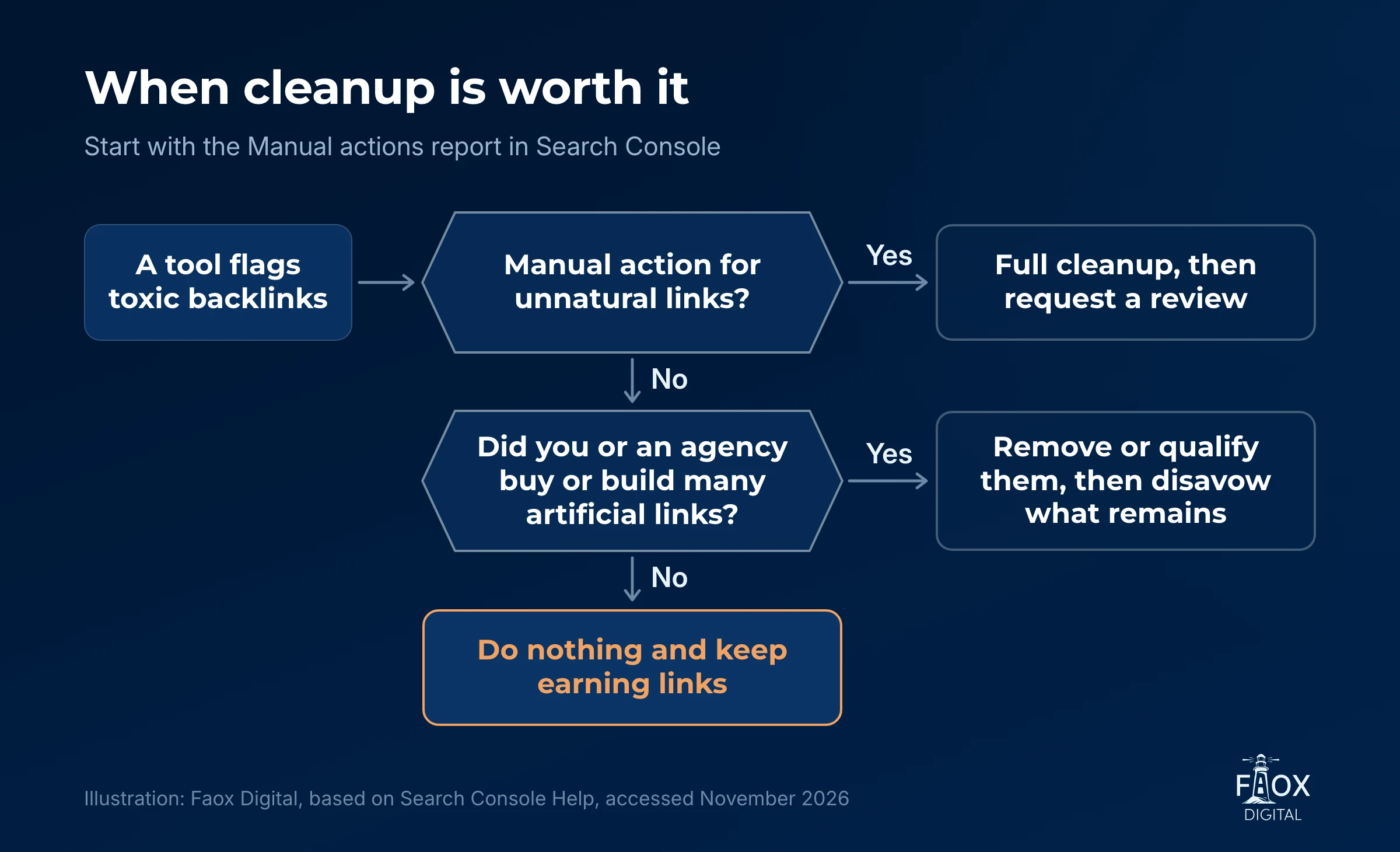
Google’s test for disavowing has two parts, and both must be true: you have a considerable number of spammy, artificial or low-quality links, and they have caused a manual action or are likely to. That is why when doing nothing is right covers most cases:
| Situation | What to do | Why |
|---|---|---|
| A tool shows a high toxicity score | Nothing, beyond a quick look | It is a tool’s estimate, not a Google finding |
| Odd links from unknown sites and scrapers | Nothing | Google says it can usually assess these itself |
| A sudden burst of links you did not build | Check the Manual actions report, then nothing | Google says it works to stop this from harming you |
| Rankings fell after an update | Look at content and technical issues first | Disavowing is unlikely to bring them back |
| You or an agency bought many links, with no manual action yet | Remove or qualify them, then disavow what remains | Google says these can lead to a manual action |
| A manual action for unnatural links | Full cleanup and a review request | Google requires both |
| You bought a site with a link history | Check the report, and take the same steps if needed | Google lets you explain the purchase in your request |
Mueller added in March 2026 that most sites do not need a disavow file but that this is not all sites, and that using one is fine if you are unsure. So a careful list is not a disaster. It is just rarely the best use of your time.
How to check for a manual action
A manual action means a human reviewer at Google has decided that pages on a site break its spam policies. Some or all of the site may then rank lower or drop out of results. You will find any action in the Manual actions report in Search Console, and Google also sends a message there. If the report shows nothing, no reviewer has acted against your site, whatever a tool says.
The action to look for is called "Unnatural links to your site". A separate one, "Unnatural links from your site", concerns links you sell or place on your own pages.
Cleaning up bought links
Cleaning up bought links follows the order Google describes: removal first, then a disavow file for what is left.
- Build the list. Export links from Search Console’s Links report, and ask any past agency for its placements. Google suggests starting with the sites that link most and links from recent months.
- Mark what breaks the rules. Look for paid posts, link networks, exchanges, widgets and keyword-rich links placed for you. Leave organic links alone, because Google warns against disavowing them.
- Ask for removal. Write to each site owner and ask them to remove the link or add
rel="nofollow"orrel="sponsored". - Keep a record. Log each request and reply. Google says disavowing everything without trying to remove links might lead to your request being rejected.
- Disavow what remains. Use the file format below, and list only what you could not get removed.
- Request a review if you have a manual action. Explain the issue, what you did and the result, and attach your record. Google says most reviews take several days or weeks, and link-related ones can take longer.
How to use the disavow tool
The disavow tool in Search Console tells Google to ignore links you cannot remove. Google calls it an advanced feature and warns that incorrect use can harm your site’s performance. When you do need to disavow links, its help page sets these rules for the disavow file format:
- A text file in UTF-8 or 7-bit ASCII, with a name ending in .txt
- One entry per line: a full URL, or
domain:example.comfor a whole domain or subdomain - Comment lines starting with
#, which Google ignores - No subpaths such as example.com/en/
- At most 100,000 lines, 2 MB in size and 2,048 characters per URL
Four details catch people out:
- Domain properties are not supported. Google says the tool does not work with them, so you need a URL-prefix property.
- Each property has one list. A new upload replaces the old one, so keep a master copy. Separate http and https properties each need a list.
- Disavowed links stay in the Links report. Seeing them there does not mean the file failed.
- It takes time. Google says a list can take a few weeks to be incorporated as it recrawls the web.
Do not build a routine around this tool. Bing announced in September 2023 that it would remove its own in October 2023, and Mueller said in May 2024 that he is sure Google will remove its tool at some point. He also called it a big red flag when a tool suggests cleaning up toxic links regularly. At the time of writing (November 2026), the tool is still available.
Where the time is better spent
If none of this applies to you, put the hours into earning links instead. Our guide to practical link building strategies starts with the relationships you already have. Our article on turning coverage into links covers trade press, and the one on brand mentions and SEO shows how to use what people already say about you.
If your bad links came from a provider, the next question is how to avoid paying for them again. Read our guide to choosing a link building service before you sign anything.
How Faox Digital looks at a link profile
When Faox Digital starts an SEO project, the audit and baseline shows where the site stands and who it competes with before any link work is planned. New authority then comes from earned coverage in the press buyers read, with any paid placement labelled as sponsored.
Key takeaways
- Toxic backlinks is a tool label. Google speaks of spammy, artificial or low-quality links and says it can usually assess them itself.
- A toxicity score is an estimate. It cannot see what Google already ignores, and a better score does not show that Google changed its view.
- Disavow only if you have a considerable number of bad links and they have caused a manual action or are likely to.
- With bought links, try removal first, keep a record and disavow only what remains.
- If you did not buy or build the links and the Manual actions report is clear, doing nothing is usually right.
Frequently asked questions
What are toxic backlinks?
They are links an SEO tool has flagged as likely to harm your site. The label is not Google’s. Google speaks of spammy, artificial or low-quality links, and says it can usually decide on its own which links to trust.
Can a competitor hurt my site with bad links?
Google says it works very hard to stop actions on other sites from harming yours, and John Mueller said in 2020 that he could not recall a site needing a disavow for negative SEO. Check the Manual actions report, and if it is clear, carry on.
How do I remove a backlink from another website?
Write to the site owner, name the page and ask them to remove the link or add rel="nofollow". If they do not reply, leave it, unless it meets Google’s test for disavowing: many bad links and a manual action, or a likely one.
How long does a disavow take to work?
Google says a list can take a few weeks to be incorporated as it recrawls the web. If you also have a manual action, most reviews take several days or weeks, and link-related ones can take longer.
Sources
- Search Console Help: Disavow links to your site, accessed November 2026
- Search Engine Roundtable: John Mueller blasts the concept of toxic links, again, 2024
- Ahrefs: I disavowed toxic backlinks, here’s what happened, 2024
- Semrush: Auditing your backlinks, accessed November 2026
Let’s talk
Where do you want to be found?
Tell us the searches that matter to your business. We will review your site and tell you plainly what to fix first, including what you can do yourself.