
B2B Link Building: Practical Strategies for Industrial Companies
How an industrial company earns links within Google’s rules, from associations, certifiers and distributors to useful content, and what to learn from competitors’ links.
B2B link building works best when links come from places your buyers already use: associations, trade fairs, certifiers, distributors, trade media and useful content of your own. Claim the links your business has already earned, study competitors’ backlinks for what you can honestly earn, and avoid bought links and keyword-rich guest post campaigns, which Google’s spam policies rule out.
Most link building advice assumes you run a publisher or an online shop. An industrial company starts somewhere else: years of memberships, certificates, trade fairs and distributor relationships, most of which nobody has ever checked for links.
This article is the practical follow-up to our guide to link building for B2B, which explains how links work and what makes one worth having. Here we cover what to do, in what order, and what to learn from competitors’ links. The examples come from a hypothetical pump seal manufacturer.
Why B2B link building starts with where buyers look
Links from industry sources do two jobs: they can help in search, and they put you where technical buyers already go. The 2026 State of Marketing to Engineers survey by GlobalSpec and TREW Marketing asked 783 respondents where they routinely look when researching a work-related purchase:
The survey comes from companies that sell marketing to engineers, so treat it as a guide and not a census. Still, it shows why a listing on one of these sites can be worth having even if it passes no ranking credit at all: a buyer can click it.
Link building strategies compared: what to do first
Work from the links that are nearly yours toward the ones that take the most effort. The table compares the main link building tactics. The effort and risk ratings are our own judgment, not Google’s.
| Tactic | What it takes | Effort | Risk |
|---|---|---|---|
| Association and trade fair listings | Membership or exhibiting, then a correct profile | Low | Low |
| Certification and membership pages | Asking the issuer to list your site | Low | Low |
| Supplier and distributor links | Accurate company data and no link clauses | Low | Low |
| Unlinked brand mentions | Finding them and asking politely | Low | Low |
| Broken link opportunities | A replacement page worth linking to | Medium | Low |
| Linkable content | Engineers’ time, then promotion | High | Low |
| Digital PR | Real news, data or expert comment | High | Low |
| Guest articles | A publication your buyers read and original writing | Medium | Medium, and high at scale with keyword links |
| Bought links | Money | Low | High |
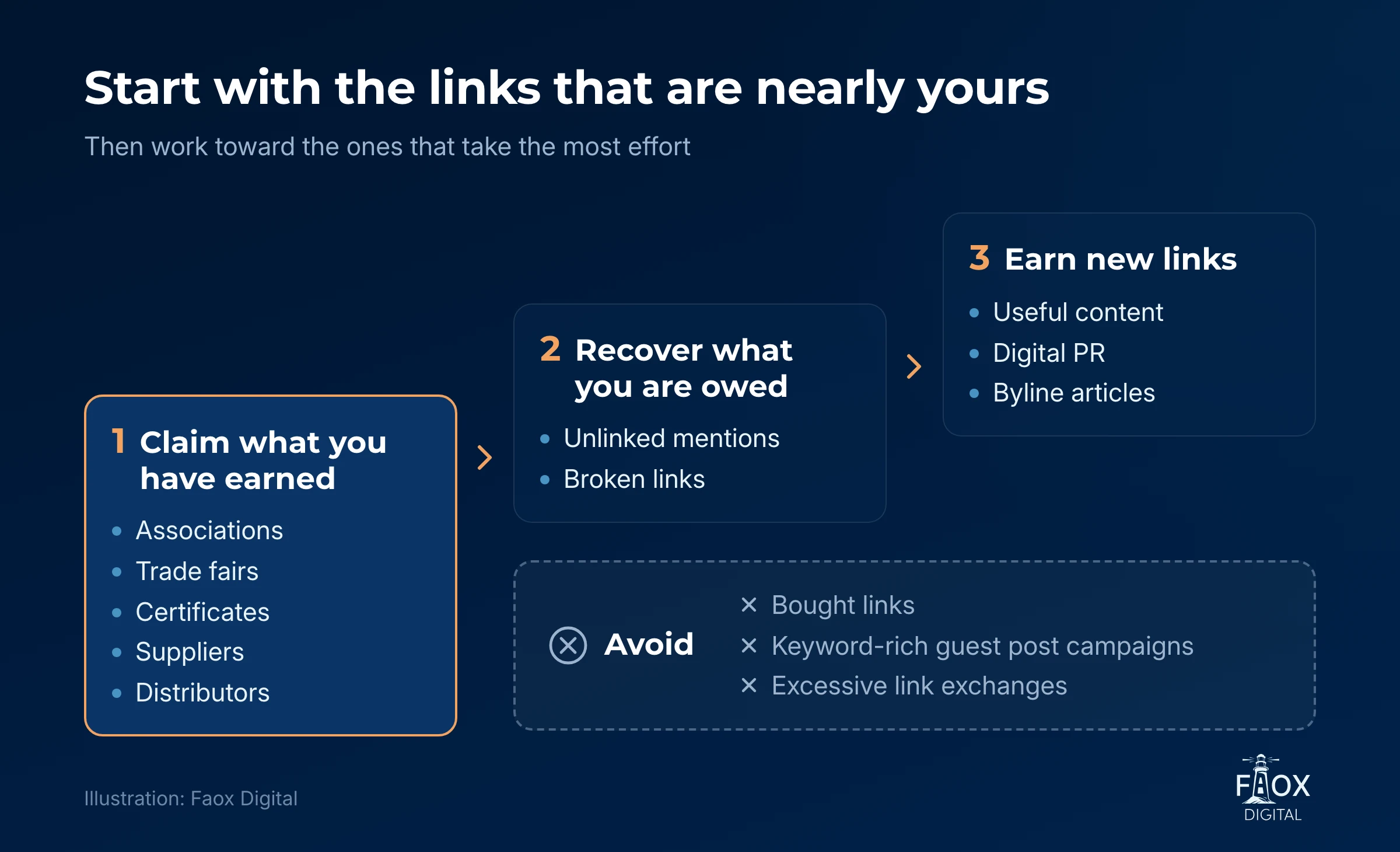
Claim the links you have already earned
Start with a list, because these relationships usually sit in different departments. Quality holds the certificates, the export team knows the distributors and marketing books the trade fairs. Ask each for names, then check every one for three things: your correct company name, a working link and the right destination page.
Industry associations and trade fair websites
Industry associations often keep a member directory, and trade fair websites keep an exhibitor directory. An exhibitor profile for Hannover Messe 2026, for example, carries a link to the company’s website. Some association lists give only a name, so ask whether a link can be added. Update fair profiles before each edition, and ask whether a speaking slot or working group comes with a page of its own. Do not reject a listing because its link is marked nofollow: a buyer can still click it.
Certification and membership pages
Certification and membership pages confirm what you claim, so they help a buyer before search comes into it. TÜV Rheinland’s Certipedia database, for instance, says it shows certificates along with a link to the customer’s website (accessed November 2026). Ask each certifier, test laboratory and standards body whether it has a public register and whether it can link to you. Send the link to a page that shows the certificate in context, and link back to the register from there so buyers can check it.
Supplier and distributor links
Supplier and distributor links come from commercial relationships you already have: a distributor’s brand page, a supplier’s customer list, an equipment maker that names your seals in its documentation. Make it easy with a short data pack: logo, one-paragraph description and the right web address for each country.
Linking back where it helps buyers is normal. An Ahrefs study updated in March 2020 found some reciprocal links on 43.7% of the 112,440 top-ranking pages it checked, though that says nothing about cause and effect. Google’s spam policies (updated August 2026) draw the line at excessive link exchanges and partner pages made only for cross-linking. They also name two traps that matter here:
- Link clauses in contracts. Requiring a link in a contract or terms of service is link spam unless the other party can choose to qualify it. Ask; do not require.
- Site-wide credits. Widely distributed links in the footers or templates of various sites also count. Think twice before sending every distributor a "powered by" or partner badge with a link in it.
Recover what you are owed: mentions and broken links
Unlinked brand mentions are the simplest request in link building, because someone has already written about you and left out the link. Think of a trade magazine’s report on your new product line or a fair’s list of award winners. Search for your company and product names, leaving out your own site, and write only where a link would help that page’s readers. Our article on brand mentions and SEO explains how to find them and how to ask.
Broken link opportunities come in two kinds:
- Your own dead pages. Old product pages, PDFs and campaign addresses keep their links long after a redesign removes them. Ahrefs’ free Broken Link Checker shows the most-linked dead pages on your site (accessed November 2026). Reinstate them or redirect each one to its closest live page. Google says 301 and other permanent redirects do not cause a loss in PageRank.
- Dead links on other people’s pages. Pew Research Center found in 2024 that 23% of news webpages and 21% of US government (.gov) webpages contained at least one broken link, and there is no reason to expect association resource pages to do better. If a page your buyers use points to a dead guide, tell the owner and, if you have a good replacement, offer it.
Keep every request short: name the page, say what is missing, give the exact web address and make it easy to say no. The note is useful to the owner even if they do not use your page.
Create content worth linking to: data, guides and tools
Publishing alone rarely earns links. Backlinko’s 2019 analysis of 912 million blog posts found that 94% had no external links at all. Linkable content is different: it saves an engineer, editor or association work, so they point others to it.
| Format | Why people cite it | Example for a pump seal maker | What it needs |
|---|---|---|---|
| Data | Numbers nobody else has, with the method shown | Causes of failure across returned seals, anonymized | Enough cases to be honest |
| Guides | They save hours of reading | A seal material selection guide by fluid and temperature, or a plain summary of a standard | Review by an engineer |
| Tools | They solve a recurring task | A face speed calculator, chemical compatibility table or CAD library | Someone to keep them correct |
GlobalSpec’s 2026 survey points the same way: ebooks and guides (47%) and CAD drawings (34%) were among the content buyers would give their details for. But an editor cannot cite what sits behind a form, so keep the main page open and gate only the extras.
Then take it to the people who can use it: the association covering the topic, your distributors’ application engineers and the trade press. Online technical publications topped the survey list above, and a story built on your own data gives an editor a reason to write. Our guide to working with journalists covers the approach, and our article on turning coverage into links covers the search side.
Competitor backlink analysis: finding links you can earn
Competitor backlink analysis shows where rivals get their links, so you can find sources you missed. Search Console covers only your own site, so you need a backlinks checker. At the time of writing (November 2026), these are three places to start:
- Bing Webmaster Tools (free). Once your site is verified, its Backlinks tool compares you with up to two other sites and can show only the domains that do not link to you. Bing says the list is representative, not complete.
- Ahrefs Backlink Checker. It has a limited free version for any site. The paid reports include Best by links, which shows a rival’s most-linked pages.
- Semrush Backlink Gap. It compares up to five sites and filters for those linking to competitors but not to you.
- Pick the right rivals. Take three to five sites that appear for your buying searches, plus the competitor your sales team meets most. Repeat for each export market.
- Look for overlap. A site linking to two or more rivals but not to you is your best lead.
- Study their most-linked pages. They show what has earned links in your sector and feed your content plan.
- Sort each lead by type. The table below shows what each type usually means.
- Ask three questions. Would our buyers read this site? Why does the link exist? Could we honestly earn the same? If any answer is no, drop it, whatever its authority score says.
- Give each lead an owner. The export manager may know the distributor, and the quality manager the test laboratory.
| What you find | What it usually means | Your move |
|---|---|---|
| Association member page | A membership | Check whether you qualify, or are a member but unlisted |
| Trade fair exhibitor page | Exhibiting | Complete your profile next time you exhibit |
| Certifier or test lab register | A certificate | Ask your own certifier for the same listing |
| Trade magazine article | News, data or expert comment | Offer the editor your own story |
| Distributor or customer page | A commercial relationship | Ask your own partners |
| Resource page or guide | A useful page | Build a better one, or ask to be added |
| Keyword-rich link in an article on an unrelated site | Probably paid | Skip it and do not copy it |
Tool data is an estimate, and some of what you find will have been bought. Use the list for ideas, not as a to-do list.
Guest posting risks, and when an article is still worth writing
Guest posting risks come from scale and intent, not from the format. Google said in 2017 that it does not discourage articles that inform readers or bring awareness to a company. What breaks its rules is when the main aim is building links at scale. It named four warning signs, when taken to an extreme: stuffing keyword-rich links, publishing across many sites, using writers who do not know the subject and reusing the same content. Its current spam policies also list optimized anchor text in guest posts as link spam. Google added that publishing such articles can change how it sees the host site, which is one more reason to avoid sites that will print anything for a fee.
So treat a guest article as publishing, not as link building:
- Write for a publication your buyers read, and whose editor would want the piece anyway
- Have someone who knows the subject write or review it, under their own name
- Offer original text, not a copy of a page on your site
- Link with your company name, or not at all
- Accept the publication’s link policy, including nofollow
- If the publication charges, treat it as advertising and ask for
rel="sponsored"
Trade media usually call this kind of piece a byline, and our guide to byline articles explains how to get one published.
The risk of buying links
The risk of buying links is easy to miss because the offers look ordinary. Google’s spam policies count more than cash: exchanging goods or services for links, or sending a product in exchange for a write-up with a link, also qualifies. A supplier discount offered in return for a link is still a purchase.
Paid placements themselves are fine. Google calls them a normal part of web advertising, as long as the link is marked rel="sponsored" or rel="nofollow". You can sponsor a fair or a trade magazine feature if any link is qualified, so ask for that in writing.
Bought links usually end one of two ways:
- They are ignored. Google said in December 2022 that SpamBrain can detect sites buying links and sites passing them, and that credit from such links is lost. The money is gone.
- They bring a manual action. Search Console Help says buying links can lead to one, and that some or all of a site may then not appear in results.
Your buyers can also see where your name appears. If an earlier agency left you with bought links, read our article on toxic backlinks before you act.
Anchor text variety: let it happen
Anchor text variety is often sold as something to engineer, with target percentages for brand and keyword links. Google publishes no such mix. Its link best practices (updated December 2025) say good anchor text is descriptive and reasonably concise, and its spam policies list optimized anchor text in distributed articles as link spam.
Links you earn use whatever the writer chooses: your company name, a product name, a web address or a phrase from their own sentence. That mix is the natural result. Two things are in your hands:
- What you suggest. If someone asks what to use, give the company name or the page’s plain title. Do not send a keyword phrase, or ask everyone to use the same one.
- What you check. Look at Top linking text in Search Console’s Links report now and then. It is a sample, but a list full of exact commercial phrases usually has a story behind it, and you should find out what it is.
How to judge the work
Agree on this before you start, because link building is slow and no one can promise a ranking from it. Count the links you earned from the sources on your list, then look at what they do: referral visits, enquiries from those visits, and whether the linked pages improve for the searches you care about in Search Console. Review it every quarter, and drop sources that bring none of this.
Your own team has to do the first stage, since only your people know these relationships. If you are considering outside help with the rest, read our guide to link building services first.
How Faox Digital approaches B2B link building
At Faox Digital, link building sits in the content and authority step of an SEO project: we create pages worth linking to and earn placements in the press buyers read, in each market’s own language. Any paid placement is labelled as sponsored.
Key takeaways
- B2B link building starts with relationships you already have: associations, trade fairs, certifiers, suppliers and distributors.
- Recover what you are owed next: unlinked mentions and dead pages that still attract links.
- Earn new links with data, guides and tools that save engineers and editors work, and take them to the people who can use them.
- Use competitor backlink analysis to find leads, and drop any link you could not honestly earn.
- Avoid bought links, link clauses in contracts and keyword-rich guest post campaigns, and mark paid placements as sponsored.
Frequently asked questions
What is a link building strategy in SEO?
It is a plan for which sites you want links from, why they would link to you, who does the work and how you will judge it. A good one starts from your buyers and your existing relationships, not from a target number of links.
How do you start link building with no budget?
List your memberships, certificates, trade fairs, suppliers and distributors, and check whether each one links to the right page. Then search for unlinked mentions of your company and use Bing Webmaster Tools to see who links to your rivals. All of this costs time, not money.
Is B2B SaaS link building different?
The rules are the same, but the sources differ. A software company has integration partners, app marketplaces and software directories where a manufacturer has associations and certifiers. The limits on buying links and on guest post campaigns apply equally.
Should I hire a B2B link building agency?
It depends on what you need. Your own team has to claim links from your relationships, while an agency can help with research, outreach and content. Be wary of any offer that promises a set number of links or a target score, because no one controls what editors choose to do.
Sources
Let’s talk
Where do you want to be found?
Tell us the searches that matter to your business. We will review your site and tell you plainly what to fix first, including what you can do yourself.