
What Is Brand Voice? A B2B Guide to Sounding Clear and Consistent
What brand voice means for a B2B company with technical products, how voice differs from tone and what voice guidelines need so that engineers, sales and AI tools all sound alike.
Brand voice is the consistent personality in how a company writes and speaks: its words, its level of formality, how much detail it gives and how it treats the reader. Tone is how that voice adapts to the situation, from a data sheet to a reply to a complaint. In B2B, a clear voice lets engineers, sales staff, distributors and AI writing tools all sound like one company, in plain language technical buyers can use.
Read a B2B company’s website, then one of its data sheets, a sales email and a LinkedIn post, and you can often hear four different companies. Each was written by a different person, in a hurry, for a different reader. A buying group that reads all four has to work out whether they belong to the same supplier.
This guide explains what brand voice is, how it differs from tone, where it comes from and how a company that sells technical products keeps it clear and consistent across channels, languages and AI writing tools. It opens our series on voice and messaging; you can find all Branding & Strategy articles on the category page.
What is brand voice?
Brand voice is the personality a company shows in words. It covers the vocabulary it uses, how formal it is, how long its sentences are, how much technical detail it gives, whether it writes "we" and "you", and how it treats the reader: as a peer, a student or someone to impress.
Brand voice is the verbal side of a company’s identity, next to the visual system; our guide to B2B brand identity shows how the two fit together. Some people call it tone of voice. In this series, voice is the constant character and tone is how it adapts to each moment.
A B2B voice has a particular job. It has to make complex, technical offers clear to people with different expertise, without sounding like a sales brochure on one side or like a technical standard on the other.
Brand voice vs tone
The difference between voice and tone is simple. Mailchimp’s content style guide puts it this way: "You have the same voice all the time, but your tone changes." Your voice is who you are; your tone is how you speak in a given situation.
Suppose a company’s voice is exact, plain and helpful. Its tone then shifts with the situation:
| Situation | Tone | How it might open |
|---|---|---|
| Product page | Confident and informative | "Designed for continuous operation, with every unit pressure-tested before shipping." |
| Data sheet | Neutral and precise | "Body material: stainless steel. Test conditions: see table below." |
| Delay notice | Direct and apologetic | "Your order will ship later than we promised. Here is why, and what we are doing." |
| LinkedIn post | Warmer and more personal | "Our new test bench went live this week, and the team who built it deserves the credit." |
| Reply to a complaint | Calm and respectful | "Thank you for telling us. We have checked the batch and found the cause." |
In every row the company still sounds exact, plain and helpful. That is what consistency means: the same character, not the same sentence.
The four dimensions of tone
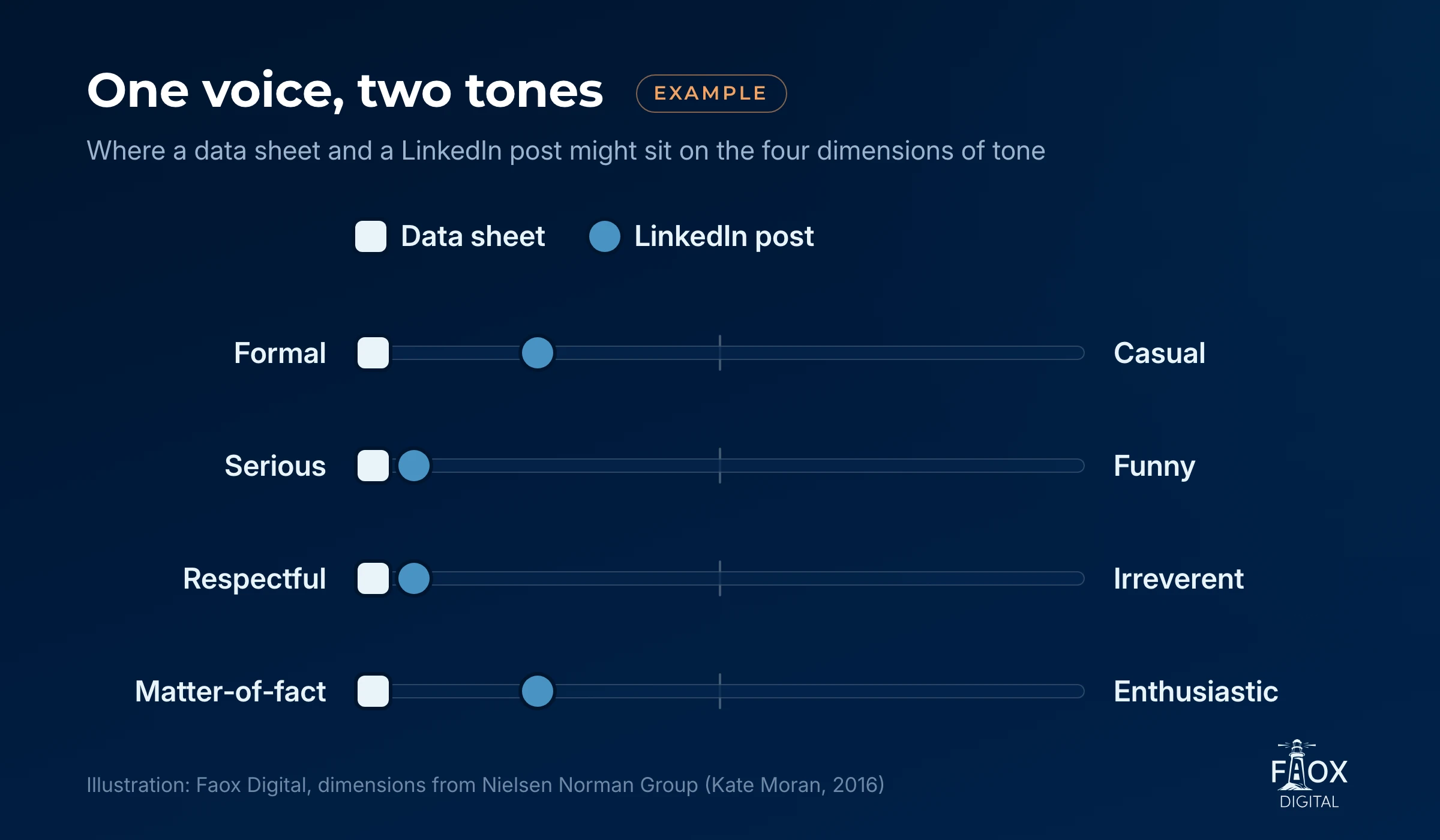
Nielsen Norman Group’s Kate Moran described tone of voice along four dimensions in 2016: formal vs casual, serious vs funny, respectful vs irreverent, and matter-of-fact vs enthusiastic. A related Nielsen Norman Group study the same year found that different tones on a website had a measurable effect on how users perceived a brand’s friendliness, trustworthiness and desirability.
For most B2B companies the useful range is narrow: more formal than casual, more serious than funny, always respectful and closer to matter-of-fact than enthusiastic. Within that range, small shifts matter. A data sheet sits at the formal, serious, respectful and matter-of-fact ends of all four dimensions; a LinkedIn post can move a little toward casual and enthusiastic while staying serious and respectful.
Where your brand voice comes from
A voice is not chosen from a list of pleasant adjectives. It follows from two earlier decisions:
- Brand personality: the few traits the company shows, such as exact, calm and helpful, each paired with what it is not: exact but not cold, confident but not arrogant, helpful but not pushy.
- Positioning: the reason buyers should choose you. A company positioned on engineering depth should sound like an expert colleague; one positioned on fast service should sound quick and practical.
Listen also to how your best salespeople and engineers already talk to customers. The voice that wins trust in meetings is usually a better starting point than one invented in a workshop.
Why brand voice matters in B2B
Many people write in your name. Engineers write data sheets and manuals, product managers write launch texts, sales staff write proposals and emails, service teams write reports, distributors and agencies write the rest. Without a shared voice, each writes in their own.
Buyers read many of these documents. A buying group meets your website, your proposal, your data sheet and your emails over months. When they sound like one company, the buyer’s picture of you grows with each one; when they do not, doubt grows instead.
Technical buyers notice vagueness. An engineer who reads "high performance" without a number or a test condition learns nothing, and may conclude there is nothing to say. Clarity is a form of respect for expert readers.
AI tools multiply output. Writing tools now produce text in seconds. Without guidance, they produce generic marketing language that sounds like everyone else.
Technical language and jargon
B2B buyers expect technical language, but not jargon. The difference:
- Technical language is the precise vocabulary your buyers use themselves: standard designations, material grades, units and test methods. Use it, and use it consistently.
- Jargon is language that does not help the reader: internal abbreviations, project code names and empty phrases such as "innovative solutions" or "value-added partnership".
A few rules handle most cases. Spell out every abbreviation at its first use. Give every number its unit and test condition. Prefer the buyer’s standard terms over your internal product codes. And say why a specification matters: not only the pressure rating, but what it allows the buyer to do.
Readability: plain language for expert readers
Expert readers are still busy readers. Plain language is not simplified language; it is writing that lets readers find, understand and use what they need. ISO 24495-1, the international plain language standard published in June 2023, sets out governing principles and guidelines for plain language documents, and it states that they also apply to technical writing.
In practice, good readability in B2B comes down to a few habits:
- Put the answer, the decision or the result first, and the background after.
- Keep sentences short and paragraphs to one idea.
- Use headings, lists and tables so readers can scan.
- Prefer active verbs: "we test every valve" rather than "every valve is tested."
- Cut words that add nothing, such as "in order to" or "at this point in time."
Tone by channel
The same voice takes a different tone by channel:
| Channel | Typical tone | What to watch |
|---|---|---|
| Website | Confident, clear, benefit first | Keep the proof close to every claim |
| Data sheets and manuals | Neutral and precise | Units, conditions and consistent terms |
| Proposals | Formal and specific to the buyer | Use the buyer’s requirements and words, not generic text |
| Sales and service emails | Direct, polite and personal | Keep them short, with one request per email |
| LinkedIn and social media | Warmer and more personal | Stay expert and avoid hype |
| Trade press and bylines | Expert and neutral | Editors remove promotional language |
| Problem and complaint messages | Calm, respectful and factual | Say what happened and what you are doing about it |
Social media is where B2B voices drift most, because posts are written quickly by many people. Our guide to B2B social media content covers how to plan, make and repurpose posts that still sound like you.
The glossary: one term for one thing
A glossary is the most practical tool in a B2B voice guide. It lists:
- Product and service names with their exact spelling and capitalization
- The preferred term for each concept, and the terms to avoid
- Abbreviations and when to spell them out
- Units, number formats and how to write dates
Without a glossary, the same product appears under three names on the website, in the catalogue and in proposals, and buyers wonder whether they are three products. Keep the glossary in every language you sell in, and make it the first file every new writer, translator and agency receives.
Do’s and don’ts
A short list of do’s and don’ts, each with a real example from your own documents, teaches faster than any description of the voice:
| Do | Don’t |
|---|---|
| Start with what the reader needs | Start with the company’s history |
| Use the buyer’s technical terms | Use internal project names and codes |
| Give numbers with units and conditions | Write "high performance" with no proof |
| Write "we" and "you" | Hide behind long passive sentences |
| Explain why a feature matters | List features without consequences |
| Admit limits and say what you are doing | Promise more than operations can deliver |
Brand voice examples: before and after
Brand voice examples are clearest as rewrites. Here are three typical B2B texts for a hypothetical valve maker whose voice is exact, plain and helpful:
| Text | Before | After |
|---|---|---|
| Catalogue introduction | "As an innovative company with decades of experience, we offer high-quality solutions that meet all your needs." | "We make industrial valves for process plants that cannot afford a leak. Every valve is pressure-tested in our own lab and ships with its test record." |
| Proposal paragraph | "Our solution provides maximum efficiency and optimal performance for your application." | "For your line we propose two valve sizes that fit your existing flanges, so the change needs no new pipework." |
| Delay email | "We regret to inform you that due to unforeseen circumstances your order has been delayed." | "Your order will ship later than promised, because a casting failed our inspection. We will confirm the new date by Friday." |
The "after" versions are not more creative. They are more specific: they name the reader’s situation, give a reason and say what happens next. That is what an exact, plain and helpful voice sounds like in practice.
Brand voice guidelines: what to include
Brand voice guidelines turn the voice into something people can apply. A useful guide fits on a few pages and contains:
- The personality traits, each paired with what it is not
- How the tone shifts by channel and situation
- The glossary of names, preferred terms and abbreviations
- Do’s and don’ts with before-and-after rewrites of real texts
- Rules for numbers, units, dates and capitalization
- Notes for each language and market
- Instructions and reference texts for AI writing tools
Examples matter most. A before-and-after rewrite of one paragraph from your own catalogue shows more than "clear and confident" ever will.
Messaging and storytelling: what the voice carries
Voice is how you say things; messaging is what you say. A messaging framework sets out the core messages, the proof behind them and the version for each audience, so that the voice always has the right content to carry.
Storytelling makes those messages memorable: a customer problem solved, an engineering decision explained, a test that failed and taught you something. Our article on why storytelling matters in B2B explains why stories work even for buyers who compare specifications line by line.
Consistency across languages
For exporters, the voice has to work in every language. Formality, directness and humor work differently from one language to the next, so a voice translated word for word can come out too stiff in one market and too casual in another.
Consistency across languages therefore means the same character, expressed by native writers:
- Write a short voice section for each language, with examples written in that language.
- Keep a glossary for each language, agreed with sales staff and distributors in that market.
- Decide the form of address, such as formal or informal "you" where a language has both.
- Have texts written or reviewed by native speakers who know your industry.
When you enter a new market, the voice guide for that language belongs to the preparation, alongside the rest of your B2B go-to-market strategy.
Brand voice and AI writing tools
AI writing tools produce fluent text quickly, and without guidance they drift toward generic marketing language. Instructions for AI writing tools should contain what you would give a new copywriter: the voice guidelines, the glossary, a few approved example texts and the facts the tool may use.
Most tools let you save standing instructions. OpenAI’s help center, for example, describes ChatGPT’s custom instructions, which apply to all chats once saved (at the time of writing, November 2026). Check each tool’s data settings before you paste internal material: OpenAI’s page notes that information from custom instructions will also be used to improve model performance. And every AI-written text still needs a reviewer who knows the product.
Signs your brand voice needs work
Your voice probably needs attention if:
- Customers describe you in different words from the ones you use about yourself
- The same product has different names on the website, in the catalogue and in proposals
- New staff ask how to write to customers, and nobody can point them to an answer
- Distributors rewrite your translated texts before they use them
- Texts written with AI tools sound like every other supplier’s
- Your website and your data sheets read as if two different companies wrote them
Each of these has a practical fix: a glossary, templates, a short guide with examples or native reviewers. None needs a new logo.
Who keeps the voice consistent
Name an owner, usually in marketing, who maintains the guidelines and the glossary and approves exceptions. Train the people who write most: sales, product management and service. Review first the texts that get copied most often, such as quote templates, standard emails and product descriptions.
Outside help makes sense when the company needs a fresh voice, works in many languages or has to produce a lot of content quickly. Our guide to hiring storytelling help covers when it is worth it and what to ask.
How Faox Digital approaches brand voice
At Faox Digital, finding the voice is the third of five working sessions with the client, after listening and positioning: together we define the tone, the narrative and a messaging framework the team can write inside. The voice is built for each market, so that the company reads as local in every language rather than translated.
Key takeaways
- Brand voice is the constant personality in how a company writes; tone is how that voice adapts to each situation and channel.
- A B2B voice follows from brand personality and positioning, and from how your best people already talk to customers.
- Use buyers’ technical language, avoid jargon and write in plain language, which ISO 24495-1 applies to technical writing too.
- Voice guidelines need traits, tone by channel, a glossary, do’s and don’ts, language notes and instructions for AI tools.
- Keep the voice consistent across languages with native writers and a glossary for each market.
Frequently asked questions
What is the difference between brand voice and messaging?
Brand voice is how a company says things: its personality in words. Messaging is what it says: the core messages, the proof behind them and the version for each audience. A messaging framework gives the voice its content, and the voice makes the messages recognizable.
What is brand voice consistency?
It means sounding like the same company everywhere: the same personality, vocabulary and standards of clarity on the website, in data sheets, proposals, emails and social media, and in every language. The tone may change by channel; the character should not.
What are examples of brand voice in B2B?
A company whose voice is exact, plain and helpful writes "every valve is pressure-tested and shipped with its test record" rather than "we deliver quality you can trust." Another, positioned on fast service, might write short, practical sentences that lead with delivery times and next steps.
How do you develop a brand voice?
Start from your positioning and brand personality, collect your best existing texts and listen to how your strongest salespeople and engineers talk to customers. Describe the voice in a few traits, write before-and-after examples, build a glossary, then test the guidelines on real documents before rolling them out.
Sources
- ISO 24495-1:2023, Plain language, Part 1: Governing principles and guidelines, 2023
- Nielsen Norman Group: The Four Dimensions of Tone of Voice, 2016
- Mailchimp Content Style Guide: Voice and Tone, accessed November 2026
- OpenAI Help Center: ChatGPT Custom Instructions, accessed November 2026
Let’s talk
Does your brand say what makes you different?
Show us how you describe your business today. We will tell you where it is clear and where buyers may get lost.