
Do You Need a B2B Storytelling Agency? When It Helps and What to Ask
When outside help with company and customer stories pays off, what a storytelling agency should deliver, and the questions that keep every story true and checkable.
You need a B2B storytelling agency when the stories exist but nobody inside the company has the time, distance or skill to find, check and tell them: a founder and family story, a history built from the archive, a brand documentary or a steady series of customer stories. Ask how the agency finds stories, how it verifies every fact, what it delivers and when, and who approves the final text. Walk away from any agency willing to invent a story.
Most B2B companies have better stories than they tell: how the company started, how a difficult project was saved, why a customer has stayed for decades. Telling them well takes time, an outside ear and the discipline to check every fact. A B2B storytelling agency offers all three, but not every company needs one.
This guide covers when outside help pays off, who does what, what an agency should deliver and the questions to ask before you sign. The stories also need a consistent voice, which our guide to brand voice for B2B covers. We work as a brand strategy agency, so we have a stake in the answer; the questions below apply to any agency, including us.
When a B2B storytelling agency helps
Outside help is worth paying for when at least one of these is true:
- The founders’ story has never been written down, and an outsider can ask the questions family members and long-serving staff do not ask each other.
- An anniversary, a succession or a new market calls for the company’s history in one place, and the archive is boxes of photographs and folders nobody has sorted.
- You want a brand documentary, which needs research, interviews, a script and a film crew.
- Customer stories stay in salespeople’s heads, because nobody has time to interview customers, get approvals and write.
- Several markets need the same stories, each in its own language and with its own examples.
When you can do it yourself
Many companies can start without an agency. If someone in marketing writes well, a few customer stories a year can be done in-house: collect cases from sales and service, interview the customer, write, check the facts with engineering and get the customer’s approval. A freelance copywriter can polish the writing. Bring in an agency when the volume grows, when the story is the company’s own history, or when it needs film.
Copywriter, storytelling agency, branding agency or film company
Four kinds of outside help, plus your own team, can take on story work:
| Option | Strong at | Watch for | Fits when |
|---|---|---|---|
| In-house writer | Knows the products and the people | Little time; too close to see the story | A few customer stories a year |
| Freelance copywriter | Clear writing at a modest cost | Needs the material and access you provide | The stories are collected and need writing |
| Storytelling or content agency | Interviews, archive research, structure and formats | Polished stories with thin proof | A series of stories, or the company’s history from scratch |
| Branding agency | Ties the story to positioning, voice and identity | Story work may be a small part of a larger project | The story is part of a rebrand or a new position |
| Video production company | Filming, editing and documentary craft | Script and facts are often left to you | The story is ready and needs to be filmed |
The table is our summary; many firms combine roles.
What the agency does: archive, interviews and narrative structure
Good story work starts with the archive and interviews. The archive means old catalogues, photographs, press cuttings, patents, order books and letters, sorted and dated so that every fact in the story has a source.
The interviews come next: founders, family members, long-serving staff, retired engineers and customers. The Oral History Association’s best practices, adopted in 2018, call for research before each interview, for the narrator’s informed consent and for a signed release, ideally when the interview is completed. They also say narrators can restrict an interview, make changes before it is shared or withdraw it. An agency that interviews your people should work the same way.
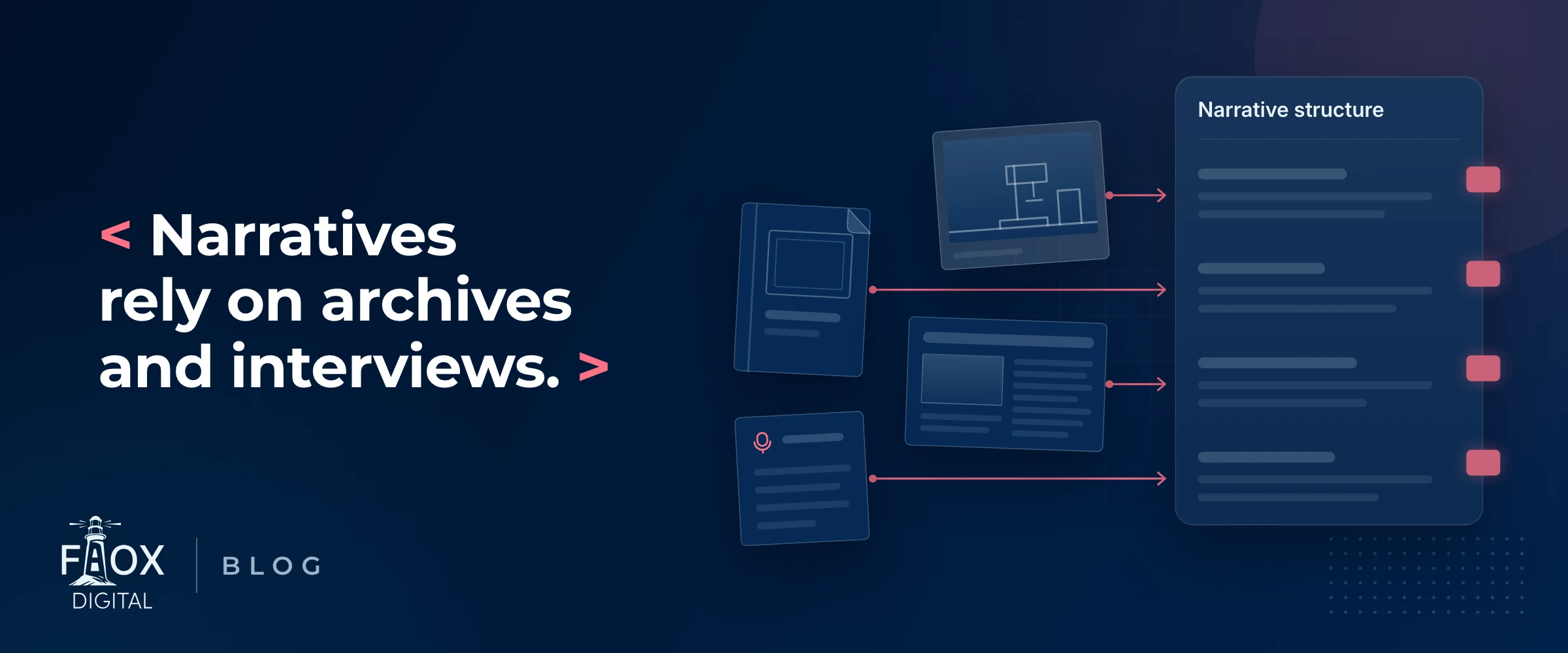
Then comes the narrative structure: the shape of the story. For a corporate story, that means where it starts, its turning points, what the company learned and what it means for buyers today. For customer stories, it is usually situation, problem, decision, work, result and proof.
Founder and family stories
A founder and family story is often the most valuable story a family company has, and the easiest to get wrong. Memories differ, dates drift and relatives disagree about who did what. A careful agency checks each memory against records, notes where accounts differ and agrees up front who approves the final version: the family, the company or both.
Avoid founding myths: if the first workshop was not in a garage, the story should not say so. Buyers look for continuity they can check, such as what the company learned early and still does today, not for a legend.
Brand documentaries and customer stories
A brand documentary is a short non-fiction film about the company, built from interviews and real places rather than actors and scripts written in advance. Clutch’s 2026 video production pricing guide, based on client reviews, puts the typical timeline for a video production project at 5 months, so plan a documentary well before the event or launch it is meant for.
Customer stories are smaller and steadier: one project, one customer, one measurable result, approved by the customer. A good agency turns one interview into several pieces: a case page, a sales slide, a short video and social posts. Our list of what B2B companies can post shows where those pieces fit.
Deliverables and timeline
Agree the deliverables by name before work starts:
- A corporate story in a long and a short version, plus a one-paragraph summary
- The narrative structure: chapters, turning points and the messages they carry
- Interview recordings, transcripts and signed releases
- An index of the archive material used
- Customer stories, each approved by the customer
- A documentary or its script, if included
- A source file showing where each fact comes from
The timeline depends more on your side than on the agency’s: how quickly founders, staff and customers can be interviewed, what state the archive is in, and how long approvals take with the family, customers and, where needed, lawyers. Film adds its own schedule. Ask for a work plan with dates for each interview and approval.
Proof, verification and the risk of invented stories
Proof and verification separate story work from fiction. Every date, number and quote should trace back to a record, a recording or a second source, and the customer or the person quoted should approve the final text. The Oral History Association makes the same point for interviews: an interview is subjective, so information presented as fact should be verified where possible.
The risk of invented stories is real. It shows up as a composite customer presented as a real one, a dramatized founding scene or a quote nobody said. AI writing tools add to it: OpenAI’s Help Center, updated in October 2026, warns that ChatGPT can produce incorrect or misleading output, including fabricated quotes and references to sources that do not exist, and advises users to verify quotes and data. Ask every agency how it uses such tools and who checks what they produce.
Put it in the contract too: the agency will not invent facts, customers or quotes, and you approve every final version.
Questions to ask a B2B storytelling agency
Use these in the first meeting:
- How do you find the stories: interviews, archive research, conversations with sales and service?
- Who conducts the interviews, and how do you handle consent and releases?
- Which B2B storytelling framework or narrative structure do you use, and why?
- Can you show B2B storytelling examples for technical companies, shared with the client’s permission?
- How do you check facts, and will we get a source for each claim?
- How do you use AI tools, and who verifies their output?
- How long will it take, and what do you need from us, and when?
- Who owns the recordings, transcripts and finished stories?
- What will you refuse to do? The answer should include inventing a story.
How Faox Digital works on company stories
Faox Digital, a digital growth partner for B2B companies in complex and international markets, works on a company’s story in its branding sessions with the client. We start by listening to how the company describes itself and what its buyers believe, then shape the tone, the narrative and a messaging framework the team can write inside. The story is built per market, so that it reads as local rather than translated, and for a company with a smaller budget we suggest a first step that fits its stage, even if the team does part of the work itself.
Key takeaways
- Hire outside help when the stories exist but nobody inside has the time, distance or skill to find, check and tell them.
- Match the provider to the job: a copywriter writes, a storytelling agency finds and structures, a film company films.
- Expect archive research, interviews with consent and releases, a narrative structure and a source for every fact.
- Agree deliverables, timeline and ownership in writing, and approve every final text.
- Rule out any agency willing to invent a story, a customer or a quote.
Frequently asked questions
What does a B2B storytelling agency do?
It finds, checks and tells a company’s stories. It researches the archive, interviews founders, staff and customers, builds a narrative structure and writes or films the stories, with a source for every fact. Some produce documentaries themselves; others hand a finished script to a film company.
What B2B storytelling examples should an agency be able to show?
Customer stories for technical products with measured results and the customer’s approval, a company history built from records and interviews, and short films in which engineers explain real work. Ask how each example was checked and who approved it.
Is there a B2B storytelling framework agencies use?
Many use a version of situation, problem, decision, work, result and proof for customer stories, and a sequence of turning points for a company’s history. The framework matters less than whether every step rests on a fact you can check.
Sources
- Clutch: Video Production Pricing Guide 2026, updated September 2026
- Oral History Association: Principles and Best Practices, 2018
- OpenAI Help Center: Does ChatGPT tell the truth?, October 2026
Let’s talk
Does your brand say what makes you different?
Show us how you describe your business today. We will tell you where it is clear and where buyers may get lost.