
How to Build a Messaging Framework Sales, Marketing and Engineering Can Share
A step-by-step guide to the one document that keeps sales, marketing and engineering saying the same thing, with a template and a worked example.

A messaging framework is a short internal document that sets out what a company says about itself: one core message, three supporting messages, the proof behind each, a version for each audience and answers to common objections. Build it from your positioning statement and value proposition, test it with sales and engineering, and keep it where every team writes, so that buyers hear one story from everyone they meet.
Ask a salesperson, a marketing manager and an application engineer why customers choose your company, and you may hear three good answers that do not match. Buyers notice the difference. A messaging framework settles it: one shared document that says what the company stands for, what to say to each audience and which proof backs it up.
Here, messaging means what a company says about its offer, not a chat or software feature. This guide shows how to create a messaging framework step by step, with a template and a worked example for a hypothetical valve maker. How the messages should sound is a separate question, covered in our guide to what brand voice means for a B2B company.
What is a brand messaging framework?
A brand messaging framework is the source text for everything the company says about itself: the website, proposals, sales presentations, data sheet introductions, trade fair stands, social posts and briefs for agencies and translators. It is internal. Buyers never see the document; they see what people write from it.
It answers four questions: what should every buyer remember, why is it true, what does it mean for each person in the buying group, and what do we say when they push back? It is not a script. Salespeople and engineers still speak in their own words, but they make the same points with the same proof.
Voice and messaging work together: the voice is how the company sounds, the messages are what it says.
Why sales, marketing and engineering need the same messages
Buyers meet a company through many people and documents, and most of that contact happens without a salesperson in the room. Gartner reported in 2020 that buyers typically spend only 17% of their time meeting with potential suppliers when they are considering a purchase. The rest goes on reading, comparing and discussing among themselves, using whatever your website, proposals and engineers have told them.
The audience is wide, too. Forrester’s State of Business Buying 2026 found that procurement professionals are decision-makers in 53% of business buying cycles, engaging from the start of the process. A message written only for engineers misses them.
When sales promises the fastest delivery, the website talks about precision and an engineer stresses low maintenance, the buyer has to guess which one is true. A shared framework turns three stories into one, and involving engineering keeps every claim technically honest.
The message hierarchy
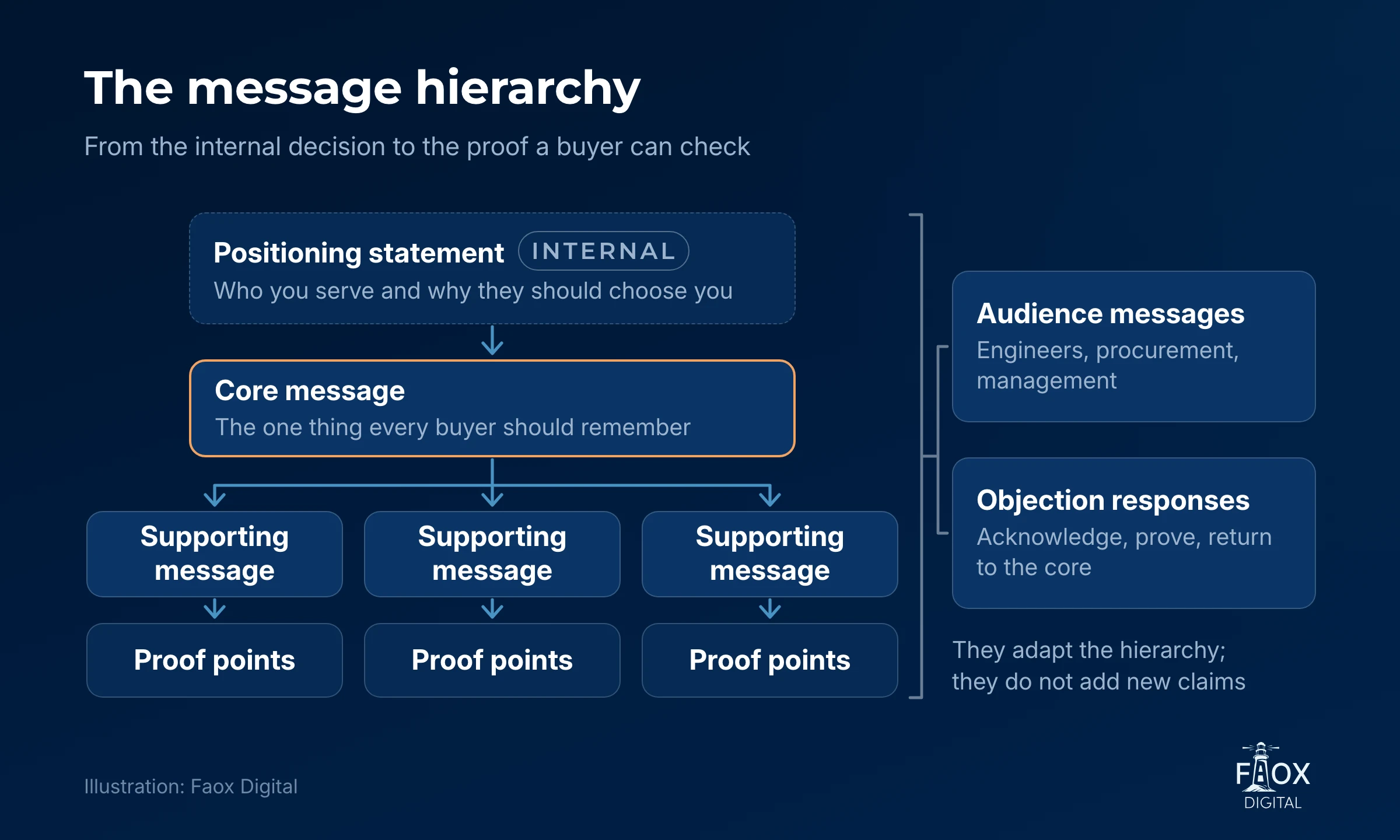
A message hierarchy puts the parts of a framework in order, from the internal decision to the proof a buyer can check:
- Positioning statement: the internal decision about who you serve and why they should choose you.
- Core message: the one thing every buyer should remember, in their words.
- Supporting messages: three reasons the core message is true.
- Proof points: the evidence under each supporting message.
Audience messages and objection responses sit beside the hierarchy. They adapt it; they do not add new claims.
Where the framework sits: positioning, identity and go-to-market
The framework starts where positioning ends. Your positioning statement is the input: if you have not written one, our positioning statement template shows how, and the valve maker example below continues from it. The value proposition, worked out for each role in the buying group, supplies the substance of the audience messages.
The framework then feeds two later pieces of work. The brand identity process gives the messages a consistent look, and a go-to-market strategy template decides which messages lead in a new market, in which channels and in what order.
Positioning statement, value proposition, core message and tagline
These four are often confused. The difference matters, because each has a different reader:
| Item | What it is | Who sees it | Length |
|---|---|---|---|
| Positioning statement | The internal decision about where you stand | Leaders and the people who write | One or two sentences |
| Value proposition | What each buyer gains from choosing you | Teams first; buyers see versions of it | A core sentence plus a line per role |
| Core message | What every buyer should remember | Buyers, in every channel | One or two sentences |
| Tagline | A short public phrase under the logo or in campaigns | Everyone | A few words |
Tagline vs message: a tagline can express part of the core message, but it cannot carry the proof. The messages do the persuading; the tagline, if you have one, makes the brand easier to recall. A company can do well without a tagline, but not without clear messages.
How to create a messaging framework, step by step
- Collect the inputs. The positioning statement, the value proposition, notes from buyer interviews and the objections sales hears most.
- Write the core message. One or two sentences a buyer would recognize as true.
- Choose three supporting messages. The three reasons the core message holds.
- Attach proof points. Evidence a buyer can check, under each supporting message.
- Write the audience messages. A version for engineers, procurement and management.
- Answer the main objections. Short responses built on proof.
- Test it. With sales, marketing and engineering, on real documents.
- Publish and maintain it. One owner, one place, a review date.
The sections below follow these steps for a hypothetical valve maker whose positioning statement reads: For chemical and food plants that cannot afford a leak or a failed audit, [company] makes industrial process valves that arrive engineered and fully documented for inspection. Square brackets mark the proof a real company would add.
Write the core message
The core message is the positioning statement turned outward: what you want a buyer to remember after a call, a visit to your website or a trade fair. Write it in the words buyers use in interviews, not in internal language, and keep it specific enough that a competitor could not sign it.
For the valve maker: "Valves that arrive tested, documented and ready for your next audit."
Test it with two questions. Would a buyer at a chemical or food plant care? Could they tell it apart from what your main competitor says? If the answer to either is no, it is still a slogan about quality.
Choose supporting messages and attach proof points
Supporting messages are the reasons the core message is true. Three is a practical number: enough to cover what the main roles in the buying group care about, few enough for a salesperson to remember. Each one needs proof points, evidence a buyer can check:
| Supporting message | Proof points |
|---|---|
| Every valve is pressure-tested before it ships, and the record travels with it | In-house test bench, a test record for each serial number, [test standard] |
| Every pressure-bearing part comes with its material certificate | Certificates traceable to the material batch, [certificate type], a sample documentation pack |
| Each valve is engineered for the process, not picked from a catalogue | Application engineers who size each valve for the medium and the cleaning cycle, [references in chemical and food plants] |
A supporting message without proof is just an adjective. If you cannot find the proof, drop the message, or make it true before you say it.
Audience messages for engineers, procurement and management
Audience messages keep the core message and change the first line, the order of the supporting messages and the proof that leads. Each member of the buying group reads the same company through a different question:
| Audience | Lead with | Example line (hypothetical valve maker) |
|---|---|---|
| Engineers | Performance and test data | Each valve is sized for your medium and tested at [test pressure], with the record tied to its serial number. |
| Procurement | Total cost and supply risk | Test records and certificates are included in the price, so audits and incoming inspection cost less: [lifetime cost example]. |
| Management | Risk to the plant | Fewer leaks and no gaps in the paperwork on the lines that carry your most hazardous media. |
What each role values is worked out in the value proposition; the framework turns it into lines people can say and write. Quality managers, operators and distributors may need rows of their own.
Objection responses
Objection responses prepare the whole team for the pushback sales hears most. Collect objections from salespeople, distributors and lost bids, then write each answer in three moves: acknowledge the concern, answer with proof, return to the core message.
| Objection | Response (hypothetical valve maker) |
|---|---|
| "You are more expensive than catalogue suppliers." | Compare the lifetime cost: testing and certificates are included, not charged later. [Cost comparison for one line.] |
| "We already have an approved supplier." | Start with one line where documentation causes the most trouble. [Pilot terms.] |
| "Your lead time is longer." | Engineering and testing take time, and we confirm the date in the quote. [On-time delivery record.] |
| "Can a smaller supplier support us for years?" | [Years in business], spare parts held for [period], [references]. |
Engineering should check every technical answer, and every salesperson should be able to give each one in their own words.
A messaging framework template
Copy this template into a shared document and fill it in from the steps above:
| Field | What to write | Rule |
|---|---|---|
| Positioning statement | The internal sentence from your positioning work | Not published as written |
| Core message | What every buyer should remember | One or two sentences, in buyers’ words |
| Supporting messages | The three reasons the core message is true | One sentence each |
| Proof points | The evidence under each supporting message | Checkable: data, certificates, references |
| Audience messages | Versions for engineers, procurement and management | Same core, different first line |
| Objection responses | The main objections and the answers | Acknowledge, prove, return to the core |
| Words to use and avoid | Preferred terms from the voice guidelines | One term for one thing |
| Tagline (optional) | A short public phrase, if you use one | Expresses part of the core message |
| Owner and review date | Who keeps the framework and when it was last checked | Review when the offer or market changes |
Keep it to one or two pages. A framework nobody can read in five minutes will not be used.
Test the framework with sales, marketing and engineering
A framework written by marketing alone tends to sound like marketing. Before you publish it, test it where it will be used:
- Each salesperson can say the core message in their own words in half a minute
- Engineering has checked every proof point and the conditions behind each number
- One real proposal and one web page have been rewritten from the framework
- A few customers recognize the supporting messages as reasons they buy
- Distributors and partners have seen the version for their market
- Every objection response has been tried in at least one real conversation
Fix what the tests show, then have the heads of sales, marketing and engineering approve the final version together.
Keep the framework in use
Put the framework where people already work: the proposal template, the sales presentation, the CRM, the website brief and the onboarding pack for new staff. Give it one owner, usually in marketing, with engineering signing off technical claims.
Use it as the brief for every channel. Social posts are a good test, because each post can carry one supporting message and one proof point; our guide to B2B social media content shows how to plan and make them. For each export market, adapt the messages with a native writer rather than translating them word for word, and keep the same hierarchy in every language.
Review the framework when the offer, the competitors or the target market change, and at least once a year.
From messages to stories
A framework says what to claim and what proves it. Stories show it happening: the customer whose audit passed, the test that caught a fault before shipping. When the framework is ready, the next question is often who will turn it into stories and content, and our guide to hiring a B2B storytelling agency covers when outside help makes sense and what to ask.
How Faox Digital builds a messaging framework
Faox Digital, a digital growth partner for B2B companies in complex and international markets, writes the messaging framework with the client in the third of its five branding sessions, once the position has been agreed. That session sets the tone, the narrative and the messages the team can write inside, and the framework is then adjusted market by market so that it reads as local rather than translated.
Key takeaways
- A messaging framework holds one core message, three supporting messages, proof points, audience messages and objection responses.
- Build it from the positioning statement and value proposition, in the words buyers use.
- Every supporting message needs proof a buyer can check.
- Test it with sales and engineering on real documents before you publish it.
- Give it one owner, keep it where people write and review it when the market changes.
Frequently asked questions
What is a key messaging framework?
It is another name for a messaging framework: the key messages are the core message and the supporting messages, organized with their proof and the versions for each audience. The structure matters more than the name.
How do you write a messaging framework?
Start from your positioning statement, write one core message in buyers’ words, add three supporting messages with proof points, then write versions for each audience and answers to common objections. Test it with sales and engineering before you share it.
How long should a messaging framework be?
One or two pages. Detailed proof, such as test reports and certificates, can sit in an appendix or a shared folder; the framework only needs to say where to find it.
Who should own the messaging framework?
Usually marketing, with engineering approving technical claims and sales approving the objection responses. One owner keeps one version; several owners end up with several frameworks.
Sources
Let’s talk
Does your brand say what makes you different?
Show us how you describe your business today. We will tell you where it is clear and where buyers may get lost.