
How to Build a Brand Identity: From Strategy to a Working Visual System
The order in which a B2B company builds its brand identity, from a brand audit and buyer interviews to a visual system, templates, guidelines and rollout.
Build a brand identity in five phases, in this order: research (a brand audit, buyer and team interviews, a competitor review), strategy (positioning, values and personality), verbal identity (name, voice and messages), the visual system (logo, color, typography and imagery) and application (templates, guidelines and rollout). Each phase decides what the next one expresses, so the logo comes near the end, not at the start.
This guide shows how to build brand identity in a B2B company in an order that works: from what buyers think of you today to a visual system your team can apply without calling a designer every time. If you need the basics first, our guide to B2B brand identity explains what an identity includes and why consistency matters to buyers.
Starting with the logo is tempting, because the logo is what everyone sees. But a logo designed before the strategy has nothing particular to express, and it usually ends up looking like everyone else’s.
How to build brand identity: five phases in order
Each phase produces a decision that the next one depends on:
| Phase | What you decide | What you have at the end |
|---|---|---|
| Research | How the company and its buyers see it today, and how competitors present themselves | An audit of current materials, interview notes, a competitor overview |
| Strategy | Where you stand in the market, why buyers should choose you and what you value | A positioning statement, three to five values, a few personality traits |
| Verbal identity | What you are called and how you speak | A checked name, a voice guide, key messages |
| Visual system | How you look | Logo versions, a color system, typefaces, an imagery style |
| Application | How everyone uses it | Templates, brand guidelines, a rollout plan |
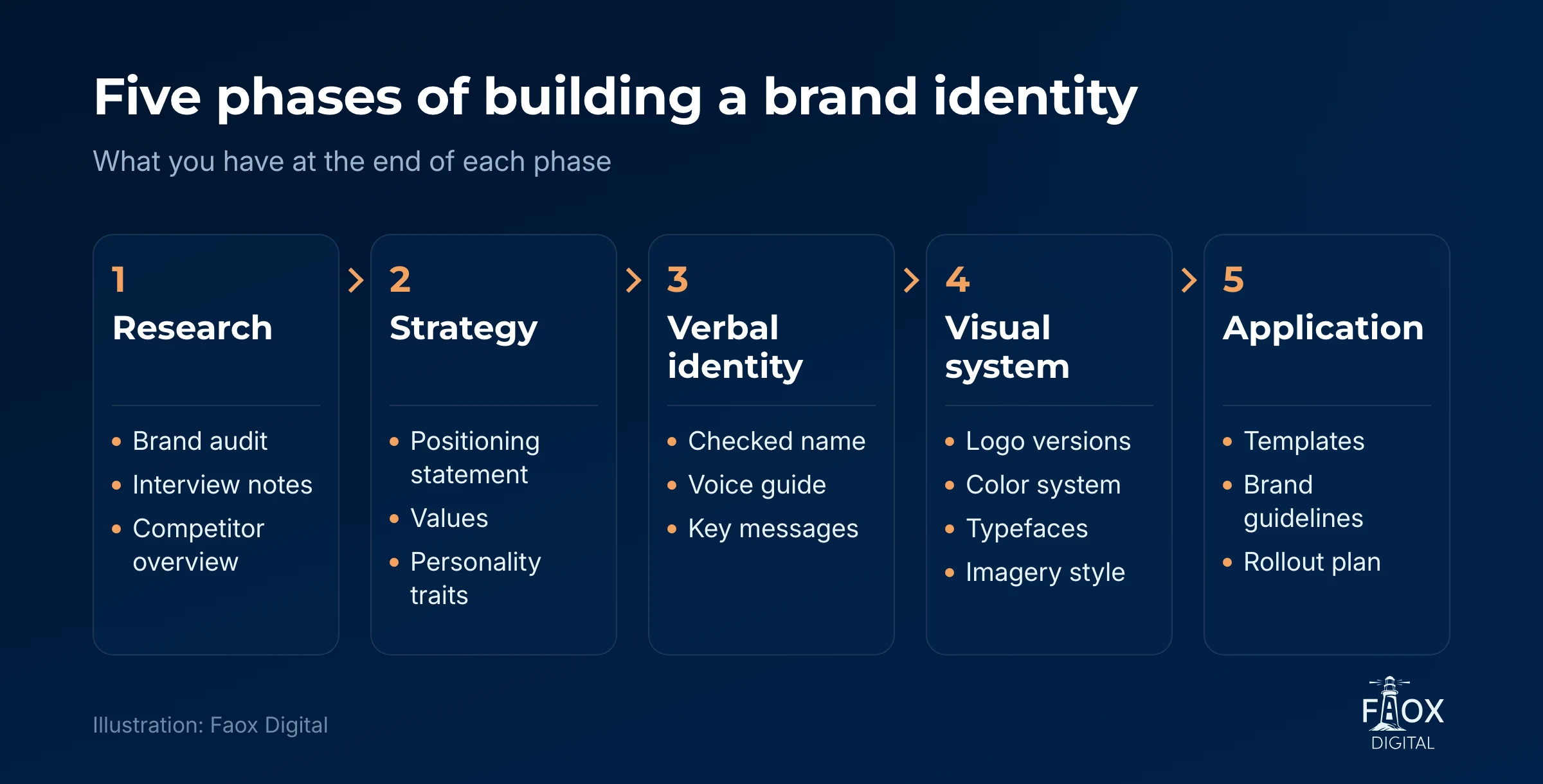
A small company can run the whole sequence in a few workshops; a group with several divisions and markets needs more time for research and rollout. The order stays the same.
Who should take part
A brand identity is a management decision with a design outcome, so the right people need to be involved at the right time:
- A decision maker, usually the owner or managing director, who approves the positioning and the final system. Without one, the project stalls in opinions.
- A project owner inside the company, who collects material, books interviews and keeps the schedule.
- Sales and service staff, who know what buyers ask and object to, and who will use the templates every day.
- Engineering or product management, who check that claims are accurate and that the visual system works on drawings, data sheets and products.
- Outside help where you need it: a strategist to run interviews and workshops without internal politics, and a designer for the visual system.
Keep the group that decides small. Many people should be heard during the research; few should vote on the logo.
Phase 1: Research what buyers see today
Brand audit. Collect one current example of everything that carries your name: the website, data sheets, catalogue pages, quotes, presentations, LinkedIn posts, the trade fair stand, product labels, vehicles and signs. Lay them side by side and note what is consistent, what is outdated and what nobody owns. The audit also shows which assets you already have and should keep, such as a color buyers recognize.
Buyer and team interviews. Talk to a handful of customers, a few prospects who chose someone else and, if you sell through them, a distributor or two. Ask why they chose you or did not, what almost stopped them, who else they considered and how they would describe you to a colleague. Then ask the same questions inside the company: management, sales, service and engineering often describe the company differently, and the differences are useful.
Competitor review. Collect the same materials from your main competitors: websites, catalogues, stands and LinkedIn pages. Note their colors, their claims, their tone and what they show in photographs. If every supplier promises quality, reliability and innovation in shades of blue, the review shows it, and it shows where there is room to be different.
Phase 2: Decide positioning, values and personality
This is where you define brand identity in words, before anyone designs anything.
Positioning comes first: which buyers you serve, in which markets, against which alternatives, and the single reason they should choose you. Write it as a short statement that management and sales both accept. Our guide on how to do brand positioning gives the steps and a statement template.
Brand values and personality come next. Choose three to five values the company actually acts on and can prove, and describe the personality in a few traits, each paired with what it is not: exact but not cold, confident but not loud, helpful but not pushy. The pairs keep the traits honest.
For a hypothetical industrial valve maker, the result might look like this:
| Element | Example |
|---|---|
| Positioning | Valves for process plants where a leak stops production, engineered and documented for audits |
| Values | Precision you can measure, honest delivery dates, documentation that passes inspection |
| Personality | Exact but not cold, calm under pressure, direct in its answers |
Phase 3: Name, voice and messages
Name. Most companies keep their name, and that is usually right, because the name carries years of recognition. Still check how it sounds and what it means in each market’s language. For a new company, product line or brand name, search the trademark registers before anyone falls in love with it. WIPO’s Global Brand Database lets you search international trademarks under the Madrid System and trademarks from participating national and regional offices by name and by image similarity; a trademark lawyer should confirm the result for each market. Check domain names and social media handles at the same time.
Voice. Write a short voice guide: the personality traits as writing rules, the terms you always use (and those you avoid), how you write numbers and units, and a few before-and-after examples. Engineers and sales staff will follow examples more readily than adjectives.
Messages. Write a company description in three lengths (one sentence, one paragraph and half a page), the three or four main reasons to choose you, and the proof behind each one. Every market should get these in its own language, written by someone who knows the industry rather than translated line by line.
Phase 4: Design the visual system
Only now does design start, and it should start from the brief the first three phases produced. This is how to design brand identity elements so that they survive B2B use:
Logo. Start in black and white, because many B2B applications are single-color: engraved nameplates, stamped parts, photocopied forms and rubber stamps. Then design the versions: full, compact, single-color and reversed, each with a minimum size and clear space. Our logo checklist for B2B follows the logo from catalogue to trade show.
Color system. Define a primary color, one or two secondary colors and a set of neutrals, each with codes for print, screen and paint. Add colors for charts, diagrams and warnings, because data sheets and presentations need them, and check text against its background: the W3C’s accessibility guidelines (WCAG 2.2) ask for a contrast ratio of at least 4.5:1 for normal text.
Typography. One or two type families are usually enough: one for headings, one for text and tables. Check that they cover every language you sell in and that the license covers print, web, apps and documents. Open-source families reduce the licensing work: Google Fonts says its fonts are without cost, may be used commercially and may be used in a logo.
Imagery and photography style. Decide what your photographs show and how: products on a neutral background or in use, your plant and people or none, technical drawings in which line style. Real photographs of your products and plant usually say more to a B2B buyer than stock images, and a consistent style makes them recognizable.
Before you approve the visual system, test it on real material:
- The logo on a nameplate, in one color, engraved or embossed
- A data sheet with a table, units, a chart and a technical drawing
- A proposal cover and a presentation slide with a chart
- A trade fair wall seen from across the aisle
- A LinkedIn post and the website on a phone
- A page in every language you sell in, including special characters
Phase 5: Templates, guidelines and rollout
Application templates do more for consistency than any rulebook, because people work in files, not in principles. Build ready-to-use templates for the documents your company produces most: letterhead and email signature, quote and proposal, presentation, data sheet, catalogue page, social media formats, stand modules and signs. Put them in one shared place and remove the old versions.
Brand guidelines explain the rules behind the templates: logo use, colors, type, imagery, voice and examples of right and wrong. Keep them short enough to be read; our guide on how to create brand guidelines covers what to include and how to make your team use them.
Rollout decides whether the new identity actually appears. A practical order:
- Explain it inside first. Show staff why the identity changed and what it says, before customers see it.
- Change the digital channels. The website, LinkedIn, email signatures and digital templates change quickly and cheaply.
- Update the sales documents. Proposals, presentations and data sheets come next, because buyers compare them directly.
- Replace print and packaging. Use up or replace stock in a planned order instead of all at once.
- Plan signage and vehicles. Schedule them with budgets and repainting cycles.
- Brief partners and distributors. Send them the files and a short guide before they produce anything new.
- Audit again. A few months after launch, repeat the brand audit and fix what slipped.
Common mistakes to avoid
Watch for these mistakes; most of them are about the order of work, not the quality of the design:
- Starting with the logo, before anyone has agreed what it should express.
- Designing for the boardroom, so the result pleases management but tells buyers nothing new.
- Copying the market leader’s look, which makes you easier to confuse with the company you want to stand apart from.
- Throwing away what buyers recognize, such as a color or a shape with years of familiarity behind it, without a good reason.
- Leaving the name and trademark check until the launch materials are already printed.
- Writing guidelines but no templates, so every department improvises its own files.
- Launching to customers before staff, so the people who use the identity every day hear about it last.
Once the system works, the question many teams ask is whether software could have done some of this faster. Our article on AI logo and identity tools looks at what they handle and what they miss.
How Faox Digital builds a brand identity
At Faox Digital, a digital growth partner for B2B companies in complex and international markets, a brand identity is built in five working sessions with the client, in much the same order as this guide: listen, position, find the voice, design the system of identity, type and color with rules, then roll it out across the channels that matter. Each market gets its own adjustments, so the story reads as local rather than translated.
Key takeaways
- Build a brand identity in five phases: research, strategy, verbal identity, visual system and application.
- Interview customers, lost prospects and your own team before deciding anything, and review how competitors present themselves.
- Decide positioning, values and personality in words before design starts.
- Test the logo, colors, typefaces and imagery on real B2B material: nameplates, data sheets, proposals and stands.
- Templates and a planned rollout keep the identity consistent once it exists.
Frequently asked questions
How do you create a brand identity from scratch?
Start with research: what buyers need, how competitors present themselves and what makes you different. Decide your positioning, values and personality, choose and check a name, write your voice and messages, then design the logo, colors, typography and imagery. Finish with templates, guidelines and a planned launch.
How do you define your brand identity?
Write it down in words before you design anything: a positioning statement, three to five values you can prove, a few personality traits with what each one is not, and a short company description. If management, sales and a customer would all recognize the result, you have defined it.
Can you create a brand identity with AI?
AI tools can suggest names, logo sketches and color palettes quickly, and they help produce material once rules exist. They cannot interview your buyers, decide your positioning or check whether a name can be registered in your markets, so they work best inside a process like the one above.
How long does it take to build a brand identity?
It depends on the size of the company, the number of markets and whether the name changes. Research and strategy often take longer than design, and rollout can run for months because signage, vehicles and printed stock change on their own schedules.
Sources
- WIPO: Global Brand Database, accessed November 2026
- Google Fonts: Frequently Asked Questions, accessed November 2026
- W3C: Understanding WCAG 2.2 Success Criterion 1.4.3, Contrast (Minimum), accessed November 2026
Let’s talk
Does your brand say what makes you different?
Show us how you describe your business today. We will tell you where it is clear and where buyers may get lost.