
B2B Brand Identity: What It Includes and Why Consistency Matters to Buyers
What a B2B brand identity includes, how it differs from brand image and corporate identity, and why buyers need to meet the same company at every touchpoint.
B2B brand identity is the set of elements a company uses to present itself the same way to every buyer: its values and personality, its voice, and a visual system of logo, color and typography. Brand image is what buyers actually think of you. Consistency matters because B2B purchases involve many people over many months, each meeting the company through different touchpoints, and a consistent identity lets all of them recognize the same supplier and trust what it says.
A purchasing manager sees your stand at a trade fair, an engineer downloads a data sheet, and a plant manager opens your quote three months later. If the stand, the data sheet and the quote look and sound like three different companies, the buying group has to work out that they are the same supplier, and that doubt does not help you.
This guide explains what brand identity means in a B2B company, what it includes, how Kapferer’s brand identity prism helps you define it and why consistency across touchpoints matters to buyers. It opens our series on brand identity; you can find all Branding & Strategy articles on the category page.
What is B2B brand identity?
The American Marketing Association defines a brand as "any distinctive feature like a name, term, design, or symbol that identifies goods or services." Brand identity is the deliberate side of that: the set of elements a company chooses and controls so that it is recognized and understood the way it intends. It covers what the company stands for, how it speaks and how it looks.
B2B brand identity applies this to companies that sell to other businesses, and three things shape it:
- Buyers are teams. Engineers, purchasers, managers and finance staff each meet the company in different places and judge it on different things.
- Decisions are long and risky. A supplier may stay in a plant for years, so buyers look for signs of reliability and care. A careless brochure or a quote on an old template counts against you.
- Much of the identity lives in documents. Data sheets, drawings, certificates, manuals, quotes and product nameplates carry the brand at least as often as the website or advertising.
A B2B identity therefore has to work on a trade fair stand and in a thick product catalogue, in a sales engineer’s email and on an engraved product label.
Brand identity, brand image and corporate identity
Several terms overlap, and agencies use them differently. This is how we use them in this series:
| Term | What it means | Who controls it |
|---|---|---|
| Brand identity | How the company wants to be known: its values, personality, voice and visual system | The company |
| Brand image | What buyers actually think of the company, built from every experience and every word they hear | Buyers |
| Corporate identity | The identity of the company as an organization: its name, its visual presence and how divisions and subsidiaries appear | The company |
| Visual identity | The visible part: logo, color, typography, imagery, icons and layouts | The company |
| Verbal identity | The written and spoken part: names, tagline, voice, key messages and terminology | The company |
Identity is the plan and brand image is the result. The gap between them is where branding work starts: a company that sees itself as an engineering specialist may find that buyers think of it as a cheap alternative, or do not think of it at all.
In many companies, corporate identity mainly means the visual system: the logo, stationery, signage and vehicle livery. The difference matters when you brief a designer, because a new logo does not change what buyers believe about you. Our guide to visual identity vs brand identity sets out what each one covers in a B2B company.
What a B2B brand identity includes
A brand identity is not a logo but a system: a small set of decisions and the rules that make them work everywhere. Brand identity systems usually have four layers:
- The strategic core: where the company stands in its market and why a buyer should choose it, plus its brand values and brand personality. This comes first, because everything else expresses it. Our guide to brand positioning for B2B covers how to decide it.
- The verbal identity: company and product names, the tagline if there is one, the brand voice and the key messages.
- The visual identity: the logo, the color palette, typography, the style of photography and illustration, icons and layouts.
- Rules and templates: the guidelines and ready-made files that let other people apply the identity correctly.
In a B2B company, each element shows up in particular places:
| Element | What it covers | Where B2B buyers meet it |
|---|---|---|
| Brand values | A few principles that guide decisions and behavior | Proposals, delivery promises, how problems are handled |
| Brand personality | The character the company shows | Emails, presentations, the people on the stand |
| Brand voice | How the company writes and speaks | Website, data sheets, LinkedIn, sales emails |
| Logo | The mark and the name, in versions for each use | Nameplates, catalogue covers, the stand, invoices |
| Color | A palette with exact codes for print, screen and paint | Website, machines, packaging, vehicles |
| Typography | Typefaces for headings and text, with language support | Catalogues, data sheets, the website |
| Imagery | The style of product, plant and people photography | Product pages, brochures, case studies |
| Templates | Layouts for repeated documents | Quotes, presentations, data sheets, manuals |
What is the brand identity prism?
The brand identity prism is a model by Jean-Noël Kapferer, set out in his book The New Strategic Brand Management (fifth edition, Kogan Page, 2012). It describes a brand through six facets. Two show the brand as a sender, two show the buyer as the brand pictures them, and two link the brand to its buyers. Each facet has a B2B meaning; here it is for a hypothetical industrial valve maker:
| Facet | The question it answers | Example for a hypothetical valve maker |
|---|---|---|
| Physique | What does the brand look like, and what does it make? | Stainless steel valves, precise drawings, a steel-blue color scheme |
| Personality | If the brand were a person, what would it be like? | A calm, exact engineer who answers questions straight |
| Relationship | What kind of relationship does it offer buyers? | A technical adviser who helps specify the right valve |
| Culture | Which values and origins drive it? | Engineering first, family-owned, built on export |
| Reflection | How does the brand picture its typical buyer? | Plant engineers who do not accept shortcuts |
| Self-image | How do buyers see themselves when they choose it? | "I made the safe, well-specified choice." |
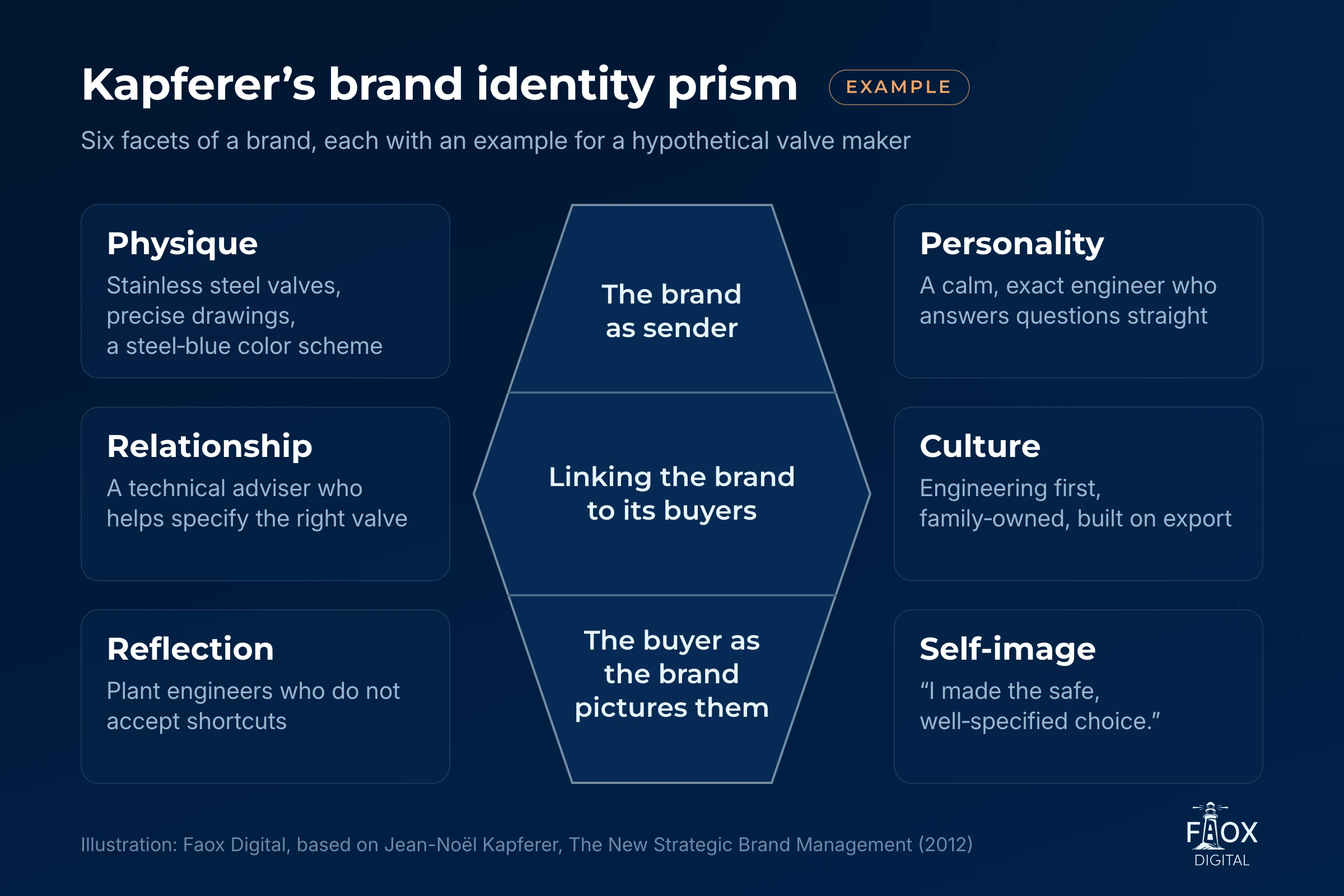
The prism is most useful as a check. If the six answers contradict each other, such as a premium physique with a discount relationship, buyers sense the contradiction long before they can name it. If one facet stays empty, that is usually where the identity is weakest.
Brand values and brand personality
Brand values are the few principles the company actually acts on. In B2B, generic values such as quality, innovation and trust say little, because every competitor claims them. A value earns its place when you can show it: precision shows in tolerances, inspection reports and on-time delivery, not in the word itself. Three to five values are usually enough; with more, nobody remembers them.
Brand personality is the character the company shows when it writes, speaks and presents itself. It is described in a few traits, such as calm, exact and helpful, and it guides the decisions that rules cannot cover: how a sales engineer answers a complaint, or how the website explains a delay. Personality is also what makes a company recognizable when two suppliers offer similar products at similar prices.
Logo, color and typography in a B2B setting
The visual identity is the part buyers notice first, and in B2B it has to survive conditions most consumer brands never face.
Logo. A B2B logo appears on a trade fair wall several meters wide and on a nameplate a few centimeters across, engraved, embossed or printed in one color. Ask for versions: the full logo, a compact version, a single-color version and a reversed one for dark backgrounds, each with a minimum size. Our industrial branding design checklist follows the logo from catalogue to trade show.
Color. Each brand color needs exact codes for every medium: CMYK and a spot color reference such as Pantone for print, RGB and HEX for screens, and a paint reference for machines and vehicles. Check legibility too. The W3C’s Web Content Accessibility Guidelines (WCAG 2.2) ask for a contrast ratio of at least 4.5:1 between normal text and its background, and 3:1 for large text, while text that is part of a logo has no contrast requirement. A pale brand color can work in a logo and still fail as the color of text on your website.
Typography. Choose typefaces whose licenses cover print, web and applications, and check that they include every character your markets need, such as Turkish ğ, ş and ı, German ß, Polish ł or Cyrillic. A font without them forces substitutions that break the identity in the documents buyers read most closely.
Brand voice: the verbal identity
Brand voice is how the company sounds in writing and speech: the words it uses, the length of its sentences, how formal it is and how it handles technical detail. In B2B the voice has to serve readers with different needs, so a good voice guide covers terminology as well as tone: which product names are fixed, which technical terms to use, how to write numbers and units, and what to avoid.
The verbal identity also includes the messages: a short description of the company, the main reasons to choose it and the proof behind each. Sales, marketing and service should describe the company in the same words. Each market should get those words written in its own language rather than translated line by line, because a phrase that sounds confident in one language can sound like a boast in another.
Touchpoints: where B2B buyers meet your identity
Touchpoints are all the places where someone meets the company. In B2B they stretch across a long journey:
- Before anyone is buying: trade press, LinkedIn, trade fairs, association events and what colleagues say.
- Research: the website, data sheets, catalogues, videos, comparison pages and answers from AI tools that summarize what others publish about you.
- Shortlist and contact: sales emails, calls, presentations, samples, quotes and references.
- Purchase and use: contracts, order confirmations, invoices, packaging, product labels, manuals, service visits and spare parts.
Most of these are not marketing materials. Quotes, invoices and manuals come from sales, finance and engineering, often from old templates, and that is where inconsistency usually hides.
Why consistency matters to buyers
Consistency means a buyer recognizes the same company, and hears the same promises, at every touchpoint. Three facts about B2B buying explain why it matters.
The buying group is large. Forrester’s State of Business Buying 2026 report found that the typical buying decision includes 13 internal stakeholders and nine external influencers. They do not meet your company together: the engineer sees the data sheet, the purchaser the quote, the finance director the contract. If each sees a different company, the buying group has to reconcile them before it can trust you.
Most buyers are not buying yet. Research by Professor John Dawes of the Ehrenberg-Bass Institute, published with LinkedIn’s B2B Institute in 2021, suggests that only about 5% of B2B buyers are in the market at any given time. The rest will buy later, and when they do, the suppliers they remember start ahead. A consistent identity builds that memory faster, because every touchpoint adds to the same picture instead of starting a new one.
Shortlists form before first contact. In 6sense’s 2026 B2B Buyer Experience Report (6sense sells B2B marketing software), buyers first contacted vendors on average 59.2% of the way through a 10.3-month cycle, and the eventual winner was already on the first-day shortlist in 92% of buying journeys. Your identity does most of its work before your sales team knows the project exists.
Consistency is not uniformity. A stand, a data sheet and a LinkedIn post have different jobs and can look different, as long as they share the same logo, colors, type, voice and promises. Markets can differ too: language, imagery and examples should feel local while the core stays the same.
A simple brand identity audit
Before you change anything, look at what buyers see today. A first audit needs no budget:
- Collect the touchpoints. Gather one current example of each: the home page and a product page, a data sheet, a catalogue page, a quote, an invoice, a presentation, a LinkedIn post, a photo of your trade fair stand and a product label.
- Lay them side by side. Print them or put them on one screen, and compare logo versions, colors, typefaces and photographs.
- Read them aloud. Check whether the company describes itself in the same words and the same tone in each one.
- Ask the people who see them. Ask sales engineers and a few customers to describe the company in one sentence, and compare their answers with your own.
- List the gaps by reach. Fix first what most buyers see, which is usually the website, the data sheets and the quotes.
The result shows whether you need better rules and templates or a deeper rebuild that starts with your positioning.
Keeping a brand identity consistent
Consistency does not come from a launch; it comes from routine. These habits make the difference:
- Written guidelines covering the logo, color, typography, imagery, voice and templates, with examples of right and wrong use
- One shared library of current logos, templates, photos and company descriptions, with old versions removed
- One person or team who owns the identity and approves exceptions
- Templates for the documents sales, finance and service produce every day, such as quotes, invoices and presentations
- A short briefing for new staff, distributors and agencies before they produce anything in your name
Our guide to B2B brand guidelines explains what to put in them, from logo rules to voice. If you are starting from scratch or rebuilding, our guide to building a brand identity walks through the process from strategy to a working visual system.
AI tools can now produce logo options and color palettes quickly, and they can help apply an identity once it exists. They cannot decide what the company stands for, check whether a name can be registered or keep a buying group’s experience consistent; our article on brand identity with AI looks at what they handle and what they miss.
Brand identity across markets
Exporters face one more test: the identity has to work in every market without turning into a different company in each. Check three things before you roll it out:
- The name. How it sounds and what it means in each language, and whether it can be protected. WIPO’s Madrid System lets a company apply for trademark protection in up to 133 countries through a single international application; a trademark lawyer can tell you which markets to cover.
- The visual system. Colors, symbols and images can carry different associations in different markets, so test them with people in each market rather than relying on general lists.
- The voice. Messages written for each market’s buyers, in their language, by people who know the industry.
How Faox Digital approaches brand identity
Faox Digital, a digital growth partner for B2B companies in complex and international markets, builds a brand identity in five working sessions with the client: listening to how the company describes itself and what its buyers believe, positioning, finding the voice, designing the system of identity, type and color with rules, and rolling it out in the right order across the channels that matter. Each market gets its own adjustments, so the story reads as local rather than translated.
Key takeaways
- B2B brand identity is how a company chooses to present itself: values, personality, voice and a visual system of logo, color and typography.
- Brand image is what buyers actually think; identity work closes the gap between the two.
- Kapferer’s brand identity prism checks an identity through six facets: physique, personality, relationship, culture, reflection and self-image.
- Consistency matters because buying groups are large, most buyers are not in the market yet and shortlists form before first contact.
- Guidelines, templates, one asset library and an owner keep the identity consistent at every touchpoint and in every market.
Frequently asked questions
What is brand identity, and why is it important?
Brand identity is the set of elements a company controls to present itself: its values, personality, voice, logo, colors and typography. It matters because buyers judge suppliers on scattered impressions, and a clear, consistent identity makes those impressions add up to one recognizable company they can trust.
What is the difference between brand identity and brand image?
Brand identity is what the company sends: how it wants to be seen. Brand image is what buyers receive: what they actually think, shaped by every touchpoint and conversation. A company controls its identity directly, and its image only through what it does and says over time.
What is a B2B brand?
It is the brand of a company that sells to other businesses. It has to win over groups of professional buyers, often technical ones, during long decisions, so it leans on proof, expertise and consistency across many documents and conversations.
What is brand identity design?
It is the visual side of brand identity: designing the logo, color palette, typography, imagery and templates, and the rules for using them. Good brand identity design starts from the strategy, so that the visuals express what the company stands for rather than a designer’s taste.
Sources
Let’s talk
Does your brand say what makes you different?
Show us how you describe your business today. We will tell you where it is clear and where buyers may get lost.