
B2B Storytelling: Why It Matters When Buyers Compare Specifications
Why stories still matter when B2B buyers compare data sheets line by line, which stories build trust, and how to keep every one of them true and checkable.
B2B storytelling explains what a company does through true, specific accounts: a customer’s problem, the decision they faced, the work done and the result, backed by proof. It matters when buyers compare specifications because data sheets often look alike, and the real question is risk: will this work in our conditions, and will this supplier stand behind it? The stories that build trust make the customer the hero and can be checked.
Engineers and purchasers compare data sheets line by line, so B2B storytelling can sound like the last thing they want. It is not about drama. A good story puts a specification into a real situation, so that each person in the buying group can see what it means for their plant, their budget and their own reputation.
This guide explains why stories work in technical purchases, which stories build trust and how to keep every one of them true. How the company sounds is covered in our guide to brand voice for B2B; this article is about what it tells.
What is B2B storytelling?
B2B storytelling is the practice of showing what a company does through real situations instead of claims alone. Take a hypothetical valve maker. A claim says "our valves are reliable". A story says which plant, which medium, what failed with the previous valve, what was changed and what the maintenance records show two years later.
Every useful story has the same parts: a situation, a problem, a decision, the work done, a result and the proof behind it. Leave out the proof and it becomes an anecdote; leave out the problem and it becomes an advertisement.
B2B brand storytelling works at a larger scale: the company’s own account of why it exists, what it is good at and where it is going, built from many smaller true stories rather than from a slogan.
Why stories work when buyers compare specifications
Specifications rarely settle a B2B purchase on their own. Several suppliers often meet the same standard, and the differences that matter sit in the application, the service and how a supplier behaves when something goes wrong. A data sheet cannot show those; a story can.
The deeper reason is purchase risk. The people who choose a supplier are accountable if it fails, so they look for evidence that it has worked somewhere similar. Forrester’s State of Business Buying 2026 describes trials as now essential to reducing risk, and a customer story is the closest thing to a trial that a buyer can get before running one.
Research on narratives explains the rest. In experiments published in 2000, psychologists Melanie Green and Timothy Brock found that readers absorbed in a story held more story-consistent beliefs and noticed fewer false notes in it, and that labeling the story as fact or fiction generally made no difference. Stories persuade, which is exactly why they have to be true.
Which stories build trust
Different stories answer different questions in a buyer’s mind:
| Story | The buyer’s question it answers | Proof it needs |
|---|---|---|
| Customer story | Has this worked for someone like us? | The customer’s approval, measured results, dates |
| Product or test story | Why is the specification what it is? | Test reports, standards, the engineer who can explain it |
| Problem story | What happens when something goes wrong? | The incident, the corrective action, what changed |
| Brand story | What does this company stand for? | Decisions it has actually made |
| Founding story | Why does this company exist? | Dates, records, the founders’ own account |
| Heritage story | Will this supplier still be there? | Years of supply, spare parts, people who stayed |
Trust grows fastest from the stories that admit difficulty. A delivery problem handled well, or a test the product failed before it passed, shows how the supplier works under pressure, which a polished success story cannot.
The customer as the hero
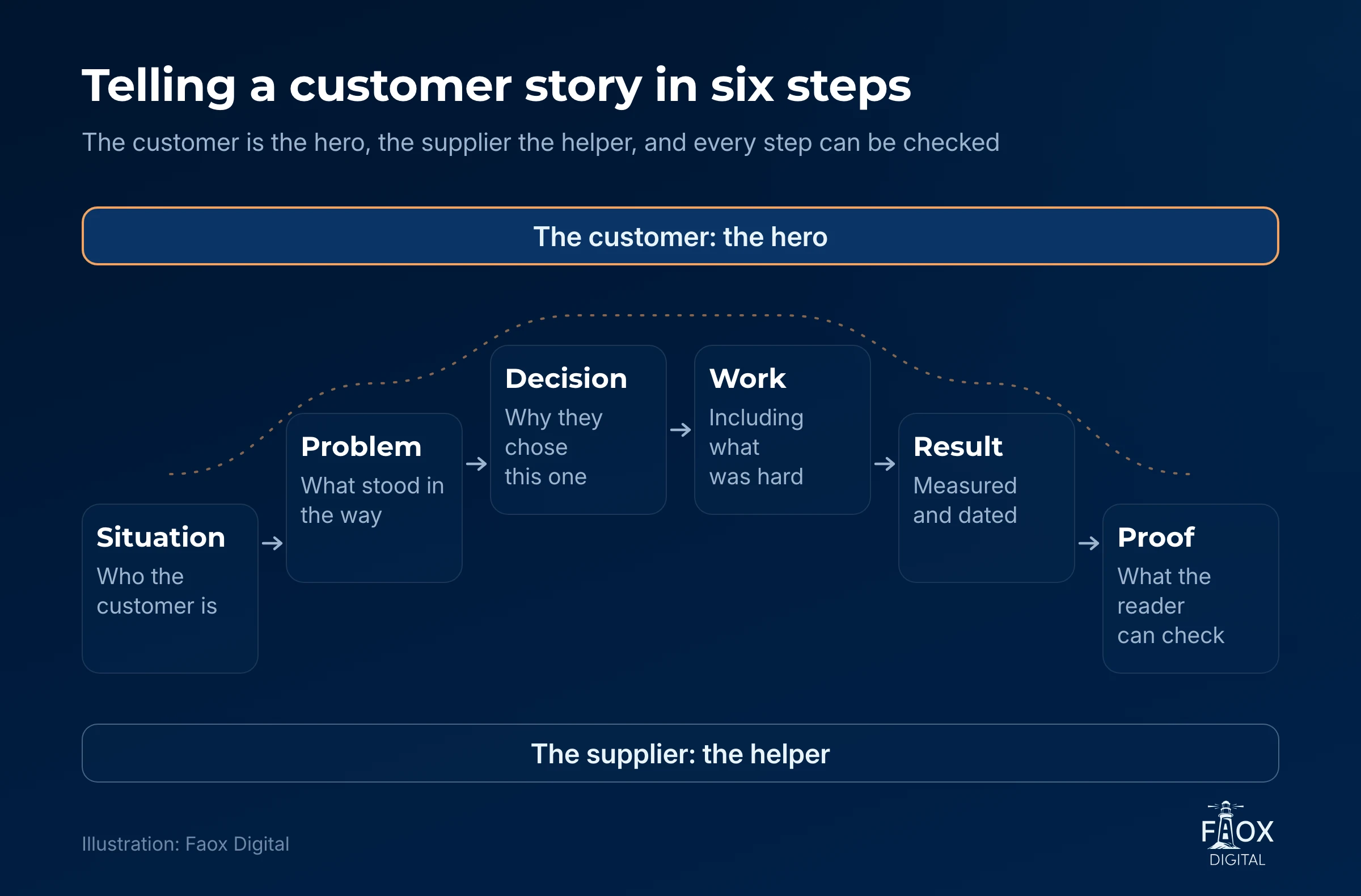
In a customer story, the customer is the hero: they faced the problem, took the risk and made the decision. The supplier is the helper who brought the right product, knowledge or service. Readers in the buying group recognize themselves in the customer, not in the supplier.
A simple structure keeps the story honest:
- Situation. Who the customer is and what they were trying to do.
- Problem. What stood in the way, in the customer’s own words.
- Decision. Which options they considered and why they chose this one.
- Work. What was done, including what was hard.
- Result. What changed, measured and dated.
- Proof. What the reader can check: a quote, a record, a visit.
Ask the customer’s permission before you name them, and let them approve the final text.
Stories for a technical product
For a technical product, the strongest story often shows a specification at work. In November 2013, Volvo Trucks released "The Epic Split", in which Jean-Claude Van Damme does the splits between two Volvo FM trucks driving in reverse, with a foot on each side mirror. According to Volvo, the film was made to demonstrate the stability and precision of Volvo Dynamic Steering, and its director said the film carries little information and lets the stunt illustrate what the trucks can do.
Few manufacturers need a film star. The industrial version is a test the buyer can follow: a pressure test, a salt spray chamber, a drop test or a start-up at a customer’s plant, filmed and explained by the engineer who ran it, with the numbers on screen. The story makes one line of the data sheet visible.
Founding, brand and heritage stories
A founding story earns its place when it explains something the buyer still benefits from: a company founded to solve one industry’s problem, and still focused on it, is telling buyers what it knows best. A brand story, the company’s account of what it stands for, is believable only when it matches decisions the company has actually made, such as the markets it declined or the standards it keeps.
Heritage and generations work the same way. "Since 1968" means little on its own. A long history becomes proof when it shows what the buyer needs: spare parts for machines sold decades ago, know-how passed from one generation of engineers to the next, or a family company whose second generation kept the quality standards while modernizing the plant. Tell what stayed and what changed, with dates and names that can be checked.
Proof and accuracy: no invented stories
A story that cannot be checked damages trust more than having no story at all. Never invent a customer, a quote or a result, never stretch a number, and label any illustrative example as such. Technical buyers will meet your claims again in trials, audits and reference calls.
There is a legal side too. In the EU, Directive 2006/114/EC protects traders against misleading advertising. In judging whether advertising misleads, it takes into account claims about a product’s specification, its fitness for purpose, the results to be expected from its use and the results of tests carried out on it: exactly the things B2B stories describe.
Before you publish a story, check:
- The customer has approved the text and the use of their name
- Every number is measured, dated and kept on file
- An engineer has checked the technical content
- No confidential customer or project data is shown
- Nothing is claimed that sales could not repeat and prove
- Everyone named or filmed has agreed
Documentary and video formats
Technical stories suit a documentary and video approach: real people in real places, little narration and the work itself on screen. The director of "The Epic Split" described Volvo Trucks’ earlier films as documentary in style, and the same approach fits a commissioning, a test or a problem solved at a customer’s plant.
One story can serve several formats: a few minutes of documentary for the website and sales meetings, short cuts for social media, a written version for proposals and a slide for the sales deck. The formats and rhythm that work on each platform are covered in our guide to making B2B social content.
Where stories fit in the brand
Stories are the proof behind the promises. The value proposition says what each buyer gains, and a customer story shows it happening, so start from your B2B value proposition when you choose which stories to tell.
Stories also belong to the brand identity, not only to the visual identity: the logo and colors make the company recognizable, while stories give it a character. Our comparison of visual identity vs brand identity explains the difference.
Where to start
Start with the stories already inside the company. Ask sales, service and engineering for recent cases where a customer had a real problem and the result can be measured. Choose one with a customer willing to be named, write it in the six parts above, check it against the list and publish it in more than one format.
As the stories add up, the next question is how to keep sales, marketing and engineering telling them the same way. Our guide to building a messaging framework covers that step.
How Faox Digital approaches B2B storytelling
Faox Digital, a digital growth partner for B2B companies in complex and international markets, starts by listening to how a company describes itself and what its buyers believe. The narrative is then shaped in the voice step of its branding work, together with a messaging framework the team can write inside, and built per market so that the story reads as local rather than translated.
Key takeaways
- B2B storytelling puts a specification into a real situation, so each buyer can see what it means for them.
- Stories work because purchases are judged on risk as well as data, and a true story is evidence from somewhere similar.
- Customer, product and test, problem, brand, founding and heritage stories each answer a different buyer question.
- Make the customer the hero, and keep every name, number and quote checkable.
- One true story can become a documentary, short videos, a written case and a sales slide.
Frequently asked questions
What is storytelling in business?
It is the use of real situations, with people, problems, decisions and results, to explain what a company does and why it matters. In B2B especially, a story has to be true and checkable, because buyers test it against their own experience and against other suppliers.
What are good B2B storytelling examples?
Volvo Trucks’ "The Epic Split" from 2013 is one: a stunt built to show the stability and precision of a steering system. For most manufacturers, the strongest examples are quieter: a customer’s problem solved and measured, a test explained by the engineer who ran it, or a delivery problem handled well.
Is there a simple B2B storytelling framework?
Yes: situation, problem, decision, work, result and proof. Make the customer the hero and the supplier the helper, and put a fact the reader can check behind every step.
Sources
- Green and Brock: The role of transportation in the persuasiveness of public narratives (APA PsycNet), 2000
- Volvo Trucks: Jean-Claude Van Damme and Volvo Trucks perform world-first stunt (press information), November 2013
- Forrester: press release on The State Of Business Buying, 2026, January 2026
- EUR-Lex: Directive 2006/114/EC concerning misleading and comparative advertising, 2006
Let’s talk
Does your brand say what makes you different?
Show us how you describe your business today. We will tell you where it is clear and where buyers may get lost.