
B2B Content Strategy: Building Content That Ranks and Gets Cited
A seven-part framework for B2B content that answers buyers’ real questions, earns its place in search and AI answers, and stays useful over time.

A B2B content strategy is a plan for which topics you publish, for whom, in what form, through which channels and how you will measure them, so that your content answers the questions buyers ask at every stage of a purchase. To rank in Google and be cited in AI answers, that content has to come from real buyer questions, be organized into topic clusters, show demonstrable expertise and be kept accurate over time.
Most B2B companies publish content; far fewer get results from it. In a 2025 survey of 1,015 B2B marketers by the Content Marketing Institute and MarketingProfs, 97% said they have a content strategy, but only 12% rated their marketing over the previous 12 months as highly effective, meaning it exceeded their goals. The gap rarely comes from a lack of articles. It comes from content that answers questions nobody in the buying group asks, sits in no clear structure and is never measured against business goals.
This guide sets out a practical framework: how to choose topics from real demand, organize them, show expertise, write content that AI tools can cite, distribute it and keep it current. It opens our series on content built to rank and be cited; you can find all SEO & AI Search articles on the category page.
What is a B2B content strategy?
A content strategy decides what content a company creates and why. For a B2B company it answers six questions: who the content is for, which of their questions it answers, which formats it uses, who produces and approves it, where it is distributed and how success is measured. Content marketing is the ongoing work of producing and distributing that content; the strategy is the plan that makes the work add up.
An SEO content strategy adds one discipline: every important piece starts from how buyers search. Topics come from search demand and intent, pages are planned so that each one has a clear search target, and the whole set is linked so that search engines understand how the topics relate.
In B2B, the strategy must also serve sales. A good article answers a question a prospect would otherwise ask a salesperson, and it can be sent to the next prospect who asks it. Google’s guidance points in the same direction: its ranking systems are designed to prioritize helpful, reliable information created to benefit people, not content created mainly to attract search visits.
Why B2B content needs a strategy
B2B buying is slow, technical and shared. A buying group includes engineers, purchasers, managers and users, each with different questions, and the same company can research for months before it contacts a supplier. Content without a plan tends to serve none of them well: a few general posts, an occasional news item, and nothing that helps a specific buyer decide.
The same survey shows where B2B marketers struggle. The top challenges were creating content that prompts a desired action such as a conversion (40%), resource constraints (39%) and measuring content effectiveness (33%). A strategy addresses all three: it ties each piece to a buyer question and a next step, focuses limited resources on the topics that matter, and defines in advance how each piece will be judged.
AI search raises the stakes further. AI Overviews, AI Mode and assistants such as ChatGPT answer questions by drawing on pages that answer them well. Generic content that repeats what every other site says has little reason to be chosen; specific, well-sourced content written by people who know the subject does.
How to create an SEO content strategy: a seven-part framework
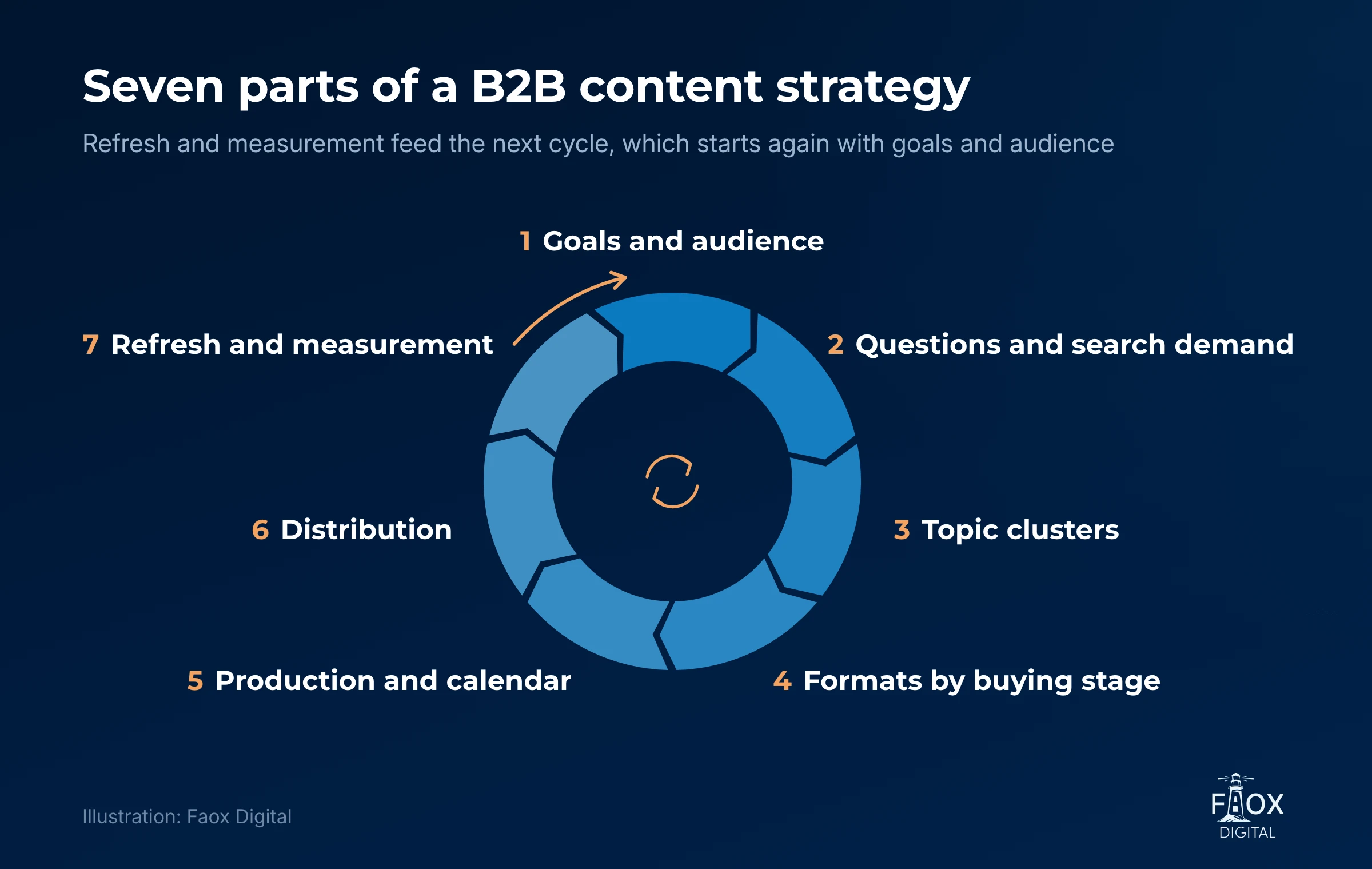
A B2B content strategy framework turns the questions above into a repeatable cycle. Each part is covered in more detail below:
- Goals and audience. Define what content should achieve (enquiries, shorter sales cycles, entry into a market) and map the roles in the buying group.
- Questions and search demand. Collect the questions buyers ask sales and support, and check how they search for them.
- Topic clusters. Group the questions into clusters, each with one guide and several supporting articles.
- Formats by buying stage. Choose the right format for each question: guide, comparison, technical page, checklist or video.
- Production and calendar. Assign owners, subject experts and reviewers, write a brief for each piece and publish to a realistic calendar.
- Distribution. Plan how each piece reaches buyers: search, LinkedIn, newsletters and the sales team.
- Refresh and measurement. Measure against the goals, update what has aged and feed the results back into the next cycle.
Start from buyers, search intent and the buying journey
Strong B2B content starts with the questions buyers actually ask. The best sources are the people who talk to them: sales engineers, customer service, application engineers and distributors. Their notes, enquiry emails and RFQs show the problems, objections and vocabulary of the buying group. The next step is to check how those questions are searched; our guide to B2B keyword research explains the method.
Every question also has a search intent: the searcher wants to learn, to compare or to act. Intent changes with the stage of the buyer journey, and each stage needs different content:
| Stage | Buyer’s question | Content that answers it | Example |
|---|---|---|---|
| Awareness and information | What is causing this problem, and what are the options? | Guides, explainers, standards and regulation summaries | "Why seals fail in high-temperature pumps" |
| Consideration and evaluation | Which approach or product fits our case? | Comparisons, selection guides, technical pages, calculators | "Mechanical seal vs packing: how to choose" |
| Decision | Which supplier can we trust to deliver? | Product pages, specifications, certifications, process and quality pages | "Mechanical seals for chemical pumps: specifications and lead times" |
A plan that covers only one stage leaves gaps. A site with nothing but product pages has no answers for buyers at the earlier stages, so they do that research on other sites and may arrive with their minds already made up.
Which topics to start with
A full content plan can list a hundred topics. Order them by four questions:
- Business value: does the cluster support products, services or markets you want to grow?
- Sales relevance: do these questions come up often in sales conversations and enquiries?
- Search demand: do buyers search for these topics, even in small numbers?
- Gap: do your competitors and other sites answer them poorly or not at all?
Start with the cluster that scores highest, publish its guide first and finish the cluster before you open the next one. A complete cluster of six linked pages usually does more for readers than twelve unrelated posts spread across six subjects.
Content marketing for manufacturers: blog, guides and technical content
For manufacturers and other technical B2B companies, the most useful content is often not a blog post at all. The formats that serve technical buyers include:
- Guides that explain a process, a material or a selection decision in depth.
- Technical content: specification pages, application notes, tolerance and material tables, and summaries of the standards a product meets, published as web pages rather than only as PDF downloads.
- Selection and comparison pages that help an engineer choose between product types or configurations.
- Answers to recurring sales questions: lead times, minimum order quantities, testing, certification and documentation.
- Photos and videos of real products, processes and test procedures. Google recommends supporting text with high-quality images and videos for people who search visually.
The B2B blog still has a place: it hosts the guides and articles that answer questions from the awareness and consideration stages, and it is where clusters are built. What matters is that each post belongs to a cluster and answers a defined question, rather than appearing because a publishing slot was free.
Show real expertise: E-E-A-T in B2B content
E-E-A-T stands for experience, expertise, authoritativeness and trustworthiness. It comes from Google’s quality rater guidelines, which added "experience" in December 2022 to recognize first-hand knowledge, such as actually using a product. Google says the rater guidelines do not directly influence ranking. Its guidance on helpful content still uses E-E-A-T to describe good content, and it states that trust is the most important of the four aspects.
B2B companies have an advantage here: their engineers, technicians and project managers have the first-hand experience generic publishers lack. Make it visible:
- Name the author or reviewer and their real role, and say who checked the technical content.
- Use your own data, test results, photos and worked examples wherever you can.
- Cite primary sources for every figure and standard, and keep facts easy to verify.
- Explain how you know: tested in our lab, measured on site, based on a defined number of projects.
Google’s "Who, How and Why" questions are a useful test: is it clear who created the content, how it was produced (including any use of automation or AI), and why it exists? Our article on showing expertise in content goes through E-E-A-T for B2B in detail.
Write content that AI answers can cite
Citable content is content an AI system can quote or summarize accurately: it answers a question directly, defines its terms, gives specific facts with sources and keeps each passage clear on its own. The same qualities make it useful to human readers.
Google says there are no special requirements or optimizations needed to appear in AI Overviews or AI Mode; pages need to be indexed and eligible to show a snippet. Its 2025 advice for AI search centers on the basics: create unique, non-commodity content, provide a good page experience, make sure Google can access the content, and keep any structured data consistent with what is visible on the page. In practice, that means:
- Open each article with a short, direct answer to its main question.
- Use descriptive headings that match the questions buyers ask.
- Put numbers, specifications and comparisons in tables and lists.
- State facts specifically, with dates and sources, and avoid vague claims.
AI tools can speed up research and drafting: in the same survey, 95% of B2B marketers said their organizations use AI-powered applications. But Google warns that producing large amounts of text with generative AI without oversight or curation shows little effort, and that generating many pages without adding value for users is scaled content abuse under its spam policies. The expertise has to come from your people. Our guide to SEO content writing covers how to write for buyers and search engines at the same time.
Plan production: briefs, owners and a content calendar
B2B content often stalls in production: the subject expert has no time, the writer lacks technical knowledge, or approval takes weeks. A workable process assigns four roles for each piece: an owner who plans it, a subject expert who supplies the knowledge, a writer or editor who shapes it and a reviewer who checks facts.
A content brief connects them. It states the question the piece answers, the reader, the search intent, the sources to use, the points to cover and the internal links to add; our content brief template shows the fields. The content calendar then schedules the pieces cluster by cluster, so that each cluster is completed before the next begins.
Plan for a pace you can keep. Google lists writing to a particular word count among the signs of search engine-first content; length should follow the question, not a target. If you publish in several languages, plan each language from its own search demand instead of translating everything; our international SEO guide explains how language versions should work. If you are deciding whether to produce content in-house or buy it, our article on paying for SEO content compares the options.
Refresh and measure: keep content accurate and useful
Content ages. Standards change, products are updated, figures go out of date and competitors publish better answers. A content refresh reviews existing pieces and updates facts, examples, sources and structure where needed. Google lists changing the date of a page to make it seem fresh when the content has not substantially changed as a sign of search engine-first content, so update the date only when the content really changes. Our guide to content refresh explains how to choose and update old posts.
Sometimes the problem is bigger than the articles: an outdated site structure, a hard-to-use navigation or a design that undermines trust. Then the question becomes a website redesign or refresh, not just new content.
Measurement closes the cycle. Track each piece against the goal it was written for:
- Visibility: impressions, clicks, queries and average position in Search Console.
- Engagement: time on page, scroll depth and the next pages readers visit.
- Business impact: enquiries, quote requests and content that sales uses in deals.
Look beyond raw clicks. Google says clicks from AI Overviews are higher quality, with visitors more likely to spend more time on the site, and it advises site owners to look at conversions and engagement as well as visits. Among B2B marketers, the same survey found audience engagement (80%) the most common measure for thought leadership, ahead of business impact such as leads and pipeline influence (63%). Aim to measure both.
Common B2B content strategy mistakes
Most content plans that disappoint make one of these mistakes:
- Publishing company news instead of answers. Announcements matter to you; buyers search for solutions to their problems.
- Writing without the experts. A writer working alone produces generic text; one interview with an engineer turns it into something only your company could publish.
- Locking the substance in PDFs. Keep brochures and datasheets, but publish the key information as web pages that can be read, searched and linked.
- Starting many topics and finishing none. Half-built clusters leave readers without the next answer.
- Translating instead of planning per market. Each language needs topics from its own buyers’ questions.
- Measuring only traffic. Visits say little about whether content helps buyers decide or helps sales close.
How Faox Digital approaches content strategy
At Faox Digital, content and authority is the fourth of five steps in an SEO project: we write pages built to rank and to be quoted by AI tools, and we earn placements in the press buyers read. The topics come from the keyword map built earlier, market by market, so each page answers a search buyers actually make.
Key takeaways
- A B2B content strategy decides topics, audience, formats, owners, channels and measurement before anything is written.
- Start from the questions buyers ask sales and support, then check how they search for them and at which stage.
- Organize content into topic clusters: one guide and several supporting articles per subject, all linked.
- Show real expertise with named experts, your own data and primary sources; that is also what makes content citable in AI answers.
- Distribute every piece through LinkedIn, newsletters and sales, refresh it when facts change and measure business impact, not only clicks.
Frequently asked questions
How do I create a B2B content strategy?
Define the goals and the buying group, collect the questions buyers ask, check how they search for them, and group the topics into clusters. Then choose formats for each buying stage, set up briefs, owners and a calendar, plan distribution and decide how you will measure and refresh each piece.
What should a B2B content strategy include in 2026?
Besides the classic parts (audience, topics, formats, calendar and measurement), it should plan for AI search: direct answers, specific and sourced facts, visible expertise and structured data that matches the page. It should also measure engagement and enquiries, not only clicks.
What does a B2B content strategist do?
A B2B content strategist researches the buying group and its search behavior, plans topics and clusters, writes briefs for writers and subject experts, sets the publishing calendar and distribution, and measures results to decide what to create, update or remove next.
What is the difference between content strategy and content marketing?
Content strategy is the plan: why you create content, for whom, on which topics and how you will judge it. Content marketing is the execution: producing, publishing and distributing that content. A strategy without execution changes nothing; execution without a strategy produces content nobody needs.
Sources
- Content Marketing Institute: 9 Takeaways and Insights From the 2026 B2B Content and Marketing Trends Research Report, 2025
- Google Search Central: Creating helpful, reliable, people-first content, 2026
- Google Search Central Blog: Top ways to ensure your content performs well in Google’s AI experiences on Search, 2025
- Search Console Help: Performance report, accessed October 2026
Let’s talk
Where do you want to be found?
Tell us the searches that matter to your business. We will review your site and tell you plainly what to fix first, including what you can do yourself.