
B2B Email Marketing: A Complete Guide for Long Sales Cycles
What B2B email marketing is and how a company with a long sales cycle sets it up: types of email, the list and consent, segmentation, the CRM, deliverability and measurement.
B2B email marketing is the use of email to stay in touch with business buyers across a long sales cycle: a regular newsletter, occasional campaign emails and automated follow-up sequences, sent to a permission-based list that lives in your CRM. Set it up by building the list with consent, segmenting it by role and stage, getting authentication right so that emails reach the inbox, and judging results by clicks, replies and the conversations sales can pick up.
A B2B purchase rarely happens in one step. A buyer meets you at a trade fair, reads a technical article months later, passes your name to a colleague, asks for a quote, waits for a budget and finally decides. Between those moments, your company can be forgotten, or it can stay in view. Email is the channel built for those in-between months.
This guide explains what B2B email marketing is and how to set it up for a long sales cycle: the types of email, how to build a list with consent, segmentation and the CRM, how to reach the inbox, what to write and what to measure. It opens our series on email campaigns and newsletters; you can find all Email & CRM articles on the category page.
What is B2B email marketing?
B2B email marketing is sending planned emails to people at the companies you sell to, or want to sell to, so that they know you, trust you and contact you when the need arises. Email marketing in general covers any planned email sent to a list; the B2B version differs in four ways:
- Fewer, more valuable recipients. A list of a few thousand engineers, buyers and managers can matter more than a consumer list a hundred times its size.
- A long sales cycle. In 6sense’s 2025 Buyer Experience Report, a survey of just under 4,000 B2B buyers, average buying cycles lasted about 10 months.
- Multi-stakeholder buying. Forrester’s State of Business Buying 2026 counts 13 internal stakeholders and nine external influencers in a typical buying decision, and each of them needs different information.
- A relationship, not a transaction. Most emails do not sell; they keep the conversation going until a buyer is ready.
Email is also a channel you own. A social media post reaches only part of your followers, depending on the platform’s feed; our article on how organic reach works explains why. An email list stays yours, and every message goes to everyone on it.
Why email suits a long sales cycle
The long sales cycle is where email earns its place. Between a first contact and a signed order, email can:
- Keep you in view while the buyer is not yet buying, with useful content rather than sales pressure
- Reach several members of the buying committee, because people forward useful emails to colleagues
- Follow up on every lead, from trade fair contacts to website downloads, so that none of them goes cold
- Support sales, by sending the right information at the right stage and showing who is engaging
- Show interest, through clicks and replies that tell sales who is worth a call
None of this needs a large team. It needs a clean list, a few well-planned types of email and a CRM that remembers who received what.
Three types of B2B email
Most B2B email programs combine three types of email:
| Type | What it does | Typical rhythm | Example |
|---|---|---|---|
| Newsletter | Keeps the whole list informed and builds familiarity | A fixed rhythm, often monthly | Technical guides, application notes, company news that matters to buyers |
| Campaign email | Announces something specific to the right segment | When there is something to say | A new product line, a trade fair invitation, a webinar |
| Automated follow-up sequence | Follows up each contact after a trigger, at the right pace | Set by the trigger | Three emails after a trade fair, a guide download or a quote request |
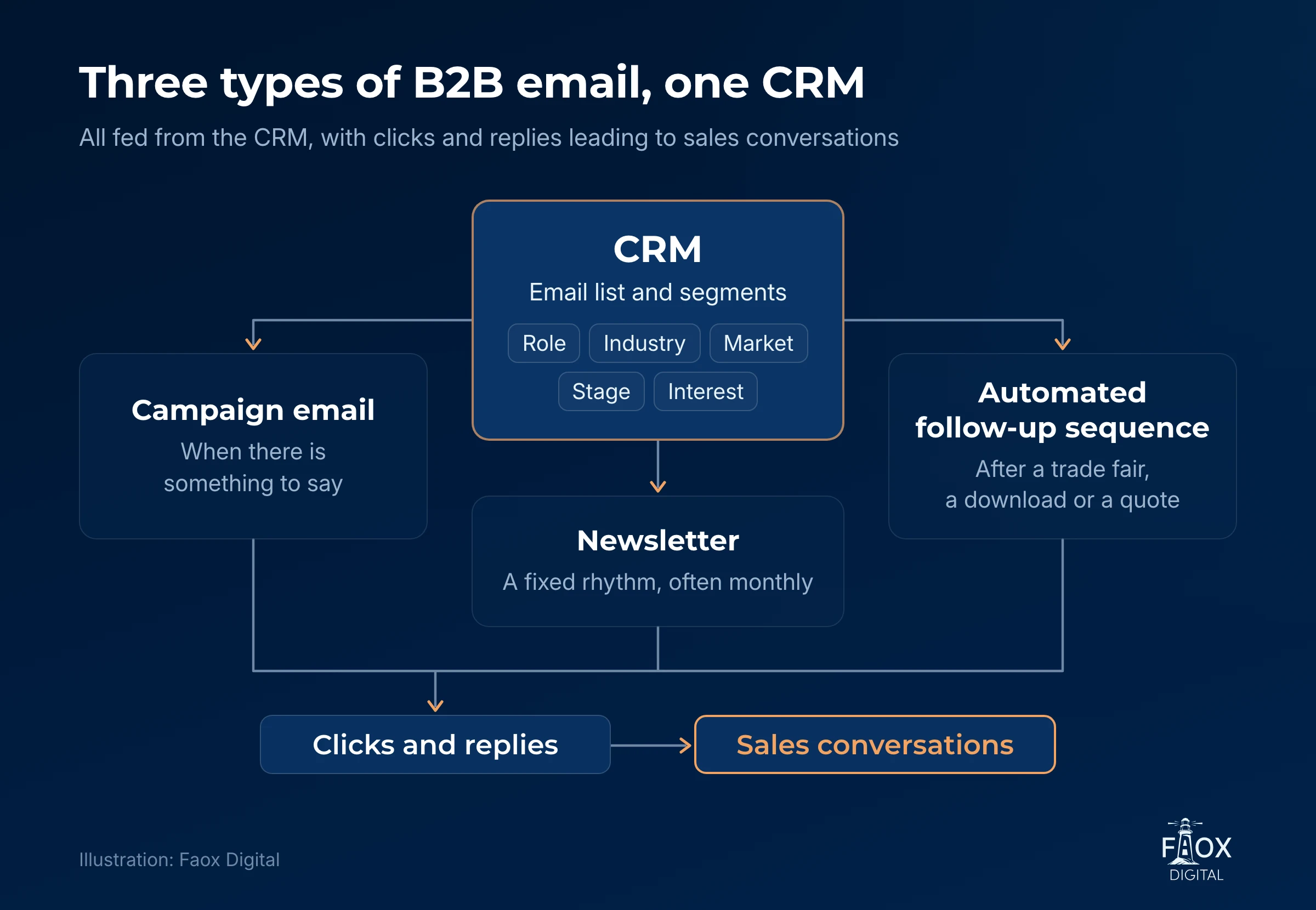
The newsletter is the backbone. A good B2B newsletter gives buyers something useful every time, so they keep opening it even in months when they are not buying. Our guides to creating a B2B newsletter and to B2B newsletter examples show how to plan and structure one.
A campaign email has one message and one action: register, download, book a meeting. Send it to the segment it concerns, not to the whole list. Our guide to writing a marketing email covers the subject line, body and call to action.
An automated follow-up sequence sends a short series of emails after a trigger, such as a trade fair conversation, a download or a quote. It is where email does the most for a long sales cycle, because it follows up every contact without relying on someone’s memory. Setting up these flows is part of what marketing automation is.
Example: a follow-up sequence after a trade fair
Trade fairs show why automated follow-up matters. A company may come home with hundreds of contacts, and within weeks most of them have heard nothing. A simple sequence changes that:
- Within two working days: a short email from the person the visitor met, thanking them, recalling what they discussed and attaching the document they asked for.
- About a week later: an application note or guide that fits the visitor’s industry or the product they looked at.
- About three weeks later: an invitation to a call, a plant visit or a webinar, with one clear action.
- After that: the contact joins the newsletter, unless they reply, ask for a quote or opt out.
Each email should come from a real person, and any reply should go straight to that person or to sales. Where a visitor scanned a badge or left a card, record what they agreed to receive, so that the sequence respects the consent rules of their market.
Build your email list with consent
Your email list is the foundation, and it should be built, not bought. Good sources for a B2B list include:
- Existing customers and their colleagues
- Contacts from trade fairs, visits and events
- Website forms: quote requests, newsletter sign-ups, guide downloads, webinar registrations
- Distributors and partners who agree to receive updates
Bought lists bring unknown addresses, no relationship and a high risk of spam complaints, which hurt whether your other emails reach the inbox.
To grow the list steadily, give people a reason to join: a newsletter sign-up on every relevant page of your website, a useful guide or checklist in exchange for an email address, a webinar, or a clear question at the trade fair stand about whether visitors want to hear from you. Say what they will receive and how often, and keep that promise.
Consent and İYS come next, because the rules differ by country and they apply to B2B email too. This is general information, not legal advice:
- European Union: Article 13 of the ePrivacy Directive requires prior consent for marketing emails to individuals, with an exception for existing customers and similar products, as long as they can object easily at collection and in every message. For business addresses, the directive leaves the protection to national law, so the rules differ between member states.
- United States: the FTC’s guide to the CAN-SPAM Act says the law makes no exception for business-to-business email. Every marketing email needs accurate sender details, an honest subject line, a valid postal address and a clear way to opt out, and opt-outs must be honored within 10 business days.
- Türkiye: Law 6563 requires prior consent for commercial electronic messages but allows them to be sent to merchants and tradesmen without it. The İleti Yönetim Sistemi (İYS), the national consent registry, adds that those addresses must still be registered in İYS before sending, and once a merchant refuses, you may not send without their consent.
The safe habit everywhere: record where and when each contact gave permission, make unsubscribing easy and respect every opt-out quickly. If you sell in several countries, ask a lawyer to check your process for each market.
Segment the list and keep it in your CRM
Segmentation means dividing the list into groups that need different emails. For a B2B company, useful segments include:
- Role: engineers, purchasing, management, users
- Industry and application: the sectors and uses your products serve
- Market and language: each country or language group
- Stage: new contacts, active prospects, customers, former customers
- Interest: the product lines or topics each contact has shown interest in
The CRM is where all of this lives. It should hold each contact’s details, consent, segments and history: which emails they received, what they clicked and what sales discussed with them. When email and CRM are connected, a click on a pricing page can alert a salesperson, and a closed deal can stop a sales sequence. Our guide to segmenting a B2B email list covers the method in detail.
Getting into the inbox
Inbox placement, often called deliverability, decides whether your email is seen at all. The large mailbox providers now set clear rules.
At the time of writing (November 2026), Gmail’s sender guidelines require every sender to authenticate with SPF or DKIM, and senders of 5,000 or more messages a day to use SPF, DKIM and DMARC and to offer one-click unsubscribe in marketing messages. Google also asks senders to keep the spam rate reported in its Postmaster Tools below 0.10% and never to reach 0.30%. Microsoft announced similar authentication requirements in April 2025 for domains sending more than 5,000 emails a day to Outlook.com addresses, with enforcement from May 2025.
Even if you send far fewer emails, the same practices protect your reputation:
- Authenticate your domain with SPF, DKIM and DMARC, with help from whoever runs your email and domain.
- Send from your own domain, never from a free email address.
- Clean the list. Remove addresses that bounce and contacts who have not engaged for a long time.
- Make unsubscribing easy, because a person who cannot leave may report you as spam instead.
Sender name, subject line and sending rhythm
Three small decisions shape whether people open your emails.
The sender name tells recipients who is writing. A real person’s name with the company, such as an engineer or a sales manager, is easier to recognize than a no-reply address. Keep it the same over time.
The subject line should make a specific promise and the email should keep it. "How to size a pump for viscous media" tells a reader what they will get; "Our November newsletter" does not.
The sending rhythm should be one you can keep for years: a newsletter on a fixed schedule, campaign emails only when there is real news, and sequences that run on their own triggers. Regular, useful emails teach recipients to expect value; long silences followed by a burst of sales emails teach them the opposite. Our article on why nobody opens your emails goes deeper into all three.
Writing for a buying committee
Multi-stakeholder buying changes how you write. The engineer wants specifications and applications, purchasing wants reliability and terms, management wants risk and return. One email cannot serve everyone equally, so:
- Segment by role where you can, and write the main message for that role.
- Keep one clear action per email, so that readers know what to do next.
- Make emails easy to forward. A buyer who sends your guide to a colleague brings a new member of the committee to you.
- Write each language for its market, with a native speaker writing or reviewing every version.
Plain, specific writing works better than heavy design in most B2B emails. Many recipients read on a phone, between meetings, so lead with the point.
What to measure: clicks and replies
Measure email by what people do, not by what the tools assume. Open rates have become unreliable: Apple’s Mail Privacy Protection, for example, prevents senders from seeing whether a message was opened, which distorts open counts. Focus on clicks and replies instead:
- Clicks: which links people follow, and to which pages
- Replies: direct answers and questions, often the most valuable result of all
- Conversions: form submissions, meeting requests and quote requests that follow an email
- Pipeline: opportunities and orders in the CRM with an email touchpoint
- Warning signs: unsubscribes, bounces and spam complaints, tracked every month
Compare your results with your own past sends rather than with published averages, which mix different industries, list sizes and ways of counting.
Make email and sales work together
In B2B, email marketing succeeds when sales can act on what it shows. A few agreements make that happen:
- Shared visibility. Sales can see in the CRM which emails a contact received and what they clicked.
- Clear signals. Agree which actions deserve a call, such as a click on a pricing or quote page, a reply or several visits to the same product.
- No double sending. When a salesperson is in an active conversation with a contact, pause the marketing sequences for that person.
- Fast replies. Replies to marketing emails reach a person who can answer the same working day.
- Feedback. Sales tells marketing which questions buyers ask, and those questions become the next emails.
Common mistakes in B2B email marketing
The same mistakes come up again and again:
- Buying a list, which damages your sender reputation and starts relationships on the wrong foot
- Sending everything to everyone, instead of segmenting by role, market and stage
- Using a no-reply address, which tells buyers you do not want their answers
- Only selling, so that recipients learn to ignore your emails until they unsubscribe
- Going silent for months, then returning with a burst of offers
- Judging by opens, instead of by clicks, replies and pipeline
How to do B2B email marketing: the first steps
If you are starting from scratch, or from a spreadsheet of trade fair contacts, work through these steps:
- Collect and clean your contacts. Bring them into one CRM, remove duplicates and record where each contact came from and what permission they gave.
- Fix the technical basics. Authenticate your domain and choose a sender name you will keep.
- Set up one automated follow-up sequence, for the most common trigger, such as trade fair contacts or quote requests.
- Launch a newsletter on a rhythm you can keep, with one useful piece of content in every issue.
- Segment as you learn, starting with role and market, and add campaign emails for specific news.
- Review every month what people clicked and replied to, and what sales could follow up.
If your team does not have the time or skills to run all of this, you can bring in help for part or all of it; our guide to a managed email program explains what such a service should include.
B2B email marketing best practices
Use this checklist to keep the program healthy:
- Every contact on the list has given permission or is covered by the rules of their market
- The domain is authenticated with SPF, DKIM and DMARC
- The sender name is a real person or a recognizable team, and it stays the same
- Every email has one main message and one action
- Subject lines make a specific promise that the email keeps
- Each language version is written or reviewed by a native speaker
- Unsubscribing takes one click and is honored quickly
- Bounces and long-inactive contacts are removed regularly
- Results are judged by clicks, replies and pipeline, not by opens
- Sales knows which emails go out, and replies reach the right person quickly
How Faox Digital approaches B2B email marketing
Faox Digital starts an email program by auditing and cleaning the list, the CRM and past sends, removing dead and duplicate contacts, and starting from trade fair contacts or a spreadsheet is fine. We then segment by behaviour and stage, build the emails and automations in the client’s own tools with the client’s sign-off, and measure the work by replies, qualified conversations and pipeline.
Key takeaways
- B2B email marketing keeps you in touch with business buyers across a long sales cycle, through newsletters, campaign emails and automated follow-up sequences.
- Build the list with consent, never buy it, and follow the rules of each market, including the İYS in Türkiye.
- Keep the list and every contact’s history in your CRM, and segment by role, market, stage and interest.
- Authenticate your domain, clean the list and make unsubscribing easy, so that your emails reach the inbox.
- Judge the program by clicks, replies and pipeline, not by open rates or published averages.
Frequently asked questions
What is B2B email marketing?
B2B email marketing is sending planned emails, such as newsletters, campaign emails and automated follow-up sequences, to people at companies you sell to. Its aim is to keep you known and trusted across a long buying cycle, so that buyers contact you when they are ready.
How do you do B2B email marketing?
Collect your contacts in a CRM with their permissions, authenticate your sending domain, set up an automated follow-up for your most common trigger, launch a newsletter on a rhythm you can keep and segment by role, market and stage. Review clicks, replies and pipeline every month.
What are the B2B email marketing best practices?
Build the list with consent, authenticate your domain, keep a recognisable sender name, send one clear message per email, write each language for its market, make unsubscribing easy, clean the list regularly and measure clicks, replies and pipeline rather than opens.
Are B2B email marketing benchmarks useful?
Only with care. Published averages mix industries, list sizes and ways of counting, and privacy features in email apps distort open rates. Compare your results with your own past sends, and focus on clicks, replies and the conversations sales can follow up.
Sources
- Gmail Help: Email sender guidelines, accessed November 2026
- EUR-Lex: Directive 2002/58/EC (ePrivacy Directive), consolidated text, Article 13, consolidated version of December 2009
- Federal Trade Commission: CAN-SPAM Act, A Compliance Guide for Business, accessed November 2026
- İleti Yönetim Sistemi: Sıkça Sorulan Sorular, accessed November 2026
Let’s talk
Have contacts you never follow up with?
Tell us about the list you already have. We will show you how email and CRM can turn it into conversations.