
B2B Newsletter Examples: What the Good Ones Have in Common
What good B2B newsletters have in common, the sections to use, three example issues built for hypothetical industrial companies, and how to handle templates and languages.
The best B2B newsletter examples share the same habits: one main story that helps the reader do their job, short sections for product updates, application examples, industry news, events and technical documents, a brief note from a named person, and one clear call to action. They use a simple one-column template with a visual hierarchy that still works with images turned off, and companies selling in several markets send a version written for each language.
Most B2B newsletters look alike: a logo, a banner, three product announcements and a list of links. The ones that get read look different, and they have more in common with a good trade magazine than with an advert.
This guide shows what those newsletters share, which sections to use and three example issues you can adapt. For where the newsletter fits among your other emails, see our B2B email marketing guide. The examples are our own mockups for hypothetical companies; we do not reproduce other companies’ newsletters.
Example 1: a monthly issue led by a technical article
A hypothetical pump maker sends this monthly issue to maintenance managers and plant engineers:
- Subject line: Pumping viscous fluids: three sizing mistakes to avoid
- Preview text: Plus a new seal kit and our trade fair dates
- Main story: a short summary of a how-to guide on sizing pumps for viscous fluids, with a "Read the guide" button
- Short items: the new seal kit that fits every pump in the range, an application example from a dairy plant and the spring trade fair dates
- From the team: an application engineer answers a reader’s question, "when do you need a heated pump jacket?"
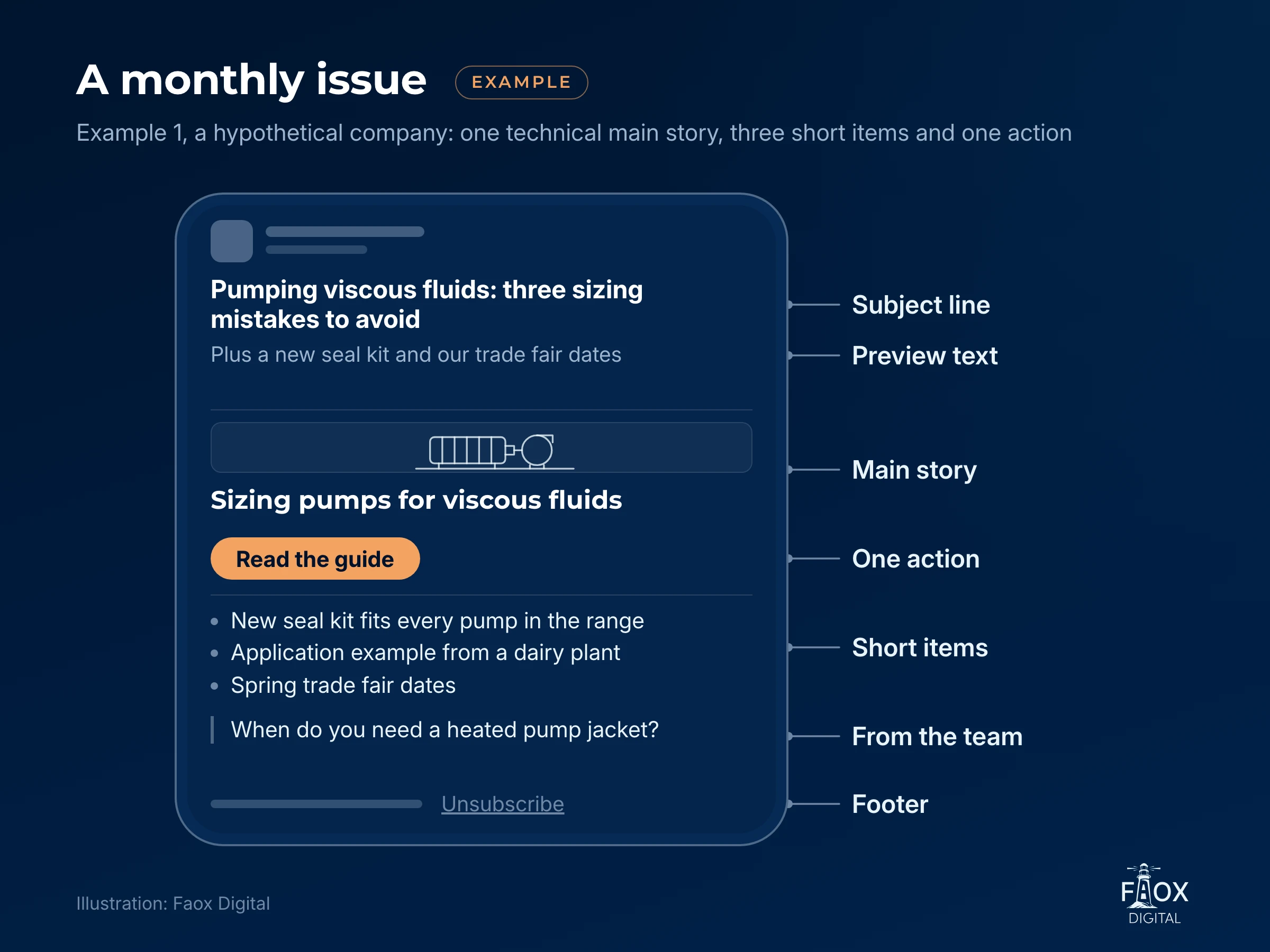
It works because it leads with the kind of content engineers value most, keeps the product news to a line and asks for one thing: reading the guide.
Example 2: a trade show issue
A hypothetical packaging machinery maker sends this issue four weeks before a trade fair:
- Subject line: See the new carton erector running at Hall 4, Stand B12
- Preview text: Book a 20-minute meeting with an engineer
- Main story: what visitors can see at the stand, and the questions engineers usually bring
- Short items: how to get a free visitor pass, and layout drawings to download
- From the team: an executive note from the managing director on why the company is showing a new machine this year
- One action: a "Book a meeting" button
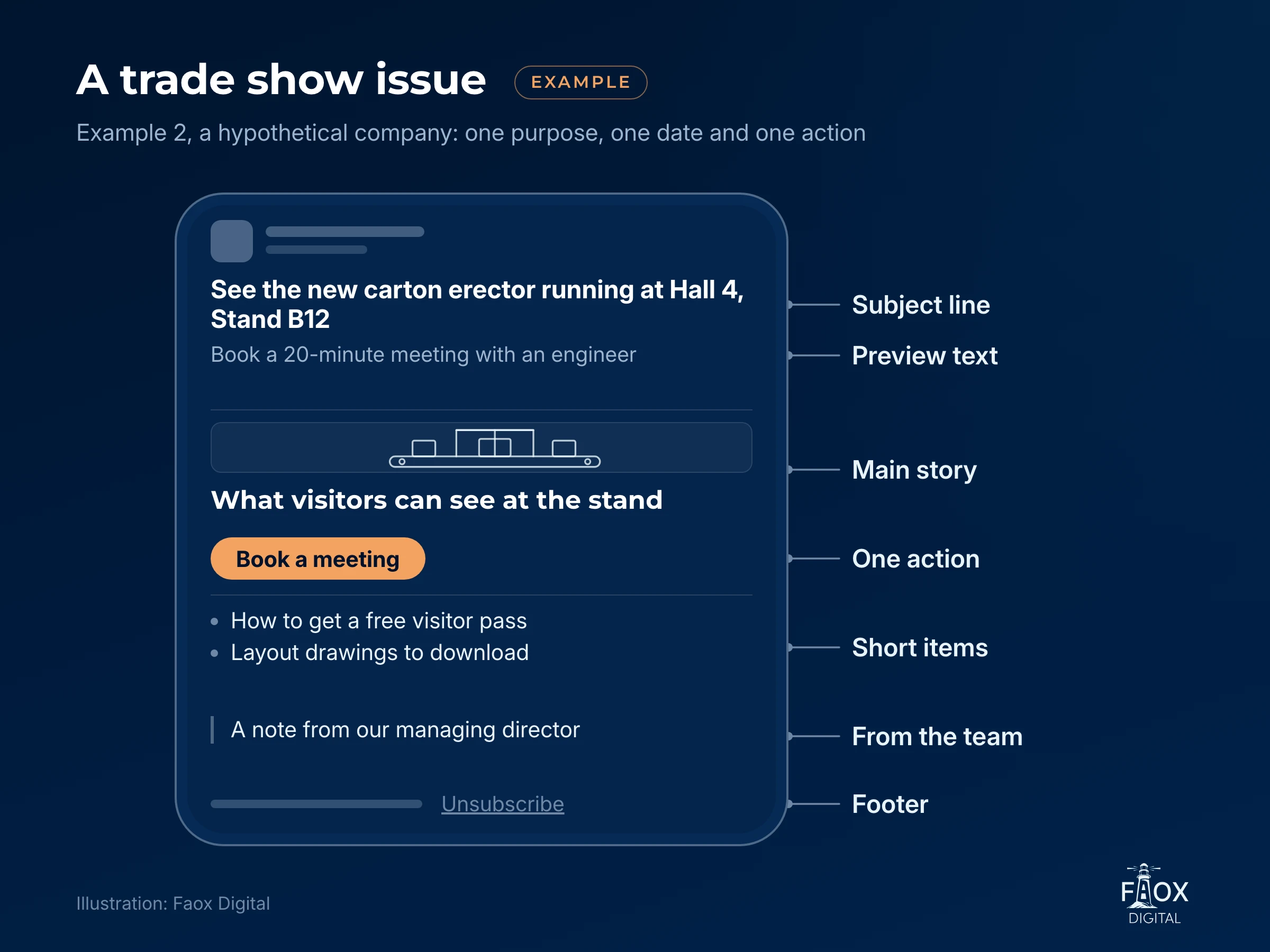
The whole issue has one purpose and a deadline, which is why it works. After the fair, the follow-up to the people who visited the stand is a separate email, written for them, not the next newsletter.
Example 3: a product update issue
A hypothetical valve maker launches a new series:
- Subject line: New valve series for higher pressures: datasheets inside
- Preview text: What changes, what stays compatible and where to find CAD files
- Main story: the product update written for engineers: the problem it solves, the key specifications in one table and what fits existing installations
- Short items: the datasheet and CAD files, where the series is used, and a note on a revised industry standard
- From the team: the product manager answers the question sales hears most about the new series
- One action: a "Download the datasheet" button
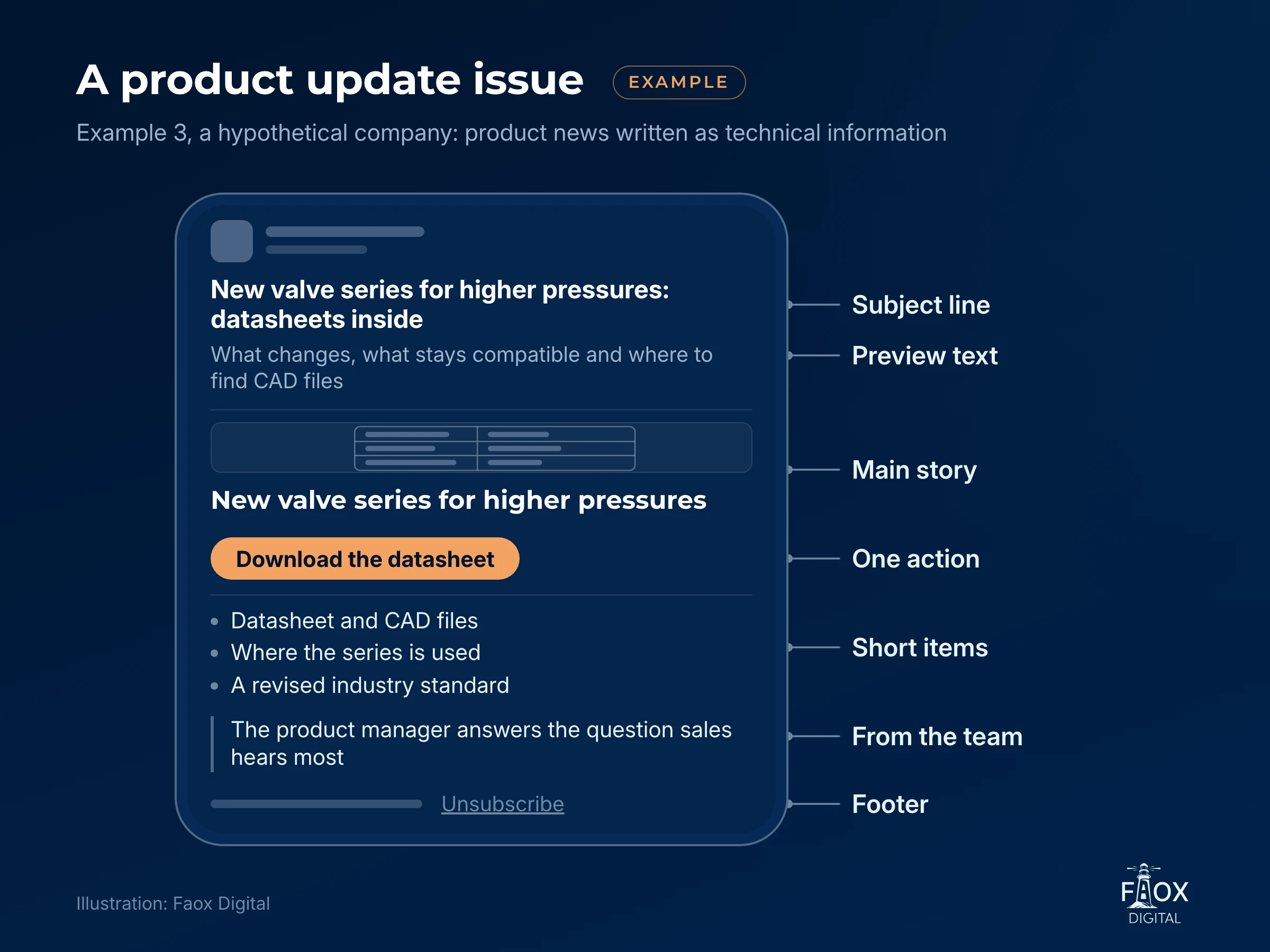
The product news reads as technical information, with the documents engineers need to specify it, so it earns its place in the inbox.
One call to action per issue
Each example asks for one thing. A call to action works best as the natural next step after the main story: read the guide, book a meeting, download the datasheet, or simply reply with a question. Other links can sit in the short items, but only one button should stand out.
Invite replies as well. In B2B, a question from a reader is often the start of a sales conversation, so make sure replies reach a person. The same principles for subject lines, body text and buttons apply to one-off campaign emails, covered in our guide to writing a marketing email.
Template and visual hierarchy
All three examples use one template: a single column, the same sections in the same order, and the same styles for headings, short items and the button. Good B2B newsletter templates fix the structure, not the content.
Visual hierarchy tells the reader where to look first. The main story gets the largest heading and the most space, short items get small headings and a sentence or two, and the button is the only element in the accent color. Two technical points matter:
- Use live text, not text inside images. Microsoft’s support pages say classic Outlook is set by default to block automatic picture downloads, so a newsletter built from images can arrive looking empty.
- Keep the contrast readable. WCAG 2.2, the W3C’s accessibility standard (current version dated December 2024), asks for a contrast ratio of at least 4.5:1 for normal text.
Our guide to creating a B2B newsletter covers building the template, the preview text and the mobile view step by step.
Multilingual versions
A company selling in several markets needs a multilingual version of its newsletter: one issue per language, sent to the subscribers who chose it. Write each version for its market rather than translating every line: local trade fairs, local contact people, local units and date formats, and examples that make sense there. The template and sections stay the same, which keeps the work manageable.
Segment the list by language and market; our guide to B2B segmentation criteria explains how. And set each version’s language in the email’s code: WCAG 2.2 asks that the language of a web page can be determined by software, and the same practice in an email helps screen readers pronounce the text correctly.
Frequently asked questions
What should a B2B newsletter include?
An opening line, one main story that is useful on its own, two or three short items such as a product update, an event or a new technical document, an optional note from a named person, one call to action and a footer with the sender’s details and an unsubscribe link.
What are B2B newsletter best practices?
Write for one type of reader, lead with useful content rather than promotion, keep the same sections in every issue, ask for one action, use live text in a one-column template and send on a rhythm your team can keep.
Should I use a B2B newsletter template?
Yes, as a structure rather than a shortcut: fix the sections, order and styles once, then write each issue for its readers. A ready-made template from your email tool is fine if it has one column, uses live text and looks right on a phone.
Should a B2B newsletter be sent in several languages?
If you sell in several markets, yes. Send one version per language to the subscribers who chose it, written for that market rather than translated line by line, and keep the template and sections the same so the extra work stays small.
Sources
- GlobalSpec and TREW Marketing: 2026 State of Marketing to Engineers, 2026
- Microsoft Support: Block or unblock automatic picture downloads in classic Outlook email messages, accessed November 2026
- W3C: Web Content Accessibility Guidelines (WCAG) 2.2, W3C Recommendation, 12 December 2024
Let’s talk
Have contacts you never follow up with?
Tell us about the list you already have. We will show you how email and CRM can turn it into conversations.