
Welcome Email Examples for B2B: A Simple Sequence for New Subscribers
A simple welcome sequence for new B2B subscribers, with three example emails, the timing between them, a plain template, the preference center and what to measure.
Good welcome email examples for B2B follow a simple sequence: the first email goes out at once, confirms the subscription and says what will come and how often; a second email a few working days later shares your most useful resource; and a third introduces the company briefly and invites a reply. Every email links to a preference center and an unsubscribe option, and the sequence then hands over to the regular newsletter.
A new subscriber is the most attentive reader you will ever have. They have just chosen to hear from you, they remember why, and they will decide within a few emails whether your messages are worth opening. Most B2B companies waste that moment with a single automatic "thanks for subscribing" and then silence until the next newsletter.
This guide gives a simple three-email welcome sequence, with example emails for a hypothetical industrial company, the timing between them and the settings that keep it working. It is about new subscribers to your emails, not about welcoming new employees. For where welcome emails fit among other automations, see our marketing automation guide.
What a B2B welcome sequence is for
A welcome sequence is a short series of automated emails sent to every new subscriber, before they join the regular newsletter. It has four jobs: confirm that the sign-up worked, set expectations, deliver something useful at once, and start a conversation with a real person.
It also comes after an earlier step. Gmail’s sender guidelines ask senders to confirm each recipient’s email address before subscribing them, and Yahoo’s sender best practices recommend an email that asks new subscribers to click to confirm their opt-in. That confirmation email is a separate, plain message; the welcome sequence starts once the address is confirmed.
Welcome email examples: a three-email sequence
Three emails are enough for most B2B companies:
| When | Purpose | Main content | Call to action | |
|---|---|---|---|---|
| Email 1 | At once | Welcome and set expectations | What they will receive, how often, the promised download | Download the guide |
| Email 2 | After 3 working days | Prove the emails are useful | Your most useful resource for their role | Read or download it |
| Email 3 | A week later | Introduce the company and start a conversation | Who you are, in a few lines, and a question | Reply with what you are working on |
| Then | Next regular send | Hand over | The regular newsletter | Its usual action |
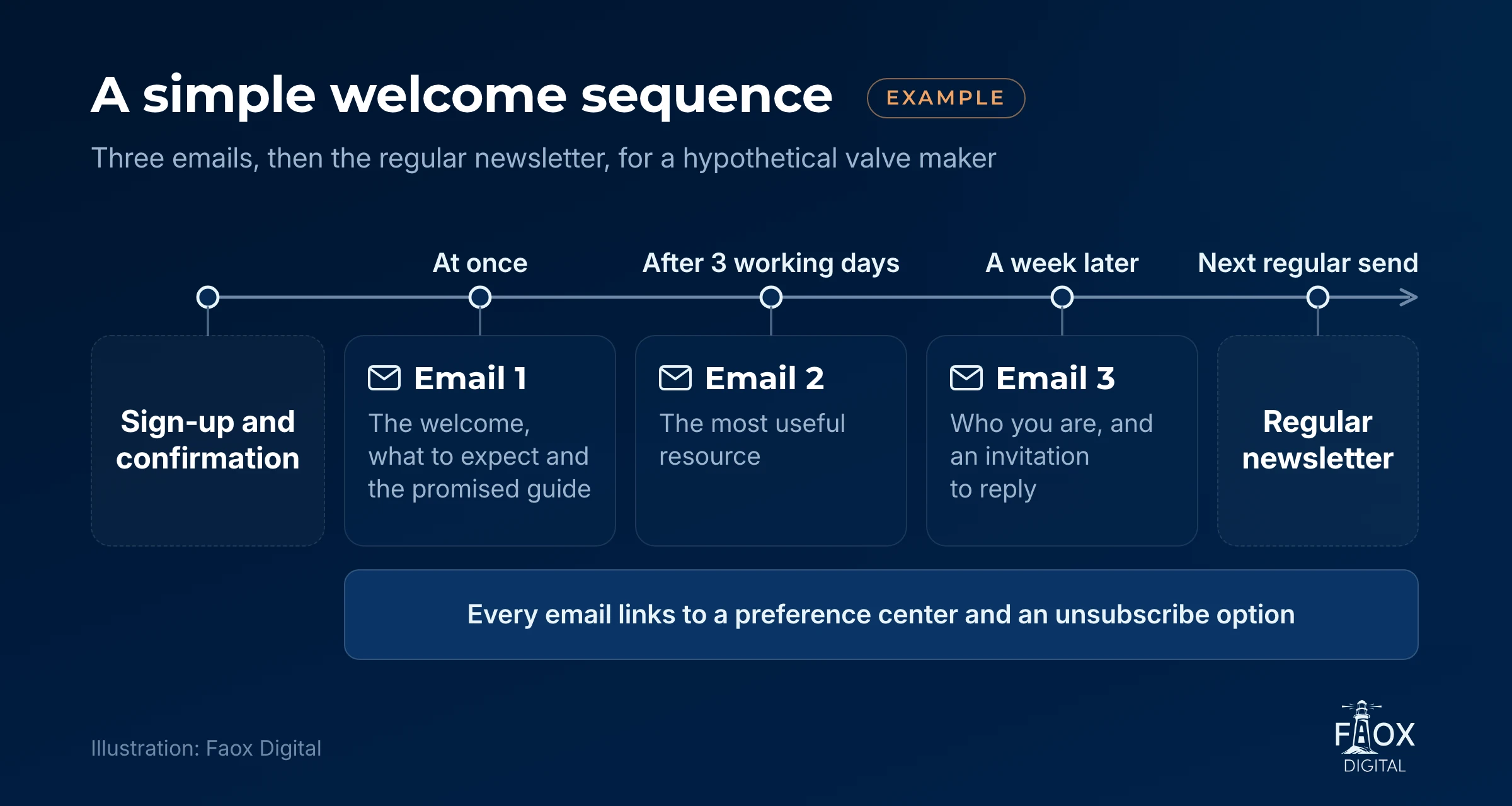
The examples below are written for a hypothetical valve maker whose newsletter goes to plant and maintenance engineers. Adapt the details, keep the structure.
Email 1: the welcome and what to expect
The first email goes out the moment the subscription is confirmed. Its job is setting expectations: Yahoo’s sender best practices advise telling subscribers what mail to expect, how often it will be sent and what it will look like. An example:
- Subject line: Welcome: here is your valve sizing guide
- Preview text: And what you will receive from us from now on
- Body: Thank you for signing up. Here is the valve sizing guide you asked for. From now on, you will receive our newsletter once a month: one practical article for engineers, a short product update and the dates of trade fairs where you can meet us. If you would rather receive only some topics, or fewer emails, you can choose on your preference page.
- Signed: the name and role of the person who writes the newsletter
State the sending frequency honestly and keep to it. If the promise is monthly, a weekly email next week breaks the first thing you told them.
Email 2: the most useful resource
The second and third email earn the subscriber’s attention. Send the second after about three working days, with the single most useful resource you have for their role: the guide engineers download most, a checklist, a recorded webinar. One resource, one link.
- Subject line: The three questions we ask before sizing any valve
- Preview text: A short checklist from our application engineers
- Body: A few lines on why these three questions matter, a link to the checklist, and one sentence on how other engineers use it.
If you know the subscriber’s interest from the sign-up form, such as a product group or industry, use it to choose the resource. A generic "our most popular articles" list is weaker than one well-chosen piece.
Email 3: who you are, and an invitation to reply
The third email, about a week after the second, is the company introduction, kept short and specific: what you make, for whom, in which markets, and who writes these emails. Leave out awards and adjectives; facts read better.
Then add an invitation to reply: ask one question the subscriber can answer in a line, such as "What are you working on this quarter?" or "Which topics should we cover?" Make sure replies reach a person who answers, not a no-reply address. A reply is the most valuable thing a welcome sequence can produce, because it turns a subscriber into a conversation.
- Subject line: Who reads this, and who writes it
- Body: Three or four sentences about the company and the author, then the question, then the name and direct email of the person who will read the answers.
Adapting email 1 to where the subscriber came from
The sequence stays the same, but the first email should reflect how the person signed up:
- From a download: deliver the file in email 1 and choose email 2’s resource from the same topic.
- From a trade fair: mention the fair and, if you met, the person they spoke to; a stand conversation deserves a more personal opening.
- From a quote or contact form: keep the welcome light, because sales is already in touch; the newsletter should not compete with that conversation.
- A new customer: add the service contacts and where to find documentation, alongside what the newsletter will bring.
Store the sign-up source on each contact, so the email tool can choose the right version.
Timing and sending frequency
Space the emails in working days and send them at a sensible hour in the subscriber’s time zone. Do not stack the sequence on top of the newsletter: if a newsletter is due during the first week, either hold it back for new subscribers or let it replace email 3. Your email tool’s exit rules and frequency settings handle this; our guide to setting up email automation shows how.
Preference center and unsubscribing
A preference center lets subscribers choose instead of leaving: topics, frequency, language, or a pause. Link to it from every email, starting with the first.
Unsubscribing must be easy from the first email too. Yahoo’s best practices call for an obvious and visible way to unsubscribe, and the FTC’s CAN-SPAM guide, which makes no exception for business-to-business email, requires every commercial email to include a clear way to opt out and a valid physical postal address. A subscriber who cannot leave tends to mark your email as spam instead.
Welcome email templates and designs
The best welcome email template is plain: one column, mostly text, the company name rather than a heavy banner, one link or button per email and a signature from a real person. Welcome email designs that look like a personal note tend to read better than ones that look like an advert. Keep the same template as your newsletter, so subscribers recognize it later; our B2B newsletter guide covers the template, footer and mobile view.
Measuring the welcome sequence
Judge the sequence by what subscribers do: clicks on the guide and the resource, replies to email 3, unsubscribes after email 1 (a sign that the promise did not match the sign-up) and how many are still subscribed a month later. Opens say little on their own; see our article on metrics beyond open rate for what to track instead.
Common welcome email mistakes
- Sending from a no-reply address, which tells the subscriber nobody is listening.
- Promising one thing and sending another, such as a monthly technical newsletter that turns into weekly offers.
- Too many links in one email: five articles, three social icons and a catalog, so the reader clicks none of them.
- A sequence that never ends, because nobody set the exit into the regular newsletter.
- Writing about the company first, before giving the subscriber anything useful.
Welcome sequence checklist
- The confirmation email is separate, and the sequence starts after it
- Email 1 goes out at once with what to expect and how often
- Each email has one useful link and one clear call to action
- Email 3 invites a reply, and replies reach a person
- Every email has the preference center, the unsubscribe link and the postal address
- New subscribers do not get the newsletter on top of the sequence in their first week
- Clicks, replies and early unsubscribes are reviewed monthly
If your current tool cannot pause the newsletter for new subscribers or personalize the resource by interest, it may be time to consider whether you are outgrowing your email tool.
How Faox Digital builds welcome sequences
Faox Digital, a digital growth partner for B2B companies in complex and international markets, builds welcome sequences, like every email and automation, in the client’s own tools, and the client signs them off before anything goes live. We keep a steady sending rhythm from the first email and judge the sequence by replies, qualified conversations and pipeline.
Key takeaways
- A B2B welcome sequence starts after the confirmation email and usually needs three emails.
- Email 1 goes out at once, sets expectations and delivers what was promised.
- Email 2 shares the single most useful resource; email 3 introduces the company and invites a reply.
- Every email links to a preference center and an easy unsubscribe option.
- Measure clicks, replies and early unsubscribes, then hand over to the regular newsletter.
Frequently asked questions
What should a B2B welcome email include?
A thank-you, what the subscriber asked for, what they will receive and how often, a link to the preference center, the name of a real sender, an unsubscribe link and your postal address. Keep it short and plain.
How many emails should a welcome sequence have?
Three is enough for most B2B companies: a welcome with expectations, a useful resource and a short company introduction with an invitation to reply. After that, subscribers move to the regular newsletter.
When should the welcome email be sent?
At once, as soon as the subscription is confirmed, while the subscriber still remembers signing up. Send the second email a few working days later and the third about a week after that.
Is a welcome sequence an example of email automation?
Yes, it is usually the first automation a B2B company sets up: one trigger (a confirmed sign-up), a few emails with delays between them and an exit into the regular newsletter.
Sources
- Yahoo Sender Hub: Sender Best Practices, accessed November 2026
- Gmail Help: Email sender guidelines, accessed November 2026
- Federal Trade Commission: CAN-SPAM Act, A Compliance Guide for Business, accessed November 2026
Let’s talk
Have contacts you never follow up with?
Tell us about the list you already have. We will show you how email and CRM can turn it into conversations.