
Link Building for B2B Companies: How Authority Is Earned
What backlinks are, how Google and AI tools treat them, and how a B2B company earns authority from relevant, trustworthy sources.
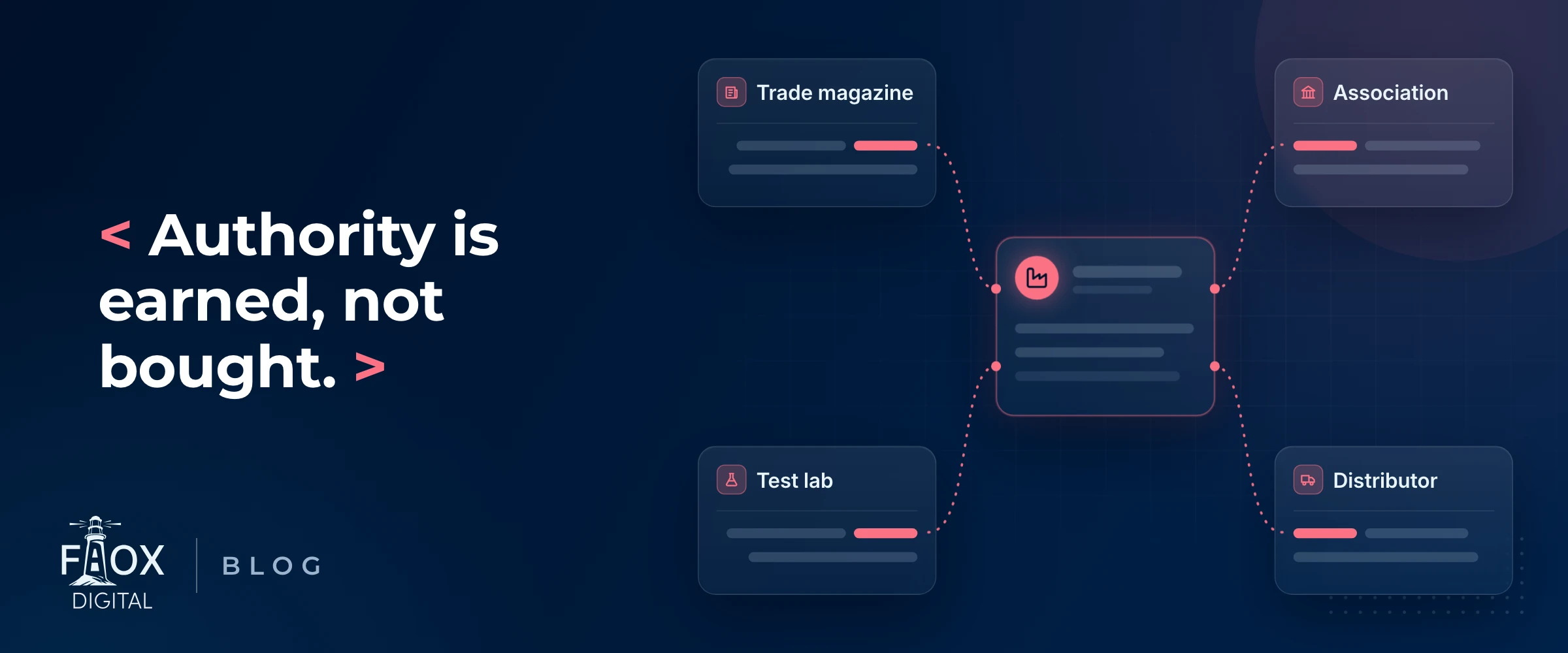
Link building is the work of earning links from other websites to yours. Google uses links to understand what pages are about and which may be most helpful, and its spam policies ban links created mainly to manipulate rankings. For a B2B site, authority comes from being cited by relevant, trustworthy sources such as trade press, associations and partners, which also shape what AI tools say about you.
A B2B company does not win by collecting the most links. It gains ground when the sites its buyers already trust mention it: the trade magazine an engineer reads, the association a purchaser checks, the test laboratory that confirms a certificate. Much link building advice is written for publishers and online shops, and it fits poorly with a business that has a small market and a long sales cycle.
This guide explains what backlinks are, how Google and AI tools treat them, what to avoid and how to earn authority. It opens our series on authority and digital PR; you can find all SEO & AI Search articles on the category page.
What is link building in SEO?
A backlink is a link from another website to yours. Link building is the work of earning those links. A good backlink does two jobs: it brings interested visitors directly, and it helps search engines understand your site.
Google says it has systems that work out how pages link to each other, to determine what pages are about and which might be most helpful for a query. PageRank, one of the systems Google launched with, has changed a lot since then but remains part of its core ranking systems. This is what people mean by link authority: the signal a link passes from one page to another.
Google does not publish that signal. Scores such as Moz’s Domain Authority and Ahrefs’ Domain Rating are third-party estimates. Moz itself says Domain Authority is not a direct ranking factor, and Google says third-party tools have no access to its internal ranking data. Our article on domain authority explains how to read these scores.
Do backlinks still matter for SEO?
Yes, though they are only one part of the picture. Google still names link analysis among its ranking systems. Ahrefs’ figures above suggest that very few pages with no backlinks earn much search traffic, although that is correlation, and such pages mostly target low-competition topics. In a small 2021 Ahrefs experiment, disavowing all links to three pages lowered estimated traffic on two of them. Three pages prove little, but the direction matches.
Links cannot rescue a page that Google cannot crawl or a page that does not answer the question. They add weight to pages that already deserve it, which is why technical work and content usually come first.
How Google reads a link: attributes and anchor text
A link can carry a rel attribute that describes the relationship between the two sites:
| Link type | What it means | When to use it |
|---|---|---|
| Normal link, often called "dofollow" | No attribute at all. "Dofollow" is shorthand and not a real value | Editorial links that you stand behind |
rel="nofollow" | You would rather not be associated with the linked page | Sources you do not trust, when the other values do not apply |
rel="sponsored" | The link is an advertisement or paid placement | Ads, sponsorships and other paid links |
rel="ugc" | The link comes from user-generated content | Comments and forum posts |
Google said in 2019 that it treats all three values as hints about which links to consider or exclude. It also advises against adding nofollow to every external link, because linking out can help establish trust when you cite sources.
Anchor text is the visible text of a link. Google says good anchor text is descriptive, reasonably concise and relevant to the page it is on. That is simple advice for your own pages, but be careful on other people’s sites: Google lists links with optimized anchor text in articles, guest posts or press releases distributed elsewhere as an example of link spam. When a magazine links to you, your company name or the writer’s own words are fine.
To see what you already have, open the Links report in Search Console. It shows your top linked pages, top linking sites and most common link text. It is a sample and not a complete list, and it does not show which links are marked nofollow.
What makes a link worth having
Google publishes no checklist for the value of a link, so these are practical tests and not official criteria. Relevant and trustworthy sources usually pass all of them:
- Would your buyers read this site? A niche trade journal may be worth more to you than a large general site.
- Is it about your sector or market? A link should make sense to someone reading that page.
- Did a person choose to link? An editor’s decision carries a meaning that an automated listing does not.
- Could it send enquiries? Referral visits are a real benefit, whatever a link does for rankings.
- Would you be comfortable explaining it? If you would not want a customer to see how you got a link, do not get it.
The best test is to ask whether you would still want the link if search engines did not exist.
Where B2B links come from
Most B2B companies already have relationships that could produce links, but they rarely list them:
| Source | Why it fits B2B | How to earn it |
|---|---|---|
| Trade magazines and industry news | Read by your buyers | Real news, data and expert comment |
| Associations and standards bodies | Lend credibility in your sector | Membership, working groups, speaking |
| Certification bodies and test labs | Confirm what you claim | Ask to appear in their public registers |
| Distributors and suppliers | Existing business relationships | Give them accurate company and product information |
| Customers | Show real use | Agree on a project story they want to publish |
| Trade fairs and research partners | Show activity and expertise | Exhibit, speak or run joint projects |
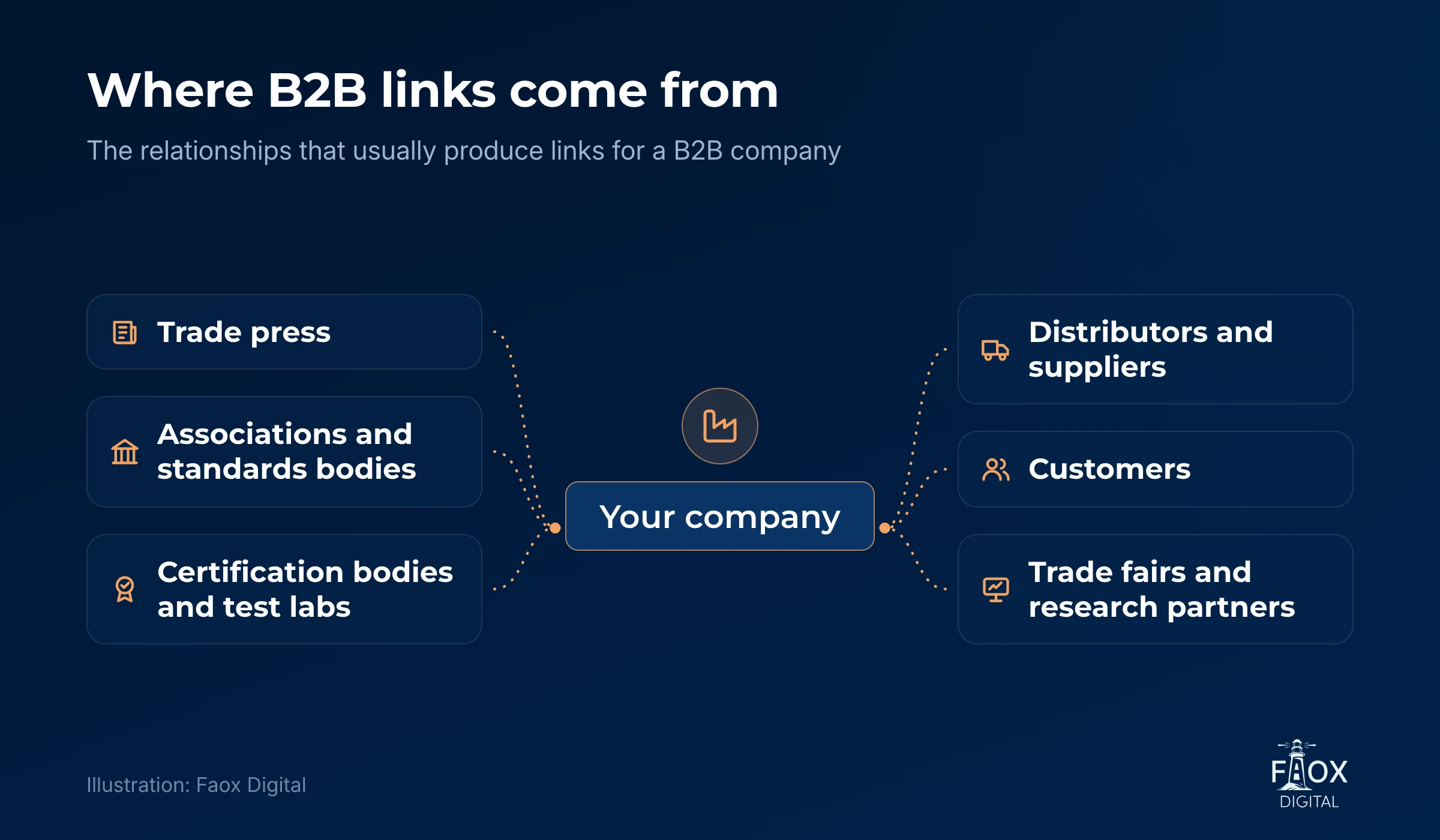
Start with the ones you have already earned. If your company exhibits at a fair or holds a certificate, check whether the organizer or certifier lists you and links to the right page. Our guide to B2B link building covers practical strategies for industrial companies.
Content helps too. People link to things they can use: a selection guide, a summary of a standard, a material comparison or a calculator. A product page rarely earns a link on its own, but a useful page beside it can.
Digital PR and link building
Digital PR earns coverage on media sites because a company has news, data or expertise worth reporting. Links follow from that coverage, and they are not the point of it. Even a mention with no link puts your name in front of the people you want to reach. Our article on digital PR for SEO explains how coverage turns into authority.
The two jobs overlap but are not the same. Press releases and working with journalists are the craft of PR, and our guide to media relations covers them. Do not treat a press release as a link tactic: as noted above, Google’s policy names optimized anchor text in distributed press releases.
Brand mentions and how AI tools choose sources
Brand mentions are references to your company, with or without a link. They matter more now that AI tools answer questions by drawing on what is said across the web. Google says its generative AI features can show what is being said about products and services in blogs, videos and forum discussions. Our article on unlinked brand mentions explains how to find them and put them to work.
The available research points the same way, with limits:
- Mentions over links. Ahrefs studied 75,000 brands in 2025. Branded web mentions correlated with visibility at 0.656 in ChatGPT, 0.709 in AI Mode and 0.664 in AI Overviews, against 0.266 to 0.326 for Domain Rating. It described the link to backlinks as very weak. This is one vendor’s correlation data on established brands, and Ahrefs says improving these metrics will not automatically raise visibility.
- Earned sources. A 2025 preprint by Chen and colleagues found AI search services leaning heavily toward third-party, authoritative sources, and giving much less weight to brand-owned and social content.
Links still count indirectly. Google says its generative AI features are rooted in its core ranking systems, and link analysis is part of those systems. Other AI companies publish no link metric, so we cannot say how much links matter to them. For the wider picture, see our guide to SEO for AI search.
The practical point is that the same work earns both. Coverage in a respected trade journal gives you a mention, often a link and a source an AI tool may read.
Competitor link analysis
Competitor link analysis shows which sites link to your rivals but not to you. It is a good way to find sources you did not know about:
- Choose the right competitors. Pick the sites that appear for your buyers’ searches, even if they are not your commercial rivals.
- Export their backlinks. You need a third-party tool for this, because Search Console covers only your own site. Treat the data as an estimate.
- Filter hard. Keep only sites your buyers might read or trust, and drop directories and obvious link schemes.
- Ask why each link exists. A membership, a news story, a shared project or a useful guide each suggests a different next step.
- Choose what you can honestly earn. Do not copy links that look paid or automated.
If you sell in several markets, run this for each one, because each market has its own trade press and associations. Our international SEO guide explains how market and language versions should work.
What Google’s link spam policy rules out
Google’s link spam policy defines link spam as creating links to or from a site primarily to manipulate search rankings. Its examples include:
- Buying or selling links for ranking purposes, whether for money, goods, services or a free product in exchange for a post with a link
- Excessive link exchanges, and partner pages that exist only for cross-linking
- Automated programs or services that create links
- Requiring a link in a contract or terms of service without letting the other party qualify it
- Advertorials and paid articles with links that pass ranking credit
- Low-quality directories and bookmark sites
- Links hidden in widgets or spread across the footers of many sites
- Forum comments with optimized links
- Low-value content created to manipulate linking signals
Paid placements are allowed when the link is marked rel="sponsored" or rel="nofollow". So you can sponsor an industry event or a trade publication for its audience, as long as the link is qualified.
The policies also cover expired domain abuse, where a lapsed domain is bought and reused mainly to manipulate rankings, and third-party content that exploits a host site’s standing, which Google’s site reputation policy addresses. Be careful if a seller offers either as a shortcut.
Google says its SpamBrain system can detect both sites buying links and sites used for passing them, and that it aims to neutralize unnatural links through algorithms and manual actions. So bought links may simply be ignored, which wastes the money, or they may lead to a manual action. Before you pay anyone, read our guide to choosing a link building service.
Toxic links: when to worry
SEO tools often flag toxic links, and those alerts can look alarming. Google’s advice is calmer. It says that in most cases it can assess which links to trust without extra guidance, so most sites will not need its disavow tool.
Google says disavowing is appropriate only when you have a considerable number of spammy, artificial or low-quality links and they have caused, or are likely to cause, a manual action. It calls the tool an advanced feature, and warns that using it incorrectly can harm your site’s performance. A strange link from an unknown site is usually nothing to act on. Our article on toxic backlinks explains when cleanup is worth it.
How to start: a first plan for a B2B site
You can begin without a large budget:
- Open the Links report in Search Console and note who already links to you
- List your associations, certificates, trade fairs, distributors and suppliers, and check whether each one lists you correctly
- Find mentions of your company that do not link, and politely ask for a link where it would help readers
- Choose or create one page in your sector that people would want to cite, such as a selection guide
- Offer one real story, data point or expert comment to a trade publication your buyers read
- Agree on how you will judge the work: referral visits, enquiries and relevant coverage, not a score
This is slow work, and no one can promise a ranking from it. But an earned link is hard for a competitor to copy, and it can keep sending the right readers to you long after the work is done.
Frequently asked questions
What is link building in digital marketing?
It is the work of earning links from other websites to yours, so that interested readers can find you and search engines can better understand your site. In B2B, it overlaps with digital PR, partnerships and association work, because those are the relationships that produce useful links.
How do you do link building in SEO?
Start with the Links report in Search Console, then claim links you have already earned from associations, certifiers, fairs and distributors. Publish pages that people want to cite, offer real news or data to trade publications, and use competitor analysis to find sources you missed.
What is a backlink in SEO?
A backlink is a link from another website to a page on yours. Google uses links as one input to understand what pages are about and which may be most helpful. A link’s value depends on the site, the context and whether it was earned or created to manipulate rankings.
How many backlinks does a B2B site need?
There is no target number, and Google publishes none. A few links from sources your buyers trust can do more for you than many from sites they never read. Compare yourself with the sites that appear for your buyers’ searches, and look at where their links come from.
Is it OK to buy backlinks?
Buying links for ranking purposes breaks Google’s spam policies. You can pay for sponsorships and advertising if the link is marked rel="sponsored" or rel="nofollow", which tells Google it is paid. Google says its systems aim to neutralize unnatural links, so bought links may bring nothing at all.
Sources
- Google Search Central: Spam policies for Google web search, accessed November 2026
- Search Console Help: Links report, accessed November 2026
- Moz: Domain Authority, 2025
- Ahrefs: 96.55% of content gets no traffic from Google, 2023
Let’s talk
Where do you want to be found?
Tell us the searches that matter to your business. We will review your site and tell you plainly what to fix first, including what you can do yourself.