
How to Calculate Share of Voice in PR: Formula, Sources and an Example
The share of voice formula, the choices that decide the result (competitor set, sources, period and counting rules), weighting by reach and publication importance, tone and topic share, and a worked example with fictional figures.

Here is how to calculate share of voice in PR: count the stories that mention your company in a fixed set of publications over a set period, divide by the total stories for you and your chosen competitors in the same sources, and multiply by 100. For a fairer picture, weight each story by the publication’s reach and importance, split the result by tone and topic, and compare the same competitor set period by period.
Counting your own coverage tells you whether PR is active. Comparing it with your competitors’ coverage tells you whether you are winning attention in your market. That comparison is share of voice, and the result depends almost entirely on how you set it up: which competitors, which publications, which period and which counting rules. This guide gives the formula, the choices behind it and a worked example with fictional figures. It builds on our media monitoring guide, which covers how to find and log the coverage in the first place.
Choose the competitor set and the sources
The competitor set decides the result more than any formula. Include the companies your buyers actually compare you with, which your sales team can name, rather than the biggest names in the industry. Keep the set fixed: adding a large competitor halfway through the year lowers your share without any change in your own coverage.
Use the same sources for every company. If you sell in several countries, calculate share of voice per market from each market’s own titles, as our guide to market-by-market media lists explains. A single global figure hides where you are strong and where you are absent.
Count the stories
The story count is the base of every version. Agree the rules before you count, write them down and keep them:
- What counts: any story that names the company, or only stories where it is a main subject
- Reposts: whether copies of the same release on several sites count once or each time
- Formats: whether newsletters, podcasts and broadcast count as well as articles
- Paid placements: leave them out, because sponsored content is advertising, not coverage you earned
Weight by reach and publication importance
A mention in the title your buyers read every month is worth more than one on a site they never visit. There are two ways to reflect that.
Weighted reach adds up the audience of each outlet that covered you. The IPR dictionary describes reach as an estimate of the audience exposed to a communication, based on an audited system, and separates it from readership, the number of people who actually read each issue. Use one source of audience figures for every outlet, audited where possible, and treat the total as potential audience, not readers.
Publication importance sorts your media list into tiers and gives each tier a weight. The weights below are our working suggestion, not an industry standard:
| Tier | Which titles | Weight |
|---|---|---|
| Tier 1 | The few titles your buyers read and trust most | 3 |
| Tier 2 | Other relevant trade and business titles | 2 |
| Tier 3 | General, regional or aggregator sites | 1 |
Prominence can be added the same way, for example extra weight when your company appears in the headline.
A worked example with fictional figures
The figures below are fictional: one quarter, one market and a media list of 12 titles, invented to show the calculation.
| Company | Stories | Share of voice by count | Tier-weighted score | Weighted share of voice |
|---|---|---|---|---|
| Your company | 18 | 22.5% | 40 | 27.8% |
| Competitor A | 30 | 37.5% | 50 | 34.7% |
| Competitor B | 12 | 15.0% | 20 | 13.9% |
| Competitor C | 20 | 25.0% | 34 | 23.6% |
| Total | 80 | 100% | 144 | 100% |
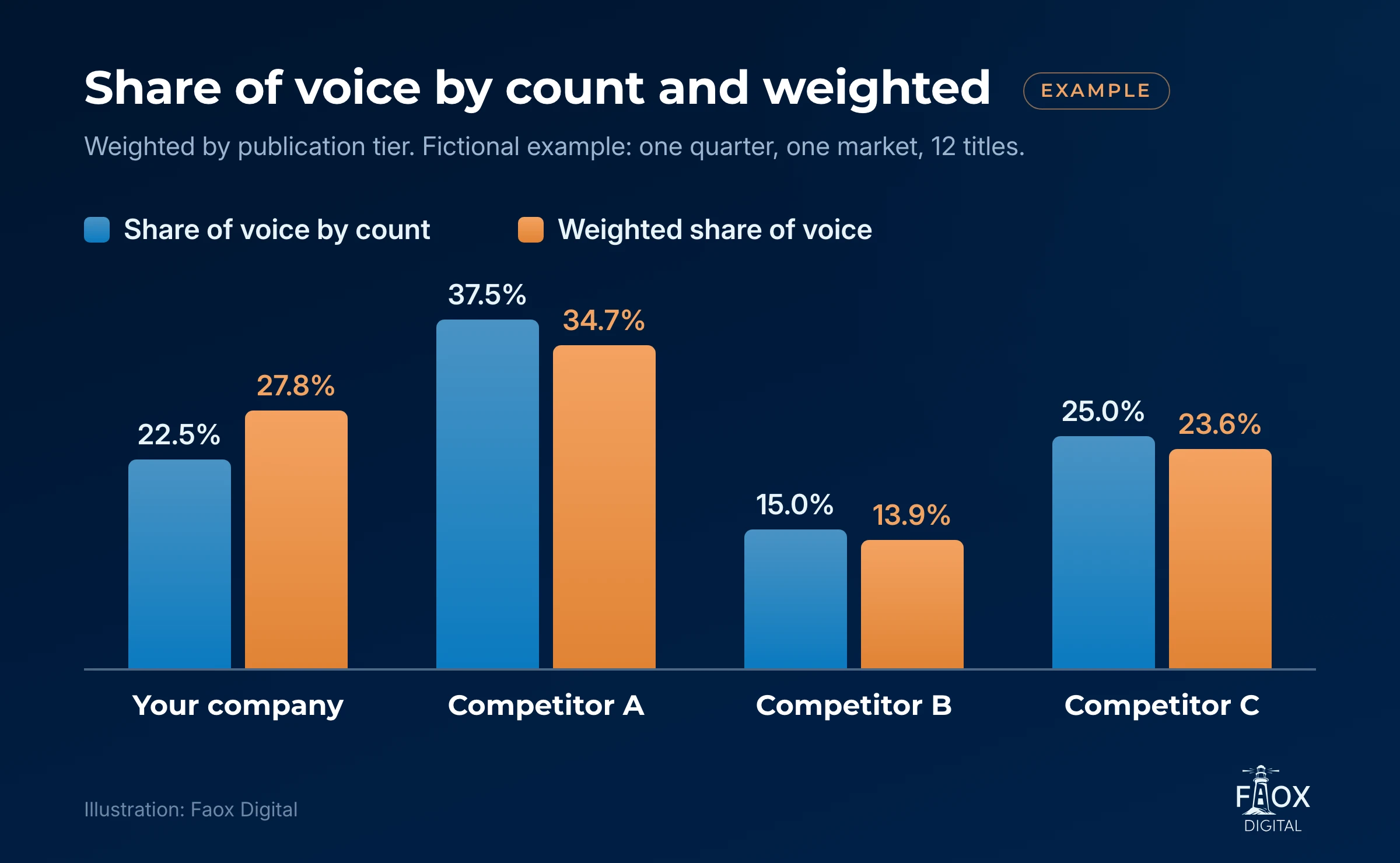
Your company’s 18 stories include 8 in tier 1 titles, 6 in tier 2 and 4 in tier 3, so its weighted score is 8 × 3 + 6 × 2 + 4 × 1 = 40. Competitor A has the most stories, but half of them sit on tier 3 sites. By count you trail A by 15 points; weighted by publication importance, the gap narrows to about 7. Tone and topic come next: if several of A’s tier 1 stories are negative, the picture changes again.
Compare periods the right way
A period comparison only works when everything else stays the same: the competitor set, the media list, the search terms and the counting rules. Compare a quarter with the previous one and with the same quarter a year earlier, because trade fairs and launches move the numbers. A quarter with a trade fair, when releases like our event press release examples go out, belongs next to last year’s fair quarter, not next to a quiet summer. Look at the trend over several periods before drawing conclusions; one month can be moved by a single story.
Frequently asked questions
How do you calculate share of voice?
Divide the number of stories that mention your company by the total stories for you and your chosen competitors in the same publications and period, then multiply by 100. A company with 18 of 80 stories has a share of voice of 22.5%.
How do you measure share of voice in PR?
Monitor the coverage of your company and three to five competitors in a fixed media list, log each story with its outlet, tone and topic, and calculate the shares each month or quarter. Monitoring tools can count mentions for you, but check what they include before you trust the totals.
What is a good share of voice?
There is no general benchmark: a good share depends on how many competitors are in your set and how large they are. Judge your share against its own trend and against the companies buyers compare you with, per market and per topic.
Is share of voice the same as share of coverage?
Yes, in PR the two terms describe the same measure. The Institute for Public Relations’ measurement dictionary gives share of coverage as another name for share of voice, and uses share of ink for press and magazine coverage.
Sources
Let’s talk
Have a story worth telling?
Tell us what is new in your business. We will tell you honestly whether it is news and where it could be published.