
Media Monitoring for B2B: Tracking and Reporting Your Press Coverage
What media monitoring is in PR, how it works, what a B2B company should track in print and online news, how to keep a coverage archive and report on it, and how to choose tools.
Media monitoring is the routine of finding and recording every article, broadcast or online story that mentions your company, products, people or competitors in the publications that matter to you. It works through alerts, monitoring tools or agencies that scan online news, trade sites, print and other sources for your search terms, plus a person who checks each result and logs it. Use what it finds to report results, correct mistakes, follow up with editors and plan the next round of PR.
Many B2B companies find out about their own coverage by accident: a customer mentions an article, a distributor forwards a link, or a sales manager spots the company in a trade magazine at a fair. Coverage that nobody records cannot be reported, corrected or built on, and the effort behind it disappears from view.
That matters to anyone who has to show what PR achieves. In Muck Rack’s State of PR 2026 survey of 971 PR professionals, 69% said producing measurable results is the most effective way to show the value of PR to company leadership or clients, and 45% said media measurement and reporting makes up at least a quarter of their job. Muck Rack sells PR software and most respondents work in the US, but the need is the same everywhere: you cannot measure coverage you have not found.
This guide covers media monitoring for press coverage: online news, trade publications, print, broadcast and podcasts. Monitoring social media is a separate job, covered in our guide to social listening. You can find all Digital PR articles on the category page.
What is media monitoring in PR?
Media monitoring in PR is the systematic news tracking of everything published about your company and the topics around it. It answers simple questions that PR teams are otherwise left guessing at: what appeared, where, when, written by whom, how accurate it was and whether it reached the readers you care about.
It grew out of the press clipping services that once cut articles out of newspapers and posted them to clients. Today most of the work is digital, but the purpose is the same: a complete and reliable record of your coverage, so that you can learn from it.
Media monitoring is different from measurement. Monitoring finds and records coverage; measurement judges what it achieved. You need the first to do the second.
How does media monitoring work?
Every monitoring setup, from a free alert to an agency service, follows the same steps:
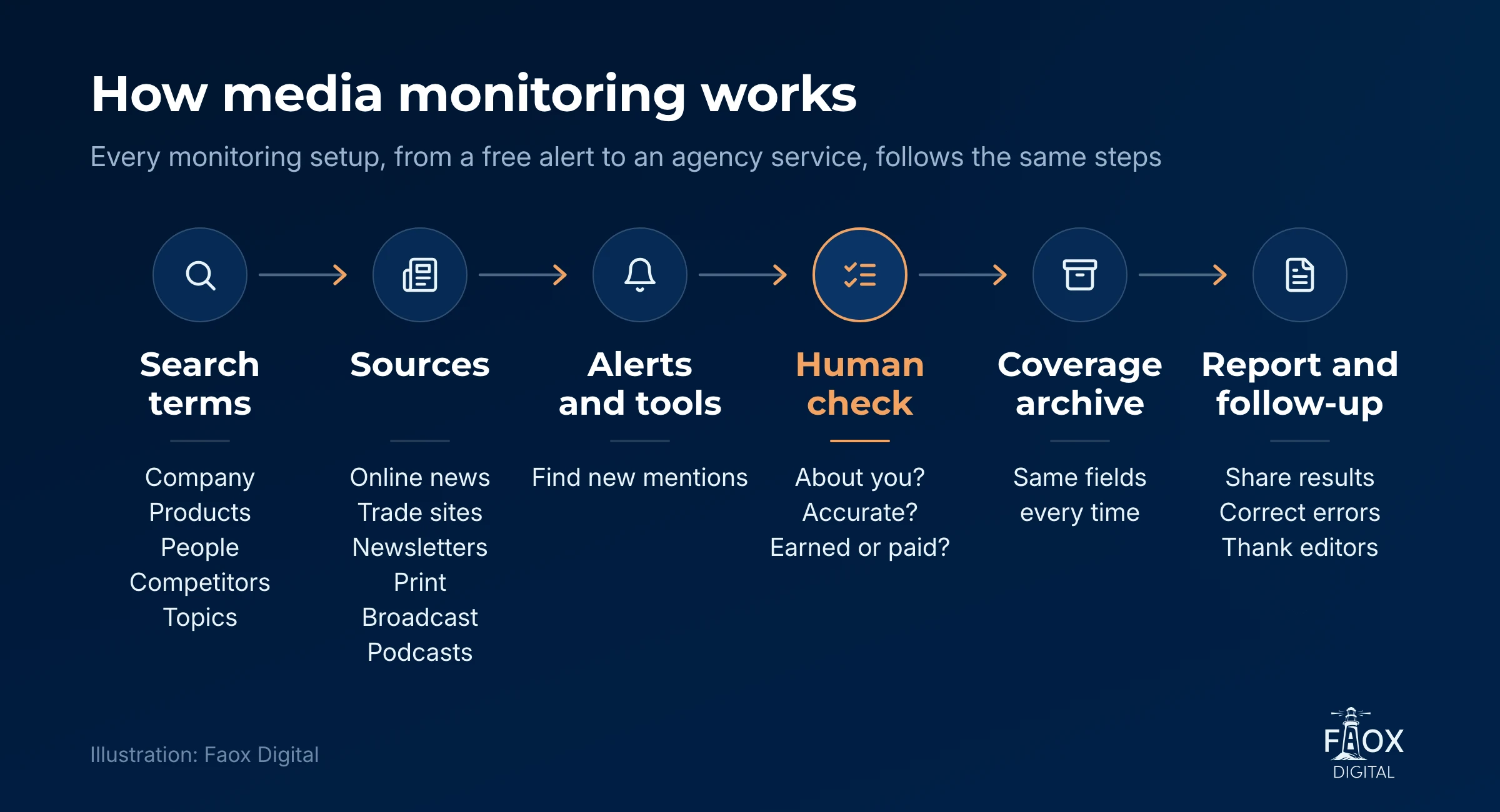
- Define the search terms: your company name and its variants, product names, executives and spokespeople, competitors and the topics you want to follow.
- Choose the sources: online news sites, trade publication websites and newsletters, print editions, broadcast and podcasts, in every market and language you work in.
- Set up alerts or a tool that searches those sources for your terms and sends you new results.
- Check each result by hand: is it really about you, is it accurate, and is it earned coverage or a paid placement?
- Record it in a coverage archive with the details you will need later.
- Report and act: share the results, correct errors, thank editors and follow up.
The simplest tool is free. Google Alerts sends an email when new results for a topic appear in Google Search, and lets you choose how often you get them, which types of sites to include, the language, the region and how many results to see. It is a useful start for one company name in a few languages, but it only finds what Google Search finds, and it misses most print and paywalled content.
Copying and sharing articles can also need permission. In the UK, for example, NLA Media Access, owned by the publishers, licenses organizations to make paper and digital copies of newspaper, magazine and news website content, and licenses the media monitoring agencies that supply that content to clients. Check the rules in each market before you circulate full articles inside your company.
What to monitor
Start with a short list of terms and widen it as you learn what you miss:
| What to track | Examples | Why it matters |
|---|---|---|
| Company name | The official name, short forms, the old name, common misspellings | Brand name tracking catches coverage that uses a version you would not search for |
| Products and brands | Product family names, model names, trademarks | Trade titles often write about the product, not the company |
| People | Executives, spokespeople, authors of your byline articles | Interviews and quotes may name the person but not the company |
| Competitors | Their names, products and spokespeople | Competitor tracking shows where they appear and which titles cover your field |
| Topics | Your industry, applications, standards and regulations | Finds stories you could contribute to next time |
| Publications | The titles on your media list | Lets you check whether they covered your news at all |
Search in every language you work in, with the local terms your buyers use. A German trade title will not write "valve"; a monitoring setup that only searches in English will miss it.
Online news and print monitoring
Online news is the easiest part: most news sites and trade publication websites are indexed by search engines and monitoring tools, often within hours. Two gaps remain. Paywalled articles may show only a headline, and some trade titles publish only part of their print issue online.
Print monitoring needs more effort, and in B2B it still matters, because many trade magazines appear in print and some articles never appear on the web. Options include monitoring services that read digital editions or print issues, asking the publication for a PDF of the page when your story runs, subscribing to the titles on your media list, and asking local staff and distributors to send in what they see. Trade fair issues are worth checking by hand, because they carry many product stories at once.
If you work in several countries, monitoring has to cover each market in its own language. Our guide to global PR strategy explains how monitoring fits into PR across markets.
Keep a coverage archive
A coverage archive is the record every report and decision draws on. Keep one entry per article or broadcast, with the same fields every time:
| Field | What to record |
|---|---|
| Date and publication | When it appeared, the title, and the market and language |
| Headline and author | The exact headline and the journalist’s name |
| Link or copy | The URL, plus a PDF or scan for print, stored within licence terms |
| Type | Earned coverage, contributed article or paid placement |
| Topic and messages | Which news or story it covers, and which key points it carries |
| People quoted | Which spokesperson or customer is quoted |
| Accuracy | Errors in names, figures or facts, and whether a correction was asked for |
| Link to your site | Whether it links to you, and to which page |
| Reach and readership | The publication’s audience figures and who its readers are |
| Follow-up | Thanks sent, corrections requested, next contact with the editor |
Record paid placements as well, but mark them clearly and keep them out of your earned coverage totals. Our guide to clearly labeled sponsored content explains why the two must stay apart.
Reach and readership profile
Reach is the size of a publication’s audience: its print circulation, website visitors or newsletter subscribers. It tells you how many people could have seen an article, not how many did. Use figures the publisher supplies, audited where possible, and say which figure you used.
The readership profile matters more for a B2B company: the industries, job functions and regions of the readers. A specialist magazine read by your buyers is worth more than a general business site with ten times the audience, and your archive should show that difference.
Avoid figures that turn coverage into a pretend advertising value. AMEC’s Barcelona Principles 4.0, the communication measurement industry’s principles updated in 2025, say invalid measures such as advertising value equivalents should not be used, and that communication should be measured and evaluated by its outcome and impact.
Reporting coverage
Reporting turns the archive into decisions. A useful monthly report for a B2B company fits on a page or two:
- The coverage of the month, earned and paid separately, with the most important pieces named
- Which titles on your media list covered you, and which did not
- The messages that came through, the spokespeople quoted and any errors
- Competitor coverage worth knowing about
- Links from coverage, and the visits and enquiries they brought where you can trace them
- What worked, what did not, and what to change next month
Tracing visits and enquiries back to coverage is a website analytics job, and our guide to B2B marketing attribution covers how to set it up and read it. For choosing the metrics themselves, see our guide to PR metrics that matter.
Choosing media monitoring tools
Tool selection comes down to whether a tool finds the coverage you care about. The options:
- Free tools: Google Alerts, searches on Google News, the newsletters and feeds of the publications on your list.
- Monitoring platforms: software from companies such as Meltwater, Cision or Muck Rack, which searches large source lists, sends alerts and builds reports.
- Monitoring agencies: services that also read print and broadcast, often with human checking.
Before you buy, test with your own terms and your own media list:
- Does it find your trade publications, in every market and language you need?
- Does it cover print, paywalled content, broadcast and podcasts, or only open websites?
- Are the copies it supplies licensed for sharing inside your company?
- How quickly do alerts arrive, and how well does it remove duplicates?
- How accurate are its automatic tags, such as sentiment, when you check them by hand?
- Can you export the data and build the reports you need?
- What does it cost, and for how long are you committed?
A tool that finds every consumer news site but misses the two trade magazines your buyers read is the wrong tool, whatever its price.
Set a monitoring routine
Monitoring works when it is somebody’s job and has a rhythm. A workable routine for most B2B companies:
- Every working day: someone skims the alerts, removes what is not about you and flags anything that needs a reply, such as an error or a journalist’s question.
- Every week: new coverage goes into the archive with all its fields, and print and foreign-language finds from colleagues and distributors are added.
- Every month: the archive becomes a short report, and the search terms and sources are reviewed for gaps.
- Around launches and trade fairs: check more often, because that is when most coverage appears at once, and separate stories editors wrote from copies of your release on distribution sites.
Give one person ownership of the archive, even if several people feed it, so that entries stay consistent and nothing is counted twice.
Common mistakes in media monitoring
- Searching only for the official company name and missing short forms, product names and people.
- Monitoring only in English when your markets read in other languages.
- Trusting a tool to find print coverage it cannot see.
- Counting copies of your own release on distribution sites as editorial coverage.
- Mixing paid and earned coverage in the same totals.
- Reporting potential reach as readers, or pricing coverage as if it were advertising.
- Keeping the archive in someone’s inbox, so it disappears when they change jobs.
Using monitoring to improve PR
Monitoring pays off when you act on it. Correct factual errors quickly and politely. Thank editors who covered you, and note what they wrote for the next pitch. See which stories and angles earned coverage, and which titles never responded. Notice the journalists who write about your competitors or your topics, because they may want your expert next time. And share good coverage with sales and distributors, within licence terms, so that it reaches customers too.
How Faox Digital approaches media monitoring
Faox Digital, a digital growth partner for B2B companies in complex and international markets, includes monitoring in its digital PR work: we track what lands in the outlets that matter to each market’s buyers, in each market’s language, and that record feeds the next round of stories, pitches and outreach.
Key takeaways
- Media monitoring finds and records every story about your company, products, people and competitors, so that coverage can be reported, corrected and built on.
- Track company and product names in all their variants, people, competitors and topics, in every language you work in.
- Online news is easy to find; print, paywalled and foreign-language trade coverage needs extra sources.
- Keep one coverage archive with the same fields for every story, and keep paid placements apart from earned coverage.
- Report reach with its source, judge readership before size, and avoid advertising value equivalents.
Frequently asked questions
What is media monitoring in PR?
It is the routine of tracking and recording the media coverage that mentions your company, products, people or competitors, in online news, trade publications, print, broadcast and podcasts. PR teams use it to report results, correct errors, follow up with journalists and plan their next stories.
How does media monitoring work?
You define search terms, choose the sources to watch, and use alerts, a monitoring platform or an agency to find new mentions. A person then checks each result for relevance and accuracy, records it in a coverage archive and uses the archive for reports and follow-up.
How do you do media monitoring yourself?
Set up Google Alerts for your company, product and people names in each language, follow the websites and newsletters of the trade titles on your media list, ask the publications for copies of print pages, and log every story in a simple spreadsheet. Review it monthly, and move to a paid tool when you start missing coverage.
What are media monitoring services?
They are companies that find and supply coverage for you, through software platforms, agencies or both. Platforms search large lists of online sources and send alerts and reports; agencies also cover print and broadcast and often check results by hand. Test any service against your own media list before you sign.
Sources
- Muck Rack: State of PR 2026, 2026
- Google Search Help: Create an alert, accessed November 2026
- The Open University Business School: Barcelona Principles 4.0, what they are, what’s new, 2025
- NLA Media Access, accessed November 2026
Let’s talk
Have a story worth telling?
Tell us what is new in your business. We will tell you honestly whether it is news and where it could be published.