
PR Measurement for B2B: Which Metrics Matter in Your PR Report
Which metrics show the value of B2B PR at each level, from earned placements in target publications and key messages to share of voice, referral traffic, branded search and enquiries, what a coverage report should contain, and why AVEs are not a valid measure.

PR measurement for a B2B company should show three things: what you earned (coverage in the titles your buyers read, carrying your key messages), how it compares (share of voice against competitors) and what readers did next (visits from coverage, branded searches, enquiries). AMEC’s Barcelona Principles 4.0 ask for outputs, outcomes and impact to be reported together and rule out advertising value equivalents. A good PR report pairs a short list of these metrics with the stories behind them and a plan for the next round.
Many PR reports are long and say little: a pile of clippings, an impressive "potential reach" in the millions and a dollar figure for what the coverage would have cost as advertising. None of it answers the question a managing director asks: is PR helping us win business? This guide sets out the metrics that do, what each one shows and what a useful report contains. It assumes you are already tracking press coverage in a coverage archive. We work as a digital PR agency and write these reports ourselves, so we have a stake in the answer; the metrics apply whoever reports them.
What PR measurement and evaluation means
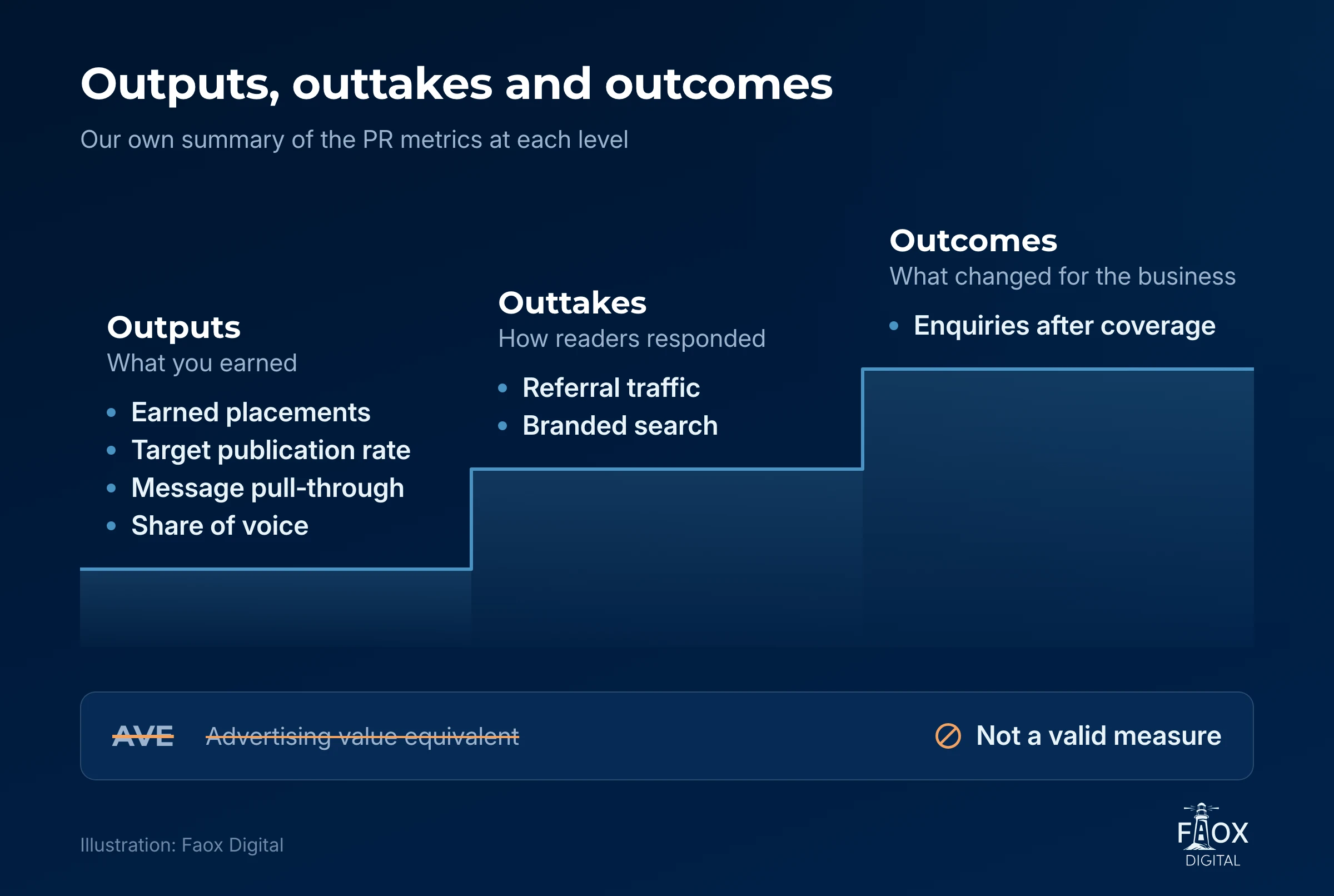
PR measurement counts and checks what PR produced and what followed; evaluation judges whether that met the objective. The Institute for Public Relations’ Dictionary of Public Relations Measurement and Research (third edition, 2013) gives the three levels most frameworks use:
- Outputs: what the PR program generates that a target audience may receive, such as published stories
- Outtakes: what audiences understood, heeded or did in response, such as looking for more information
- Outcomes: changes in awareness, knowledge, attitude, opinion and behavior that result from the program
The first of AMEC’s Barcelona Principles 4.0, published in 2025, makes clear, measurable objectives a critical prerequisite, so set them before you choose the metrics.
The PR metrics that matter at each level
| Metric | What it shows | Level | Where the data comes from |
|---|---|---|---|
| Earned placements | How much coverage you won, and its quality | Output | Your coverage archive |
| Target publication rate | Share of placements in the titles your buyers read | Output | Coverage archive against your media list |
| Message pull-through | Share of placements carrying a key message | Output | Reading each story |
| Share of voice | Your share of coverage against competitors | Output | Monitoring of you and your competitors |
| Referral traffic | Visits from coverage to your website | Outtake | GA4 Referral channel |
| Branded search | Searches for your company name over time | Outtake | Search Console branded queries filter |
| Enquiries after coverage | Contacts that cite or follow a story | Outcome | Forms, CRM and the sales team |
| Advertising value equivalent | The price of the space as advertising | Not valid | Leave it out |
Number and quality of placements
Count earned placements, the stories editors chose to publish, and judge each one: is the outlet relevant, is your company a main subject or a passing mention, are the facts right, is a spokesperson quoted, and does the story link to your site? A few strong stories in the right titles are worth more than many automatic reposts. Copies of a release on partner sites belong in a separate line, as our comparison of press release distribution services explains, and potential audience is never the same as readers.
Target publication rate
The target publication rate is the share of your earned placements that appeared in the titles on your target list: target-list placements divided by all earned placements, times 100. It shows whether PR reaches the publications your buyers actually read. A rising number of stories with a falling rate usually means the coverage is drifting toward outlets that matter less.
Message pull-through
Message pull-through is the share of placements that carry at least one of your key messages. The IPR dictionary describes key messages as the essential ideas behind a campaign that third parties should take up. Agree two or three messages per campaign, read each story, and record which messages appeared and how accurately. A story that names you but misses the point counts as a placement, not as a message delivered.
Referral traffic and branded search
Outtakes show whether readers acted. Referral traffic counts visits that come to your site from links in coverage: Google Analytics’ default channel group defines Referral as visits via non-ad links on other sites, such as blogs and news sites. Look at the sessions from each publication’s domain, and at what those visitors did next.
Branded search shows whether more people look for you by name. Google introduced a branded queries filter in Search Console’s Performance report in November 2025, and since March 2026 it has been available to all eligible sites; it separates queries containing your brand name, its misspellings and your product names from all others. Google notes that the classification is AI-assisted and some queries may be misidentified, so read it as a trend over months. Connecting these visits and searches to pipeline is a job for analytics and your CRM; our guide to measuring marketing’s contribution to sales covers GA4, attribution and the sales side.
The Barcelona Principles and why AVEs are out
The Barcelona Principles, the measurement standards of AMEC, the International Association for the Measurement and Evaluation of Communication, were updated to version 4.0 in 2025. Several of the seven principles shape a PR report directly: measurement requires both qualitative and quantitative analysis, and outputs, outcomes and impact should be reported together, related to the organization and its audiences.
Principle 5 is explicit: invalid measures such as advertising value equivalents (AVEs) should not be used; the contribution of communication should be measured by its outcome and impact. An AVE prices coverage as if it were bought advertising space. The IPR dictionary calls it a discredited output score, and AMEC runs a campaign to eradicate AVEs and their variants from PR work. AVE is never a success measure: it says nothing about who read the story, what they took from it or what they did next.
Setting targets for each metric
Targets turn metrics into a test. In its guidance on the first principle, AMEC asks for SMARTER objectives: specific, measurable, achievable, relevant, time-bound, evaluated and reviewed. In practice, take a baseline from the last six to twelve months of your coverage archive, set targets only for the few metrics tied to the objective, such as the target publication rate or share of voice in one market, and review them each quarter. A launch quarter and a quiet quarter need different targets, so compare like with like.
What a coverage report should contain
A coverage report should be short enough to read and complete enough to trust. Each month or quarter it should include:
- Every earned story, with publication, date, market, headline, link and whether key messages appeared
- The metrics above against the targets you set and against the previous period
- Share of voice per market, with the same competitor set as before
- Referral visits, branded search and the enquiries you can connect to coverage
- Paid placements in a separate section, measured as advertising
- What worked, what did not and what you will do next
Paid arrangements such as media partnerships need their own figures, so they never inflate the coverage you earned.
Questions to ask about PR reporting
When you compare agencies or review your own team’s reporting, ask how each number is counted. Is "reach" a potential audience or measured readers? Are reposted releases counted as coverage? Which titles are on the target list, and who chose them? How are key messages coded, and can you see the stories behind each figure? Does the report include an AVE or any other dollar value for coverage? These questions belong in any process for choosing a digital PR agency, and the answers show quickly whether a report is built to inform or to impress.
How Faox Digital measures PR
Faox Digital, a digital growth partner for B2B companies in complex and international markets, measures each round of digital PR by what landed. The outlets, writers and markets come from the map of the field drawn at the start, so the report shows whether coverage reached the readers who matter. Paid placements are arranged only when they make sense and are labeled as sponsored, and what each round shows feeds the next one.
Key takeaways
- Measure PR at three levels: what you earned, how readers responded and what changed for the business.
- Count earned placements in target titles, check message pull-through and share of voice, and keep reposts and paid placements separate.
- Track referral traffic in GA4 and branded search in Search Console, and connect enquiries in your CRM.
- AMEC’s Barcelona Principles 4.0 rule out AVEs; measure outcomes and impact instead.
- A good coverage report lists every story, compares results with targets and the last period, and says what to do next.
Frequently asked questions
How do you measure PR?
Set objectives first, then track three levels: outputs such as earned placements, target publication rate, message pull-through and share of voice; outtakes such as referral visits and branded search; and outcomes such as enquiries. Compare each period with your targets and the period before.
How do you measure share of voice?
Count the stories that mention your company and a fixed set of competitors in the same publications and period, divide your stories by the total and multiply by 100. Weighting each story by the importance of the publication gives a fairer picture.
What are the most important PR metrics for a B2B company?
The share of earned placements in the titles your buyers read, whether they carried your key messages, your share of voice, visits from coverage, branded search and the enquiries that follow. Which matter most depends on the objective you set.
Why are AVEs not a valid PR metric?
An advertising value equivalent prices coverage as if it were bought advertising space, which says nothing about who read it or what changed. The Institute for Public Relations calls it a discredited output score, and AMEC’s Barcelona Principles 4.0 say it should not be used.
Sources
- The Open University Business School: Barcelona Principles 4.0, what they are, what’s new, 2025
- Institute for Public Relations: Dictionary of Public Relations Measurement and Research, third edition, 2013
- AMEC: Say No to AVEs, accessed November 2026
- Google Search Central Blog: Introducing the branded queries filter in Search Console, November 2025
Let’s talk
Have a story worth telling?
Tell us what is new in your business. We will tell you honestly whether it is news and where it could be published.