
International Branding: What to Keep Fixed and What to Adapt in Each Market
What international branding means for a B2B company entering new markets, which parts of the brand to keep fixed, which to adapt and how to manage the balance centrally.

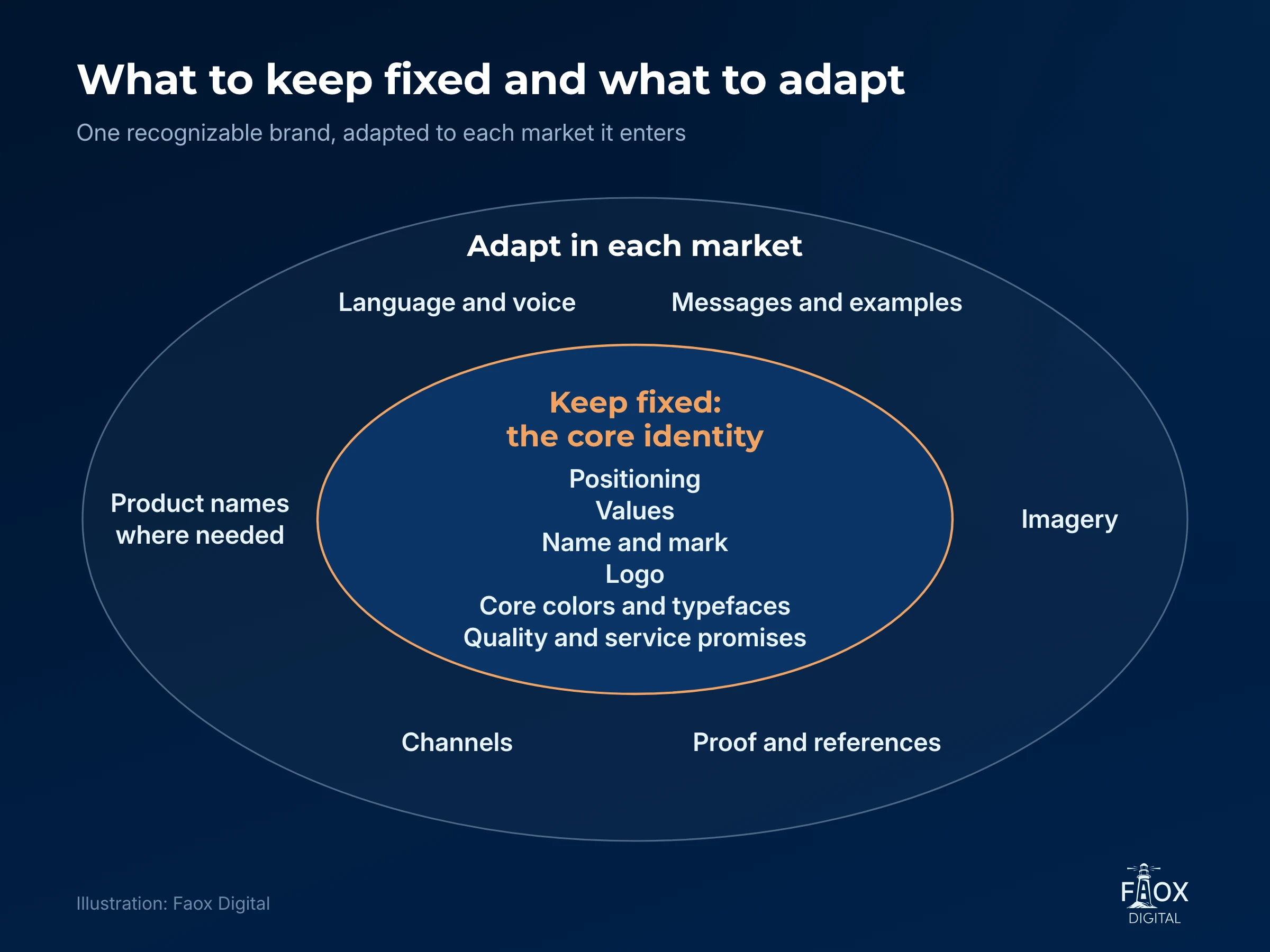
International branding is how a company keeps one recognizable brand while adapting it to each market it enters. Keep the core identity fixed: positioning, values, name and mark, logo, core colors and typefaces, and the promises buyers can count on. Adapt what buyers in each market experience directly (language, messages and examples, imagery, proof, channels and sometimes product names), and let a central owner and multi-market guidelines keep the balance.
A company that sells in five countries can easily end up with five brands: a German website written by one agency, a Polish distributor’s brochure with its own photographs, an American trade fair stand built from scratch. Each looks reasonable on its own. Together they make a company that buyers in different markets would not recognize as the same supplier.
This guide explains what international branding means for a B2B company, which parts of a brand to keep fixed across markets, which to adapt, and how to manage the balance. It opens our series on multi-market branding; you can find all Branding & Strategy articles on the category page.
What is international branding?
International branding is the work of building and managing a brand across several countries and languages. Its central question is not whether to adapt, but what: which parts of the brand stay the same everywhere and which change to fit each market.
A global brand is the result when that work succeeds: a brand that buyers in different countries recognize as the same company, with the same character and the same promises, even when they read about it in different languages and meet it through different partners.
For B2B companies, international branding usually grows out of exporting. The brand was built for the home market, and each new market added its own website version, brochures and distributor materials. International branding brings those pieces back under one identity, ideally before a new market entry rather than after.
When to start thinking about international branding
The best time is before the first serious market entry, when there is little to undo. In practice, most companies start later, when one of these signs appears:
- The company sells in several countries and each has its own website version, brochures or social media pages
- Distributors produce their own materials and describe the company in their own words
- An acquired company or a local subsidiary brings a second name and look
- A planned market entry raises the question of whether the name and messages will work there
- Buyers who meet the company in two countries do not seem to realize it is the same supplier
Any of these is a reason to step back and decide what the brand should be everywhere, before the next market adds another variation.
Global brand strategy: standardize, adapt or both
Every global brand strategy has to settle the tension between standardization and adaptation. In his 1983 Harvard Business Review article "The Globalization of Markets", Theodore Levitt argued that technology was driving the world toward a "converging commonality" and that companies should sell standardized offers worldwide. Yet B2B buyers still read in their own language, compare you with their local alternatives and trust proof from their own market.
That is why most B2B brands end up combining both: a fixed core and adapted expression. This is often called glocalization: a global identity applied with local judgment. The practical question is where to draw the line, and the rest of this guide is about drawing it.
What to keep fixed: the core identity
The core identity is what makes the company recognizable everywhere. Keep it fixed in every market:
- Positioning: the reason to choose you, in essence, even if the emphasis shifts by market.
- Values and personality: how the company behaves and sounds.
- Name and mark: the company name, logo and its construction.
- Core colors and typefaces: the visual signals buyers learn to recognize.
- Quality and service promises: what every customer can count on, in every country.
Changing any of these by market creates several brands where you wanted one. Our guide to B2B brand identity covers what the core includes and why consistency matters to buyers.
What to adapt: local adaptation
Local adaptation covers what buyers in each market experience directly:
- Language and voice: written by native speakers, with the formality and directness each market expects.
- Messages and examples: the benefits that matter most there, explained with local examples, units and standards.
- Imagery: photographs that show settings, people and applications buyers recognize.
- Proof: references, certifications and coverage from that market.
- Channels: the trade fairs, publications and platforms buyers there actually use.
- Product names, where a name does not work in a language or is already taken.
Adaptation is not a loss of control. A brand that speaks each market’s language, with its examples and proof, is more credible there than one that sounds translated. Our guide to adapting your brand by market shows how to do it step by step.
Fixed or adapted: element by element
Most decisions fall into a clear pattern:
| Element | Usually fixed | Usually adapted | Why |
|---|---|---|---|
| Positioning | The core reason to choose you | The emphasis and the competitors named | Alternatives differ by market |
| Name and logo | Yes | Only if a legal or language problem forces it | Recognition builds across borders |
| Colors and typefaces | Core palette and families | Font versions for other scripts | Some markets need other character sets |
| Voice | Personality traits | Formality, directness, idioms | Each language has its own norms |
| Messages | The main promises | Order, examples, units, proof | Buyers weigh benefits differently |
| Imagery | Style and quality | Settings, people, applications | Buyers trust what they recognize |
| Product names | Ideally | When a name fails or is taken | Meaning and trademarks vary |
| Website | Structure and design | Language, content, contacts | Local search and local buyers |
| Sales materials | Templates | Content and references | Distributors need local proof |
When you are unsure, ask whether a change would make the brand harder to recognize across markets. If yes, keep it fixed; if it only makes the brand easier to understand locally, adapt.
Brand architecture across markets
Brand architecture is how a company organizes its company name, product brands and any local brands. International expansion often complicates it: a local subsidiary may keep its own name, an acquired company may bring a known local brand, and distributors may present your products under their own name.
The usual options:
- One master brand everywhere: the simplest and strongest for recognition, if the name works in every market.
- Endorsed local brands: a local brand "by" or "part of" the master brand, useful when a local name has value buyers know.
- Separate brands: independent local brands, which keep local value but build little shared recognition.
Decide this deliberately, market by market, rather than letting each acquisition or distributor decide it for you.
Checking the brand name
A brand name check belongs before any market entry, because a name that fails in a new market is expensive to change later. Check how the name sounds and what it means in each language, whether it is easy to pronounce and spell, and whether it can be protected.
For protection, WIPO’s Global Brand Database lets you search international trademarks under the Madrid System and trademarks from participating national and regional offices by name and by image similarity. The Madrid System itself lets a company apply for protection in the 133 countries it covers through one international application. A trademark lawyer should confirm the result for each market.
Our guides to brand naming and to international trademark search cover both steps in detail.
Colors, symbols and cultural fit
Cultural fit asks whether the brand’s visual and verbal signals mean what you intend in each market. The meanings of colors and symbols vary, so test your palette, icons, gestures in photographs and any symbolic imagery with people in each market rather than relying on general lists of color meanings.
Industrial brands have an extra check: safety colors. In the EU, Council Directive 92/58/EEC (1992) on safety signs at work assigns meanings to colors: red for prohibition, danger alarms and fire-fighting equipment, yellow or amber for warnings, blue for mandatory signs such as wearing protective equipment, and green for emergency escape, first aid and "no danger". A brand color that sits close to one of these on machines, signs or labels can confuse users, so check how your palette works next to safety markings in each market.
Language and voice in each market
Language is where most international brands drift. Each market should get texts written or reviewed by native speakers who know the industry, a voice section for that language with real examples, and a glossary of product names and technical terms agreed with local sales staff and distributors.
The website is usually the biggest single piece of this work. A multilingual site needs its own structure for each language, not a translation button; our guide to building a multilingual website covers structure, translation and localization.
Proof and examples that travel
Buyers in a new market do not know your reputation at home. Give them proof from their own context: references from customers in that market or a similar one, the certifications and approvals they expect, documentation in their language and a local contact or partner.
Keep the proof format consistent across markets, for example the same structure for case studies and data sheets, while the content stays local. Buyers then recognize the brand in the format and trust the facts in the content.
Visibility in each market: search and press
Buyers find suppliers in their own language. Each market therefore needs pages built for the terms buyers there search for, with the technical setup that tells search engines which version is for whom; our guide to international SEO explains what that takes.
Coverage in each market’s trade press does the same for reputation. A local trade publication that writes about you tells buyers you are part of their market, not a distant exporter; our international PR guide covers how to earn that coverage country by country.
Auditing your brand across markets
Before you write rules, look at what buyers in each market actually see. A simple audit across markets:
- Collect current examples from every market: website versions, distributor brochures, proposals, trade fair stands, LinkedIn pages and product labels.
- Lay them side by side and compare logo versions, colors, typefaces and photographs.
- Compare the claims: does each market describe the company and its promises the same way?
- Check names and terms: are products called the same in every language, and do the translations mean what you intend?
- Check the proof: does each market show references and certifications its buyers recognize?
- List the differences by how many buyers see them, and fix the most visible ones first.
The audit usually shows two kinds of difference: drift that weakens the brand, such as old logos and improvised translations, and adaptation that helps, such as local references and examples. Remove the first, keep and formalize the second.
Multi-market brand guidelines
Multi-market brand guidelines make the fixed-or-adapted decisions usable by everyone, at headquarters and in every market. Alongside the usual rules (see what brand guidelines include), they should add:
- A clear list of what may never change, and what each market may adapt
- Language versions of the voice section and glossary
- Font versions for markets that use other scripts
- Local templates for documents, with space for local contacts and references
- Co-branding rules for distributors and partners in each market
- Who approves local materials, and how quickly
Give every market the same files from the same source, so that a local agency or printer never has to rebuild the brand from a screenshot.
Central brand management: who decides what
Central brand management keeps the core consistent while markets adapt. A practical division of roles:
- The central brand owner decides the core identity, maintains the guidelines and files, and approves exceptions.
- Each market adapts messages, examples, imagery and channels within the guidelines, and shares what works.
- Distributors and agencies apply the brand with the local templates and get their materials approved.
Hold a short review of each market’s materials every few months. It catches drift early and spreads good local ideas to other markets.
Global branding strategies with examples
Here is how the balance can look for a hypothetical industrial valve maker selling in Germany, Poland and the United States:
- Fixed everywhere: the name, logo, steel-blue color, typefaces, the position on complete documentation for audited plants, and the promise that every valve ships with its test record.
- Adapted in Germany: messages that lead with standards and documentation, technical depth, formal voice, references from German process plants.
- Adapted in Poland: messages that lead with delivery reliability and local service through a distributor, Polish documentation, references from the region.
- Adapted in the United States: imperial units alongside metric, references to the standards buyers there specify, a more direct voice, presence at the trade fairs buyers there attend.
The company stays recognizably one brand, while each market reads it as relevant to its own buyers.
International branding for smaller exporters
International branding is not only for multinationals. A smaller exporter often has an advantage: fewer markets, fewer people and fewer old materials to bring into line.
A practical start fits on a few pages: the fixed core (name, logo, colors, typefaces and the main promise), a short voice section and glossary for each language, and templates for the documents distributors and sales staff use most. Add a native-speaking reviewer for each market, even a trusted distributor, and one person at headquarters who approves what goes out under the company’s name. That is enough to stop drift before it starts.
Common mistakes in international branding
- Translating instead of localizing, so the brand sounds foreign in every market but home.
- Letting each market or distributor redesign the brand, until there are several logos and palettes.
- Skipping the name and trademark check until a market entry is already underway.
- Adapting the core (position, logo, promises) when only the expression needed to change.
- Having no central owner, so nobody notices drift until it is expensive to fix.
- Ignoring local proof, and expecting home-market references to persuade foreign buyers.
How Faox Digital approaches international branding
At Faox Digital, a digital growth partner for B2B companies in complex and international markets, branding is built per market: the core identity is set once, in working sessions with the client, and then rolled out in the right order across the channels that matter, adjusted for each market so that the story reads as local rather than translated. Each language gets its own voice and materials, written for buyers in that market.
Key takeaways
- International branding keeps one recognizable brand while adapting it to each market.
- Keep the core identity fixed: positioning, values, name and mark, logo, core colors and type, and promises.
- Adapt language, messages, examples, imagery, proof, channels and, where needed, product names.
- Check names, trademarks, colors and symbols in each market before you enter it, including how brand colors sit next to safety colors.
- Use multi-market guidelines and a central owner to keep the balance, with local input from each market.
Frequently asked questions
What is international brand management?
It is the ongoing work of keeping a brand consistent across countries while letting each market adapt within agreed limits: owning the core identity, maintaining multi-market guidelines and files, approving local materials and reviewing each market’s work regularly.
What is global brand marketing?
It is marketing a brand across several countries in a coordinated way: one core identity and set of promises, with campaigns, messages and channels adapted to each market. It differs from running separate national campaigns that share only a logo.
How is international branding different from international marketing?
International branding decides who the company is in every market: its identity, name, promises and the limits of adaptation. International marketing decides how to reach and win buyers in each market: channels, campaigns, pricing and sales. Branding sets the frame that marketing works within.
Should brand positioning change between markets?
The core reason to choose you should stay the same, but the emphasis can change, because buyers in each market compare you with different alternatives. A documentation strength may lead in one market and delivery reliability in another, while the brand stays recognizably the same.
Sources
Let’s talk
Does your brand say what makes you different?
Show us how you describe your business today. We will tell you where it is clear and where buyers may get lost.