
Global PR Strategy for B2B Companies: Earning Coverage Across Markets
How a B2B company plans international PR so that it appears in the publications its buyers read abroad: market priorities, local media, the story for each market, language, spokespeople, timing and monitoring.

A global PR strategy is a plan for earning coverage in the publications your buyers read in each target market: which markets come first, what each one cares about, which trade titles, news agencies and journalists matter there, and who speaks for you in the local language. Keep one story and one set of approved facts at the center, then adapt the angle, language, timing and spokesperson market by market, and monitor coverage in each.
Many exporters do international PR the same way: they write one English press release, send it to every country and hear nothing back. Foreign trade editors have never heard of the company, the release does not mention their market, and the person named as the contact does not speak their language. The problem is not the news. It is that the work was planned for one market and sent to all of them.
This guide explains how a B2B company plans a global PR strategy: how to organize the work, choose markets, read each local media landscape, find the story for each market, write in the local language, prepare spokespeople, plan around time zones and calendars, and monitor what appears. It opens our series on international outreach; you can find all Digital PR articles on the category page.
What is international PR?
International PR, or international public relations, is PR work that crosses borders: earning coverage, building relationships with journalists and managing a company’s reputation in more than one country. A global PR strategy is the plan that holds that work together, so that each market gets news it cares about while the company’s facts and positioning stay the same everywhere.
For a B2B company, international PR is mostly about the trade press. A buyer of process equipment in Germany reads German trade titles, a plant manager in Poland reads Polish ones, and a purchasing team in the United States follows the American trade press of its industry. Each market has its own editors, deadlines and expectations, and each one judges your news by what it means locally.
Language is part of that. In the European Commission’s 2024 Eurobarometer on languages, 47% of Europeans said they can speak English, the most widely spoken foreign language. Many of your buyers will read English, but national trade titles usually publish in their country’s own language.
How to organize a global PR strategy: central, local or both
There are three common ways to run PR across markets:
| Approach | How it works | Strengths | Risks |
|---|---|---|---|
| Central | Head office writes one story, has it translated and sends it everywhere | Consistent facts and control | Misses local angles; editors receive news that does not fit their readers |
| Local | Each market runs its own PR, with its own team or agency | Local relevance and relationships | Inconsistent facts, duplicated effort, no shared view of results |
| Hub and spoke | Head office sets the story, facts and calendar; people in each market adapt and pitch | Consistency with local relevance | Needs clear roles and regular coordination |
For most B2B companies we recommend some form of hub and spoke, because it keeps one version of the facts while letting each market tell the story its way. The center owns the news, the evidence and the approvals; the markets own the angle, the language and the relationships with local editors.
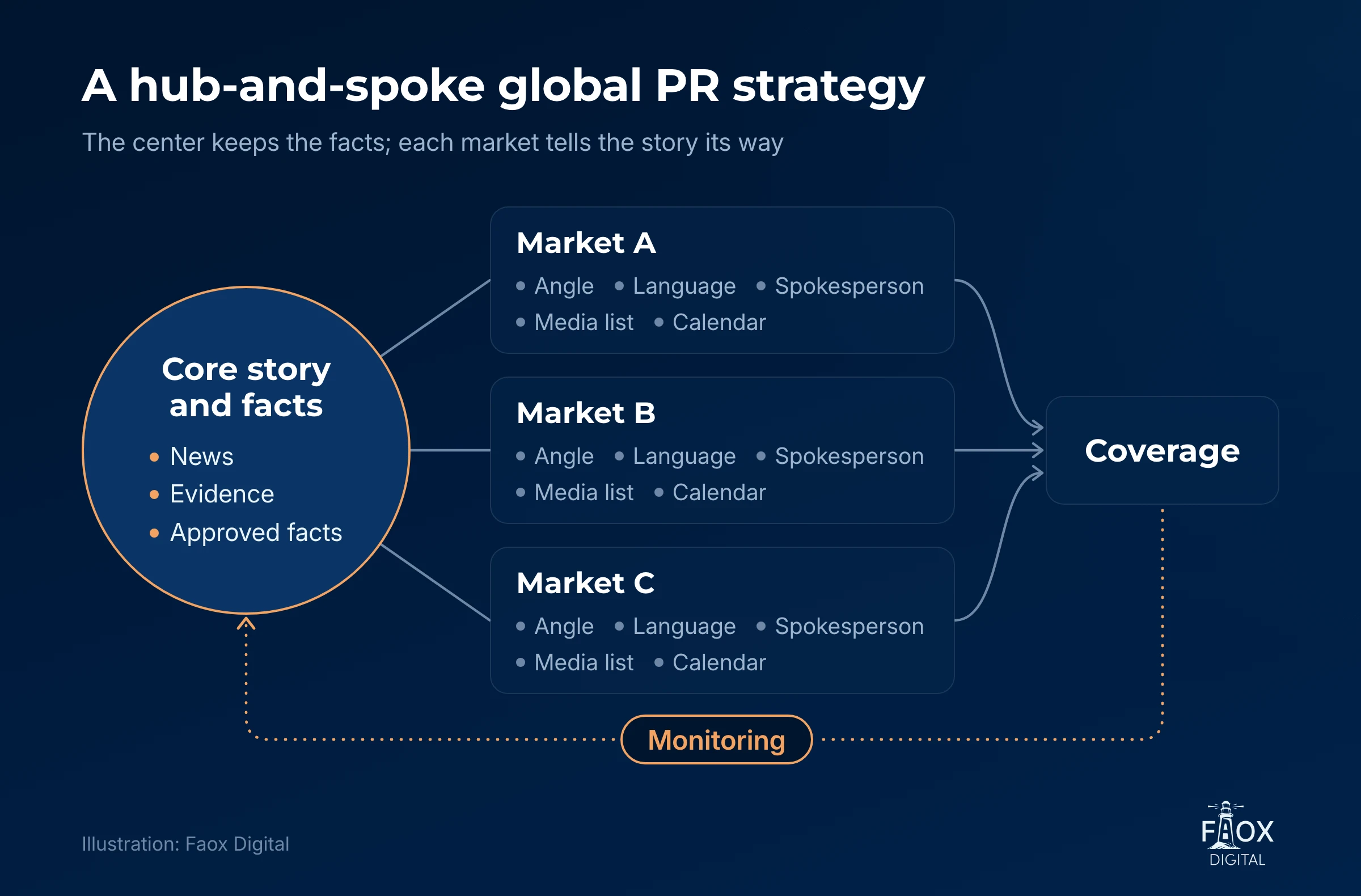
Who does the work in each market is a separate decision: an in-house team, local agencies, a global network or one team that covers several markets. Our guide to international PR support compares the options.
Choose and prioritize your target markets
A global PR strategy does not mean every country at once. Start with the markets where coverage can make a difference to sales:
- Markets where you already sell, or where a distributor or office is ready to answer enquiries
- Markets where you have news that is genuinely local, such as a new distributor, a plant, a certification or a reference customer who agrees to be named
- Markets where your buyers meet at a trade fair you attend
- Markets where your product has the approvals it needs to be sold
Each target market you add multiplies the work, because it needs its own media list, language, spokesperson and follow-up. A few markets done well usually beat many done badly. Choosing and preparing a new market is a business decision before it is a PR one, and our guide to B2B go-to-market strategy covers how to prioritize.
Understand the local media landscape
Every market has its own local media landscape: which publications exist, how they make money, how they work with companies and how news travels between them. Before you contact anyone, map it:
- Trade publications. The magazines, websites and newsletters of your industry in that country, and those of your customers’ industries.
- Business press. National and regional business papers, which may care about investments, plants and jobs more than products.
- News agencies. National agencies supply news to many outlets, and some run services that carry company news. In Germany, for example, news aktuell, a wholly owned subsidiary of the national news agency dpa, distributes company releases to newsrooms through its ots service.
- Associations and trade fairs. Industry associations often publish magazines or newsletters, and fairs have media partners and press centers.
- Platforms journalists use. Channels differ by market. In Cision’s 2026 State of the Media survey of journalists in 19 markets, LinkedIn was among the top platforms for work in North America and EMEA, while in China 58% of journalists favored WeChat.
From that map, build a media list by market: the titles that matter in each country, the editors and reporters who cover your field, their language, deadlines and preferred formats. Our guide to international media outreach shows how to build one.
Find the story each market cares about
The news may be the same everywhere; the reason to cover it is not. Keep one core story with its evidence and approved facts, then ask what it means in each market:
- Local relevance. A new distributor, local stock, a service team, a plant or a project in the country.
- Local rules and standards. A certification that opens that market, or a new regulation your product helps buyers meet.
- Local data. Test results, surveys or examples from that market’s customers, with their permission.
- Local timing. A national trade fair, an industry event or a policy change that makes the story timely there.
Cultural context also shapes how the story should be told: how direct a headline can be, how much technical detail editors expect, how formal a quote should sound, and which examples feel familiar. Some markets expect a modest tone where others expect a confident one. Our guide to international branding explains what to keep fixed across markets and what to adapt. The structure of the release itself stays the same, and our B2B press release guide covers it.
Write in the local language
Editors in each market write in their local language, and a release they can use as it is, or nearly, has a better chance than one they must translate. That does not mean translating the English release word for word. It means writing the release for that market in its language: the local angle first, the units and number formats readers use, the local names of standards and product categories, and quotes that sound natural.
The person who writes or checks the text should know both the language and the industry. A fluent translator who does not know the difference between two valve types can make a technical story wrong in a way a local editor will notice. Our article on localizing press releases explains why a translated release is not enough and how to adapt one.
Prepare a local spokesperson
A local spokesperson is someone who can speak for the company in the market’s language: a country manager, a sales engineer, a distributor’s managing director who represents your products, or a head office expert who speaks the language well. Editors want someone they can call during their working day, who knows the market and can answer follow-up questions without waiting for head office.
Prepare each spokesperson with the core facts, the local angle and the questions they are likely to face, and agree what they may say about customers, prices and plans. Relationships with editors are built in each market separately; our media relations guide explains how to build them.
Work with distributors and local offices
In many B2B markets, a distributor or local office is the face of the company. Bring them into the plan:
- Coordinate the news. Agree what is announced, when and by whom, so that a distributor does not publish a different version first.
- Use their knowledge. They know which trade titles customers read, which fairs matter and which angle will interest local editors.
- Quote them where it helps. A distributor’s manager talking about local stock, service and response times is often the most relevant voice for local readers.
- Check their details. If enquiries from coverage go to them, their contact information must be right in every release and on your website.
- Keep the facts consistent. Give them the approved fact sheet, images and company description, and ask them not to change technical claims.
Pitch editors in other markets
Pitching a foreign editor follows the same rules as pitching at home, with a few additions:
- Write in their language, and make the local angle clear in the first sentence.
- Explain who you are. A foreign editor may not know your company. One sentence on what you make, where, and your presence in their market, such as an office, a distributor or local customers, answers their first question.
- Offer someone local to talk to, with a phone number, languages and working hours.
- Adapt the material, not only the text: captions in the local language, the units readers use, and photos that show the product in a setting local readers recognize, where you have them.
- Respect local conventions. How formally to address an editor and how soon to follow up differ from country to country; when in doubt, be more formal and follow up once.
- Choose between an exclusive and a simultaneous release. Offering the story first to the leading title in one market can earn deeper coverage there, while a simultaneous release keeps every market on the same footing. Never promise the same exclusive to two titles.
Trade fairs abroad are often the easiest place to start. Editors attend to find news, and a short meeting at the stand, with the product there, can begin a relationship that email alone would not.
Plan around time zones and publishing calendars
Timing is where international PR most often goes wrong. Plan for time zones and publishing calendars in every market:
- Time zones. An embargo that lifts at 09:00 in Istanbul lifts at 01:00 in New York in winter. Give the time and time zone in every embargo, and send releases during the editor’s working day.
- Publishing calendars. Monthly trade magazines close their issues weeks ahead, while news sites publish the same day. Check each title’s editorial calendar and deadlines.
- Trade fairs. Fair issues and fair previews have their own deadlines, often well before the event.
- Holidays. Public and religious holidays differ by country, as do the months when newsrooms are short of staff.
- Coordinated launches. If the news must go public everywhere on one day, set one embargo time and convert it for each market.
Monitor coverage in every market
Media monitoring tells you what appeared, where and how accurately. In international PR it has to work in every language you pitch in: a monitoring tool set up only for English will miss most of your coverage abroad. For each market, track:
- Stories, interviews and quotes in the titles on your media list
- Whether the facts, product names and spokesperson’s name are correct
- Whether the coverage links to the right language version of your website
- Which angles and titles produced results, so the next round can build on them
Useful sources include search alerts in each language, the publications’ own websites and newsletters, clippings that distributors and local staff send in, and monitoring services that also cover print titles. Bring the results back to the center regularly. Monitoring is what turns a set of separate country efforts into one strategy that learns.
Global PR, search and AI
Coverage abroad also helps buyers find you in their own language. A story in a German trade title that links to your German product page, rather than to your English home page, serves both the reader and search. Google’s guidance on multi-regional sites, updated in December 2025, lists links from other local sites among the signals that show which audience a site is meant for. Our international SEO guide covers the website side: language versions, hreflang and local keywords.
Where to start if international PR is new to you
- Pick one or two markets where you already sell and have someone who can answer editors in the local language.
- Map the media in those markets: trade titles, business press, news agencies and associations.
- Prepare local material: the fact sheet in the local language, local references you are allowed to name, and photos with local captions.
- Introduce yourself to the editors who cover your field, before you have news to pitch.
- Pitch one story with a clear local angle, and make the spokesperson available.
- Monitor and review what appeared, then decide whether to deepen that market or add the next one.
A global PR campaign plan on one page
Before a global PR campaign starts, write down the answers to these questions for each market:
| Decision | Questions to answer |
|---|---|
| Markets | Which markets first, and why these? |
| Story | What is the core news, and what is the angle in each market? |
| Media | Which trade titles, business press, news agencies and journalists? |
| Language | Who writes or adapts the text, and who checks it? |
| Spokespeople | Who speaks for you in each language, and when are they available? |
| Timing | Which dates, time zones, holidays, fairs and deadlines apply? |
| Assets | Which images, data and local references does each market need? |
| Monitoring | How will you find and assess coverage in each language? |
Plan the budget per market, not per release. Each market needs time for the media list, language work, spokesperson preparation, follow-up and monitoring, and often travel to a fair. Decide early whether each market is covered by your own staff, a local agency or a team that works across several markets.
Common mistakes in international PR
- One English release for every market, with no local angle.
- Translation by someone who does not know the industry, which turns technical terms into errors.
- A head office contact who cannot answer in the local language or time zone.
- Ignoring local timing: embargoes in the wrong time zone, releases during national holidays, missed fair deadlines.
- Different facts in different markets, because each team edited the figures.
- Claims that do not travel: superlatives, comparisons or certifications that mean nothing, or are not allowed, in another market.
- No monitoring in local languages, so nobody knows what worked.
- Expecting coverage everywhere at once, instead of building relationships market by market.
How Faox Digital approaches international PR
Faox Digital, a digital growth partner for B2B companies in complex and international markets, plans international PR market by market: we map each market’s buyers and the outlets and writers who matter to them, and look for what is genuinely newsworthy there. Outreach happens in each market’s own language, directly to editors, with no mass sends and no bought lists.
Key takeaways
- A global PR strategy keeps one story and one set of facts at the center and adapts the angle, language, timing and spokesperson for each market.
- Start with a few target markets where coverage can support sales, rather than every country at once.
- Map each local media landscape, from trade publications to news agencies, and build a media list for each market.
- Write in the local language for local editors, with a spokesperson they can reach in their working day.
- Monitor coverage in every language and feed what works back into the plan.
Frequently asked questions
What is a global PR strategy?
It is a plan for earning media coverage in several countries in a coordinated way. It sets which markets come first, the core story and facts, the angle and language for each market, the publications and journalists to approach, who speaks for the company and how results are monitored.
What is the difference between international PR and global PR?
The terms are often used interchangeably. International PR usually describes the work of reaching media in other countries; a global PR strategy is the coordinated plan behind it, which keeps the company’s facts and positioning consistent while each market adapts the story.
What is an example of a global PR strategy for a B2B company?
Take a hypothetical valve maker launching a new hygienic valve series. It keeps one fact sheet and one set of test data at the center. In Germany, its German-speaking sales engineer briefs process engineering editors in German before a national fair; in Poland, the story is the new local distributor’s stock and service, told in Polish; in the United States, the release goes to the food processing trade press during the American working day. Coverage in all three languages is monitored and compared.
How do you run a global PR campaign?
Choose the markets, agree the core story and facts, find the angle for each market, build a media list per market, write the materials in each language, prepare local spokespeople, set the timing for every time zone and monitor coverage in every language. Then review what worked in each market before the next round.
Sources
- Cision: 5 PR Lessons to Shape Your Media Relations Strategy (2026 State of the Media findings), 2026
- European Commission, European Education Area: Europeans strive toward multilingualism and value language diversity, according to latest Eurobarometer, May 2024
- news aktuell: Über uns, accessed November 2026
- Google Search Central: Managing multi-regional and multilingual sites, updated December 2025
Let’s talk
Have a story worth telling?
Tell us what is new in your business. We will tell you honestly whether it is news and where it could be published.