
B2B Press Releases: A Complete Guide From News Angle to Distribution
What a press release is and how a B2B company turns an announcement into news an editor can use: the news angle, the parts of a release, embargoes, the media list, distribution and the online newsroom.
A B2B press release is a short, factual announcement that a company sends to editors so they can report its news: a new product, an investment, a certification or a move into a new market. It works when the news matters to a publication’s readers and the release reads like a news story, with the key facts in the headline and first paragraph, a quote that adds meaning and a contact who answers. Send it directly to the editors who cover your field and publish it in your online newsroom; a paid distribution service can widen its reach, but it cannot make an editor interested.
Most journalists receive 50 or more pitches a week, and 72% say fewer than a quarter of them are relevant to their work, according to Cision’s 2026 State of the Media survey of 1,899 journalists. A B2B company’s release often lands in that pile: an "innovative" product line, a "strategic" partnership, a stand number for next month’s trade fair. The editor needs one answer within seconds: why would my readers care?
This guide follows a release from the news angle to distribution: what a press release is, what makes company news worth publishing, the parts of a release, embargoes, the media list, distribution and the online newsroom. It opens our series on press releases; you can find all Digital PR articles on the category page.
What is a press release?
A press release, also called a news release or media release, is a written announcement that an organization sends to journalists, written as a news story so that they can report it. In public relations, it is the standard way to give the media the facts of a piece of news in one document: what happened, why it matters, who says what about it and whom to call with questions.
The editor decides what happens next. A trade title may publish product news close to the release text, a reporter may quote from it, an editor may use it as the start of their own story, or nobody uses it at all. You do not pay for publication and you do not control it. That loss of control is the point: what appears is the publication’s judgment, not your advertisement.
A press release is not:
- An advertisement or sponsored content. Those are paid for, you control the text, and they must be labeled as paid.
- A pitch. The pitch is the short personal email that tells one editor why the story suits their readers; the release is the document with the facts that travels with it.
- A brochure. Adjectives and sales benefits do not help an editor, who needs facts, evidence and a reason to write now.
Why a B2B press release still matters
Journalists still use them. In Cision’s 2026 survey, 66% of journalists said they rely on content from PR teams, such as press releases, pitches and media kits, for story ideas. Cision also runs the PR Newswire distribution service, so it has an interest in this finding, but the logic holds in trade journalism: a small editorial team covering a whole industry cannot discover every new product, plant or approval on its own.
Your buyers read the publications those editors fill. In the 2026 State of Marketing to Engineers survey by GlobalSpec and TREW Marketing, 76% of 783 technical buyers said they routinely research work-related purchases in online technical publications, slightly more than the 74% who use supplier websites. GlobalSpec’s reading is that buyers may form opinions about a supplier in these publications before ever visiting its site.
A release also creates a record. Published in your online newsroom with its date, it becomes the page that editors, buyers, distributors, search engines and AI tools can come back to for the facts of your news, long after the announcement.
Find the news angle before you write
The news angle is the reason a publication’s readers would care, now. It is not the same as the announcement. "We have launched a new valve series" is an announcement; "a valve series that shortens cleaning stops in dairy plants" is an angle, because it tells a reader at a dairy what changes for them.
Journalists judge stories by news values. In a 2017 study of UK news media, journalism researchers Tony Harcup and Deirdre O’Neill listed 15 of them and found that a story generally needs to meet one, and preferably more, to be selected. A B2B company can usually offer a handful:
- Magnitude: the news involves many people or has a large potential impact, such as a new plant or a product that changes how a process runs.
- Surprise: something unusual or unexpected, such as a first in the industry.
- Good news: a breakthrough, a win or a milestone.
- Exclusivity: a story available first to one publication.
- Follow-up: a subject already in the news, such as a new regulation and what it means for buyers.
- Audio-visuals: strong photos, video or an infographic.
- The publication’s own agenda: a topic the title has chosen to cover, such as a special issue.
Evidence makes an angle stronger. In Cision’s 2026 survey, 47% of journalists said their ideal pitch includes compelling data. The table shows when common B2B announcements tend to be news and when they are not.
| Announcement | Usually news when | Usually not news when |
|---|---|---|
| New product | It solves a known problem in a new way, with test results | It is a new size, color or name for an existing product |
| Investment or new plant | It adds capacity, jobs or a capability the market lacks | It is a plan with no figures, dates or place |
| Certification or approval | It lets buyers use the product where they could not before | It is a routine renewal |
| New market or distributor | Buyers in that market get local stock, service or support | It only adds a name to your website |
| Appointment | The person is known in the sector, or the role signals a new direction | It is a routine hire |
| Customer project | The customer agrees to be named and the project is a first or unusually large | Neither the customer nor the details can be shared |
| Trade fair | You launch or demonstrate something new at the stand | The release only gives the stand number |
| Data or research | The method is sound and the findings help the sector | It is a self-serving survey with no method |
If you cannot state the angle in one sentence without adjectives, you have an update for your website or newsletter, not news for an editor. That is fine: not every update needs a release. Our article on newsworthy company announcements goes through each news value with B2B examples.
The parts of a B2B press release
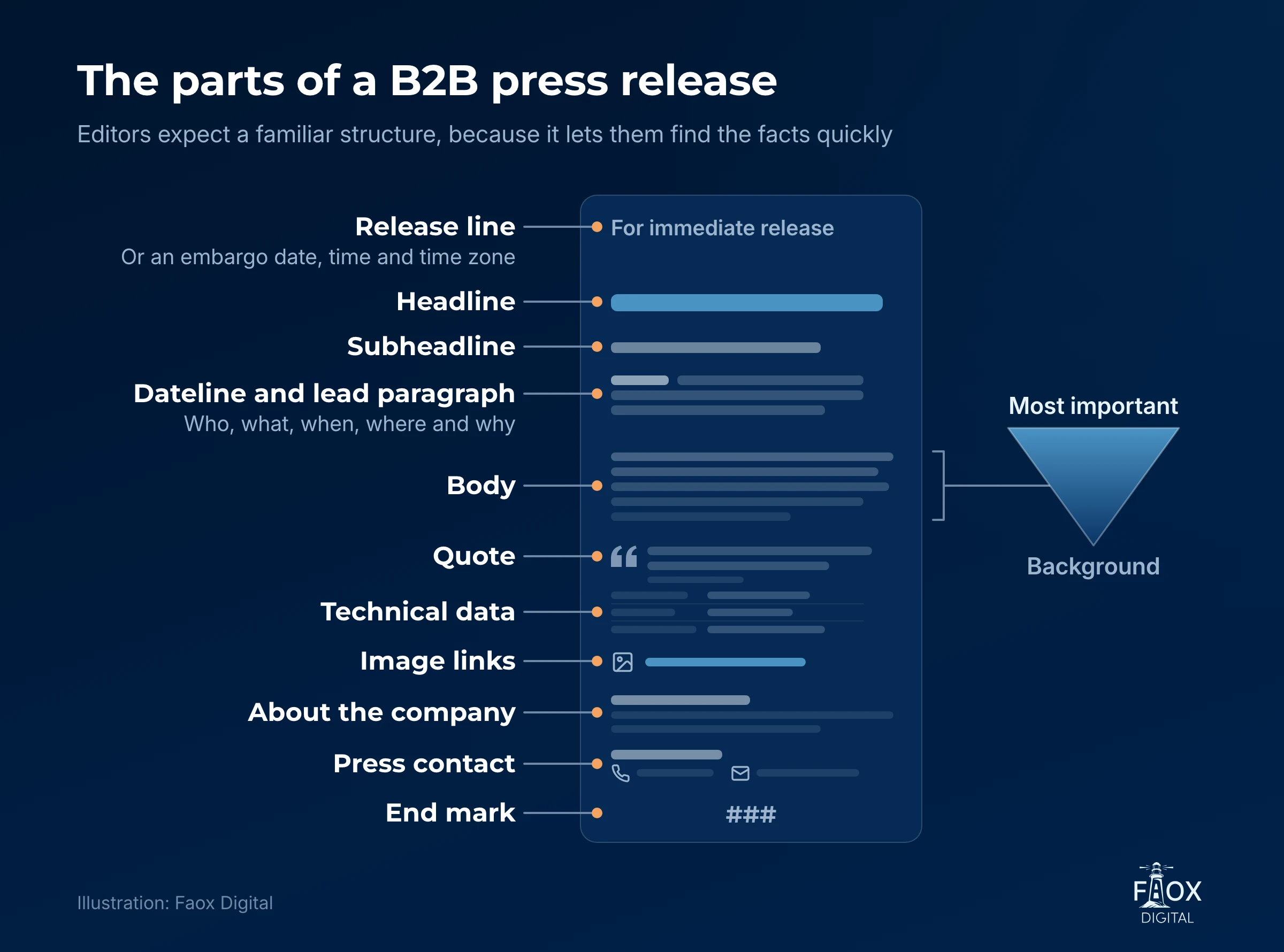
Editors expect a familiar structure, because it lets them find the facts quickly. A typical release has these parts:
| Part | What it does |
|---|---|
| Release line | Says when the news may be published: "For immediate release", or an embargo with date, time and time zone |
| Headline | States the news in one line |
| Subheadline | Adds the most important supporting fact |
| Dateline and lead paragraph | Gives the place and date, then answers who, what, when, where and why in one or two sentences |
| Body | Adds detail in order of importance: context, how it works, availability |
| Quote | Gives a named person’s view of what the news means |
| Technical data | Lists specifications, standards and figures with units, or links to a data sheet |
| Images | Links to high-resolution photos, drawings or video, with captions and credits |
| About the company | A short, factual paragraph on who you are |
| Press contact | Names a person who can answer questions, with email, phone and languages |
Headline and subheadline. The headline carries the news, not the company’s pride. Compare "Company X proudly announces an innovative new valve series" with "Valve maker launches stainless steel series for dairy plants that clean in place": the second tells an editor and a dairy engineer what changed and for whom. Superlatives such as "leading" or "unique" give an editor nothing to report unless you can prove them. The subheadline adds the strongest supporting fact, such as availability, a test result or the market concerned.
The lead and the inverted pyramid. After the dateline, the city and date at the start, the first paragraph answers the basic questions: who, what, when, where and why. The rest follows the inverted pyramid: the most important information first, then supporting detail, then background. An editor can cut from the bottom without losing the story, and online readers benefit too: Nielsen Norman Group’s 2018 article on the structure notes that readers can stop wherever they like and still leave with the main point.
Quotes. A quote should add what the facts cannot: a view, a reason, or what the news means for customers. "We are proud to announce" adds nothing. In B2B, consider quoting the engineer or product manager who knows the subject, not only the chief executive. In the 2026 GlobalSpec and TREW survey, 66% of technical buyers rated engineering experts at vendor companies very or extremely trustworthy as authors of technical content, against 45% for technical publication editors. Quote a customer only with their written approval.
Technical data and images. Trade editors and their readers look for figures with units, standards met, materials, sizes and availability. Put them in a short list or link to a data sheet. Offer high-resolution photos of the real product or site, not only renderings, with captions, credits and permission to publish, and link to them rather than attaching large files.
About the company and the press contact. The boilerplate, the short "About" paragraph near the end, says what you make or do, for whom, where you are based and where to find out more, in neutral words. The press contact is a named person, with email, phone and the languages they speak, who can be reached on the day the release goes out. Many releases end with a mark such as "###" or "Ends", so the editor knows nothing is missing.
If you use AI tools to draft, have someone who knows the subject check every fact and write the pitch: in Cision’s 2026 survey, 53% of journalists opposed PR professionals using AI, with concerns about spam, low-quality writing and a lack of personalization. Our step-by-step guide to writing a press release covers each part in detail, and our press release template gives filled-in examples for product, investment and certification news.
Embargoes: when to use one
An embargo asks journalists not to publish before a stated date and time. It gives editors time to prepare a proper story, for example on a technical launch, research findings or news that will be announced at a trade fair. In Cision’s 2026 survey, 45% of journalists said their ideal pitch includes embargoed or early-access information.
An embargo is an agreement, not a law. Use it only when it helps the editor, put the date, time and time zone at the top of the release ("Embargoed until 09:00 CET, 3 March"), and send it only to journalists you trust or who have agreed to it in advance. Do not embargo news that is already public on your website, a distributor’s site or social media. If you offer one publication the story first, as an exclusive, say so clearly and keep your word.
Editors, trade publications and your media list
A release reaches readers only through an editor, so the real question is which editors. For most B2B companies the answer starts with trade publications: the magazines, websites and newsletters of your own industry and of your customers’ industries. A maker of packaging machines may need packaging titles and food industry titles alike. Add the regional business press where you have a plant, association newsletters and, in export markets, the trade titles of each country.
A media list records who should receive your news. For each publication, note:
- The market, language and readership
- The editor or reporter who covers your topic, and the address for news
- Whether it publishes product news, people news or only features
- Its deadlines, publishing rhythm and editorial calendar, including special and trade fair issues
- The format it prefers for text and images
- What you sent, when, and what came of it
Keep the list short and current. Relevance decides whether a release is read, as the Cision figures above show, and a bought list is often outdated and treats every journalist the same. Building lasting relationships with editors is the subject of our media relations guide. If you sell in several countries, each market needs its own list in its own language, and our international PR guide explains how to plan coverage across markets.
How to distribute a press release
Distribution means getting the release to the people who decide whether to use it, and putting it where others can find it. There are three routes, and most companies combine them:
| Route | How it works | What it costs | What to expect |
|---|---|---|---|
| Direct to editors | A personal email to each editor on your media list, with the release in the email body and a link to images | Your team’s time, or an agency’s fee | The editors who cover your field see it, and some may write about it |
| Distribution service | A newswire posts the release on its own site and partner sites and sends it to journalists who follow your industry or region | A fee per release, rising with reach | Many online copies and a public, time-stamped record, but no editorial choice behind them |
| Your own channels | Your online newsroom, LinkedIn page, newsletter, sales team and distributors | Little extra | Customers and partners hear it from you, and search engines can find it |
Direct outreach should carry most trade news, because a trade editor decides what their readers see. Use a subject line that states the news, write two or three sentences on why it suits that publication’s readers, then paste the release below. Write to one editor at a time, never as a mass email with every address visible.
A distribution service, also called a newswire, suits news that needs a public, time-stamped record or wide online reach. Copies on partner sites are not stories that editors chose to write, and the links in them do not build search authority: Google’s spam policies, updated in August 2026, list links with optimized anchor text in press releases distributed on other sites as link spam. Some distribution packages still advertised keyword anchor text links when we checked in November 2026. Our article on digital PR for SEO explains how earned coverage, not the release itself, brings links and authority.
Your own channels follow on the same day: publish the release in your online newsroom, share it on your company’s LinkedIn page, brief your sales team and distributors, and mention it in your next newsletter. Choosing between a service and direct outreach, with costs and questions for providers, is covered in our guide to distributing a press release.
Timing and follow-up
Send the release when the news is final and approved, and before it is old. Check each title’s deadlines: a monthly magazine plans its issues well ahead, while a news website can publish the same day. Send during the editor’s working hours in their time zone, and avoid public holidays in that market.
Trade fairs need their own plan. Many trade titles prepare preview issues before major fairs, and editors walk the halls looking for news, so a launch may call for a release before the fair, one on the opening day and one afterwards. Our article on trade show press releases gives examples for each stage.
Follow up once, a few days later, and only with something useful: an image the editor may have missed, a test result or the offer of an interview with your engineer. Do not call to ask whether the release arrived. When a story appears, read it, thank the editor and ask for a correction only if a fact is wrong. Then record the outcome in your media list, so that the next release goes to the people who used this one.
Your online newsroom
An online newsroom, also called a press room, is the section of your website where every release lives with its date, next to what editors need to write about you. Cision’s summary of its 2026 survey lists ready-to-use assets among the things that work for journalists. A useful newsroom holds:
- Every release, dated, in each language you publish in
- A named press contact with email, phone and languages
- The boilerplate and a short fact sheet on products, markets and sites
- High-resolution images and logos, with captions, credits and terms of use
- Photos and short biographies of the people you quote
- Data sheets and technical drawings an editor may publish
Publish each release there on the day it goes public, or when the embargo lifts, at an address that will not change. Buyers and distributors who hear about the news later will look for it there.
Common mistakes in B2B press releases
- No news: an update that matters to the company but not to the publication’s readers.
- Adjectives instead of facts: "innovative", "unique" and "leading", with no evidence.
- The news in the third paragraph, after the company history.
- Quotes that repeat the facts or praise the company.
- The wrong level of detail: jargon a business title’s readers will not follow, or no technical data for a technical title.
- An attachment and nothing else, or images too small to print.
- One email to hundreds of addresses, or an English release sent to editors who publish in another language.
- A press contact nobody can reach on the day the news goes out.
How Faox Digital approaches press releases
At Faox Digital, a digital growth partner for B2B companies in complex and international markets, a press release comes after two earlier steps: mapping the market, the buyers and the outlets they read, and finding what in a company’s news is genuinely newsworthy. We then write each release and pitch for its outlet and reader and send it to editors directly, in each market’s own language, with no mass sends and no bought lists. What lands feeds the next round.
Key takeaways
- A B2B press release is a factual news announcement written for editors, who decide whether and how their readers see it.
- Find the news angle first: why the publication’s readers would care, now. Without one, use your website or newsletter instead.
- Put the news in the headline and the first paragraph, follow the inverted pyramid, and quote someone who adds meaning, such as your engineer.
- Send the release directly to the editors on a short, current media list, in their language, with an embargo only when it helps them.
- Publish every release in your online newsroom. A distribution service adds online copies, not coverage, and its links do not build authority.
Frequently asked questions
What does a B2B press release look like?
It looks like a short news article with a few fixed parts: a line saying when it may be published, a headline and subheadline, a dateline and a lead paragraph with the key facts, the body, one or two quotes, technical details, links to images, a short "About" paragraph and a press contact. It is written in plain, neutral language, without sales claims.
How are press releases distributed?
In three ways, often combined: by personal email to the editors on your media list, through a paid distribution service that posts the release on its own and partner sites and sends it to journalists, and through your own channels, such as your online newsroom, LinkedIn, newsletter and sales team. For news aimed at trade publications, direct contact with the right editors matters most.
How much does press release distribution cost?
At the time of writing (November 2026), EIN Presswire’s price list showed $149 for a single release, PRWeb listed $120 to $480 per release depending on reach and features, and PR Newswire gave prices only on request. Sending a release directly to editors costs no fee, but building the media list and writing personal notes takes time, or an agency’s fee.
Which press release distribution service is right for a B2B company?
There is no single right answer. Ask which publications on your media list actually see the service’s feed, which countries and industries it covers, what its report counts as a pickup and whether it sells keyword links, which Google treats as link spam. If your news is aimed at a short list of trade titles, you may not need a service at all.
Sources
- Cision: PR Emerges as the Primary Source for Journalists in High-Pressure Newsrooms (2026 State of the Media Report), May 2026
- GlobalSpec and TREW Marketing: 2026 State of Marketing to Engineers, 2026
- Harcup and O’Neill: What is news? News values revisited (again), Journalism Studies, 2017
- Google Search Central: Spam policies for Google web search, updated August 2026
Let’s talk
Have a story worth telling?
Tell us what is new in your business. We will tell you honestly whether it is news and where it could be published.