
Global PR Companies vs Local Agencies: Choosing International PR Support
How a B2B company that wants coverage in several markets chooses between a global agency network, local agencies and one team that coordinates every market, judged on market knowledge, language capacity, editor relationships, reporting, budget and accountability.

Global PR companies suit a business that needs coverage in many markets at once, under one contract and one set of rules, while local agencies suit one or two priority markets where depth and local editor relationships matter most. One team that coordinates several markets suits many mid-sized B2B exporters, as long as it has native speakers who know the sector in each language. In every model, one person must be accountable for the story, the facts, the budget and the report.
A B2B company that wants coverage in Germany, Mexico and the Gulf soon has to decide who does the work in each market. The options look alike in a pitch meeting: global PR companies with offices or partner agencies in many countries, local agencies hired market by market, and one team that runs several markets, at an agency or inside the company. They differ in who knows each market, who writes in each language, who knows the editors and who answers for the result.
This guide compares the options and shows how to choose. It follows our international PR guide, which covers the strategy itself. We work as a B2B PR agency ourselves, so we have a stake in the answer; the comparison below applies to any provider, including us.
Four ways to staff multi-country PR
Multi-country PR can be staffed in four ways:
- A global agency network. Either a multinational agency with its own offices in many countries, or a network of independent agencies that work together under a lead agency. You sign with one company and deal with one account lead, while offices or partners do the local work.
- A local agency in each market. You hire, brief and pay each agency separately and coordinate them yourself.
- One team across markets. One agency or specialist team runs several markets from one place, with native-speaking writers, and adds freelancers or partners where it needs them.
- In-house with local help. Your own PR or marketing team leads, with country managers, distributors or freelancers in each market. The general choice between an agency or in-house team applies here too.
The models can be combined: an in-house lead with one agency for most markets and a local agency for the biggest one, for example.
Global PR companies vs local agencies: how they compare
| Global agency network | Local agencies | One team across markets | |
|---|---|---|---|
| Market knowledge | Strong where it has an office or partner, uneven elsewhere | Deep in its own market | Depends on its research and local partners |
| Language capacity | Local staff in covered countries | Native in one language | Limited to the languages its writers handle well |
| Editor relationships | Held by each local office or partner | Strongest, but only in one market | Built market by market, often more slowly |
| Coordination | Lead office coordinates; partners keep their own priorities | You coordinate every agency | Built into one team and one plan |
| Reporting | One format if the lead office enforces it | A different report from each agency | One report across markets |
| Budget | Higher overall, plus coordination time | Several contracts and fees | One fee, spread across markets |
| Accountability | One contract, local delivery varies | Split between agencies and you | One team answers for every market |
| Fits best | Many markets at once, one set of rules | One or two priority markets | Three to six markets with a shared story |
Market knowledge
Market knowledge means knowing which trade titles, news agencies, trade fairs and platforms matter to buyers in a country. It differs more than many companies expect. In Cision’s 2026 State of the Media survey of more than 1,800 journalists, LinkedIn, Instagram and Facebook were the social platforms journalists used most for work in North America and in Europe, the Middle East and Africa, while 58% of journalists in China favored WeChat.
A local agency knows its own market best. In a network, knowledge depends on the office or partner in each country, so ask who covers your markets in practice. A team that runs several markets should show its research for each one: ask every candidate for a target publication list per market before you decide.
Language capacity
Language capacity decides whether editors can use what you send. In the European Commission’s Eurobarometer survey published in May 2024, 47% of Europeans said they speak English as a foreign or second language, yet national trade titles usually publish in their own language. A release that has to be translated by the editor starts at a disadvantage.
Ask who writes and pitches in each language, and whether they are native speakers who know your sector or translators working from English. Ask for samples in each language and have someone you trust read them. A provider that lists twenty languages may have strong writers in three.
Editor relationships
Editor relationships are with people, not publications, and they sit in each market. In Muck Rack’s 2026 survey of 897 journalists, mostly in the US, 40% said they pitch and choose their own stories, and 53% called relationships with PR professionals important or very important to their work.
So ask each provider which editors on your list they have worked with in the past year, and open the articles that came out of that work. In a network, those relationships belong to the local office or partner, not to the lead agency. A team running several markets may need time, or a local partner, to build them. A newswire with international circuits reaches many outlets without any relationship at all, and our guide to distributing a press release explains when that is enough.
Single-team coordination and clear accountability
Clear accountability means one named person answers for the story, the approved facts, the calendar, the budget and the report in every market. With local agencies, that person is usually you, and coordinating three agencies in three languages takes real time each month. With a network, the lead office coordinates, but each office or partner has its own priorities, so ask how partners are briefed, paid and replaced. With single-team coordination, the plan, the facts and the follow-up live in one place, and the risk shifts to capacity in each language.
Agree in writing who owns the media lists, the texts and the coverage archive, and what happens if a market produces nothing for a quarter. Your website faces the same question, and our guide to choosing an international SEO consultant covers the search side.
Reporting across markets
Reporting should let you compare markets. Ask for one format everywhere: each story with its publication, market, language, date and link, whether your messages and spokespeople appeared, and earned coverage kept apart from paid placements. Coverage in other languages needs a short summary in your working language. With several local agencies, agree this format at the start, or you will receive several reports that cannot be added up.
Budget allocation
Budget allocation is a choice about markets, not a single fee divided equally. The same hour costs different amounts in different countries: Clutch’s PR pricing guide, updated in September 2026, gives average hourly rates of $100 to $149 for PR firms in the United States, Spain and Mexico, $50 to $99 in Poland and $25 to $49 in India. The same guide notes that larger agencies, with more resources and a broader range of services, tend to charge more.
Put more into priority markets and less into markets with occasional news, and count coordination time, translation and travel, whoever does the work. Our guide to PR agency cost explains what drives fees and what sits outside them.
Warning signs in multi-country offers
Some offers look broader than the work behind them. Look closely when you see:
- A long list of countries with no named people or partners behind them
- "Global distribution" that turns out to be a newswire circuit rather than outreach to editors
- One English release translated for every market, with no local angle
- A promised number of articles per country, which usually means paid placements; ask how they are labeled
- Reports that add up reach across markets without listing the stories
Which model fits your company
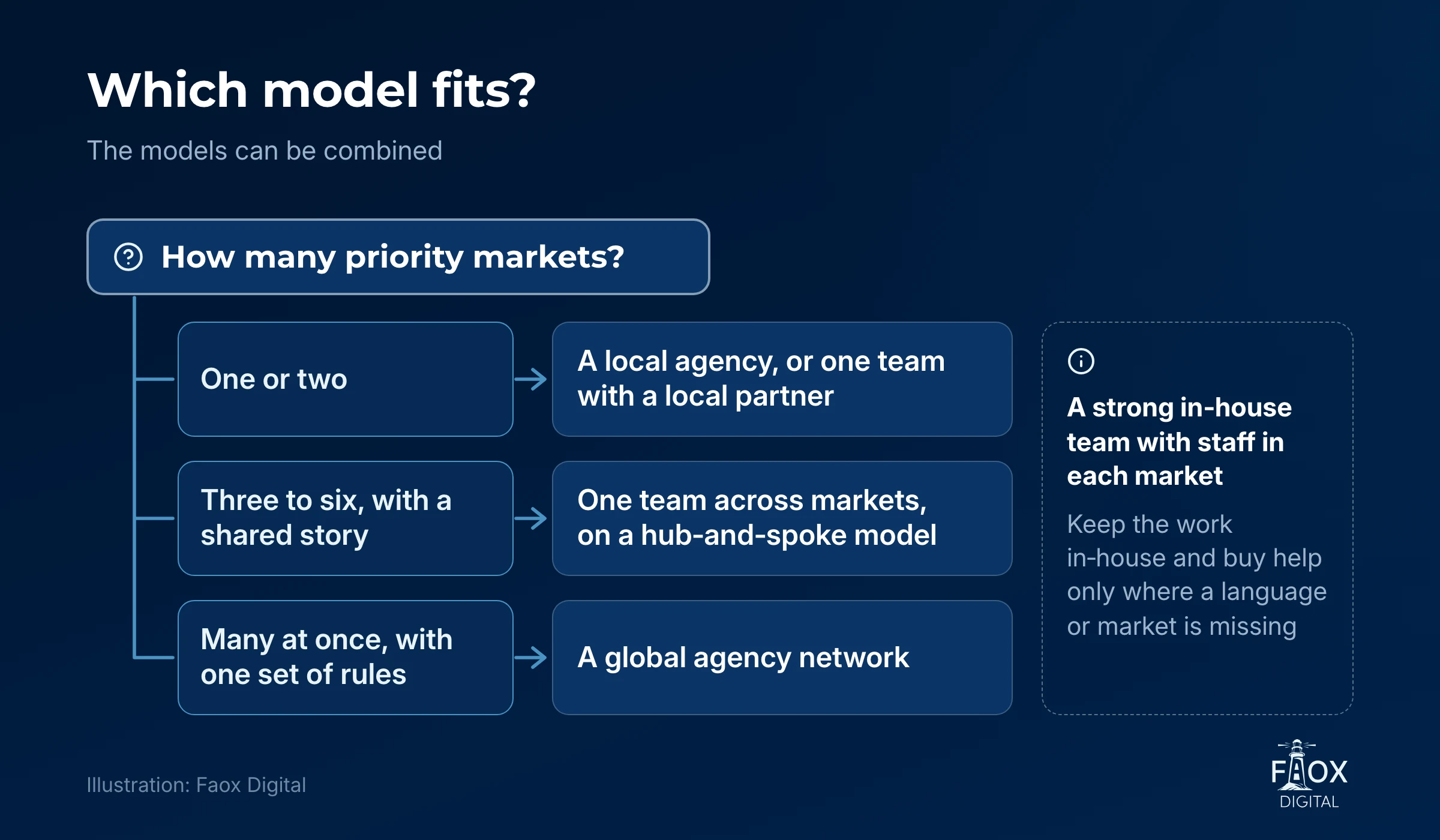
- One or two priority markets: a local agency, or one team with a local partner, gives the depth those markets need.
- Three to six markets with a shared story: one team across markets, run on a hub-and-spoke model, keeps the facts consistent and the angles local.
- Many markets at once, with one set of rules: a global agency network suits large launches, corporate news and companies with strict global approvals.
- A strong in-house team with staff in each market: keep the work in-house and buy help only where a language or market is missing.
Then shortlist two or three providers and put the same brief to each. Our questions for a PR agency cover the basics; for international work, add three: who writes in each language, which editors on your list they have worked with, and how every market reports to one person.
How Faox Digital runs PR across markets
Faox Digital, a digital growth partner for B2B companies in complex and international markets, approaches multi-country PR market by market, starting from each market’s buyers and the outlets and writers who matter to them. Releases, bylines and pitches are written for each outlet in that market’s own language and go to editors directly, with no mass sends and no bought lists. Paid placements are arranged only when they make sense, and they are labeled as sponsored. We suggest first steps that fit a company’s budget and stage, even if that means the company does part of the work itself.
Key takeaways
- Global PR companies offer one contract and wide reach, local agencies offer depth in one market, and one team offers coordination across a few markets.
- Judge each option on market knowledge, language capacity and editor relationships in every market you need, not on the number of offices.
- Make one person accountable for the story, the facts, the budget and the report across all markets.
- Ask for one report format in every market, with earned coverage and paid placements kept apart.
- Spread the budget by market priority, and count coordination time, translation and travel.
Frequently asked questions
What are global PR companies?
Agencies that work in many countries, either through their own offices or through a network of partner agencies, under one contract and one account lead. They suit companies that need coordinated coverage in many markets at the same time.
Is an international PR agency the same as a global PR agency?
The terms overlap. A global PR agency usually has offices or partners on several continents, while an international PR agency may be based in one country and run outreach abroad. Ask how each of your markets is covered and by whom, rather than relying on the label.
Should each country have its own PR agency?
Only where a market is a priority and needs continuous local work. For markets with occasional news, one team with local freelance or distributor support can be enough, as long as one person coordinates every market.
Sources
Let’s talk
Have a story worth telling?
Tell us what is new in your business. We will tell you honestly whether it is news and where it could be published.