
Lead Nurturing for B2B: How to Stay Useful Until the Buyer Is Ready
How to keep in touch with B2B leads who are interested but not ready to buy, from content matched to the buying cycle and a steady sending interval to signals of renewed interest and a planned end.
Lead nurturing means staying in touch with leads who are interested but not ready to buy: you send each one useful content matched to their role, product interest and stage of the buying cycle, at a steady interval, until they show renewed interest and sales takes over. Watch replies, clicks and requests rather than opens, hand active leads to a salesperson with context, and decide in advance what happens when the sequence ends.
Many B2B leads are real but early. An engineer downloads a data sheet for a project that starts next year; a visitor at your stand asks you to call back after the budget round; a quote stalls because the plant postponed its investment. Calling every week drives these people away, and doing nothing hands them to whoever stays in touch. Lead nurturing is the middle path: useful, regular contact until the buyer is ready.
This guide picks up where our guide to lead generation for manufacturers leaves off, with the leads that are not ready yet. It covers what to send, how often, how to read signals of renewed interest and when to stop.
What lead nurturing is, and why B2B buyers need it
Lead nurturing is the work of keeping in touch with leads who fit your market but are not ready to buy, with content that helps them move forward, until they are ready to talk to sales or clearly are not. It differs from a newsletter, which goes to everyone, and from sales follow-up, which assumes a live project.
B2B needs it because the buying cycle is long and the decision process involves many people. In 6sense’s 2026 B2B Buyer Experience Report, based on 3,596 completed purchases and 1,011 evaluations that stalled or were abandoned, the average cycle lasted 10.3 months, and buyers first contacted sellers about 59% of the way through it. Forrester’s State of Business Buying 2026 (January 2026) puts the typical buying decision at 13 internal stakeholders and nine external influencers. 6sense sells account-based marketing software, and its sample covers software, services and physical goods, not manufacturing alone, but many manufacturers will recognize the pattern.
A quiet lead is not a lost one either. In the same 6sense report, 96% of buyers said they keep up with their category between evaluations, and 78% of buyers whose evaluation stalled or ended without a purchase expected to revisit it within 12 months. Nurturing keeps you in that picture.
Drip campaign vs nurture campaign
The two terms are often mixed up. A drip campaign is a fixed series of emails sent on a schedule after a trigger, the same for everyone. A nurture campaign runs for months and adapts to each lead:
| Drip campaign | Nurture campaign | |
|---|---|---|
| Starts with | A trigger, such as a download or a sign-up | A lead that fits but is not ready |
| Lasts | Days or weeks | Months, as long as the buying cycle |
| Content | The same for everyone | Matched to role, product interest and stage |
| Reacts to behavior | No | Yes: clicks, replies and requests change what comes next |
| Ends when | The last email is sent | The lead goes to sales, goes quiet or opts out |
In practice, nurturing often starts after a short sequence, such as a trade show follow-up or the first emails after a form submission, and takes over when that sequence ends without a conversation.
The lead nurturing process, step by step
A workable lead nurturing process has seven steps:
- Decide who enters. Leads that fit your criteria but have no project yet: when a first follow-up ends without a conversation, or when sales marks a lead "not ready".
- Segment them. Role, product interest and stage of the buying cycle are usually enough to start.
- Match content to each segment. Plan one useful piece for each stage and each main role.
- Set the sending interval. Regular enough to be remembered, rare enough to stay welcome.
- Use what sales knows. Read the salesperson’s notes before choosing content and timing.
- Agree the signals and the hand-over. Decide which actions send a lead back to sales, and how fast sales responds.
- Decide how it ends. Plan what happens when the content runs out or the lead goes quiet.
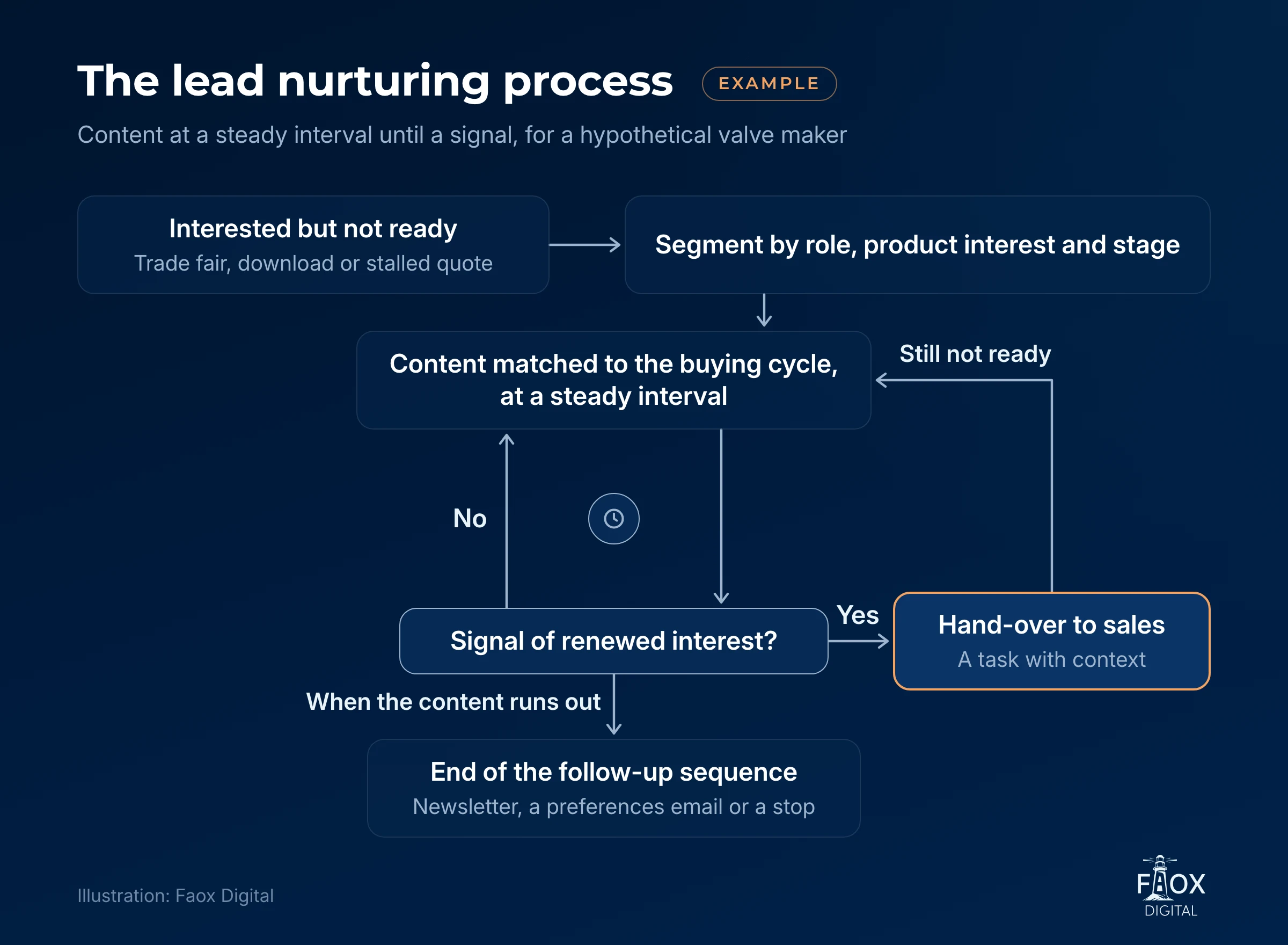
The sections below go through each step. The workflows themselves, with their triggers, delays and branches, are built as our guide to setting up email automation describes.
Segment by role, product interest and stage
Nurturing works when each lead receives what is relevant to them. Three criteria do most of the work:
- Role: an engineer, a purchaser and a plant manager at the same company want different things.
- Product interest: taken from the form, the download or the trade fair conversation.
- Stage: early research, specifying, building the internal case or choosing a supplier.
Store each one as a CRM field with fixed values, so segments update themselves as leads move. Our guide to B2B segmentation criteria shows how to set them up.
Content matching: what to send at each stage
Content matching means choosing each email’s content for the lead’s stage and role, not for your publishing calendar. For a hypothetical valve maker, it could look like this:
| Stage of the buying cycle | What the buyer is doing | What to send |
|---|---|---|
| Early research | Understanding the problem and the options | A guide to the application, a standard explained, a comparison of valve types |
| Specifying | Writing requirements and checking fit | Technical documents: data sheets, drawings, CAD files, certificates, test reports |
| Building the case | Convincing colleagues and management | Application examples from similar plants, a total cost comparison, maintenance intervals |
| Choosing a supplier | Comparing a short list | A sample or trial, a call with an application engineer, delivery and service terms |
Technical documents answer the engineer’s questions; application examples answer the manager’s question of whether it has worked somewhere like their plant. Describe examples without naming customers unless they have agreed to it. In a decision process with many people, send each role its own material: the purchaser wants lead times and certificates, the engineer wants drawings, the plant manager wants risk and cost.
Lead nurturing emails that stay useful
A good lead nurturing email is short, plain and specific: one topic, one useful link, sent by a person whose name the reader may remember. For the valve maker, an email to an engineer specifying control valves might read:
- Subject line: Sizing control valves for steam: the three checks we run first
- Body: Three short paragraphs on the checks, a link to the sizing guide and an offer to review the data sheet with an application engineer.
- Signed: the application engineer, with a direct email address.
Avoid "just checking in" emails, discount offers to people who are not buying yet and newsletters relabelled as nurturing. Every email should leave the reader knowing something useful, whether or not they reply.
Setting the sending interval
The sending interval decides whether nurturing feels helpful or intrusive. There is no universal number; tie it to the buying cycle and to each lead’s interest level:
- Start with an email every three to four weeks for leads in early research, and adjust from there.
- Send more to engaged leads, those who click, reply or download, and less to quiet ones.
- Count every email a contact receives, newsletters and campaigns included, not only the nurture flow.
- Time content to the project when you know it: a check-in two months before a planned investment beats a monthly reminder.
Judge interest level by clicks, replies, form submissions and, where visitors have accepted tracking, website visits. Do not judge it by opens: Apple says its Mail Privacy Protection prevents senders from seeing whether a message was opened.
Use the salesperson’s notes
Some of the most useful nurturing data is not in the email tool but in the CRM: the salesperson’s notes from calls, visits and trade fairs. A note such as "budget approved for next year, replacing the valves in the boiler house, the engineering manager decides" tells you what to send, to whom and when.
Ask salespeople to record three things after every conversation: the project and its timing, who else is involved in the decision, and what the contact asked for. Then let the salesperson send the important emails personally, such as a check-in before the planned budget round, while automation handles the regular content.
Between emails, visibility on LinkedIn helps: posts by your engineers and salespeople keep the company in front of the same people. An employee advocacy program can make that regular rather than accidental.
Signals of renewed interest and the hand-over to sales
Nurturing succeeds when a lead becomes active again. Agree with sales which signals of renewed interest count:
- A reply, especially one with a question
- A request for a sample, a quote, a drawing or a call
- Repeated visits to product or pricing pages in a short time, where tracking is consented to
- A second download on the same product, or a webinar registration
- A new contact from the same company entering your CRM
When a signal appears, the lead leaves the nurture flow and the hand-over to sales begins: a task in the CRM for the owner, with what the lead read, clicked and asked, and a response time agreed in advance. If sales finds the lead is still not ready, it returns to nurturing with a note, not to a drawer. Lead scoring can combine these signals once you have enough data, but a short agreed list is enough to start.
What happens at the end of the follow-up sequence
Every nurture flow runs out of planned content at some point. Decide the end of the follow-up sequence in advance:
- Move engaged leads to the regular newsletter, if they agreed to receive it, with a reminder for sales at the expected project date.
- Ask quiet leads what they want: a short email offering topics, a lower frequency or a pause, with a clear way to say no.
- Stop for those who opt out or show no interest at all, and keep the CRM record with the reason, so sales knows the history if they return.
Do not drop quiet leads too fast: in the 6sense figures above, most buyers whose evaluation stalled or ended without a purchase expected to revisit it within a year.
Measuring what nurturing achieves
Measure what nurturing is for: conversations and opportunities.
- Replies and requests from nurtured leads
- Clicks on technical documents and application examples, by segment
- Hand-overs accepted by sales, and the reasons for any returned
- Opportunities and orders from nurtured leads, recorded in the CRM
- Unsubscribes per email, a sign that content or frequency does not fit
Review these monthly with sales, and change one thing at a time: a piece of content, the interval or a signal.
Common mistakes
- Treating nurturing as a newsletter, with the same email to every lead.
- Pushing for a meeting in every email, before the buyer is ready.
- Ignoring what sales knows, so a lead with a project next spring gets generic content.
- No agreed signals, so active leads wait in the flow while a competitor calls.
- No end, so leads keep receiving emails long after they stopped reading.
- Judging success by opens, which privacy features make unreliable.
A checklist for your lead nurturing strategy
- Entry rules say which leads join, and when
- Role, product interest and stage are stored as CRM fields
- Each stage and main role has at least one useful piece of content
- The sending interval is set and counts every email a lead receives
- Salespeople record project timing, the people involved and requests
- Signals of renewed interest and the hand-over are agreed with sales
- The end of the sequence is planned, and results are reviewed monthly
Nurturing makes the most of the leads you already have. If you have too few of them, the next question is whether to work with lead generation companies or keep building your own pipeline.
How Faox Digital approaches lead nurturing
Faox Digital, a digital growth partner for B2B companies in complex and international markets, plans nurturing by behavior and stage rather than one message for everyone, and builds the emails and automations in the client’s own tools, signed off by the client. We keep a steady sending rhythm, with automatic follow-up once each person is ready, and judge the work by replies, qualified conversations and pipeline.
Key takeaways
- Lead nurturing keeps in touch with leads who fit but are not ready, with useful content, until they are ready to talk to sales.
- Segment by role, product interest and stage, and match technical documents and application examples to each.
- Set a steady sending interval, adjust it by interest level and count every email a lead receives.
- Use the salesperson’s notes, agree signals of renewed interest and hand active leads to sales with context.
- Plan the end of the sequence, and measure replies, hand-overs and opportunities, not opens.
Frequently asked questions
What is lead nurturing in marketing?
Lead nurturing is the part of marketing that keeps in touch with potential customers who are interested but not ready to buy. It sends useful content matched to their role and stage until they are ready to talk to sales, then hands them over with context.
What is a lead nurturing email?
An email to a lead who is not ready to buy, with one useful piece of content for their role and stage, such as a technical document or an application example. It informs rather than sells, and it comes from a named person the lead can reply to.
How do you nurture leads in B2B?
Decide which leads enter, segment them by role, product interest and stage, plan content for each stage, send at a steady interval and watch for replies, requests and repeated visits. When a lead shows renewed interest, hand it to sales with what they read and asked.
What is a lead nurturing system?
The combination of a CRM, an email tool or marketing automation platform and agreed rules: who enters, what they receive and when, which signals trigger a hand-over and when the sequence ends. The rules matter more than the software.
Sources
- 6sense: 2026 B2B Buyer Experience Report, 2026
- Forrester: The State Of Business Buying, 2026 (press release), January 2026
- Apple Support: Use Mail Privacy Protection on iPhone, accessed November 2026
Let’s talk
Have contacts you never follow up with?
Tell us about the list you already have. We will show you how email and CRM can turn it into conversations.