
Employee Advocacy Programs: Do You Need One, and Do You Need a Platform?
When a B2B company needs an employee advocacy program, how to run a light one with a guide, a content library, training and a policy, and when an advocacy platform is worth paying for.
An employee advocacy program is a structured way to help your employees share and discuss company content on their own profiles, mostly on LinkedIn. Most B2B companies need a light program before a platform: voluntary participation, a short sharing guide, a few posts worth sharing each week, some training and a clear policy. A platform pays off once dozens of employees take part regularly and you need the content library, approvals and measurement in one place.
Your employees already talk about your company online, or could: salespeople who know your buyers, engineers who solve their problems, managers who hire. An employee advocacy program turns that into something steady and useful, without turning colleagues into a megaphone.
This guide helps you decide whether you need a program, how to run one and whether a platform is worth paying for. It builds on our guide to social media community management. We work as a B2B social media agency, so we have a stake in how you organize your social media; the tests below apply whether you run it yourself or with outside help.
What an employee advocacy program is
Employee advocacy means employees sharing, commenting on and adding to their company’s content on their own social profiles. A program adds the structure: who takes part, what they share, which rules apply and how you see the results.
On LinkedIn, the platform’s own tools have narrowed. LinkedIn began discontinuing the My Company tab and Employee Advocacy tab for Pages in November 2024. What remains, at the time of writing (November 2026), is simpler: page admins can notify employees about an important post once per day, reshare employees’ posts and mentions from the page’s Feed tab, and, for anything more, LinkedIn suggests an external partner.
The relationship with the company page runs both ways. The page publishes the company’s news, guides and job openings; employees add reach and a human voice, and the page reshares their best posts. Employees count as such once they list your page in the experience section of their profile, which is also who receives employee notifications.
Do you need an employee advocacy program?
You do not need a formal program to ask colleagues to share a good post. A program becomes worth the effort when several of these are true:
- Some employees already share company posts or write about their work, and others would if they knew what is allowed
- Your sales and technical teams are in regular contact with buyers on LinkedIn
- You hire regularly and want candidates to see the people behind the job ads
- Your company page posts reach mostly the same small audience
- You have at least a few posts a week that employees would be glad to share
If none of these apply, start with the page itself. If only one or two apply, a short email with the week’s best post and a line on why it matters may be all you need.
Employee advocacy options compared
There are four levels, from informal sharing to a dedicated platform:
| Option | What it involves | Cost | Fits when | Watch for |
|---|---|---|---|---|
| Informal sharing | Employee notifications on LinkedIn and the occasional request | Free | A small team or a first test | Depends on a few enthusiasts |
| Light program | A sharing guide, a weekly selection of posts, training, a policy and simple measurement | Staff time, a few hours a week | Most small and mid-sized B2B companies | Someone must own it every week |
| Module in a social media suite | An advocacy add-on in the tool your team already uses for publishing | Priced by the vendor, often on request | You already use the suite and want one workflow | Paying for seats few people use |
| Dedicated advocacy platform | A separate app with a content library, approvals, notifications, gamification and analytics | Quoted by number of users and modules | Dozens of active employees across teams, countries or languages | Turning sharing into a points game |
Most B2B companies should start with a light program and move to software only when the manual work becomes the bottleneck.
Voluntary participation and a personal voice
Advocacy works only with voluntary participation. Invite people, explain why their voice helps, and accept that some will never take part. Quotas for likes or shares create an internal engagement pod, and readers notice when ten colleagues post the same sentence.
A personal voice is the point of the exercise. Suggest a line, but ask people to say in their own words what the post means for them: what they learned on the project, what a customer asked them, why the new product matters. An engineer’s two honest sentences carry more weight than a polished caption pasted by ten people.
Start with the LinkedIn profiles themselves. A complete profile with a clear photo, a headline that says what the person does, and a current position linked to your company page makes every share more credible.
Training keeps this practical. A one-hour session covers profiles, what to share, how to add a comment, how to reply and what to pass to colleagues. Repeat it for new joiners, and offer short one-to-one help to the few who want to post more often.
Sales and technical teams first
In B2B, the most useful advocates are rarely the ones with the largest networks. They are the people buyers already deal with: salespeople, application engineers, service technicians and product managers. Their contacts are the customers, distributors and specifiers you want to reach.
Give each group content that fits its role. Salespeople share case studies, trade fair news and product launches; technical staff share how-to content, test results and answers to common questions. Some will start writing their own posts, which is where advocacy turns into expertise.
Advocacy builds your own pipeline slowly, through relationships. If you are weighing it against buying contacts, our guide to lead generation companies compares the two approaches.
The sharing guide, content library and approval process
Three working tools make a light program run.
A sharing guide of one or two pages says what to share, what never to share (confidential projects, prices, customer names without permission), how to add a personal comment, how to answer questions and when to pass a conversation to sales, HR or communications.
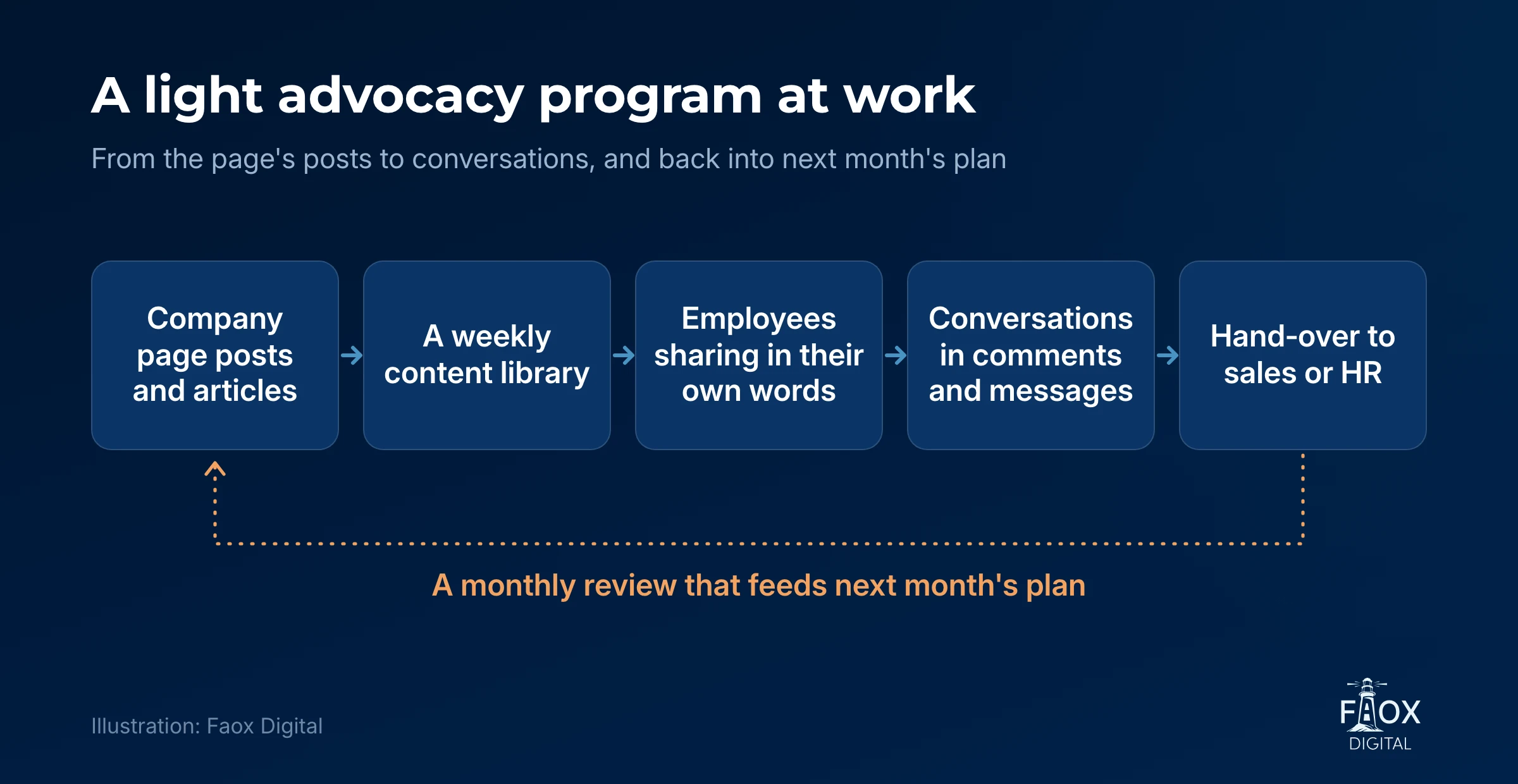
A ready-to-share content library is a short weekly selection: three to five posts with a suggested line for each, sent by email, in Slack or Microsoft Teams, or kept in a shared document. Keep it small; a long list gets ignored.
An approval process applies to the company’s content, not to every employee post. Content in the library is approved once, by whoever approves the page’s posts. Employees’ own posts need no approval, except for topics your guide marks as sensitive, such as legal disputes, safety incidents or financial results, where a quick check with communications comes first.
Measurement
Measure the program at four levels, from activity to results:
- Participation: how many employees share at least once a month, and how many add their own comment.
- Reach: what LinkedIn’s post analytics show. Page posts sent through employee notifications are labelled "Employees notified".
- Visits: clicks on tagged links in the content library, seen in your web analytics.
- Conversations and results: inquiries, meetings and applications that name an employee’s post as the starting point.
Review these numbers each month, and use what started conversations to choose next month’s selection. Advocacy platforms add their own reports, and some convert reach into an "earned media value" in money. Treat that as an estimate of saved advertising, not as revenue.
Choosing a platform and tools
Choosing a platform and tools becomes worth it when the content library, reminders and reporting take more time than the sharing itself. Advocacy platforms work in a similar way. Sprout Social’s Employee Advocacy and Hootsuite’s Parliament both let administrators prepare pre-approved content for employees to share, and Sprout’s adds newsletters through Slack or Microsoft Teams, a mobile app and gamification. Neither publishes an advocacy price on its product page at the time of writing. DSMN8 quotes by number of users and modules on annual contracts, and says prices typically start from a few dollars per employee per month.
When you compare tools, check:
- Networks and languages: LinkedIn first, then any other networks and every language your teams use.
- Workflow: how content gets in, who approves it and how employees are reminded.
- Freedom to edit: whether employees can rewrite the suggested text easily.
- Measurement: clicks, tagged links and a connection to your web analytics or CRM.
- Contract: minimum users, contract length and the cost of adding seats later.
Run a pilot with one team for a quarter before you buy seats for everyone.
Where Faox Digital fits in employee advocacy
Faox Digital runs organic social media for B2B companies in complex and international markets, and the company page posts we write can be shared by employees with their own comment. We plan that content market by market and language by language, write it in the company’s own voice, and the client approves a monthly calendar before anything goes live. Expertise content for executives is part of the work, and we reply to comments and messages and join the conversations where buyers already are. We judge it by reach among the right people and the conversations and inquiries that follow.
Key takeaways
- An employee advocacy program helps employees share and discuss company content on their own profiles, mostly on LinkedIn.
- LinkedIn retired its own Employee Advocacy tab from November 2024; employee notifications and reshares remain.
- Most B2B companies need a light program first: voluntary participation, a sharing guide, a weekly content library, training and a policy.
- Start with sales and technical teams, ask for a personal voice and never set sharing quotas.
- Choose a platform only when manual work becomes the bottleneck, and test it with one team first.
Frequently asked questions
What is an employee advocacy program?
It is a structured way for employees to share, comment on and add to their company’s content on their own social profiles. A program sets who takes part, what is shared, which rules apply and how results are measured, and it works best when participation is voluntary.
What is employee advocacy on LinkedIn?
Employees sharing or commenting on their company page’s posts and writing about their own work, with their own view added. At the time of writing, LinkedIn lets page admins notify employees about a post once per day and reshare employees’ posts; dedicated advocacy tools come from outside vendors.
How much does an employee advocacy platform cost?
Prices depend on the number of users and the modules you choose. Many vendors quote on request; DSMN8, for example, says its prices typically start from a few dollars per employee per month on an annual contract. A light program without a platform costs mainly staff time.
Should employees be required to share company posts?
No. Required sharing produces identical posts that readers ignore and can feel like pressure to employees. Invite people, make sharing easy and give them content worth their name.
Sources
- LinkedIn Help: My Company tab and Employee Advocacy tab is no longer available, accessed November 2026
- Federal Trade Commission: FTC’s Endorsement Guides, What People Are Asking, June 2023
- Sprout Social: Employee Advocacy, accessed November 2026
- DSMN8: Pricing, accessed November 2026
Let’s talk
Want social media that reaches the right people?
Tell us who you want to reach. We will look at your channels and suggest a plan your team can keep up with.