
Trade Show Follow-Up: Emails, Timing and Templates for B2B Exhibitors
How to capture contacts at the stand, send the thank-you email at the right time and keep following up until the visitor asks for a quote, with five email templates.
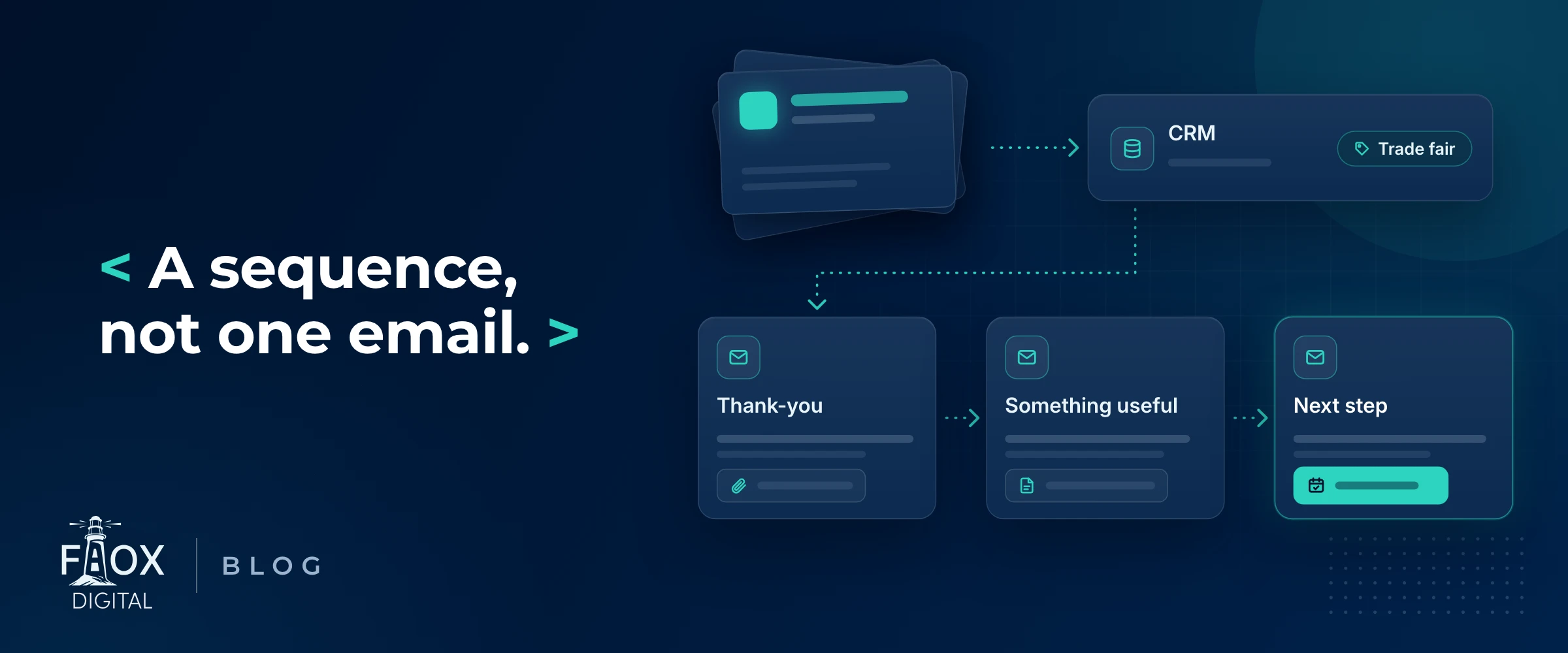
Good trade show follow-up is a planned sequence, not a single email. Send a personal thank-you email within two working days of the fair, from the person the visitor met, with what you promised at the stand. About a week later, send something useful for their application, and around three weeks after the fair invite them to a concrete next step, such as a call, a visit or a quote. Import every contact into the CRM with the fair as its source before the first email goes out.
A trade fair is one of the most expensive ways a manufacturer meets buyers, and one of the easiest to waste. The stand is busy, the conversations are good, and then the team comes home to a backlog of normal work. Business cards stay in a drawer, badge scans in a file, and by the time someone writes, the visitor has forgotten the conversation.
This article shows how to follow up after a trade show step by step: what to record at the stand, how to get contacts into the CRM, when to send each email, five templates you can adapt and how to judge the fair afterwards. It builds on our guide to capturing and following up leads, which covers every lead source.
Before the fair: plan the follow-up
The follow-up starts before the stand is built. Decide in advance:
- Who follows up whom: usually the person who had the conversation, with sales taking over hot leads.
- What the sequence is: the emails, their timing and who sends each one.
- What you will record for each visitor, and how: a badge scanner app, a form on a tablet or business cards with notes.
- How contacts reach the CRM: the import routine, the fields and the source tag for this fair.
Write the emails before the fair as well, so that after it you only personalize them. A simple form on a tablet at the stand works like any other of your lead capture forms: short, with the fields sales needs.
At the stand: business cards and visitor notes
A business card or a badge scan tells you who someone is, not what they want. The visitor notes you take during or right after the conversation are what make the follow-up personal. For every visitor worth following up, record:
- Name, company, role, country and language
- The product interest: which products, applications or problems you discussed
- What you promised: a catalog, a data sheet, a sample, a drawing check or a quote
- How hot the lead is: a project with a date, early research or general interest
- The next step and who owns it
- What the visitor agreed to receive from you
Keep the notes short and factual: "Needs a seal for 140 °C steam, sample promised, quote by March" is enough. Write them on the back of the card or in the app before the next visitor arrives.
Import contacts into the CRM with a source tag
Every contact should be in the CRM before the first email goes out. A clean CRM import for each fair:
- One file per fair, exported from the scanner app or typed from the cards
- A source tag naming the fair and the year, so that every contact, quote and order can be traced back to it
- The visitor notes and product interest in the fields that segments and reports use
- A check against existing records, so that a current customer does not become a new contact
- An owner for each contact, and a task for every promised sample, catalog or quote
If your CRM has no agreed fields or import rules yet, set them up first; our CRM implementation plan covers data migration, duplicates and the import of trade fair contacts.
Timing of the first contact
The timing of the first contact matters because memory fades quickly after a busy fair. Send the thank-you email within two working days of the fair, and on the next working day to visitors who asked for a quote or had a project with a date.
Email is the right channel for it. In the 2026 State of Marketing to Engineers survey by GlobalSpec and TREW Marketing, 59% of technical buyers said email is their preferred way to make first contact with a vendor’s salesperson, against 22% for a phone call. A call can follow, once the email has reminded them who you are.
A follow-up sequence from thank-you to quote
One email is rarely enough. A follow-up sequence keeps the conversation going until the visitor is ready:
| When | Goal | Sent by | |
|---|---|---|---|
| Within two working days | Thank-you with what you promised | Recall the conversation and keep the promise | The person they met |
| When samples or catalogs ship | Shipping confirmation | Say what is coming and how to evaluate it | The person they met, or customer service |
| About a week later | Something useful for their application | Show expertise and keep the conversation going | Salesperson or engineer |
| About three weeks later | Invitation to a next step | A call, a visit, a trial or a quote | Salesperson |
| After a quote | Quote follow-up | Answer questions and agree the next step | Salesperson |
| After that | The newsletter | Stay in touch until they are ready | Marketing |
Stop the sequence for anyone who replies, asks for a quote or unsubscribes, and let sales take over the conversation with those who reply or ask for a quote. Visitors who are interested but not ready move to longer-term follow-up; our guide to nurturing B2B leads explains how to stay useful until they are.
Many visitors will also look at your website after the fair. If they visit without getting in touch, our article on why sites get no enquiries explains the usual reasons.
Trade show follow-up email templates
Use these as starting points and fill each bracket from your visitor notes. The English template set below suits most export markets; where you can, send the thank-you email in the visitor’s own language, written or checked by a native speaker.
Template 1: The thank-you email
Subject: Our conversation at [fair name] about [topic]
Dear [first name],
Thank you for stopping by our stand at [fair name]. I enjoyed our conversation about [their application or problem].
As promised, I have attached [the data sheet, catalog or drawing]. [One sentence on the part most relevant to them.]
If it helps, I can [the next step you discussed: send a sample, check the specification with our engineers or prepare a quote]. Would [a call next week] suit you?
Best regards, [Name, role, direct phone number]
Template 2: Samples or catalogs on their way
Subject: Your [product] samples are on their way
Dear [first name],
The samples you asked for at [fair name] left our plant today: [what is included]. They should arrive by [date], and the tracking number is [number].
To test them under your conditions, [one practical tip]. I will get in touch on [date] to hear what you found.
Template 3: Something useful, about a week later
Subject: [Topic] for [their industry or application]
Dear [first name],
Following our talk at [fair name], here is [an application note or short guide] on [topic], which covers the question you raised about [question]. [One sentence on the key point.]
If you have a drawing or specification, send it over and our engineers will take a look.
Template 4: Invitation to the next step
Subject: Next step on [their project]
Dear [first name],
When we met at [fair name], you mentioned [the project or need, and its timing]. Would it help to [arrange a call with our application engineer, visit our plant or prepare a quote]? I am free on [two dates]; just reply with what suits you.
If the timing has changed, no problem. Tell me when to get back in touch.
Template 5: Sorry we missed you
Subject: Sorry we missed you at [fair name]
Dear [first name],
Thank you for leaving your card at our stand at [fair name]. I am sorry we did not get the chance to talk. [One line on what you showed at the fair.]
If you tell me what you are working on, I will send you the most relevant information or put you in touch with the right engineer.
Samples, catalogs and quotes
Sample and catalog requests are promises, and an unkept promise ends the relationship before it starts. Give each one a task in the CRM with a date and an owner, ship it within the time you mentioned at the stand, and follow up when it has arrived.
A quote requested at the fair goes straight to sales, with the visitor notes attached. Agree a date for the quote at the stand if you can, and keep it. After sending, follow up with an answer to the questions the buyer is likely to have rather than a simple "any news?".
Example: a routine for trade fair contacts
Here is a simple routine that keeps contacts from piling up during and after the fair:
- Each evening of the fair, export the day’s badge scans and notes, or photograph the cards with their notes.
- Clean and match the contacts against the CRM, fixing names, companies and countries.
- Import them with the source tag and an owner, and create tasks for every promised sample, catalog or quote.
- Send the thank-you emails within two working days of the fair, starting with the hot leads.
- Start the follow-up sequence for everyone else, with the stop rules set.
- A week after the fair, check that every contact has had a first email and every promise has a date.
Post-show evaluation
A post-show evaluation tells you whether the fair was worth it and how to do the next one better. Look at it twice: a few weeks after the fair, and again after several months, because B2B orders take time.
- Contacts: how many, and how many were worth following up
- Follow-up: how many received a first email within two working days, and how many promises were kept
- Qualified leads and quotes: how many visitors became real opportunities
- Orders: what came from the fair, traced through the source tag
- Cost: the total cost of the fair against the qualified leads and orders
Compare fairs with each other on the same measures, and decide which to repeat, which to change and which to drop.
Trade show follow-up best practices
- The follow-up sequence and email drafts are ready before the fair
- Every conversation worth following up has visitor notes
- Contacts are in the CRM, with a source tag, before the first email
- The thank-you email goes out within two working days, from the person the visitor met
- Every promised sample, catalog and quote has an owner and a date
- The sequence stops when a visitor replies, asks for a quote or unsubscribes
- The fair is evaluated on qualified leads and orders, not on the number of cards
If fairs and your website still do not bring enough leads, the next question is whether to buy them. Our guide compares lead generation companies with building your own pipeline.
How Faox Digital approaches trade show follow-up
After a trade fair, Faox Digital works from what the team brings home, whether that is a scanner export, a spreadsheet or a stack of business cards, and cleans it into the client’s CRM before anything is sent. The follow-up emails and automations are built in the client’s own tools and signed off by the client, and automatic follow-up takes over once each contact is ready, judged by replies, qualified conversations and pipeline.
Key takeaways
- Plan the follow-up before the fair: owners, sequence, email drafts, CRM fields and the source tag.
- Record visitor notes for every useful conversation, and import contacts into the CRM before the first email.
- Send a personal thank-you email within two working days, from the person the visitor met.
- Follow with something useful about a week later and an invitation to a next step around three weeks after the fair.
- Keep every promise with an owner and a date, and judge the fair by qualified leads and orders.
Frequently asked questions
How do you follow up after a trade show?
Import your contacts into the CRM with the fair as their source, send a personal thank-you email within two working days with what you promised, follow with something useful about a week later and invite the visitor to a next step around three weeks after the fair. Stop when they reply or ask for a quote, and let sales take over.
When should you send a trade show follow-up email?
Within two working days of the fair, while the visitor still remembers the conversation. Send it on the next working day to visitors who asked for a quote or have a project with a date.
What should a trade show follow-up email include?
A subject line that names the fair and the topic, a reminder of what you discussed, what you promised at the stand, such as a data sheet or a sample, one clear next step and the sender’s direct contact details. Keep it short and personal.
How many follow-up emails should you send after a trade show?
Usually three or four over the first month: the thank-you, something useful about a week later, an invitation to a next step around three weeks after the fair and, where relevant, a shipping or quote follow-up. After that, contacts who are not ready can move to your newsletter.
Sources
Let’s talk
Have contacts you never follow up with?
Tell us about the list you already have. We will show you how email and CRM can turn it into conversations.