
E-E-A-T for B2B Content: How to Show Real Experience and Expertise
What E-E-A-T means in Google’s own framework, and how a B2B company makes its engineers’ real experience visible to buyers and search engines.

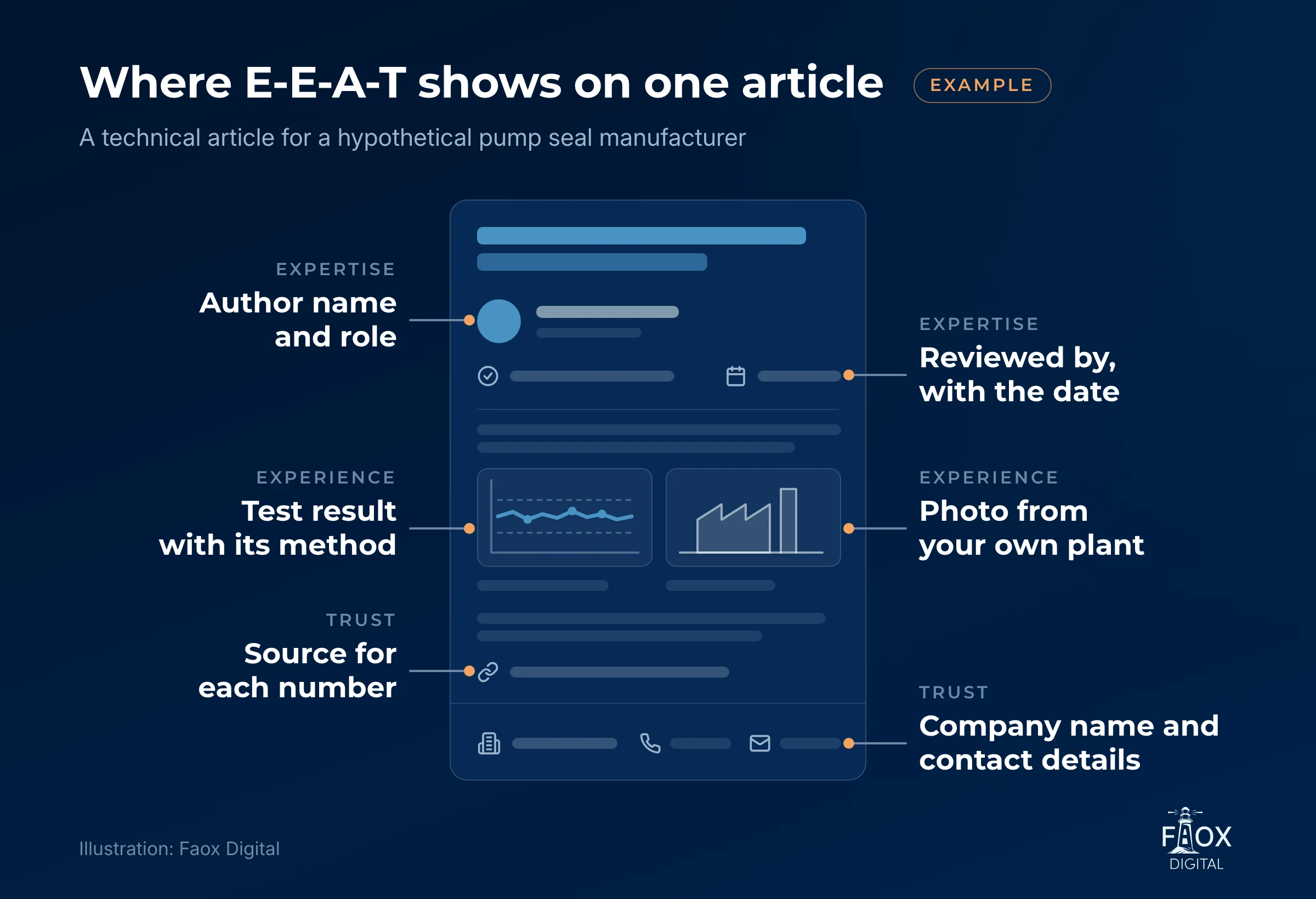
E-E-A-T stands for experience, expertise, authoritativeness and trust, the framework Google’s quality raters use to judge content. It is not a ranking factor or a score, and Google says trust matters most. A B2B company shows it by naming the engineers behind its content, publishing first-hand tests and field experience, citing primary sources and making its company details and certificates easy to check.
Most B2B companies have what publishers would pay for: people who have actually done the work. Yet their websites often claim expertise and show nothing to prove it: no author, no test data, no way to check a certificate. This guide explains what E-E-A-T means in Google’s own framework and how to make real experience visible, as part of your B2B content strategy. The examples come from a hypothetical pump seal manufacturer.
What is E-E-A-T?
E-E-A-T, often written EEAT, comes from Google’s quality rater guidelines, the document Google gives the people who assess the quality of its search results. Google added the first E, for experience, in December 2022. The current guidelines (September 2025) describe four things to consider about a page and its creator:
| Part | What the guidelines ask | What it looks like on a B2B site |
|---|---|---|
| Experience | Does the creator have first-hand experience of the topic? | Field reports, test results, photos from your own plant |
| Expertise | Does the creator have the knowledge or skill the topic needs? | A named engineer with a relevant role and background |
| Authoritativeness | Is the creator or site known as a go-to source? | Trade press coverage, standards work, association references |
| Trust | Is the page accurate, honest, safe and reliable? | Checked facts, sources, real company details, stated limits |
Trust sits at the center. The guidelines say untrustworthy pages have low E-E-A-T however expert they seem, and Google says content does not have to demonstrate all of the others. A field report can show experience without an academic title, and a standards explainer can show expertise without a story from the plant floor. Authoritativeness is the hardest to claim for yourself, because it depends on what others say.
A framework, not a ranking factor
SEO advice often describes E-E-A-T as something Google scores. It is not. Google’s SEO Starter Guide (2025) lists thinking E-E-A-T is a ranking factor among the things not to focus on. Its guidance on helpful content (updated October 2026) explains the relationship: E-E-A-T itself is not a specific ranking factor, but its automated systems use a mix of factors that can identify content with good E-E-A-T.
The Search Quality Rater Guidelines work the same way. Google says raters have no control over how pages rank and that their data is not used directly in ranking, and it compares their work to feedback cards from a restaurant’s diners. So read the guidelines as a description of good content, not as a ranking checklist. Two things follow:
- There is no E-E-A-T score. If a tool gives you one, it is that tool’s own estimate. Scores such as domain authority measure something else; our guide to what DA scores mean explains them.
- It does not rescue the wrong page. A trustworthy article still fails a buyer who wanted a product page, so check the search intent first.
Why it matters to B2B buyers
The better reason to show experience is that technical buyers look for it. The 2026 State of Marketing to Engineers survey by TREW Marketing and GlobalSpec, with more than 1,000 respondents worldwide, asked how far they trust different authors of technical content:
The survey comes from companies that sell marketing to engineers, but the message is hard to miss: vendor engineers ranked first of the six author types. Buyers also verify what they read. Of those who notice AI summaries in search, the same survey found 69% go on to the results and only 6% say the summary is usually enough.
The 2024 Edelman and LinkedIn study of nearly 3,500 managers in seven countries points the same way, with 73% of B2B decision-makers calling thought leadership a more trustworthy basis for judging a company’s competencies than traditional marketing materials.
First-hand experience: what others cannot copy
First-hand experience is what generic publishers and AI tools lack. Google’s 2026 guide to generative AI features makes the same point: a first-hand account offers a perspective that a summary of existing content cannot. In B2B, it usually takes these forms:
- Test results with their method. What you tested, under which conditions and what happened.
- Field cases. The failure, the diagnosis and the fix, anonymized if the customer prefers.
- Your own photos and video. The real plant, product and test rig, not stock images.
- Honest limits. Where the product should not be used, which only someone who has seen it fail can say.
Say how you know. Google’s guidance notes that product reviews build trust when readers understand how many products were tested, what the results were and how the tests ran, with evidence such as photographs. The same applies to a comparison of seal materials.
Certifications, references and success stories
Certifications and references are claims buyers can check, so make checking easy. The guidelines also tell raters to look beyond what a company says about itself, at independent reviews, references and news articles. You can run the same kind of search they describe: "company name" -site:example.com shows what others say about you, away from your own site.
- Certificates: give the standard, scope, issuer and validity date, and link to the issuer’s register where one exists.
- References: name a customer only with permission. Otherwise describe the type of plant and the market.
- Success stories: state the problem, what you did, the measured result and the period. Leave out any result you cannot back up with records.
- Recognition: trade press articles, association memberships, standards committee work and conference talks show what others think. Being known for one subject also depends on building topical authority.
Citing sources and company information
Citing sources lets a reader check you. Google’s guidance counts clear sourcing among the things that make content worth trusting, so name the standard with its number and year, the test report or the regulator, and link to it where you can. A phrase like "studies show" proves nothing. Change a page’s date only when the content really changes, because Google lists doing otherwise as a warning sign.
Company information answers the question behind every B2B page: who is this? The guidelines say it should be clear who is responsible for a website, and they point raters to the About page as a starting point. Give your legal name, address, phone number, named contacts, what you make and where you sell. These details are part of the wider B2B website trust signals buyers check before they contact you.
YMYL topics in B2B
YMYL topics, short for Your Money or Your Life, are those that could significantly affect the health, financial stability or safety of people, or the welfare of society. Google says its systems give even more weight to content with strong E-E-A-T on them. The guidelines treat this as a spectrum and note that many or most topics are not YMYL, so a page on seal dimensions is unlikely to count.
The guidelines give no B2B list, but by our reading some B2B pages come close:
- Safety instructions for pressure equipment, hazardous chemicals or electrical work
- Medical devices and materials that touch food
- Tax, legal or financial guidance for businesses
On those pages, have a qualified person review the text, cite the standard or regulation, show the date and say when the reader should ask a professional.
A quick E-E-A-T review for any page
You do not have to fix the whole site at once. Start with the pages buyers see most before they contact you, usually your main guides and category pages, and run each one through this list:
- It says who wrote or reviewed it, and that person’s role is real
- It contains something only your company could say
- Every number, standard and claim has a named source
- Certificates and references can be checked
- The company behind the page is easy to identify and contact
- The date shows the last real change
The easiest place to build this in is before anyone writes. The next question is how to tell a writer and an engineer what each page needs, which our guide to the SEO content brief covers.
How Faox Digital shows expertise in content
At Faox Digital, the content and authority step of an SEO project covers pages built to rank and be quoted by AI tools, and placements in the press buyers read. It follows the audit and the keyword map, so every page has a search behind it.
Key takeaways
- E-E-A-T is a framework from Google’s quality rater guidelines, not a ranking factor or a score.
- Trust matters most, and a page does not have to show all four parts.
- Your engineers are your strongest asset: name them, interview them and have them review the text.
- Show first-hand tests, field cases and honest limits, and make certificates and references easy to check.
- Take most care on YMYL topics, where a wrong answer could hurt someone.
Frequently asked questions
Is E-E-A-T a ranking factor?
No. Google says E-E-A-T itself is not a specific ranking factor, though its systems use a mix of factors that can identify content with good E-E-A-T. Treat it as a way to judge your own content.
How do I create SEO content that shows E-E-A-T?
Start from a question buyers really ask, interview the engineer who can answer it and write from what that person knows. Add test data and sources, have the engineer review the draft and name both of you on the page.
Can AI-assisted content meet E-E-A-T?
AI can help with research and structure. Google’s guidance on generative AI (updated October 2026) calls it critical to fact-check all AI-generated content before publishing, and says generating many pages without adding value may break its spam policies. The experience still has to come from your people.
Does every page need an author bio?
No. Google asks for bylines where readers might expect them, which usually means guides and technical articles. Product and category pages more often need clear company details and named contacts.
Sources
- Google Search Central: Creating helpful, reliable, people-first content, 2026
- Google: Search Quality Rater Guidelines, September 2025
- GlobalSpec: 2026 State of Marketing to Engineers research report, 2026
- Edelman: Reaching Beyond the Ready: How thought leadership gets out-of-market B2B buyers back into the game, 2024
Let’s talk
Where do you want to be found?
Tell us the searches that matter to your business. We will review your site and tell you plainly what to fix first, including what you can do yourself.