
B2B Website Trust Signals: What Buyers Check Before They Contact You
How a buyer who has never heard of you decides whether to trust your website, which proof counts and how to make it easy to check.
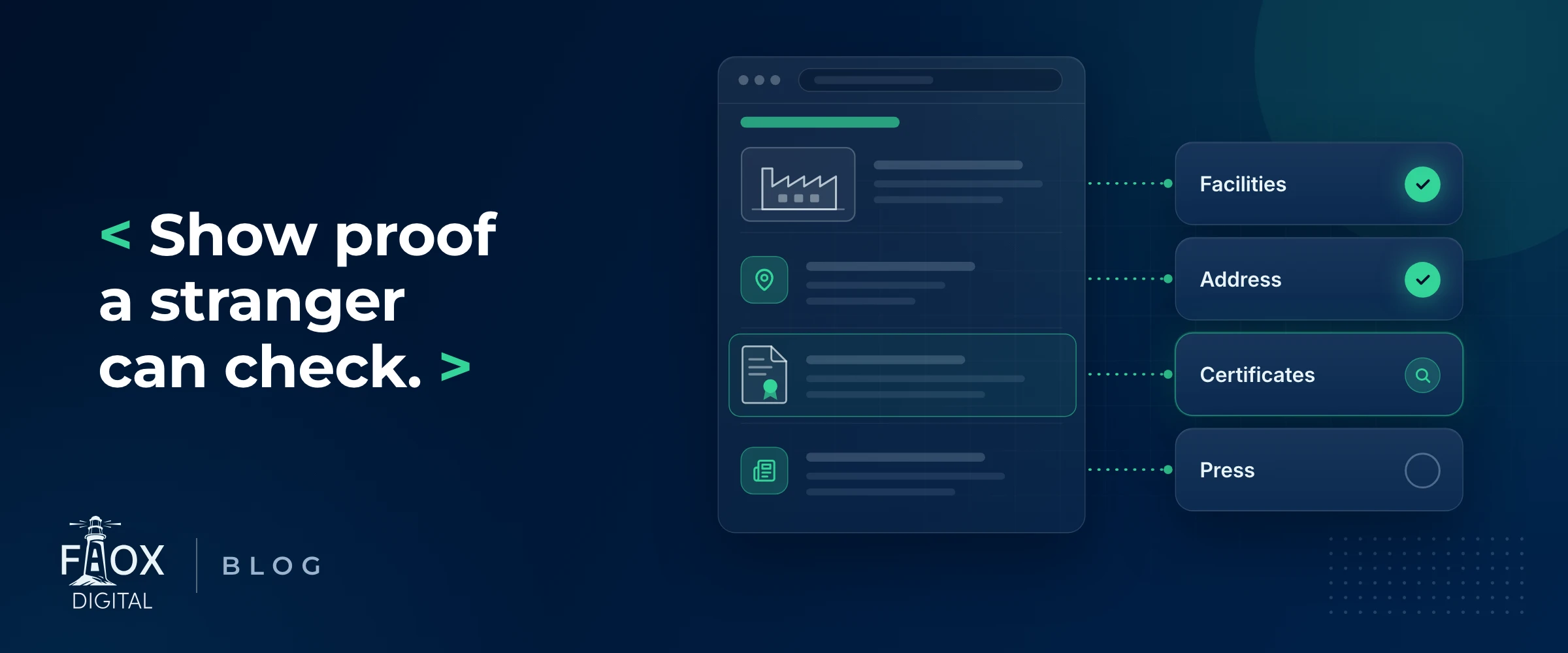
B2B website trust signals are the details a buyer can check before contacting you: a real address and named people, certificates with their numbers, references and success stories, press coverage, current content and basic security. A buyer who does not know you believes proof, not claims, so make each signal specific, dated and easy to verify.
A buyer who has never heard of you has a simple question: can this company be trusted with an order that matters? They rarely ask you directly. In the 2026 State of Marketing to Engineers survey, 62% of the buying process happens online before a technical buyer contacts a vendor, and 70% said they would likely choose the better-known brand between two technically similar solutions.
If you are not the better-known name, your website has to close that gap. This article covers the proof that does it; our guide to how a B2B website works covers the site around it.
What B2B website trust signals have to prove
B2B website credibility comes down to three questions. The Stanford Guidelines for Web Credibility (2002), based on research with over 4,500 people, and Nielsen Norman Group’s four credibility factors (2016) point the same way: show a real organization, make claims easy to verify, stay current and avoid errors.
| Buyer’s question | Trust signals that answer it | What weakens them |
|---|---|---|
| Is this company real? | Street address, phone, named people, real photos | A form and nothing else, stock photos |
| Can it do this job? | Certificates, references, success stories, press coverage | Logos with no context, "leading supplier" claims |
| Is it careful and still active? | Current content, no errors, HTTPS, a plain privacy policy | Old news, broken links, expired certificates |
Trust signals work only if a stranger can check them. In Nielsen Norman Group’s 2019 research on about pages, users were more skeptical than in earlier rounds, and they often compared what a company said with third-party review sites. So ask of every signal below: how could someone verify this?
Address and contact information
A clear address and contact details are the quickest test. Stanford’s guidelines call a physical address the easiest way to show a real organization behind a site, and GlobalSpec’s 2020 article lists having no way to contact a company among the things that erode engineers’ trust. In the EU, the e-Commerce Directive (Article 5) also requires online service providers to make their name, geographic address, email address and any trade register number easy to find.
- Show the street address of your head office and each plant, not only a PO box.
- Give a direct phone number and a monitored email address, not only a form.
- Put the company’s registration details in the footer or on a legal page.
- Name a contact for each region or product line, if you can.
Team and facility images
Team and facility images prove that the people and the plant exist. Nielsen Norman Group’s eyetracking studies found that users pay attention to photos of real people who work at a company and ignore stock photos of generic people (2010, reviewed 2026). For a B2B buyer, facility photos also answer a practical question about capacity. Show the production floor, the test lab and the people who run them, with captions that say what each photo shows.
Name your engineers too. In the 2026 survey, 66% of technical buyers rated engineering experts at vendor companies as very or extremely trustworthy, against 10% for generative AI tools. Our article on showing expertise in content goes further.
Certificates, standards and compliance documents
Certificates are a purchasing filter, and they count only if they can be checked. Give each one the standard, the scope, the issuer, the number and the validity date, and link to the document. Then:
- Word them correctly. ISO says it does not perform certification, so do not write "certified by ISO". Refer to the standard by its full reference, as in "certified to ISO 9001:2015".
- Leave out the ISO logo. ISO does not permit anyone to use it in connection with certification. Ask your certification body about its own mark.
- Say where to check. Point buyers to the issuer, or to the IAF CertSearch database for accredited certificates.
- Watch the dates. An expired certificate casts doubt on the rest of the page, so give someone the job of updating renewals.
Standards and compliance documents, such as declarations of conformity or material statements, belong beside the products they cover, dated and owned by your quality team. Our guide to B2B product page design shows how they fit on the page.
References and customer reviews
References are the strongest proof you control. Name the customer, the sector and what you supplied, with their permission, and offer a reference call for serious buyers. A wall of logos with no context proves little. Nielsen Norman Group found that users liked quotes and case studies on company sites but doubted them, noting that a site would of course show only positive ones (2016). So add details that are hard to invent: the application, the country, the year, and a person’s name and role.
Customer reviews differ, because you do not control them, and that is why they count. Nielsen Norman Group says people have learned to trust external sources more than company-sponsored content. Many manufacturers have few public reviews, so start where your buyers look, such as your Google Business Profile and your sector’s directories, and link to them.
Two limits apply. Google’s review snippet rules leave out reviews that a company controls about itself, so markup on your own testimonials will not earn stars. And the US FTC’s guides say an endorsement must reflect the endorser’s honest opinion and that material connections should be disclosed, which is a good rule in any market.
Success stories
Success stories show the work itself. A credible one states the application, the conditions, what you supplied, what changed and for whom. Use only figures you can document and the customer agrees to. If a customer cannot be named, keep the sector and the technical problem, and say that the name is withheld. Put a date on each story. One detailed story does more than ten short paragraphs of praise.
Press coverage and third-party proof
Press coverage counts because buyers often read it before they reach you. In the 2026 survey, online technical publications (76%) edged out supplier and vendor websites (74%) as the place technical buyers routinely research purchases. Nielsen Norman Group adds that a site with no presence on third-party sites can appear to have something to hide.
Link to each article itself, with the publication’s name and the date, and not only to a logo. Label anything you paid for as sponsored. Earning that coverage is a media relations job, which our guide to working with journalists and editors covers, and why people trust what others say about you explains the reasoning behind it.
Current content
Current content shows that someone is home. Stanford’s guidelines advise updating content often, or at least showing that it has been reviewed recently, and Nielsen Norman Group warns that typos and broken links quickly degrade credibility. Check the date of your latest news, your documents, your team page, your product range and your certificates. If you cannot keep a news section alive, remove it instead of leaving a last post from years ago, and name an owner for each section.
HTTPS and the privacy policy
HTTPS is now the minimum. Google said in October 2026 that Chrome asks users for permission before making an insecure HTTP connection, by default for all users, so a buyer may meet a warning before they see your page. Check that every page, form and download loads over HTTPS, and that your certificate renews on time.
It does not prove honesty, though. The Chromium Blog said in 2023 that the lock icon does not indicate trustworthiness, that nearly all phishing sites use HTTPS and that only 11% of participants in its 2021 research understood the icon’s precise meaning. So fix it, and do not advertise it as proof.
A privacy policy is a small signal that buyers’ legal and IT teams do check. Link it from the footer and every form. The GDPR (Article 12) asks for clear and plain language, so write who you are, what you collect and which tools receive it, and date it. A copied template that names another company is a bad sign. Our article on RFQ page design covers the notice next to a quote form.
Where each signal belongs
Trust signals work best where the buyer is asking the question:
| Page | Signals to show |
|---|---|
| Home page | What you do, the certificates that matter most, a few named customers |
| Product page | Approvals and certificates for that product, dated documents |
| About page | Address, history, team, facilities, ownership |
| Quote page | Named team, reply time, address, privacy notice |
| Footer | Address, phone, registration details, privacy policy |
For how strong industrial sites arrange all this, see our article on manufacturing website design.
How to audit your trust signals
Ask someone who does not know your company to go through this list:
- They can find your street address, a phone number and a named contact within a minute
- Photos show your real people and facilities
- Each certificate gives its standard, scope, issuer, number and validity date, and none has expired
- No page says "certified by ISO" or uses the ISO logo
- References and logos have permission and context
- Success stories state the application, what you supplied and what changed
- Press links open the article itself
- News, documents and team pages are current
- There are no broken links or typos, and no browser warnings
- The privacy policy is dated, names your company and is linked from every form
If fixing these means fighting your platform or your site structure, the next question is when to redesign a website.
How Faox Digital builds trust into a website
When Faox Digital builds a B2B website, we first learn what the company sells, who buys it and which markets matter, then map what each page has to do before design starts. After launch we keep the site fast and healthy, and we tell a company whether its site needs a rebuild or a few focused changes.
Key takeaways
- A buyer who does not know you believes proof that can be checked, not claims.
- Show a street address, a phone number, named people and real photos of your team and facilities.
- Give each certificate its standard, scope, issuer, number and validity date, and never write "certified by ISO".
- Use references, success stories and press with permission, context and dates, and link to third-party sources.
- Current content, HTTPS and a plain privacy policy rarely win trust alone, but their absence can lose it.
Frequently asked questions
What are website trust signals?
They are the details that tell a cautious visitor a company is real, capable and current. On a B2B website, they include a street address, named people, certificates with their numbers, references, success stories, press coverage, current content, HTTPS and a privacy policy.
How do you build credibility on a B2B website?
Replace claims with proof a stranger can check. State facts instead of adjectives, name real people and customers with their permission, and link to issuers and publications. Then keep it all current and free of errors, because outdated pages undo the rest.
What if we have no well-known customers?
Start with what you can show: your plant, your people, your certificates and detailed stories from smaller customers, named or not. A specific account of a technical problem you solved says more than a famous logo with no context.
Do customer reviews matter on a B2B website?
They help, mostly on sites you do not control. Buyers often compare your testimonials with third-party sites, so link to your profiles there and do not hand-pick only the good ones. Many manufacturers have few public reviews, so references and success stories usually carry more weight.
Does HTTPS make a website trustworthy?
No. It protects the connection, and Chrome now warns before insecure ones, so a site without it looks careless. But nearly all phishing sites use HTTPS too, according to the Chromium Blog, so it is a minimum and not proof of honesty.
Sources
Let’s talk
Planning a new website or a fix?
Send us your current site and what you need it to do. We will tell you whether it needs a rebuild or a few focused changes.