
Manufacturing Website Design: What Good Industrial Websites Have in Common
What separates good industrial websites from ordinary ones, what six manufacturers’ sites show, and how to study examples for your own project.
Good manufacturing website design makes it quick for an engineer or purchaser to answer three questions: what do you make, does it fit my case and how do I ask for a price? The sites that do this well share a plain home page message, a catalog organized by how buyers specify, real plant images, checkable certificates, sector pages, one place for technical documents, real language versions and a clear quote route.
Ask what makes an industrial website good and you will often hear "modern design". Engineers say something else. In GlobalSpec and TREW Marketing’s 2020 research, asked which features of their favorite websites mattered most, engineers named in-depth technical information (81%) and technical specifications (75%), while only 11% named a wide range of content. The audience is there too: in the 2026 State of Marketing to Engineers survey, 74% of technical buyers said they routinely research purchases on supplier and vendor websites.
This article looks at what established manufacturers’ sites do, and how to study examples for your own project. For the whole picture of how a B2B website works, start with our guide.
Manufacturing website design: what separates good sites from ordinary ones
Most of the difference lies in content and structure, not in decoration. This table is our own summary from reviewing the sites below:
| Feature | Ordinary site | Good site |
|---|---|---|
| Home page message | A slogan that could fit any company | What you make and for whom, with routes to products |
| Product catalog | PDF brochures, or names and photos | Searchable by what buyers specify |
| Facility images | Stock photos of handshakes | Real plant, people and equipment |
| Certificates | A row of logos | Standard and scope, in one findable place |
| Sector pages | The same text with the sector name changed | Conditions, problems and products for each sector |
| Documents | Scattered PDFs, or forms in front of them | One filterable center, by product and language |
| Languages | A translate button | Own URLs, translated documents, local contacts |
| Quote route | "Contact us" and nothing else | A clear route from each product, or to a local partner |
| Visual language | Decorative images | Consistent photos, drawings and icons tied to the content |
Manufacturing website examples worth studying
An example analysis is more useful when it looks at specific features than at overall looks. We reviewed these six sites in November 2026, and we describe them in words because we do not reproduce other companies’ pages. As with any list of B2B website examples, read them with your own buyers in mind. Most of these companies are large, so copy the idea and not the size of the site.
| Site | What it makes | What to note |
|---|---|---|
| Swagelok | Fluid system components | A menu of products, industries and resources; one hub for compliance and certificates; a library of CAD files |
| Sandvik Coromant | Metal cutting tools | A home page that opens onto product categories; catalogs filtered by type and language |
| igus | Polymer bearings and cable carriers | Filters on operating conditions, with an immediate price indication; a 360° factory tour |
| Phoenix Contact | Electrical connection and automation products | A section of application examples; a language notice in place of a forced redirect |
| Alfa Laval | Heat transfer, separation and fluid handling equipment | A home page route to the catalog and to a local partner for a quote |
| Hainbuch | Workholding equipment | A product finder by industry, machining and workpiece; CAD data and downloads under service |
Home page message
The home page message has one job: to say what you make and for whom. In Nielsen Norman Group’s 2019 research on company information, users marked sites down when critical information, such as what the company does, was hard to find.
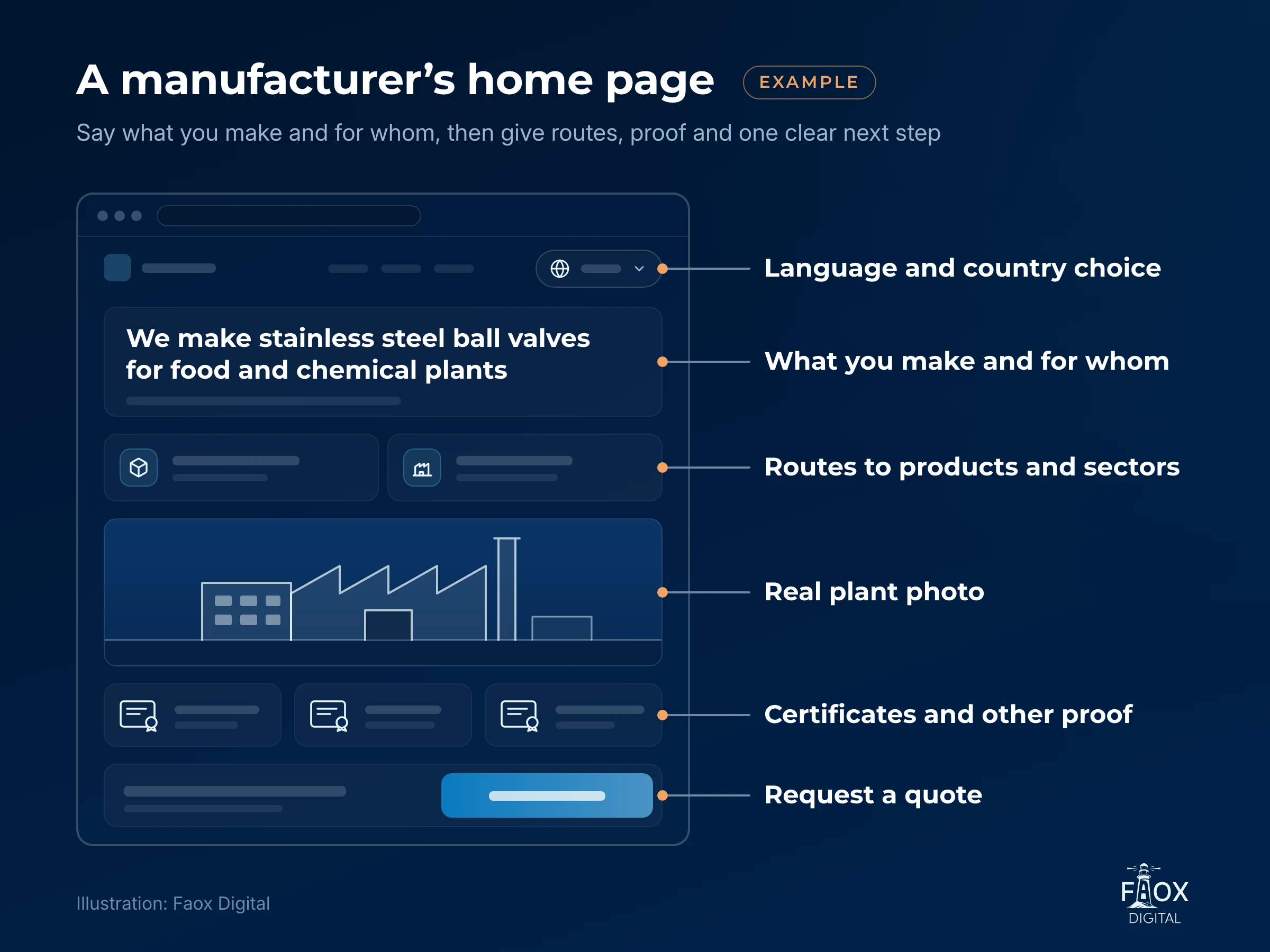
Swagelok’s home page calls the company a source for fluid system solutions and says that customers count on it to contain and control liquids and gases in critical applications. Sandvik Coromant goes straight to its product categories, such as turning, milling and drilling tools. Neither makes a visitor guess. Compare "Innovative solutions for a changing world" with "We make stainless steel ball valves for food and chemical plants": both are invented here, but only the second tells a buyer whether to stay. Below the message, give routes to your main product families and sectors, some proof and one clear next step.
Product catalog
The product catalog should open the way buyers think, and they do not all think the same way. Hainbuch offers a product finder by industry, machining type and workpiece, alongside its product overview. The igus sleeve bearing shop lets buyers enter dimensions, temperature, load and speed, and it answers with suitable parts and an immediate price indication.
Whichever entry points you choose, each one should end on a page with full specifications in text. Our guide to B2B product page design covers that page in detail.
Facility and production images
Facility and production images prove capacity in a way that claims cannot. In Nielsen Norman Group’s 2019 research, stock photography counted against sites and authentic, realistic imagery counted for them, and users liked seeing real employees and products. The igus factory page offers a 360° tour from injection molding to the tool shop, quality control and the laboratory, and it invites visitors to book a factory visit.
You do not need a virtual tour. A photographer’s day in the plant is enough to show the production floor, test equipment and people at work. Check first that no customer’s confidential part is in the picture.
Certificates
Certificates are a purchasing filter, so buyers should not have to hunt for them. Swagelok gathers material certifications, quality-system registrations and global compliance documents in one hub under its resources menu, and Phoenix Contact’s product pages list approvals with their IDs. Do both if you can: one page for the company’s certificates, and the relevant approvals on each product page, with the number, scope and validity date.
Sector and application pages
Sector and application pages meet buyers who start with a problem. Swagelok, igus and Phoenix Contact all have a section for industries, and Phoenix Contact adds application examples from practice. A good page covers the operating conditions in that sector, what tends to go wrong, which products fit and why. Ask your application engineers what customers ask before they order. If two sector pages differ only by name, merge them or write the second one properly.
Technical document center
A technical document center gives engineers one place to find what they would otherwise request by email. Sandvik Coromant’s catalogs and handbooks can be filtered by type and language, with a date on each publication. Swagelok lists a catalog library and CAD files with sales drawings under its resources menu, and Phoenix Contact offers downloads by language on each product page.
Keep the key facts on web pages as well. Nielsen Norman Group reports that users in B2B tests complained about product specifications presented in PDF, and it advises a web page that summarizes the content and offers the PDF as a download (2020). Date every document, keep one stable address for it and do not put a form in front of standard data sheets.
Multilingual structure
A multilingual structure decides whether export buyers can use the site at all. Google recommends different URLs for each language version, and it advises against redirecting people automatically to the language you think they speak.
The sites above follow that logic in visible ways. Phoenix Contact’s US pages show a notice that the content is tailored for the United States and offer the visitor’s own country, Sandvik Coromant says which country and language it selected and offers a way to change them, and igus suggests its local site without forcing the move. Beyond the pages, translate documents and forms, adapt units and give each market a contact who can reply in that language.
Quote call to action
A quote call to action should be easy to find and honest about what happens next. Alfa Laval’s home page tells visitors to find their products and contact a local partner to request a quote, which makes clear how the company sells. If you sell through distributors, say so; if you quote directly, put the button on each product page. Our guide to the request a quote page covers where it sits and what it asks.
Visual language
Visual language in industrial design means images that carry information. In GlobalSpec and TREW’s 2020 research, 43% of engineers wanted imagery or icons related to the content, and 75% preferred concise information with links to the detail. Phoenix Contact’s product pages, for example, use small pictograms for values such as voltage.
In practice, use real photos, technical drawings and a small set of icons, and apply them the same way across the site. Keep tables and specifications easy to read before you think about effects. A large video at the top of the home page may look impressive, but it adds weight and rarely answers an engineer’s question.
How to analyze examples for your own site
Use other sites to find ideas, not designs to copy:
- Choose about five sites: two or three competitors, and two or three manufacturers in other sectors whose buyers resemble yours.
- Set real tasks: find a product for a given specification, find a certificate, find a data sheet in a second language, ask for a price.
- Do the tasks on a phone and a desktop, and note what helped and what got in the way.
- Compare them feature by feature, using the table at the top of this article.
- Ask your sales team which sites customers mention, and what they say about them.
- Write down what to adopt. Copy ideas, not text or images, which belong to their owners.
Then put your findings to use when writing a website brief, so that every provider works from the same evidence. If you already have a site and the gaps look large, the next question is when to redesign a website.
How Faox Digital approaches manufacturing websites
When Faox Digital builds a website for a manufacturer, we start with what the company sells, who buys it and which markets matter, then map what each page has to do. We design for the phone screen first, give each language its own structure rather than a translate button, and test the site in every language and on every device before launch.
Key takeaways
- Engineers value in-depth technical information and specifications far more than a wide range of content.
- Say on the home page what you make and for whom, and open the catalog the way buyers specify.
- Show your real plant, gather your certificates in one place, and write real pages for each sector.
- Give documents one filterable home, with dates and languages, and keep the key facts on web pages.
- Study other sites through real tasks, then copy the ideas and not the design.
Frequently asked questions
What is a manufacturing website?
It is a manufacturer’s main website, which explains what the company makes, helps engineers and purchasers check whether its products fit and gives them a way to ask for a quote. It usually holds a product catalog, sector pages, technical documents and proof such as certificates.
What makes a good manufacturing website?
It answers a technical buyer’s questions without a phone call: what you make, whether it meets the specification, whether you can be trusted and how to get a price. Clear structure and full technical content matter more than visual effects.
What should an industrial website include?
Most need a home page with a plain message, a catalog with product pages, sector or application pages, a document center, a certificates page, an about page with real photos, language versions for export markets and a quote route.
Does a small manufacturer need all of this?
Not at once. Start with a clear home page, proper pages for your main product family, your certificates and a simple quote route. You can add sector pages and a document center later, and much of the first step can be done without rebuilding the site.
Sources
Let’s talk
Planning a new website or a fix?
Send us your current site and what you need it to do. We will tell you whether it needs a rebuild or a few focused changes.