
Thought Leadership Examples: What Strong B2B Executives Do on LinkedIn
What B2B executives who build a strong presence on LinkedIn do differently, shown through public examples and recurring patterns, with the lessons any leader can apply.

Thought leadership examples on LinkedIn share a pattern: strong B2B executives stick to one clear theme, post on a regular rhythm, write from field experience rather than slogans, support opinions with data, admit mistakes, and spend as much time commenting as posting. They avoid self-promotion, one of the things LinkedIn’s editors check when they choose Top Voices, and they avoid hype.
Executives often ask for good thought leadership examples before they start posting. The best ones are rarely famous; they are leaders who explain their field so well that buyers, partners and future colleagues start to rely on what they say.
This article shows what those executives do differently, with public examples and the patterns behind them. How to build your own presence step by step is covered in our guide to B2B thought leadership.
Why examples matter
Thought leadership is read by the people B2B companies want to reach. The 2024 Edelman-LinkedIn B2B Thought Leadership Impact Report, summarized on LinkedIn’s marketing blog, found that 52% of decision-makers and 54% of C-suite executives spend an hour or more each week reading it. The same research found a quality problem: less than half of respondents rated the thought leadership they read as good, and only 15% as very good.
That gap is the opportunity. An executive who writes clearly about real work stands out, because most of what readers see does not.
Public examples: what LinkedIn’s editors look for
The most useful public benchmark is LinkedIn’s own Top Voices program, a select, invitation-only group whose members carry a blue badge. At the time of writing (November 2026), LinkedIn’s Help Center lists several factors LinkedIn considers when it selects Top Voices, including but not limited to:
- Platform presence: consistent content and regular engagement with the community.
- Quality and originality: a distinctive voice and an original perspective.
- Subject matter expertise: insights, commentary and analysis on professional topics.
- Safety, trust and professionalism: profiles, content and on-platform interactions that abide by LinkedIn’s Professional Community Policies.
- Prominence: editors may also grant the badge to select members with an outsized influence in their local market’s economy, job market or industry.
Its advice to members who hope to earn the badge is just as telling: post regularly, share knowledge that informs others, and add value in a non-promotional way. LinkedIn says members who primarily or exclusively promote paid services are not considered.
LinkedIn News also publishes lists of Top Voices with a short note on what each one does. Its 2022 list of leadership voices in the U.S. described Ebony Beckwith, then Salesforce’s chief business officer, sharing advice through a recurring #BossNotes series, and Padmasree Warrior, then founder and chief executive of Fable, writing a newsletter called "Lifelong Learning". Both show the same habit: a recognizable format that readers know to expect. Roles change, so check any public example again before you quote it.
Thought leadership examples: the patterns that repeat
Look at executives who are worth following in any industry and the same patterns appear. The examples in the table are illustrations of each pattern, not real posts:
| Pattern | What it looks like | Illustration | What to avoid |
|---|---|---|---|
| Consistent theme | One or two subjects the executive knows deeply | A pump maker’s CEO who writes only about energy use in industrial water systems | Posting about everything |
| Regular rhythm | A pace readers can count on, often a series | A weekly post called "One question from the field" | Bursts of posts, then silence |
| Field experience | What happened on a site, a project or a customer visit | A service director describing a failure found during commissioning | Generic advice anyone could write |
| Industry commentary | A view on news, regulation or a market shift | A note on what a new efficiency rule means for buyers next year | Repeating the headline |
| Mistakes and lessons | What went wrong and what changed | A production head explaining a delayed launch and the new checks | Disguised boasting |
| Data-backed opinion | A claim supported by figures from the company’s own work | Test results from a product comparison, with the method explained | Unsourced statistics |
| Commenting culture | Thoughtful replies and comments on others’ posts | Adding a field example under a customer’s question | Posting and disappearing |
| Founder story | Why the company exists, told through decisions | How a supplier problem led to a new product line | A biography with no lesson |
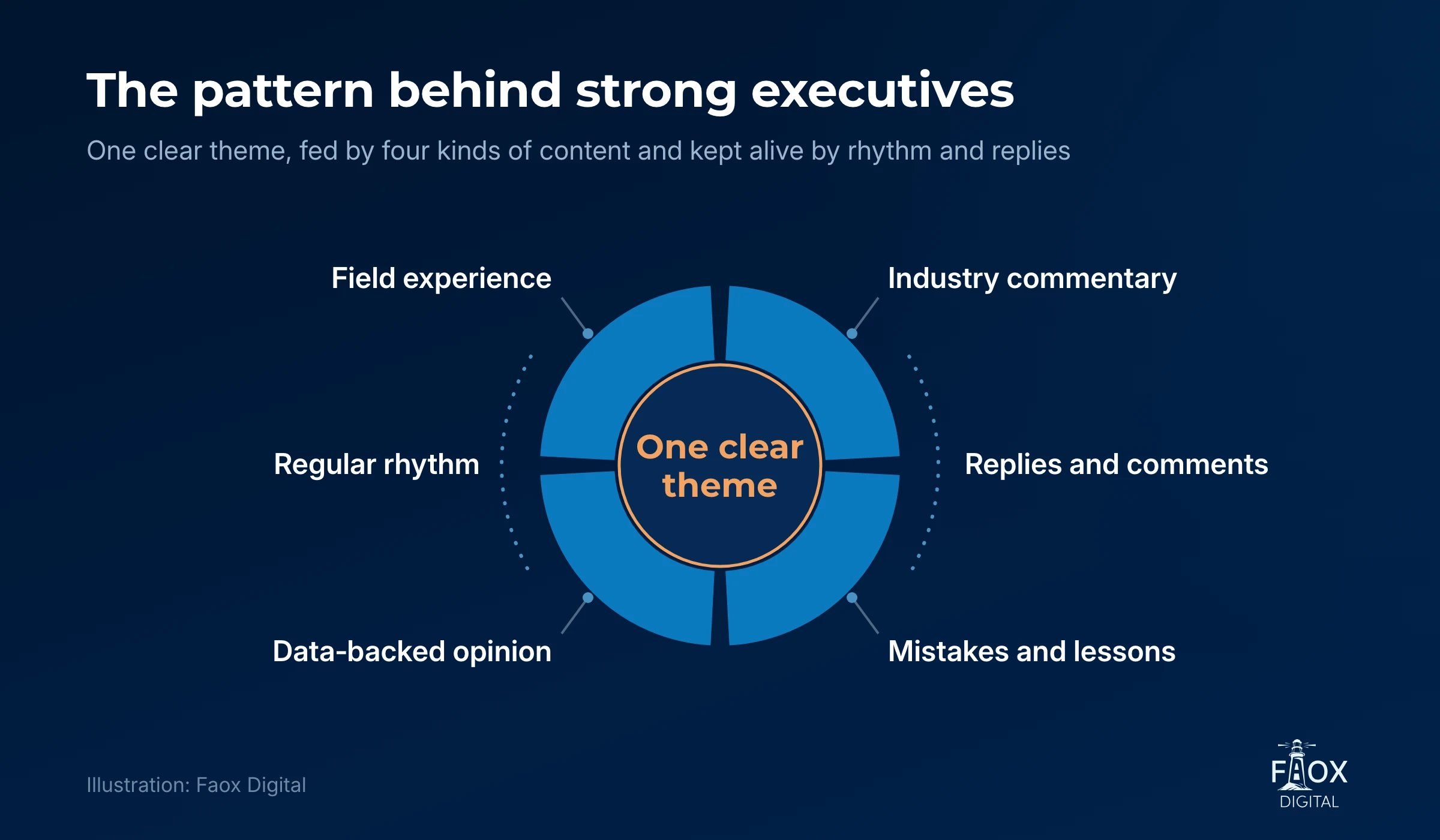
A consistent theme and a regular rhythm
The strongest executive profiles are easy to describe in one sentence: "she writes about X." A consistent theme lets readers know why to follow, and it keeps the executive in the subject they know best. Two themes are usually the limit: the core expertise and one wider interest such as leadership or the industry’s future.
A regular rhythm matters as much as the content. LinkedIn’s own advice to members is to post regularly to keep an ongoing presence. A weekly post is a pace most executives can keep; a named series, like the formats LinkedIn’s editors highlighted, makes each post easier to start and easier for readers to recognize.
Field experience and industry commentary
Field experience is the material no marketing team can invent: what a customer asked during a plant visit, why a project ran late, which specification caused trouble. Executives who write from it sound different from those who repeat general advice, and readers notice.
Industry commentary adds the executive’s view to what is happening in the market: new regulation, a change in raw material prices, a shift in how buyers purchase. The value is in the interpretation. "What this means for buyers in our sector" is worth more than a link to the news.
Mistakes and lessons, and data-backed opinion
Sharing mistakes and lessons builds trust because it shows judgment. The best posts of this kind describe the situation, what went wrong, what was learned and what changed, without blaming customers or colleagues and without turning the story into praise of the company.
A data-backed opinion carries more weight than a strong claim alone. In the 2024 Edelman-LinkedIn research, 55% of decision-makers named strong research and data as a top characteristic of high-quality thought leadership. That data can come from the company’s own work: test results, service records, project timelines. State the source and the method in a sentence, and keep confidential figures out. Data from outside sources needs a named source and a year.
The founder story and an understated tone
The founder story works when it explains decisions: why the company entered a market, why it chose a technology, what it refused to do. Told as a series of choices, it shows how the company thinks. Told as a list of achievements, it reads like an advertisement.
An understated tone runs through all the good examples. Strong executives write plainly, give credit to their teams and customers, and let the substance carry the post. LinkedIn’s own guidance points the same way: it looks for content that adds value in a non-promotional way.
A commenting culture
Many executives treat LinkedIn as a place to publish. The strongest treat it as a conversation. A commenting culture means replying to comments on their own posts, often with a follow-up question, and leaving thoughtful comments on posts by customers, partners, journalists and peers. LinkedIn’s Top Voices criteria name regular engagement with the community alongside consistent content, for good reason.
A simple CEO LinkedIn strategy
A CEO LinkedIn strategy built on these patterns fits into a normal week. One post, written or at least reviewed by the CEO. Fifteen minutes a day for replies and comments. One longer piece a quarter, on the theme the CEO knows best. A short monthly look at who engaged: customers, partners, candidates, journalists or people who will never buy.
Agree the theme with the marketing team, so that the executive profile and the company page support each other. The page carries the facts about the company; the profile carries a person’s view and experience. When the two say the same thing in different voices, both become more credible.
How to learn from examples without copying them
Copying another executive’s style rarely works, because the voice is the part readers trust. Study examples for their structure instead:
- Choose five people in your field whose posts you read to the end: customers, peers, analysts or journalists, not only competitors.
- Note their habits: theme, rhythm, formats, and how often they comment compared with how often they post.
- Mark what earns real replies, such as questions from practitioners, rather than reactions alone.
- Write your own theme in one sentence, based on your work, not theirs.
- Draft four posts before you publish the first, to test whether the theme gives you enough to say.
Thought leadership articles and bylines
Some executives also publish longer thought leadership articles, on LinkedIn or in trade media. A LinkedIn article suits a deeper explanation that will be linked from future posts. Publishing in the trade press reaches readers outside your network, and our guide to executive byline articles covers how those are pitched and written.
What to avoid
Before you post, check that the post avoids the habits that weaken even good executives:
- No self-promotion disguised as advice
- No unsourced statistics or borrowed claims
- No engagement bait such as "comment YES if you agree"
- No posts written entirely by someone else without the executive’s review
- No criticism of customers, competitors or former employees
- No confidential figures, prices or customer names without permission
How the examples connect to your own profile
The patterns above work only if the profile behind them is complete and current; our checklist for an executive LinkedIn profile covers what to fix. For topics, our list of B2B social media content ideas gives material executives can build on, and leaders who like to show the plant and the team can read our guide to using Instagram in B2B.
The next question is usually practical: who writes? Our guide to founder-led content explains when leaders should write themselves and when to get help.
How Faox Digital supports executive thought leadership
Expertise content for executives is part of Faox Digital’s organic social media work for B2B companies in complex and international markets. As with every channel, we start by listening to what the company already says, who follows it and what its buyers care about, then plan topics market by market and language by language in a monthly calendar the client approves before anything goes live.
Key takeaways
- Thought leadership examples worth copying share one clear theme, a regular rhythm and writing from field experience.
- LinkedIn’s Top Voices criteria name consistent content, original voice, expertise and non-promotional value.
- Industry commentary, mistakes and lessons, and data-backed opinions build more trust than claims and slogans.
- A commenting culture and an understated tone separate strong executives from those who only publish.
- Check public examples again before quoting them, because roles and profiles change.
Frequently asked questions
What is thought leadership on LinkedIn?
It is expertise shared consistently on LinkedIn, in posts, comments, articles or newsletters, so that people in a field come to rely on someone’s view. For B2B executives, it usually means writing about one or two subjects they know from their own work.
What is an example of thought leadership?
A plant manager who writes a weekly post on what customers ask during factory visits, or a sales director who explains each month what a regulation change means for buyers. Good examples teach something specific and come from real experience.
What is a thought leadership article?
A longer piece that explains a subject in depth and takes a clear position, published on LinkedIn, on the company website or in trade media. It differs from a post in length and in the evidence it can carry.
How do you post thought leadership on LinkedIn?
Pick one theme, post on a regular rhythm, write from your own experience, support opinions with data, and reply to comments. Avoid promotion and bait; LinkedIn’s editors look for non-promotional, original content.
Sources
Let’s talk
Want social media that reaches the right people?
Tell us who you want to reach. We will look at your channels and suggest a plan your team can keep up with.