
Rebrand or Refresh? What to Check Before Rebranding Your Business
What separates a rebrand from a refresh, the signs for each, and what to check before you change a name, a logo or a position.
Rebranding your business changes what the company stands for or what it is called: its positioning, its name, or both, usually with a new identity. A refresh keeps the name and the position and updates how the brand looks and sounds. Rebrand when the business itself has changed, after a merger, a change of strategy or when the name fails in a new market; refresh when only the expression has aged or drifted.
The logo looks dated next to a new competitor. The website, the catalogue and the trade fair stand each tell a slightly different story. A merger has closed, and nobody knows which name goes on the gate. Someone soon says "rebrand", which is often a bigger answer than the problem needs.
This guide covers what to check before rebranding your business: what has really changed, what the current brand is worth to buyers and what a change would cost in recognition. We work as a B2B branding agency, so we have a stake in the answer; the checks apply whoever does the work, and they often point to a refresh.
What is rebranding in business?
Rebranding changes the core of a brand: its name, its positioning, or both. It usually brings a new visual identity, but the new look is the result, not the point. A brand refresh keeps the name and the position and updates the expression: logo details, colors, typography, imagery, voice and templates.
Between the two sits repositioning: changing the place you hold in buyers’ minds compared with the alternatives, while the name stays. Think of the three as stops on one scale: the further you go, the more of what buyers already know about you is put at risk.
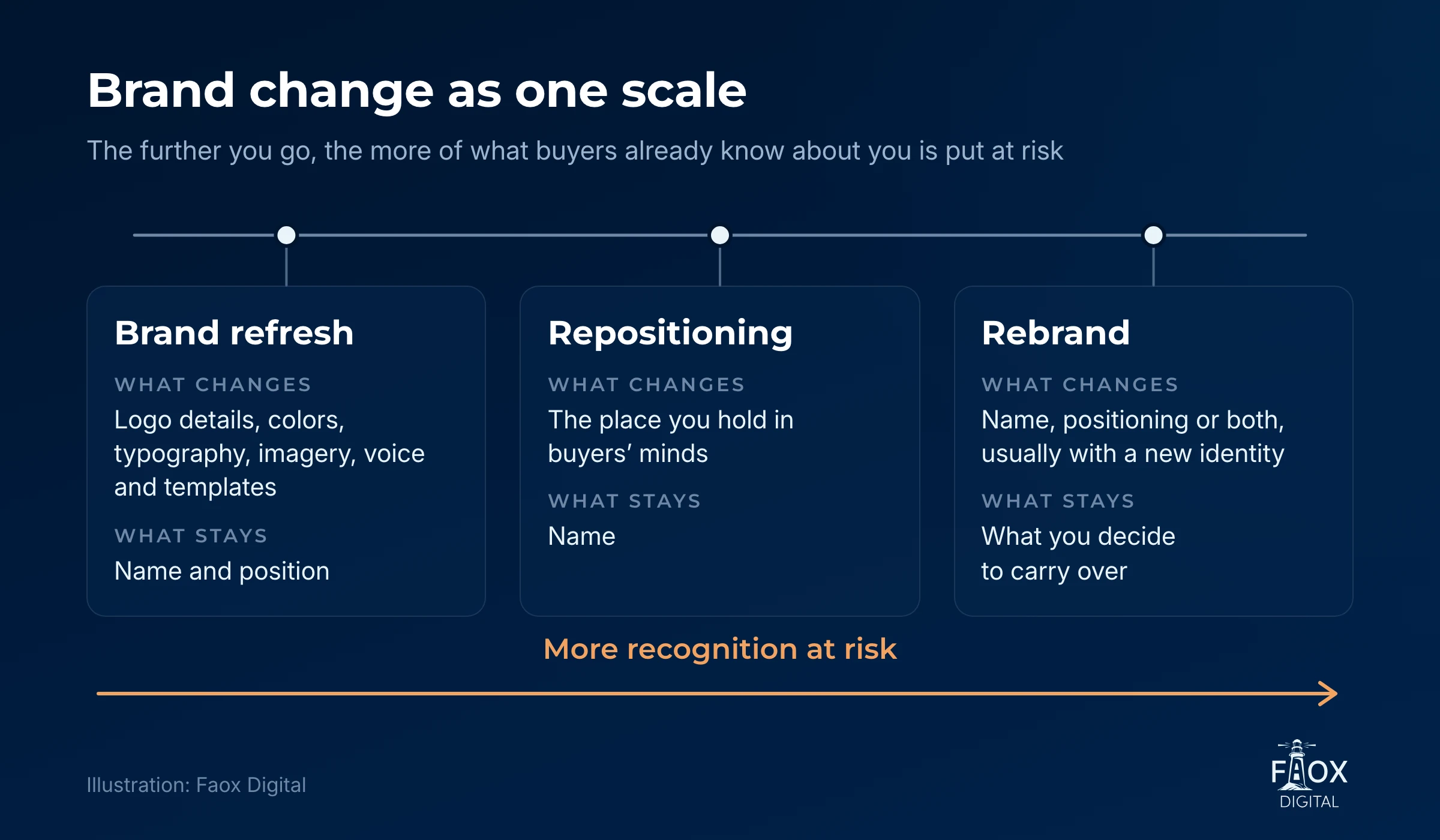
Rebrand vs refresh: how they compare
| Aspect | Brand refresh | Rebrand |
|---|---|---|
| What changes | Logo details, colors, type, imagery, voice, templates | Name, positioning or both, usually with a new identity |
| What stays | Name, position, the strongest assets | What you decide to carry over |
| Typical trigger | A dated or inconsistent look, legibility problems | A merger, a new strategy, a name that no longer fits or cannot be used |
| Risk to recognition | Low, if the strongest assets stay | High: buyers must learn the new brand |
| Who takes part | Marketing, sales, a designer or agency | Management, legal, sales, operations, everyone who issues documents |
| Announcement | A note to customers and partners | A planned launch: own people, customers, partners, then the public |
The table is our summary; many projects sit between the two columns.
Signs a refresh is enough
A refresh is usually enough when buyers still describe you correctly and the problem lies in how the brand is applied:
- The logo fails when small, in one color or on screens
- Materials differ from office to office, distributor to distributor or fair to fair
- The look is dated next to competitors, but your position still holds
- Text fails contrast checks, or the typefaces lack characters for your languages
Brand inconsistency is rarely a reason to start again. It usually means the rules and files never reached the people who make materials, so make sure a refresh ends with a complete brand identity package: master files, templates and guidelines.
Signs that rebranding your business is the right call
A rebrand is worth considering when the business itself has changed, not only its look:
- A merger, acquisition or separation. Two companies become one, or a unit leaves a group and loses the right to its name.
- A new strategy. You sell different things to different buyers, and the old name points the wrong way, for example toward one product line or one city.
- A name that fails in a new market. It is hard to pronounce there, means something unfortunate or is already registered as a trademark.
- A legal obligation. According to Accenture’s 2001 prospectus, an arbitration award required Andersen Consulting to stop using the Andersen name by December 31, 2000, and the firm began doing business as Accenture on January 1, 2001.
- A damaged reputation. This is the weakest reason on its own: a new name does not change what buyers experienced, so it helps only when the company has changed too.
Repositioning: fix the position before the logo
Many requests for a new logo are positioning problems. If buyers, or your own sales team, cannot say why someone should choose you over a cheaper competitor, a new identity makes an unclear message look newer, not clearer.
Settle the position first: who you serve, what you are compared with and the one difference you can prove. If the position changes but the name still fits, repositioning with a refresh is often enough.
Brand equity and logo evolution: what to keep
Brand equity is the value that buyers’ familiarity and associations add to your name: they recognize your mark across a trade fair hall, remember reliable deliveries and find you on approved supplier lists. A rebrand puts some of that at risk, so take stock first.
In her 2018 book Building Distinctive Brand Assets, Jenni Romaniuk of the Ehrenberg-Bass Institute judges brand assets on fame and uniqueness: do buyers think of your brand when they see the asset, and does it point to you rather than to a competitor? Assets that pass both tests are worth keeping. Ask customers, distributors and sales staff which colors, shapes, names and phrases they link to you.
Logo evolution changes a mark step by step instead of replacing it. In January 2019, Mastercard kept the red and yellow circles that had marked its brand for more than 50 years and dropped its name from the mark in selected uses, saying that more than 80% of people recognized the symbol unprompted, without the word.
Brand architecture: decide which names stay
Brand architecture is how the company name relates to the names of its units, product lines and acquired businesses. The broad options are one master brand on everything (a branded house), endorsed brands that keep their own names with a line such as "a [group name] company", and separate brands that stand on their own (a house of brands).
Settle this before design starts. Treat product names with care: B2B buyers often write them into specifications, approved lists and tenders, so renaming a product creates paperwork for your customers too.
Rebranding a company after a merger or acquisition
A deal forces a brand decision whether anyone plans for it or not. Richard Ettenson and Jonathan Knowles studied more than 200 mergers and acquisitions since 1995, each worth over $250 million, and reported in MIT Sloan Management Review in 2006 that brand strategy had low to moderate priority in the pre-merger talks of nearly two-thirds of them. They describe 10 distinct branding options after an acquisition, but the choice usually turns on a few questions:
- If one brand clearly carries more trust with buyers, keep it and move the other under it, often with a "now part of" line for a period.
- If both are strong in different markets or product areas, keeping both can be the safer first step.
- If neither name describes the combined company, a new name may be justified, along with the cost of building recognition from zero.
Decide as early as the deal allows, so that customers hear one story.
Entering a new market: adapt before you rename
A new market rarely needs a new brand. Most companies keep the name and adapt language, messages, proof and imagery. Rename for a market only when the name fails there: check early how it sounds and what it means locally, whether a similar mark is already registered for your products (the WIPO Global Brand Database is a starting point) and whether a local trademark lawyer sees a risk.
How buyers will read the change
Forrester’s State of Business Buying 2026 report found that a typical buying decision now includes 13 internal stakeholders and nine external influencers. Each of them has to recognize you after the change, and some will ask practical questions: has the company been sold, is our supplier approval still valid, do the bank details change?
Buyer perception depends on answering before they ask. List the documents that carry your name inside customers’ systems, such as supplier records, approved vendor lists, quality certificates, declarations of conformity, product markings and contracts, and ask your certification body and lawyers what each change requires.
Plan the transition and the announcement
A transition and announcement plan turns the decision into a sequence:
- List every touchpoint. Website, documents, signage, vehicles, packaging, product markings, profiles and partner materials.
- Clear the legal steps. Company registration, trademarks, domains and certificates come before anything public.
- Brief your own people first. Sales and service teams need the reasons and answers to customers’ questions.
- Tell key customers and partners directly. Use their usual contact, before the public announcement.
- Move the website with care. Google’s 2026 site move guidance advises one change at a time, redirects kept generally for at least a year and the Change of Address tool in Search Console for a new domain.
- Announce publicly. Put "formerly" and the old name next to the new one for a while.
- Measure. Track searches for both names, enquiries and what customers say.
Rankings can fluctuate during a move, Google warns. Our website migration checklist covers the technical steps, and our guide on how to redesign a website without losing SEO lists what to agree with your web team first.
The return and limits of rebranding
Hard evidence on what a rebrand returns is limited. In a 1987 Marketing Science study, Dan Horsky and Patrick Swyngedouw measured the stock market’s reaction to 58 companies that changed their names between 1981 and 1985. For most, the change was associated with improved performance, most of all at industrial goods producers whose results had been relatively poor. But they found no support for the idea that a new name by itself raises demand: the change worked as a signal that real changes in products and organization would follow.
So a rebrand can make a real change visible, remove a legal or market barrier and give a merged company one story. It cannot fix a product, a delivery record or a service problem, and nobody can promise that it will win more business. The bigger the change, the higher the cost; our guide to what brand identity work costs explains the price drivers.
Before you decide: a short checklist
- We can name what has changed in the business, not only in the look
- Buyers and our sales team describe our position the same way
- We know which assets buyers link to us and plan to keep the strongest
- Brand architecture is decided: which names stay, go or become endorsed
- Any new name has passed language and trademark checks in our markets
- Certificates, registrations and customer records are on the transition list
- Customers and partners will hear about the change from us first
If several of these are still open, the decision is not ready. Whoever does the work needs a clear brief, and our marketing agency brief checklist shows what to include; our branding agency selection questions help you compare providers. A smaller company can often run the asset review and the touchpoint list itself.
How Faox Digital approaches a rebrand or a refresh
Faox Digital, a digital growth partner for B2B companies in complex and international markets, handles a rebrand or a refresh in five steps, each a working session with the client. We first listen to how the company describes itself and what its buyers believe, agree its position, find the voice and only then design the identity system with its rules. The rollout follows in the right order across the channels that matter, adjusted per market so that the brand reads as local rather than translated. We suggest first steps that fit the company’s stage and budget, even when the company does part of the work itself.
Key takeaways
- A refresh changes how the brand looks and sounds; a rebrand changes its name, its position or both.
- Rebrand when the business has changed: a merger, a new strategy, a name that fails or cannot be used.
- Take stock of the assets buyers link to you, and keep the strongest.
- Settle positioning and brand architecture before design starts.
- Plan the transition: legal steps, your own people, customers, then the public.
Frequently asked questions
How do you rebrand your business?
Start with the reason: what has changed in the business and what the current brand is worth to buyers. Then settle the position and the brand architecture, check any new name in each market, design the identity and plan the transition, from legal steps and internal briefings to customers, the website and the public announcement.
What does rebranding a company involve?
More than design. A rebrand touches registrations, trademarks, domains, certificates, contracts, product markings, signage and every document the company issues, as well as the website and sales materials, so management, legal and operations need to take part.
Is rebranding your business worth it?
It can be when it marks a real change, such as a merger or a new strategy, or removes a barrier, such as a name you cannot use. In Horsky and Swyngedouw’s 1987 study of 58 name changes, the findings did not support the idea that a new name by itself raises demand. If nothing else changes, a refresh is usually the better investment.
Sources
- Google Search Central: Site moves with URL changes, updated August 2026
- Horsky and Swyngedouw: Does It Pay to Change Your Company’s Name? A Stock Market Perspective, Marketing Science, 1987
- Ettenson and Knowles: Merging the Brands and Branding the Merger, MIT Sloan Management Review, 2006
- Mastercard: Mastercard evolves its brand mark by dropping its name, 2019
Let’s talk
Does your brand say what makes you different?
Show us how you describe your business today. We will tell you where it is clear and where buyers may get lost.