
How to Redesign a Website Without Losing SEO: Decisions to Make First
The decisions that protect search visibility in a redesign, who should own each one and what to agree in writing with your agency before work starts.
To redesign a website without losing SEO, decide before work starts which URLs and content stay, who builds and tests the redirect map, how the new site is checked on a protected staging copy and how results will be compared after launch. Then write those responsibilities and acceptance criteria into the agency’s contract, and change as little at once as the project allows. Rankings can still move, so judge a plan by how well it controls the risk, not by promises.
A redesign can keep a site’s search traffic, or lose part of it. The difference rarely lies in how the new site looks. It lies in decisions taken, or skipped, before the project starts: which addresses change, which pages disappear, who maps the redirects and who checks them.
This guide covers those decisions and what to agree with your agency. The technical steps, from redirect rules to Search Console, are in our migration checklist. We work as a B2B website design agency, so we have a stake in the answer; the checks below apply to any provider, including us.
Website redesign SEO: what puts rankings at risk
Not every redesign carries the same ranking risk. It depends on what changes:
| What changes | Ranking risk | Decide first |
|---|---|---|
| Design only, with the same URLs, text and structure | Lowest | Keep page titles, headings and internal links as they are |
| Content cut, merged or rewritten | Higher for the pages affected | Which pages keep their substance, and where removed pages redirect |
| URL structure | High, because Google treats it as a site move | Whether the change is worth it, and who maps every old URL |
| Platform (CMS) | Depends on what survives the move | What the new platform does to URLs, titles and structured data |
| Domain | High | Whether it can wait for a separate project |
| Several of these at once | Highest | What can move to a second phase |
The ratings are our judgment, but they follow Google’s own advice for site moves: change only one thing at a time, for example moving to a new domain first and changing the layout afterwards. Google also warns that with any significant change to a site, rankings may fluctuate while it recrawls and reindexes the pages.
So the first decision is scope. A site redesign that keeps the URLs and the content of pages that rank is a far smaller risk than one that changes everything together. If the platform changes as well, the choice between a custom website vs template matters less for search than whether the new system can keep your existing addresses.
Decision 1: build the URL inventory and decide what stays
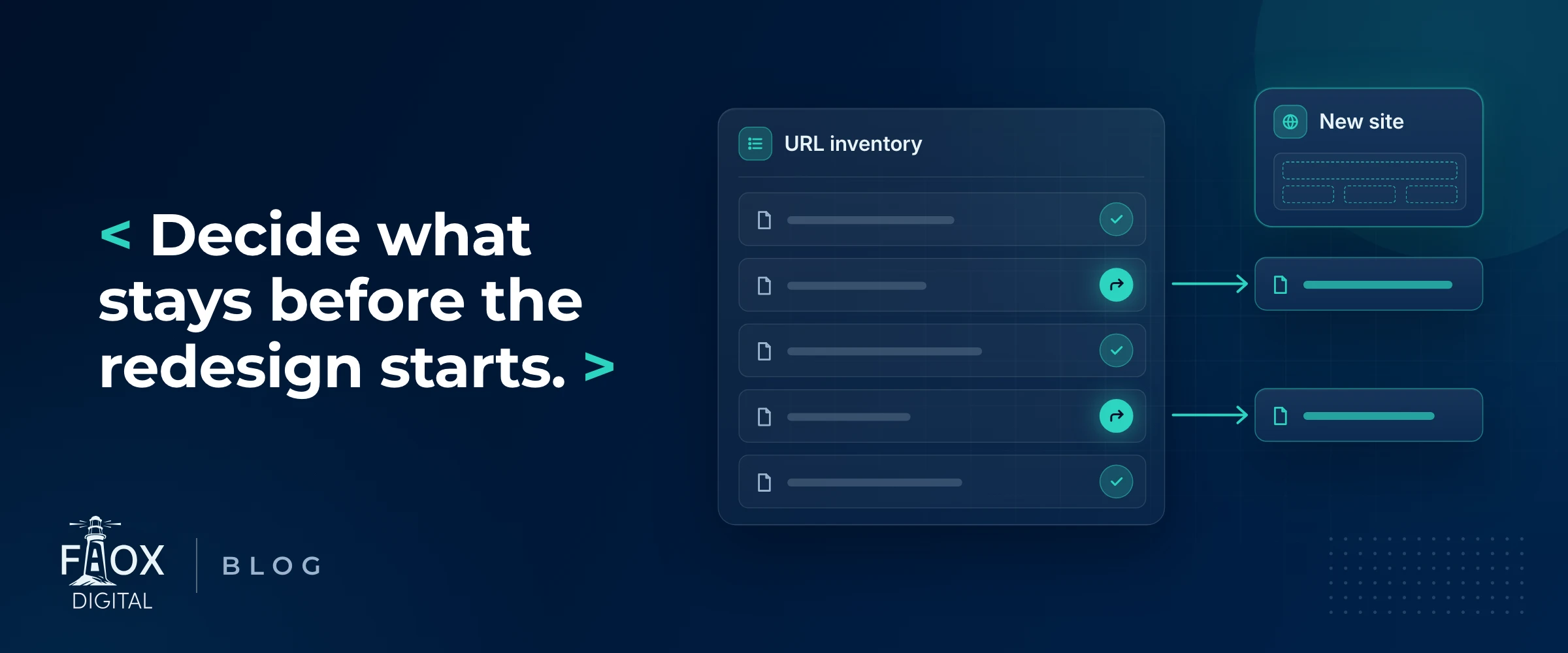
The URL inventory is the list of every address worth protecting: pages that get clicks from search, pages that other sites link to and pages that bring enquiries. Your sources are Search Console’s Performance report, your analytics landing pages and a crawl of the current site.
Export the data now, while the old site is still live. Google’s guide to debugging traffic drops suggests looking at the last 16 months in Search Console, so that seasonal patterns do not look like losses, and it points to the API or bulk data exports if you want to keep data longer than that.
Then decide, page by page, whether each one stays, changes address, merges with another or goes, and name who on your side signs that list off.
Content preservation is part of the same decision. Pages rank for what they say: their text, headings, page titles and specifications. A new template that cuts a ranking product page down to a large image and two lines changes what Google finds there. If key pages are to be rewritten, make that a deliberate choice with a reason, not a side effect of the design.
Decision 2: decide who owns the redirect map
Every old URL that changes needs a redirect to its new equivalent, and 301 redirect responsibility has to sit with a named person. Google recommends server-side permanent redirects from the old URLs to the new ones, following your mapping.
Agree four things:
- Who builds the map, usually the agency’s SEO specialist or your own.
- Who approves it, someone on your side who knows the products and the pages.
- Who implements and tests it, on the staging site and again after launch.
- Who maintains it after the project ends, and for how long.
The map should send each page to its closest equivalent. Google warns against redirecting many old URLs to one irrelevant page such as the home page, which can confuse users and might be treated as a soft 404 error.
Decision 3: test everything on a protected staging site
A staging site is the private copy where the new site is built and tested. Keep it out of search: Google says password protection keeps private content out of its results. In our view, it is also safer than relying on rules that someone must remember to remove at launch.
Agree what will be tested there and what must be true on launch day. A launch checklist at contract level looks like this, and our migration checklist covers the technical detail behind each line:
- Every URL in the inventory shows its new page or redirects to the agreed target
- The staging password and any rules blocking search are gone from the live site
- Ranking pages keep their titles, headings and key text, or were changed on purpose
- Analytics, key events and Search Console work on the new site
- The sitemap is updated and submitted
- Forms are tested from submission to the inbox
- A named person watches errors and Search Console in the first weeks
Decision 4: agree how you will compare before and after
An analytics comparison only works if you decide in advance what to compare. Record the baseline before launch: clicks and impressions by page group, indexed pages, top landing pages from search and enquiries.
Compare like with like. Use the same weeks of the previous year where seasons matter, and allow time, since Google warns of fluctuations while it recrawls and reindexes. Agree what counts as SEO loss worth acting on, such as a key page group falling clearly below last year, and who investigates when it happens.
What to put in the agency contract
Most of the decisions above fail quietly when they are nobody’s job. Write them into the contract scope:
- The URL inventory, redirect map, implementation and testing, each with an owner
- Tests on the staging site before launch, and the launch checks
- A monitoring period after launch, with regular reports
- Fixing migration errors found in that period, within the agreed price
Then define acceptance criteria: the conditions the site must meet before you sign off the project. The launch checklist above is a good start, together with any speed and accessibility targets from your brief. Final payment can depend on them.
Do not ask for promises about rankings, and be wary of any that are offered. Google’s advice on hiring an SEO is plain: if someone promises that their changes will give you first place in search results, find someone else. Ask for commitments about the process instead. These are good questions to raise when choosing a website agency, and they take time, so build them into the schedule; our website redesign timeline shows where they fit.
How Faox Digital handles SEO in a redesign
Faox Digital, a digital growth partner for B2B companies in complex and international markets, starts a redesign by learning what the company sells, who buys it and which markets matter. On the search side, that begins with an audit of what the site ranks for today, and the client sees the priorities and the reasons before any work begins. We do not promise rankings, because Google decides positions. The client signs off each step before the next one, and the new site is tested in every language and on every device before anyone outside sees it.
Key takeaways
- Decide the scope first: the fewer things that change at once, the smaller the risk.
- Build a URL inventory from Search Console, analytics and a crawl, and export the data before the old site changes.
- Name who builds, approves, implements and tests the redirect map, and redirect each page to its closest equivalent.
- Test on a password-protected staging site, and agree a launch checklist and acceptance criteria in the contract.
- Ask for process commitments, not ranking promises, and compare results against a baseline you recorded in advance.
Frequently asked questions
How do I redesign a website without losing SEO?
Keep as many URLs and as much ranking content as you can, map every changed URL to its closest new page with permanent redirects, test on a protected staging site and compare results against a baseline you recorded before launch. Write who does each step into the contract.
Does changing only the design affect SEO?
It carries the least risk, as long as the URLs, text, page titles, headings and internal links stay the same. Check that the new templates do not drop or hide content that ranking pages relied on, and compare the key pages after launch.
Who is responsible for redirects in a redesign?
Whoever the contract names. Usually the agency builds and implements the redirect map, and someone on your side approves it, but it must be written down, along with who tests it and who maintains it after the project ends.
Can an agency promise that rankings will hold?
No, and Google advises against hiring anyone who promises first place in search results. A good agency commits to the process instead: inventory, redirects, testing, monitoring and fixing what goes wrong.
Sources
- Google Search Central: Site moves with URL changes, updated August 2026
- Google Search Central: Do you need an SEO?, updated June 2026
- Google Search Central: Debugging drops in Google Search traffic, updated December 2025
- Google Search Central: Control what you share with Google, updated October 2026
Let’s talk
Planning a new website or a fix?
Send us your current site and what you need it to do. We will tell you whether it needs a rebuild or a few focused changes.