
Press Release Examples for Events and Trade Shows: Before, During, After
How to plan press releases around a trade show or industry event, with fictional, labelled examples for the pre-show announcement, the launch at the show and the post-show release, plus timing, the press kit and the fair’s press centre.
Good press release examples for events follow three stages: before the show, send product releases for the trade publications’ show issues, which can close two months or more ahead, and, close to the show, a pre-show announcement about what you will launch or demonstrate, with stand information. During the show, put a press kit with the release, an image set and contacts in the fair’s press centre, and release launch news when the stand opens. After the show, send a post-show release only if there is real news, such as a launch that drew attention or an agreement signed at the fair.
A trade fair is the one week of the year when the editors of your sector gather in one place, looking for news. Many exhibitors waste it: they send a release that only says where their stand is, or send nothing until the fair is over. This guide gives press release examples for events and trade shows at each stage, before, during and after, with the timing and the materials editors expect.
It assumes you know the press release basics, from the news angle to the parts of a release. Every example below is fictional, written for a hypothetical machine builder and labelled as an example; names, dates and figures are placeholders in square brackets.
Press release examples for events: what to send when
Timing decides whether trade show news is used. Editors plan their show coverage long before the doors open:
| Stage | When | What to send |
|---|---|---|
| Show previews | Reporting on a fair starts 4 to 6 months before it, according to Messe Stuttgart | Story ideas and interview offers to the editors who plan previews |
| Show issues | Modern Machine Shop asks for material at least eight weeks before its show issue | One product release per product, with an image and stand information |
| Pre-show announcement | Close to the show, once details are final | What you will show, where and when, and who is available for interviews |
| At the show | Opening day and the days of the fair | The launch release and a press kit in the fair’s press centre |
| Post-show release | Within the month after the fair, while it is still being reported | Results or news from the fair, if there is any |
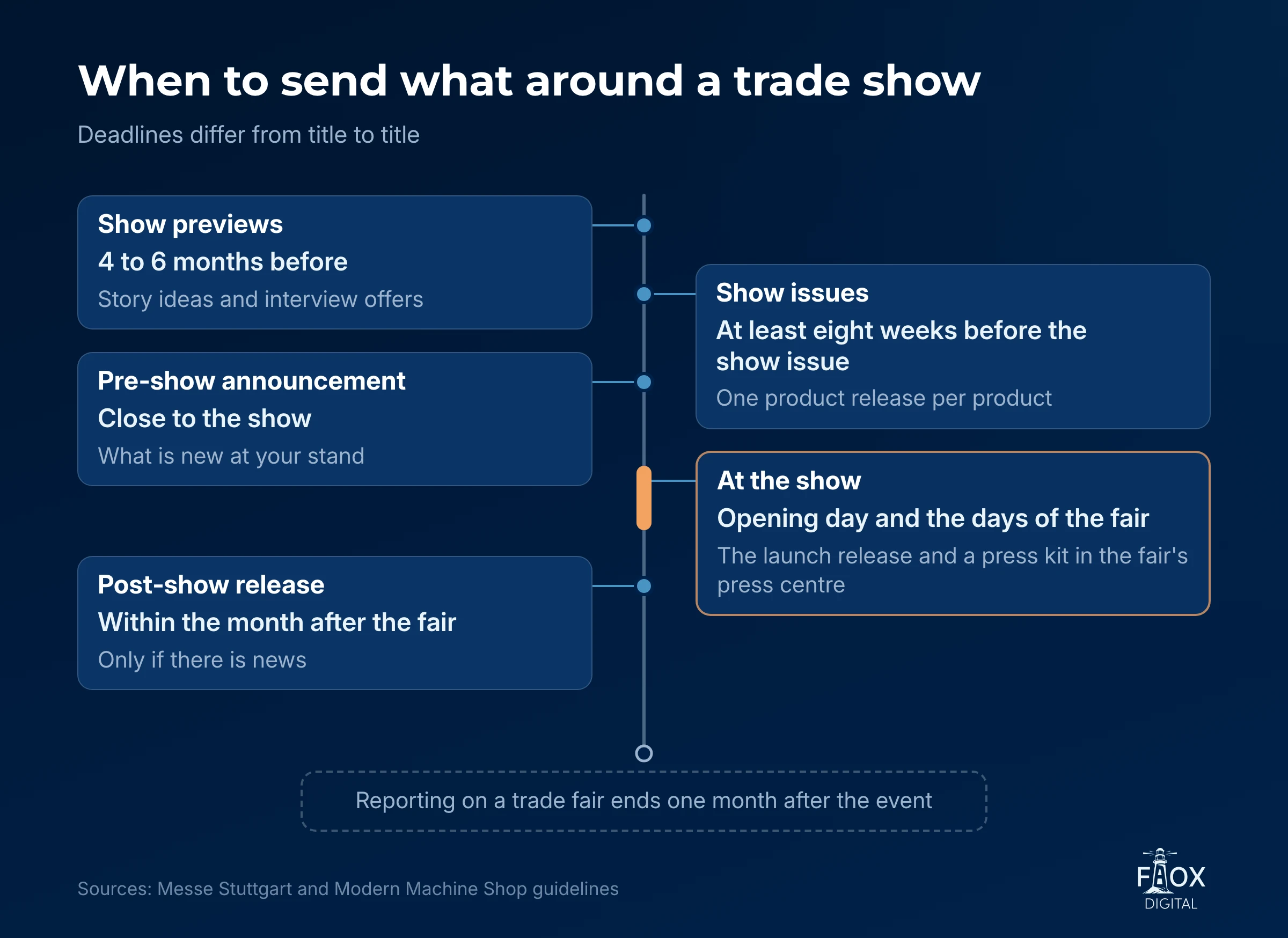
Messe Stuttgart, which organizes the VISION fair for machine vision, says reporting on a trade fair ends one month after the event. Check the dates in each publication’s editorial calendar, because deadlines differ from title to title.
Trade publications’ show issues
Many trade publications publish a special issue or section before major fairs. Trade publications’ show issues collect the products and news that visitors will see. Modern Machine Shop, for example, runs special sections on products shown at IMTS, EMO, Fabtech and other machining shows, and its guidelines ask for:
- One product per release, rather than a round-up of everything on the stand
- An image, if available, and the booth information
- The material at least eight weeks before the show issue, with general editorial deadlines three months before the issue date
Ask each publication for its show issue dates and send each product release separately, written for that title’s readers. Our guide to writing a press release covers each part of a product release step by step.
Before the show: the pre-show announcement
A pre-show announcement tells editors and visitors what is new at your stand. Stand information alone is not news: what matters is what visitors can see, test or learn that they could not before. The trade title Automatic Merchandiser asks exhibitors to include the booth number, demo information, product launch timing, media availability and why the news matters for that show.
Example (fictional):
- Headline: Machine builder to show cobot palletizer for small batches at [fair]
- Lead: [CITY, Country], [date]. [Company], a maker of end-of-line packaging machines, will show a collaborative palletizer for food producers who run many short batches at [fair] in [city], [dates], hall [number], stand [number]. Live demonstrations run daily at [times].
- Include: what is new and for whom, the stand information (fair, city, dates, hall and stand), demo times, who is available for interviews in which languages, and how to book a slot.
Send it to the editors who cover the fair, publish it in your online newsroom and add it to the fair’s own online press service if it has one.
Product launch at the show: embargo and timing
A product launch at a fair gets the most attention when it is shown first at the stand or at a press conference. If editors need time to prepare, send the release before the fair under an embargo, only to journalists who have agreed to hold it, with the date, time and time zone when it may be published, such as the opening of the fair or the start of your press conference.
Fair organizers help with this: Messe Stuttgart, for example, offers exhibitors rooms for press conferences and adds their events to the journalists’ schedule.
Example (fictional):
- Release line: EMBARGOED UNTIL [time, time zone], [date]
- Headline: [Company] launches palletizer that changes pallet patterns without a programmer
- Quote: "Food producers told us that every new pallet pattern meant waiting for a programmer," said [Name], product manager at [Company]. "Now an operator can set up a new pattern at the machine."
During the show: press kit and the fair’s press centre
Large fairs, such as those at Messe Düsseldorf and Messe Stuttgart, run a trade fair press centre where journalists work during the show. Messe Düsseldorf’s Press Center offers journalists the press information provided by exhibitors, and Messe Stuttgart lets exhibitors book a press box in its Press Center for the whole fair, stocked with documents from the first day. Messe Stuttgart also runs an online press server, where it says exhibitors’ publications are open to journalists at all times and make an impression for up to nine months.
A press kit for the fair holds:
- The launch release and the pre-show announcement
- An image set: product photos cut out and in use, a photo of the stand once it is built, and portraits of the people available for interviews, each with a caption, a credit and the right to publish
- Data sheets and technical drawings
- The names, phone numbers and languages of the people at the stand
- A short link or QR code to the same material online
Keep the digital version up to date during the fair, and add photos from the stand as soon as they are taken.
After the show: the post-show release
A post-show release is worth sending only when the fair produced news: a launch that drew strong interest, an agreement or partnership signed at the show, an order the customer agrees to name, or results from a live demonstration. A "thank you for visiting our stand" message belongs in your newsletter, not in a release.
Example (fictional):
- Headline: [Company] signs distribution agreement for [country] at [fair]
- Lead: [CITY, Country], [date]. [Company] and [distributor] signed an agreement at [fair] under which [distributor] will stock and service [Company]’s palletizers in [country] from [month].
Send it within the month after the fair, while editors are still reporting on it. For releases about announcements that are not tied to an event, our B2B press release examples give templates for products, investments, certifications and more.
The fair’s commercial follow-up runs in parallel: the visitors you met need their own emails, covered in our guide to trade show follow-up.
Measuring trade show PR
Judge the effort by what was published and said, not by the number of releases sent: articles in show issues and online, interviews at the stand, mentions in fair reports and how often your company appeared compared with your competitors. Our guide to calculating share of voice shows how to make that comparison.
Trade show PR checklist
- Show issue deadlines collected from each target publication
- One product release per product, with an image and stand information
- Pre-show announcement with what is new, demo times and interview contacts
- Launch release ready, with an embargo only for editors who agreed to it
- Press kit and image set in the fair’s press centre and online
- People at the stand briefed and named as press contacts
- Post-show release only if there is news
- Coverage collected for a month after the fair
Once the releases are written, the next question is how to send them; our comparison of press release distribution services and direct outreach to editors helps you choose.
How Faox Digital handles trade show PR
Faox Digital, a digital growth partner for B2B companies in complex and international markets, maps the publications and writers that matter for each fair and market, looks for what in the stand’s news is genuinely newsworthy, and writes each release and pitch for its outlet and readers. Releases go to editors directly, in each market’s own language, and what lands at one fair feeds the plan for the next.
Key takeaways
- Plan event press releases in three stages: before, during and after the show.
- Show issues close early: Modern Machine Shop asks for material at least eight weeks before its show issue.
- A pre-show announcement needs news, not just stand information: what visitors can see, demo times and interview contacts.
- Put a press kit with an image set in the fair’s press centre, and keep the online version up to date.
- Send a post-show release only if the fair produced news, within the month after it.
Frequently asked questions
What should an event press release include?
What is new at the event and why it matters to the publication’s readers, the event’s name, place and dates, your hall and stand, demo or presentation times, who is available for interviews, and an image. A release that only gives the stand number is rarely published.
When should you send a press release for a trade show?
In stages: story ideas for previews several months ahead, product releases for show issues by each title’s deadline, which can be two months or more before the issue, a pre-show announcement close to the fair, the launch release at the show and, if there is news, a post-show release within a month after.
What goes in a trade show press kit?
The launch release and any pre-show announcement, an image set with captions and credits, data sheets and technical drawings, and the names and phone numbers of the people at the stand, both in the fair’s press centre and online through a short link or QR code.
Is a post-show press release worth sending?
Only if the fair produced news, such as a launch that drew attention, an agreement signed at the show or an order the customer agrees to name. Thanks to visitors and general impressions belong in your newsletter or on social media.
Sources
- Messe Stuttgart, VISION: Press services for exhibitors, accessed November 2026
- Messe Düsseldorf: Press service, accessed November 2026
- Modern Machine Shop: Editorial submission guidelines, updated January 2021
- Automatic Merchandiser and VendingMarketWatch.com: Guidelines for submitting a product announcement or press release, 2024
Let’s talk
Have a story worth telling?
Tell us what is new in your business. We will tell you honestly whether it is news and where it could be published.