
Lead Generation for Manufacturers: How to Capture and Follow Up Every Lead
Where manufacturers’ leads come from, and how to capture, qualify and follow up each one so that no enquiry is lost between the channel and the sale.
Lead generation for manufacturers means attracting enquiries from engineers, buyers and distributors through the channels they already use, such as your website and quote forms, search, trade fairs, trade publications, LinkedIn, email and distributors, and then following up every one. Record each lead in the CRM with its source, respond fast, qualify it against criteria agreed with sales, and either hand it to a salesperson or keep it in a follow-up sequence until the buyer is ready.
Manufacturers rarely lack leads as much as they lose them. Business cards from a trade fair sit in a drawer, quote requests land in a shared inbox, a LinkedIn message waits for someone to notice it. In an audit of 2,241 US companies, published in Harvard Business Review in 2011, 24% took more than 24 hours to answer a test enquiry from their website and 23% never answered at all. The article does not say which industries the audited companies were in, and the study is old, but many manufacturers will recognize the pattern.
This guide covers both halves of B2B lead generation for manufacturers: where leads come from, and how to capture, qualify and follow up each one so that none is lost. It opens our series on lead capture and follow-up; you can find all Email & CRM articles on the category page.
What is lead generation for manufacturers?
A lead is a person or company that has shown interest in what you make: they asked for a quote, downloaded a data sheet, visited your stand or replied to an email. A prospect is a lead you have checked and found worth pursuing: the right kind of company, a real need and a person who can act. An opportunity is a prospect with a concrete project in your sales pipeline.
Lead generation for manufacturers is the work of bringing in those enquiries and turning them into conversations with sales. Two things set it apart from consumer lead generation:
- Fewer, more valuable leads. One enquiry from the right engineer can lead to years of orders, so following up each one matters more than volume.
- Long, technical buying. Leads often arrive early, while an engineer is still researching, and need months of follow-up before a quote.
That is why this guide spends as much time on follow-up as on sources.
It also helps to separate inbound from outbound. Inbound leads come to you: form submissions, visitors at your stand, readers of your articles. Outbound means you contact companies first, by phone, email or a visit. Most manufacturers need both, but outbound contacts belong in the same CRM and follow the same rules, and buying lists of strangers to email is a poor substitute for either.
Where manufacturers’ leads come from
Most manufacturers draw on the same group of lead sources. Each brings a different kind of lead and needs a different follow-up:
| Lead source | Typical leads | What the follow-up needs |
|---|---|---|
| Website forms and quote requests | Engineers and buyers with a specific need | A fast, informed answer and a CRM record |
| Search | People researching a product, an application or a supplier | Pages that answer the search, and an easy next step |
| Trade fairs | Visitors who talked to you at your stand | Follow-up within days, while the conversation is fresh |
| Trade publications and webinars | Technical readers early in their research | Useful content and patience |
| LinkedIn and social media | Comments, messages and profile visits | A personal reply, then a route into the CRM |
| Email and newsletters | Existing contacts whose interest returns | An alert to sales when someone clicks on pricing or replies |
| Distributors and referrals | Projects passed on by partners or customers | Clear rules on who follows up and who owns the customer |
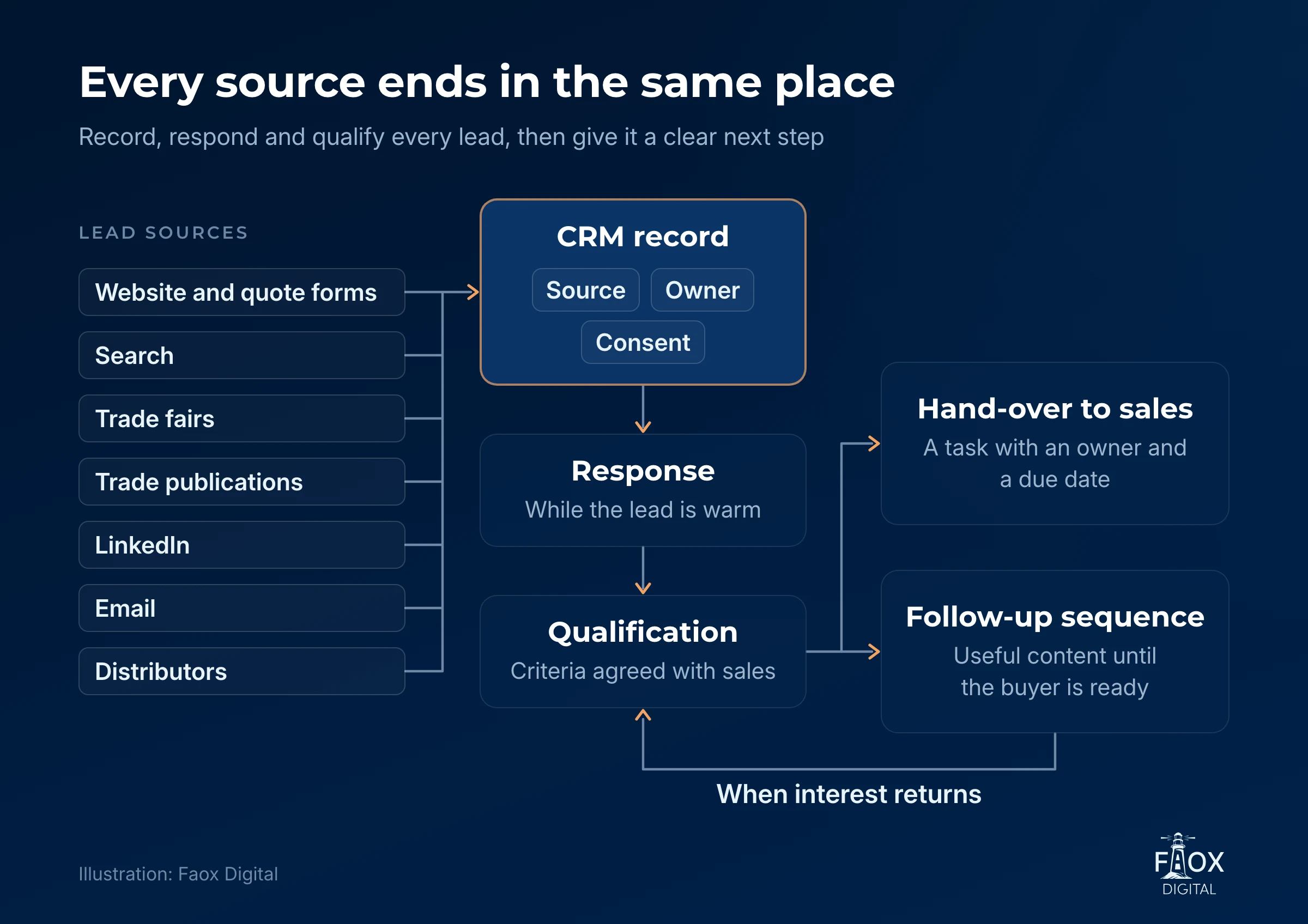
The sections below summarize each channel.
Your website and quote requests
Your website is where most other channels end up: a buyer who meets you at a fair, reads about you in a trade publication or finds you in search usually checks the site before getting in touch. A website form, and above all the quote request form, is your most direct lead source. Keep forms short, ask only what sales needs for a first answer and say who will reply and when.
If the site gets visitors but few enquiries, our article on why a website is not bringing customers lists the usual causes. Mapping what each page has to do and how a visitor moves to an enquiry is part of our work as a B2B website design agency.
Search and content
Engineers search in precise terms: product types, materials, standards, sizes and applications. Pages that answer those searches, such as product pages with full specifications, application notes and readable data sheets, bring leads who already know what they need. Each page should offer a clear next step, such as a quote request, a sample or a question to an engineer. Building pages that rank and are quoted by AI answer tools is part of our B2B SEO services.
Trade fairs
For many manufacturers, the trade fair remains the biggest single source of leads. AUMA, the association of the German trade fair industry, reports that Germany’s 158 national and international trade fairs drew 150,260 exhibitors and 8.3 million visitors in 2025, and that around three quarters of the 400 exhibiting companies in its latest survey plan to take part in as many or more trade fairs this year and next.
The leads a fair produces are only as good as what happens at the stand and afterwards:
- Record each conversation while it is fresh: products discussed, samples or documents promised, next step and what the visitor agreed to receive.
- Import badge scans and business cards into the CRM within days, with the fair as the source.
- Send the first follow-up while the visitor still remembers the stand.
Our article on after-show follow-up emails covers the timing and templates.
Trade publications, webinars and PR
Technical buyers read before they buy. In the 2026 State of Marketing to Engineers survey by GlobalSpec and TREW Marketing, 76% of technical buyers said they routinely research on online technical publications, now their first destination, ahead of vendor websites, and 91% attend at least one work-related webinar a year.
That makes bylined articles, application stories and webinars in the publications your buyers read a lead source in their own right: readers who follow a link or register for a webinar arrive already interested in a technical topic. Treat them as early leads and follow up with useful content rather than a sales call. Placements in the trade press are part of our work as a B2B PR agency.
Email, distributors and referrals
Email generates leads from contacts you already have. A newsletter reader who clicks on a pricing page, a customer who replies to an announcement or a former customer who returns to your site are leads again, and the CRM should flag them to sales.
Distributors and referrals bring some of the most valuable leads, because someone the buyer trusts has already vouched for you. Agree with each distributor who follows up an enquiry, how it is recorded and who owns the customer, so that leads do not fall between the two companies.
Leads from export markets
For exporters, leads arrive from many countries and in many languages. A few rules keep them from slipping:
- Answer in the buyer’s language where you can, or at least in clear English, and keep the language on the contact record.
- Route by country: decide in advance whether each market is served by your own team, a local agent or a distributor, so that an enquiry reaches the right person at once.
- Mind the time zones: an enquiry that arrives overnight should still meet your response target.
- Record the market on every lead, so that you can see which countries bring enquiries and which bring orders.
Consent when you capture leads
A lead’s consent travels with the record. Note what each person agreed to receive and where: a quote request lets you answer the quote, but it does not necessarily allow you to add the person to your newsletter. The rules differ between the EU, the United States, Türkiye and other markets, so record consent at the point of capture and check the rules of each market you sell to. This is general information, not legal advice.
Capture every lead in the CRM
Whatever the source, each lead should become a CRM record within hours, not days. A useful record holds:
- Source: the form, fair, publication, LinkedIn conversation or distributor it came from
- Contact and company details, linked to an existing company if there is one
- What they asked or showed interest in
- Consent: what they agreed to receive
- Owner: the person responsible for the next step
Forms can create records automatically, and fair contacts can be imported in one file per event. Messages that arrive by email or LinkedIn need a habit: the person who receives them records them. If you are unsure what the record should hold, our guide on what a B2B CRM is explains how contact, company and activity records fit together. For forms in particular, our article on what should happen after a form submission covers the fields and the next steps.
Response time: answer while the lead is warm
Response time decides whether a lead becomes a conversation. Set targets by type of lead and make them visible:
- Quote requests and direct questions: a personal answer the same working day
- Trade fair contacts: a first email within a few working days of the fair
- Downloads and webinar registrations: an automatic email at once, and a personal contact only when there is a signal of real interest
An automatic acknowledgement helps, but it does not replace the answer. Route each enquiry to a named person, cover holidays and trade fair weeks, and check every week which leads are still waiting.
Qualify leads with agreed criteria
Not every lead is ready for sales, and sales time is limited. Qualification criteria agreed between marketing and sales decide which leads go to a salesperson now:
| Criterion | Question | Where the answer comes from |
|---|---|---|
| Fit | Is the company the right industry, size and region for what we make? | Company record, website, the form |
| Need | Is there a specific application, product or problem? | The enquiry, the conversation at the fair |
| Timing | Is there a project with a date, or only research? | The conversation, the quote request |
| Role | Can this person decide or influence the purchase? | Job title, the conversation |
| Route | Should we sell directly, or through a distributor in their region? | Country and your distribution model |
Each lead then takes one of three paths: ready for sales, not ready yet, or not a fit. Leads that are not a fit still deserve a polite answer, and sometimes a referral to the right distributor.
Follow-up sequences for leads that are not ready
Many leads are real but early. A follow-up sequence keeps you in touch with useful content until they are ready: an application note, a relevant case, an invitation to a webinar, a short check-in from the engineer they met. Stop the sequence when the person replies, asks for a quote or unsubscribes.
Our guide to lead nurturing shows how to stay useful until the buyer is ready, and our marketing automation guide explains how triggers, scoring and alerts run these sequences without someone remembering each step.
The hand-over to sales
The hand-over to sales is where leads are most often lost. Make it explicit:
- Context: the salesperson sees the source, what the lead asked, what they received and any notes from marketing.
- A task, not just an email: with an owner and a due date in the CRM.
- Feedback: sales accepts the lead or sends it back with a reason, such as "too early" or "not our product".
- A way back: leads that stall return to the follow-up sequence rather than disappearing.
Review the hand-over every month with both teams: how many leads were passed, how many were accepted, how fast they were contacted and what happened next.
A weekly lead review
A short weekly meeting with the people who handle leads keeps the whole system honest. Go through:
- New leads by source since the last review
- Quote requests and questions still waiting for an answer
- Leads handed to sales, and what sales did with them
- Leads returned by sales, and why
- Trade fair or campaign contacts not yet imported
The point is not reporting; it is catching the lead that is about to be lost.
Measuring lead generation
Measure the whole path, not just the number of leads:
- Leads by source, and how many of them were qualified
- Response time to quote requests and direct questions
- Hand-overs accepted by sales, and the reasons for rejection
- Opportunities and orders by source, recorded in the CRM
- Leads still waiting for a first answer
A source that brings fewer leads but more orders deserves more attention than one that fills the list.
Common reasons manufacturers lose leads
- Contacts from fairs that are never entered into the CRM
- Forms that send email to a shared inbox nobody owns
- LinkedIn messages that nobody records or answers
- No agreed criteria, so sales ignores marketing’s leads
- Distributor enquiries with no rule on who follows up
- No follow-up for leads that are interested but early
Some companies try to fix the volume by buying leads. Before you do, compare bought lists and lead generation companies with building your own pipeline.
Lead generation on a small budget
You do not need every channel at once. On a small budget, the first steps are often ones you can take yourself:
- Shorten the quote request form and send its submissions to a named person and to the CRM.
- Import the contacts from your last trade fair and follow them up.
- Ask your engineers to share one useful post a month on LinkedIn, and answer the replies.
- Agree with sales what makes a lead ready, and review leads every week.
- Add one follow-up sequence for your most common type of enquiry.
Each of these costs more time than money, and together they often recover leads that are already arriving.
How Faox Digital approaches lead capture and follow-up
Faox Digital starts lead follow-up from the contacts a company already has, and trade fair cards or a spreadsheet are a fine starting point, with an audit that first cleans the list and the CRM. The CRM, the follow-up emails and the automations are then built in the client’s own tools and signed off by the client, with automatic follow-up once each contact is ready and results read in replies, qualified conversations and pipeline.
Key takeaways
- Lead generation for manufacturers is as much about following up every enquiry as about finding new ones.
- Website and quote forms, search, trade fairs, trade publications, LinkedIn, email and distributors each need their own follow-up.
- Record every lead in the CRM with its source, owner and consent, within hours.
- Answer quote requests the same working day, and qualify leads against criteria agreed with sales.
- Hand ready leads to sales as tasks with context, and keep early leads in a follow-up sequence until they are ready.
Frequently asked questions
What is B2B lead generation for manufacturers?
It is the work of attracting enquiries from engineers, buyers and distributors and turning them into sales conversations. For a manufacturer it combines channels such as quote forms, search, trade fairs, trade publications, LinkedIn and distributors with a process that records, qualifies and follows up every lead.
How do manufacturing companies generate leads?
Most combine a website with clear quote request forms, pages that answer technical searches, trade fair participation, articles and webinars in trade publications, LinkedIn, email to existing contacts and enquiries passed on by distributors. The results depend as much on the follow-up as on the channels.
How do you generate leads on LinkedIn?
Post useful technical content from the company page and from your experts, answer comments and messages personally, and follow up with the people who engage. When a conversation shows a real interest, record the contact in your CRM with LinkedIn as the source, so that it gets the same follow-up as any other lead.
How fast should a manufacturer respond to a lead?
Answer quote requests and direct questions personally on the same working day, send trade fair contacts a first email within a few working days and follow downloads with an automatic email at once. An automatic acknowledgement helps, but a named person should own every enquiry until it is answered.
Sources
- Harvard Business Review: The Short Life of Online Sales Leads (Oldroyd, McElheran and Elkington), March 2011
- GlobalSpec and TREW Marketing: 2026 State of Marketing to Engineers, 2026
- AUMA: German trade fair industry in figures, accessed November 2026
- LinkedIn Pressroom: About us, accessed November 2026
Let’s talk
Have contacts you never follow up with?
Tell us about the list you already have. We will show you how email and CRM can turn it into conversations.