
How to Write a Marketing Email: Subject Line, Body and Call to Action
How to plan and write a B2B campaign email from the goal and segment to the subject line, body, call to action, test send, send time and follow-up, with examples to adapt.
Knowing how to write a marketing email for B2B buyers comes down to a fixed order: one campaign goal and one target segment, a sender name people recognize, a subject line that makes a specific promise, preview text that adds to it, an opening sentence that gets to the point, a short body and a single call to action, signed by a real person. Then send a test, choose a send time in the reader’s working day and plan the follow-up email before you send.
Most marketing emails fail before anyone reads them: they go to everyone, promise nothing in particular and ask for three things at once. B2B buyers read email at work, between meetings, and decide in seconds whether a message deserves their attention.
This guide takes a campaign email from plan to follow-up: the decisions before you write, each part of the email, the test and the timing, with examples you can adapt. How campaign emails fit with newsletters and automated sequences is covered in our guide to email marketing for B2B.
How to write a marketing email: start with the goal and the segment
Write nothing until you can finish two sentences. The campaign goal: "After reading this, we want the reader to…" register for a webinar, book a meeting at a trade fair, download a datasheet or reply with a question. One goal per email; a second goal is a second email.
The target segment: "This email is for…" maintenance managers at food plants in Germany, say, or design engineers who downloaded last year’s catalog. Unlike a social post, whose audience the feed decides (our article on how organic reach works explains why), a campaign email goes to the people you choose, so the choice of segment shapes everything you write. If two groups need different arguments, write two versions.
Sender name, subject line and preview text
These three lines decide whether the email is opened, and they appear together in the inbox.
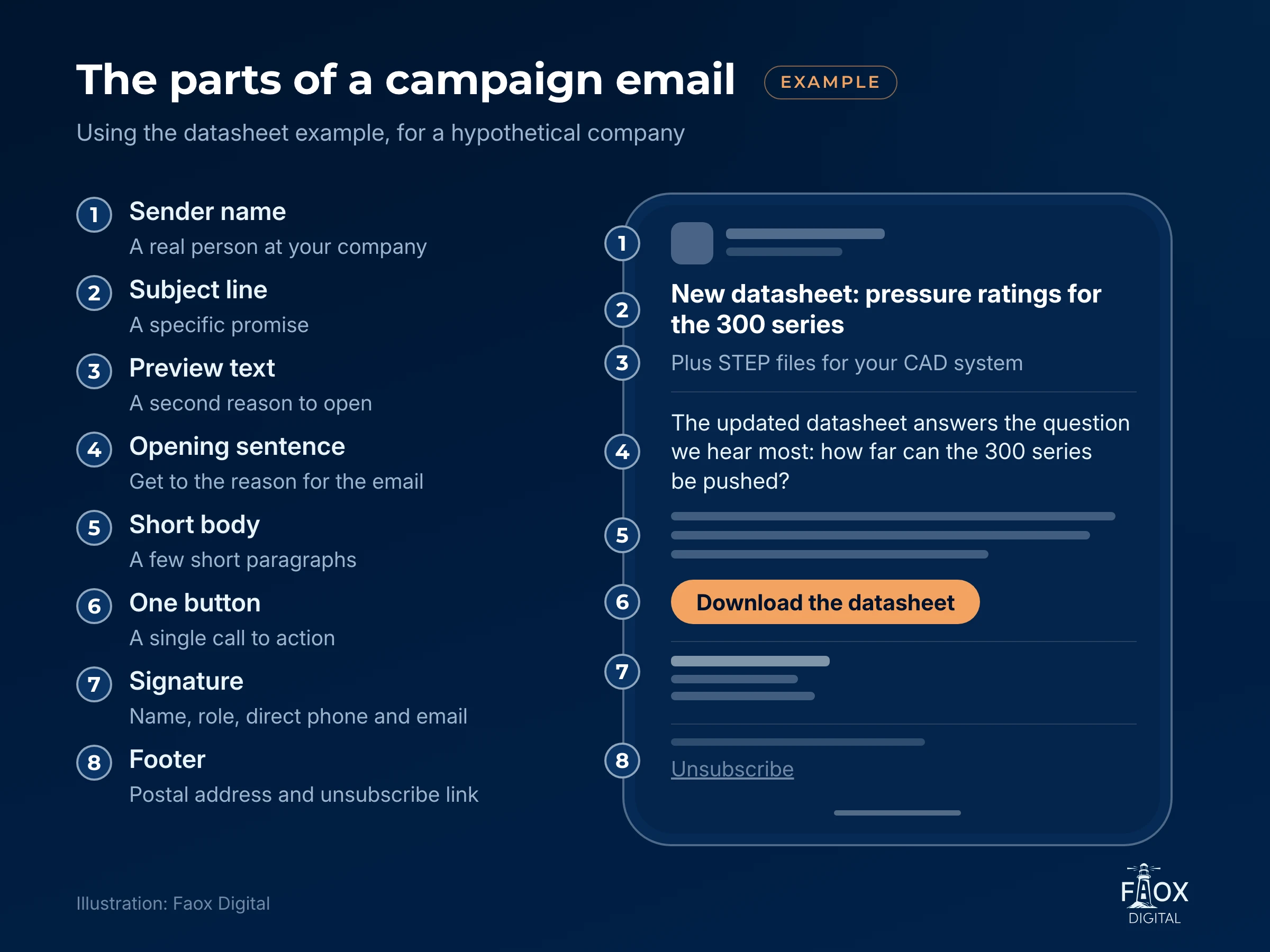
The sender name should be one people recognize: a real person at your company, with the company name, kept the same from one email to the next. A no-reply address tells the reader nobody is listening.
The subject line should make a specific promise to the reader and the email should keep it. "Our June newsletter" says what the email is to you; "Three sizing mistakes we see in pump orders" says what is in it for them. Put the promise in the first few words, because inboxes and phones cut subject lines short. Two rules are not optional: the FTC’s CAN-SPAM guide says the subject line must accurately reflect the content of the message, and Gmail’s sender guidelines say not to start a subject line with "Re:" or "Fwd:" unless the message really is a reply or a forward.
The preview text is the line email apps show after the subject; Apple’s iPhone guide says Mail shows two lines of text for each message by default. Use it to add a second reason to open, not "View this email in your browser".
The opening sentence, the body and personalization
The opening sentence is the second subject line. Get to the reason for the email at once: "The updated datasheet answers the question we hear most: how far can the 300 series be pushed?" Skip "I hope this email finds you well" and paragraphs about your company.
Keep the body short enough to read on a phone between meetings: a few short paragraphs, one idea each, with specifics the reader can use. If you need more space, link to a page or a document and let the email be the introduction.
Personalization helps when it reflects the reader’s situation, not only their first name: their industry, the product they use, the trade fair where you met. Set a fallback for every merge field, because "Dear ," is worse than no greeting at all.
Plain text or designed? A campaign email from a person usually works best when it looks like one: mostly text, a simple header at most and one button or link. Heavier design suits newsletters and product announcements with strong visuals. Whichever you choose, keep the message in live text, so it still reads when images are blocked.
A single call to action
A campaign email asks for one thing, with a single call to action that follows from the opening: download, register, book, or simply reply. Repeat it once as a link if the email is long, but do not add a second, competing request. A newsletter can carry several short items, as our B2B newsletter examples show; a campaign email cannot.
In B2B, a reply is often the most valuable action of all. Make replies welcome, and make sure they reach a person who answers within a working day.
Email campaign examples you can adapt
These B2B email marketing examples, written for hypothetical companies, show how the parts fit together:
| Campaign | Subject line | Preview text | Opening sentence | Call to action |
|---|---|---|---|---|
| Webinar invitation | Cleaning validation for hygienic pumps: a 45-minute webinar | Thursday afternoon, with time for your questions | Most cleaning problems we see start with the pump layout, not the pump. | Save your place |
| New datasheet | New datasheet: pressure ratings for the 300 series | Plus STEP files for your CAD system | The updated datasheet answers the question we hear most: how far can the 300 series be pushed? | Download the datasheet |
| Trade fair follow-up | The drawings you asked for at our stand | As promised at the fair last week | Thank you for stopping by our stand; here are the drawings we discussed. | Reply to book a call |
| Spare parts reminder | Is your spare parts list ready for the winter shutdown? | A short checklist from our service team | Many plants order spare parts before the winter shutdown, and this checklist helps you do it in one go. | Download the checklist |
Each one has one goal, one segment and one action, and each subject line promises something the email delivers.
Test send before you send
A test send catches the mistakes your readers would otherwise find. Before every campaign:
- Send it to yourself and two colleagues, on different email apps and on a phone
- Click every link and the button
- Read it with images turned off: Microsoft says classic Outlook is set by default to block automatic picture downloads
- Check every personalized field, including one with an empty value
- Read the subject line and preview text together, as they appear in the inbox
- Reply to the test and check that the reply reaches a person
- Click the unsubscribe link and check it works
Make sure your sending domain is authenticated, too; our guide to SPF, DKIM and DMARC explains the setup.
Send time
Choose a send time in the reader’s working day and time zone, when they have a moment to act: not late on a Friday, and not on a public holiday in their country. If your list spans several markets, schedule each one separately.
Then test your own timing rather than trusting a general rule, and judge it by clicks and replies, not opens. Apple says its Mail Privacy Protection prevents senders from seeing whether a message was opened, and that it does not extend to links.
Plan the follow-up email before you send
Write the follow-up email at the same time as the first one, because what happens after the send decides the result:
- People who clicked get a personal follow-up from sales or a useful next step, such as a related document.
- People who did not click can get one more email a few days later, with a different angle, not the same email again.
- People who replied get an answer from a person, fast.
Stop there. Repeated sends to people who are not interested lead to spam complaints, and Gmail’s sender guidelines ask senders to keep their spam rate below 0.10% and never reach 0.30%. Follow-ups that depend on what each person did are best handled by email automation workflows rather than by hand. And if planning, writing and following up every campaign is more than your team can take on, see what email marketing for manufacturers looks like as a managed program.
Common mistakes in B2B marketing emails
The same few mistakes cost most campaigns their replies:
- Writing for everyone. One email to the whole list says too little to each reader.
- A subject line that hides the point, such as "Update" or "News from us".
- Three requests at once: register, download and follow us, so the reader does none of them.
- Opening with the company, not with the reader’s problem or question.
- Putting the message in images, so the email looks empty when images are blocked.
- No plan for the response: clicks and replies that nobody follows up.
How Faox Digital writes campaign emails
Faox Digital, a digital growth partner for B2B companies in complex and international markets, writes campaign emails for segments defined by behavior and stage rather than one message for everyone, and builds them in the client’s own tools for the client to sign off. Follow-up runs automatically once each person is ready, and we judge a campaign by replies, qualified conversations and pipeline.
Key takeaways
- Decide one campaign goal and one target segment before you write a word.
- Use a recognizable sender name, a subject line that makes a specific and honest promise, and preview text that adds to it.
- Open with the reason for the email, keep the body short and ask for a single call to action.
- Sign as a real person, include the postal address and a working unsubscribe link, and send a test every time.
- Plan the follow-up email before you send, and judge the campaign by clicks, replies and meetings.
Frequently asked questions
How do you write a marketing email?
Decide one goal and one segment first. Then write a subject line that makes a specific promise, preview text that adds to it, an opening sentence that gets to the point, a short body, one call to action and a signature from a real person. Send a test, pick a send time in the reader’s working day and plan the follow-up.
How do you create an email campaign for B2B buyers?
Define the goal, the segment and the offer, write the first email and the follow-up together, build them in your email tool with tracked links, send a test, schedule by time zone, and agree in advance how sales will handle replies and clicks.
How long should a B2B marketing email be?
Long enough to make one point and short enough to read on a phone between meetings, usually a few short paragraphs. If you need more, link to a page or a document and keep the email as the introduction.
What should you measure after sending a marketing email?
Clicks, replies and the meetings or requests that follow. Open rates are unreliable, because Apple’s Mail Privacy Protection prevents senders from seeing whether a message was opened, while clicks on links are still counted.
Sources
- Gmail Help: Email sender guidelines, accessed November 2026
- Federal Trade Commission: CAN-SPAM Act, A Compliance Guide for Business, accessed November 2026
- Apple Support: Use Mail Privacy Protection on iPhone, accessed November 2026
- Microsoft Support: Block or unblock automatic picture downloads in classic Outlook email messages, accessed November 2026
Let’s talk
Have contacts you never follow up with?
Tell us about the list you already have. We will show you how email and CRM can turn it into conversations.